You question if solar pumps are reliable.
You worry they will fail on cloudy days, leaving you without water.
Modern systems, however, offer consistent and dependable water solutions.
Yes, solar-powered water pumps work exceptionally well.
They are a reliable and cost-effective solution for providing water in off-grid locations.
Their success depends on a properly designed system that matches the pump type, motor, and solar array to the specific water requirement.
The question is not just "if" they work, but "how" they work so effectively.
The answer lies in modern technology.
Solar pumps have moved beyond being a niche product for sunny days only.
They are now robust systems used globally for everything from providing drinking water to irrigating entire farms.
This reliability comes from a combination of specialized pumps, ultra-efficient motors, and intelligent controllers.
Understanding these three core components is the key to understanding why solar water pumps are no longer a hopeful alternative.
They are a primary solution.
This article will break down the technology piece by piece.
We will explore the different types of pumps available and show you how to match them to your needs.
We will also uncover the most important part of the system that many people overlook: the motor.
By the end, you will see exactly how these systems provide a dependable water supply, rain or shine.
How Does the Technology Actually Work?
You see the panels and the pump but the connection seems like magic.
You might think the system is too complex to be reliable for a critical need like water.
This uncertainty can make you hesitant to adopt the technology.
The technology is simple and robust.
Solar panels generate DC electricity from sunlight.
This power flows to a controller, which manages the power and runs an efficient motor.
The motor then drives the pump to move water.
The working principle of a solar water pump is surprisingly direct.
It is an elegant system with few moving parts, which is a key reason for its reliability.
There is no complex grid connection, no fuel, and no generator to maintain.
The entire operation is powered by a clean, free source of energy.
The process begins with the solar panels.
They are the system's power plant.
When sunlight hits the photovoltaic (PV) cells in the panels, it creates a direct current (DC) of electricity.
This raw power is then sent through a cable to the system's brain: the controller.
The controller is a vital piece of the puzzle.
It regulates the electricity, ensuring the motor receives the correct voltage and current.
More advanced controllers use a technology called Maximum Power Point Tracking (MPPT).
This technology optimizes the power output from the panels, essentially squeezing every last drop of energy from the available sunlight, even in low-light conditions.
The controller then sends this refined power to the motor.
The motor converts the electrical energy into mechanical energy, causing it to spin.
This spinning action drives the pump.
Finally, the pump, submerged deep in a well or connected to a surface source, moves the water to where it is needed.
The entire process is automated and begins as soon as there is enough sunlight.
The Four Core Components of a Solar Pump System
A functional solar water pump system consists of four main parts that work together.
Understanding the role of each part clarifies how the system operates so dependably.
- The Solar Array: This is the collection of solar panels. Its size (measured in watts) is determined by how much power the pump's motor needs to perform its job. A larger or deeper pump requires a larger solar array.
- The Pump Controller: This electronic device is the system's manager. It not only protects the motor from damage by regulating power but also maximizes water output using MPPT. Many controllers also have inputs for sensors, such as well probes that shut the pump off if the water level gets too low, preventing the pump from running dry.
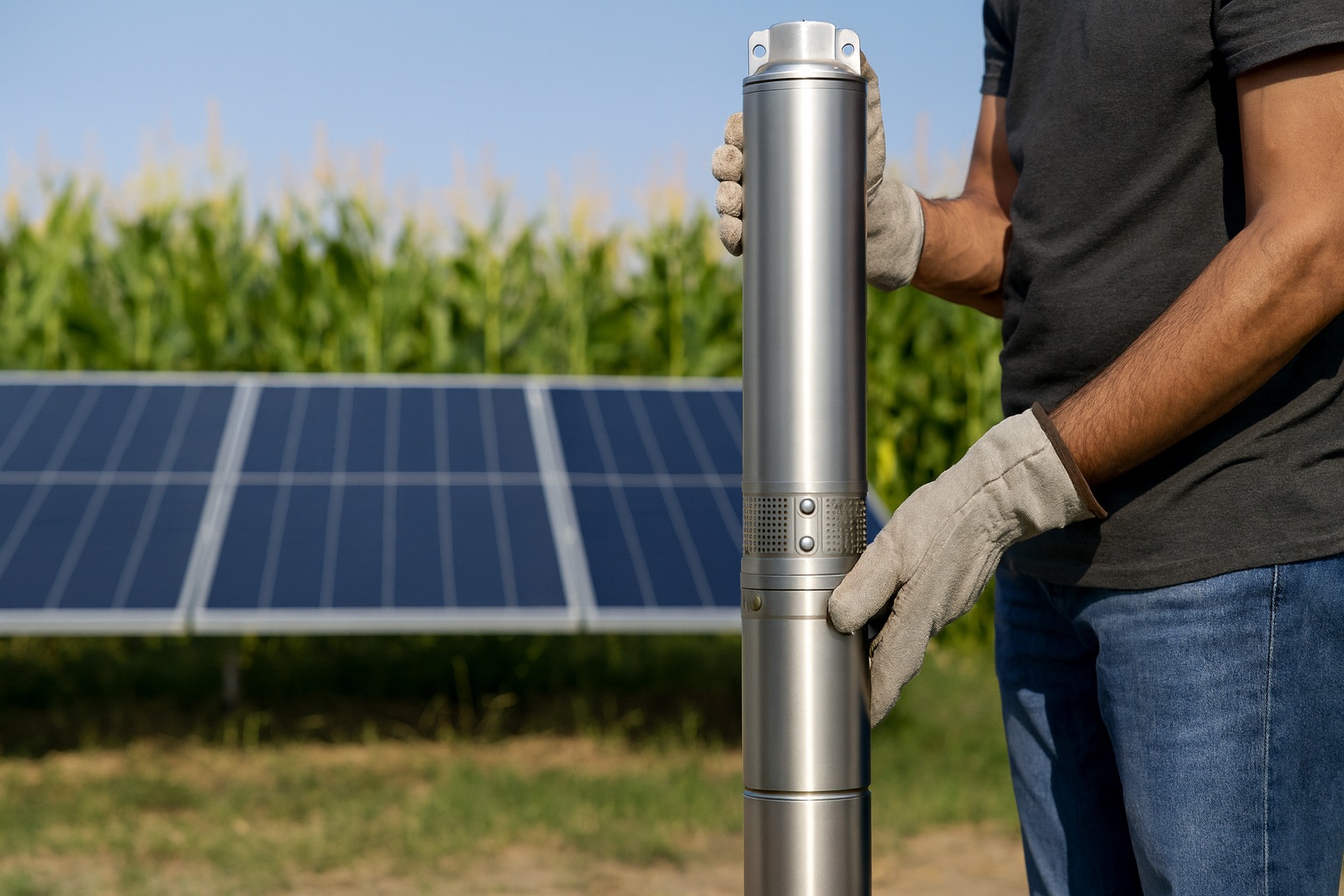
- The Pump Unit: This is the heart of the system. It consists of the pump end (the part that moves water) and the motor. High-quality systems use brushless DC (BLDC) motors for their high efficiency and long, maintenance-free life.
- Mounting and Hardware: This includes the racking that holds the solar panels, waterproof wiring, and any necessary plumbing fittings. Using durable, corrosion-resistant hardware is critical for the long-term physical integrity of the system.
A Typical System's Workflow
This table illustrates the simple, linear flow of energy and action in the system.
| Step | Component | Function | Result |
|---|---|---|---|
| 1 | Solar Panels | Convert sunlight into DC electricity. | Raw electrical power is generated. |
| 2 | Controller | Manages and optimizes the DC power. | Stable, usable power is sent to the motor. |
| 3 | Motor | Converts electrical energy to mechanical energy. | The pump's mechanism is driven to spin. |
| 4 | Pump | Uses mechanical motion to move water. | Water is lifted from the source to the outlet. |
The beauty of this system is its directness.
There are very few points of potential failure.
When built with quality components, this straightforward process works reliably day after day for years.
Matching the Pump to the Job: Finding the Right Fit
You think any solar pump will do the job.
You could buy a high-flow pump for a deep well, only to find it cannot lift the water.
This mismatch leads to a complete system failure and wasted investment.
Solar pumps are specialized tools, not one-size-fits-all devices.
Their effectiveness comes from choosing the right type of pump for your specific need, whether it is high pressure for deep wells or high volume for irrigation.
Solar pumps are not a single product.
They are a category of products, each engineered to solve a specific water problem.
The reason they "work" so well is that a correctly chosen pump operates in its peak efficiency zone.
Choosing the wrong one is like using a sports car to haul lumber.
It might move, but it will not work well, and it will likely break down.
The two most important factors in choosing a pump are head and flow.
'Head' is the total vertical distance the pump needs to lift the water.
'Flow' is the amount of water you need in a given period (e.g., liters per minute).
A pump designed for high head may have a low flow rate, and vice versa.
The global market features three main types of solar deep well pumps, each with a distinct design for a specific combination of head and flow.
Understanding the strengths and weaknesses of each type is the first step in designing a system that will work reliably and efficiently for your application.
A good distributor will not just sell a pump; they will help the customer analyze their needs to find the perfect match.
Type 1: The Solar Screw Pump (The Deep Well Specialist)
- Best For: Low flow and very high head. This is the go-to pump for deep wells, providing domestic water, and lifting water to high-elevation tanks for livestock. It is ideal for situations where pressure is the main challenge.
- How It Works: It uses a positive displacement mechanism. A rotating stainless steel screw (rotor) turns inside a fixed rubber housing (stator). This action creates sealed cavities of water that are pushed upwards with immense force. It is excellent at creating pressure.
- Strengths: Can lift water from extreme depths. It is highly resistant to sand and silt, which would quickly destroy other pumps. It maintains efficiency even in harsh water conditions.
Type 2: The Solar Plastic Impeller Pump (The Volume Mover)
- Best For: High flow and low-to-medium head. This is the workhorse for farm irrigation, filling ponds, and any application where moving a lot of water quickly is the main goal.
- How It Works: This is a multi-stage centrifugal pump. A series of spinning plastic impellers grab the water and accelerate it outwards, stage by stage, to build flow and moderate pressure.
- Strengths: Moves a very large volume of water. It is lightweight and the most economical option. The engineered plastic is highly resistant to wear from fine sand.
Type 3: The Solar Stainless Steel Impeller Pump (The Durability Expert)
- Best For: High flow and medium-to-high head in corrosive water. It is designed for acidic or alkaline water conditions, high-value properties, or any environment where longevity and reliability are the absolute top priorities.
- How It Works: It functions just like the plastic impeller pump, but every part that touches water is made from corrosion-resistant SS304 stainless steel.
- Strengths: Extremely high resistance to corrosion. It has a very long service life and high reliability even in harsh chemical environments.
Application Quick Guide
| Requirement | Best Pump Type | Why It Works Best |
|---|---|---|
| Deep well (over 80m) | Solar Screw Pump | Its design is made specifically to create high pressure. |
| Farm Irrigation | Solar Plastic Impeller Pump | It provides the highest water volume for the lowest cost. |
| Slightly Acidic Water | Solar Stainless Steel Impeller Pump | The stainless steel material will not corrode over time. |
By selecting the correct pump from the start, you ensure the system is not just working, but working at its maximum potential.
The Engine Room: Why the Motor is Key to Performance
You focus only on the pump and panels.
You end up with an inefficient motor that wastes solar power, delivering less water than you expected.
This oversight results in poor performance and higher overall system costs.
The heart of a solar pump is its motor.
A high-efficiency brushless DC (BLDC) motor is the secret to a powerful and reliable system.
It converts more sunlight into pumped water, ensuring the system works well even in low light.
While the pump does the visible work, the motor is the unsung hero that truly determines if a solar pump system "works" effectively.
The motor's job is to convert the precious electrical energy from the solar panels into the mechanical force that drives the pump.
Any inefficiency in this process means wasted energy.
Wasted energy means less water is pumped and requires you to buy more solar panels to compensate, driving up the total system cost.
This is why the choice of motor technology is so critical.
Modern, high-performance solar pumps have abandoned older, inefficient motor designs.
They have standardized on Brushless DC (BLDC) permanent magnet motors.
This technology is a game-changer for solar pumping.
A BLDC motor can achieve efficiencies of over 90%.
This means that for every 100 watts of power generated by your panels, over 90 watts are turned into useful work.
Older brushed motors might only be 60-70% efficient.
That difference is enormous.
It is the difference between having water on an overcast day and having none.
For a distributor, highlighting the motor's efficiency is a powerful way to demonstrate a product's superior value, shifting the conversation from the pump's price to the system's overall performance and long-term savings.
Technical Advantages of a BLDC Motor
BLDC motors are not just slightly better; they are a leap forward in technology.
Their design provides several key advantages that are perfect for solar applications.
- High Efficiency: As mentioned, they waste very little energy. This strong efficiency across a wide range of speeds means they start pumping earlier in the morning and stop later in the evening.
- High Torque: They use powerful rare-earth magnets (like 40SH neodymium iron boron) to produce high starting torque. This allows the pump to start easily, even under load, and helps it handle difficult water conditions.
- Long, Maintenance-Free Life: The "brushless" design means there are no physical brushes to wear out. This eliminates the most common point of failure in older DC motors, leading to a service life that can exceed a decade with no maintenance.
- Compact and Lightweight: The powerful magnets and efficient design allow BLDC motors to be much smaller and lighter than traditional motors of the same power output. This makes installation easier and reduces shipping costs.
How Efficiency Makes a Real-World Difference
Let's imagine you need 400 watts of pumping power to meet your water needs.
| Motor Type | Motor Efficiency | Power Required from Panels | Solar Array Size Needed |
|---|---|---|---|
| Old Brushed Motor | 65% | 400W / 0.65 = 615 Watts | Two 330W panels |
| High-Efficiency BLDC | 92% | 400W / 0.92 = 435 Watts | Two 250W panels |
The BLDC motor's efficiency means you can power the same pump with a smaller, less expensive solar array.
Over the lifetime of the system, this efficiency translates into more water pumped for every hour of sunlight, making the system far more productive and reliable.
The motor is not just a component; it is the core of the system's performance.
What About Bad Weather? The 24/7 Water Solution
You love the idea of solar, but fear cloudy days.
You worry that a week of bad weather will leave your home or livestock without water.
This legitimate concern stops many from adopting a fully solar solution.
**Modern solar pump systems can work in any weather, day or night.
The solution is a hybrid AC/DC controller.
It automatically switches to grid power or a generator when sunlight is insufficient, guaranteeing an uninterrupted water supply.**
The most common and valid concern about solar power is its dependence on the sun.
What happens on cloudy days, during heavy rain, or at night when you still need water?
Early solar pump systems did not have a good answer to this question.
You either installed a massive water tank to store several days' worth of water, or you went without.
However, modern technology has completely solved this problem.
The solution is not in the pump or the panels, but in the controller.
Advanced systems now use a hybrid AC/DC controller.
This brilliant device acts as an automatic power manager, ensuring the pump never stops working due to a lack of sun.
The controller has two power inputs: one for the DC power from the solar panels and another for AC power from the electrical grid or a generator.
It is programmed with intelligent logic to always prioritize solar power.
When the sun is shining, the controller directs free DC energy to the pump motor.
If clouds roll in and the solar power drops, the hybrid function kicks in.
The controller seamlessly blends AC power with the available solar power to keep the pump running at full speed, maximizing the use of every bit of solar energy.
If the sun disappears completely at night or during a storm, the controller automatically switches over to use only the AC power source.
The user does not have to do anything.
The switch is seamless and automatic.
This technology transforms a solar pump from a "daytime-only" device into a true 24/7, all-weather water solution.
How a Hybrid AC/DC Controller Works
The process is fully automated to ensure maximum efficiency and continuous operation.
The controller's internal logic follows a clear priority system.
- Priority 1: Full Solar Power: If the solar panels are producing enough power to run the pump at the required speed, the controller will use 100% solar energy. The AC input is on standby.
- Priority 2: Hybrid Power (Solar + AC): If solar output drops due to clouds, the controller calculates the shortfall. It then draws just enough AC power to make up the difference, blending it with the available DC power. This maximizes the use of free solar energy before relying on paid electricity.
- Priority 3: Full AC Power: If there is no solar input (e.g., at night or during a storm), the controller automatically switches to the AC power source. The pump continues to run at full capacity.
Benefits of the Hybrid System
| Feature | Advantage | User Benefit |
|---|---|---|
| Automatic Switching | No manual intervention needed. | "Set it and forget it" convenience. |
| Solar Priority | Always uses free solar energy first. | Lowers electricity bills significantly. |
| Power Blending | Maximizes use of partial sunlight. | Better performance on overcast days. |
| 24/7 Operation | Eliminates weather-related downtime. | Complete water security and peace of mind. |
A hybrid AC/DC controller removes the final barrier to adopting solar water pumping.
It offers the best of both worlds: the cost savings and environmental benefits of solar, combined with the absolute reliability of a conventional electric pump.
It proves that modern solar pumps do indeed work, regardless of the weather.
Conclusion
Yes, solar water pumps work reliably.
Their success comes from a complete system: the right pump for the job, an efficient motor, and an intelligent controller that ensures water flows in any weather.
FAQs
What are the disadvantages of a solar water pump?
The main disadvantage is the initial investment cost.
They are also dependent on sunlight, though this can be solved with a hybrid controller or battery backup for 24/7 operation.
Can a solar pump fill a water tank?
Yes, this is one of their most common and effective uses.
The pump fills a storage tank during the day, and water is then gravity-fed to where it is needed, day or night.
How deep can a solar water pump go?
The depth depends on the pump type.
Solar screw pumps are designed for deep wells and can effectively lift water from depths of 200 meters (over 650 feet) or more.
Do I need batteries for my solar water pump?
Batteries are not usually necessary.
Most systems pump water into a storage tank during the day, which provides water at night.
A hybrid controller is a more common solution for 24/7 pumping.
How many solar panels are needed to run a water pump?
This depends on the pump motor's size and efficiency.
A small, efficient pump may only need one or two panels, while a large irrigation pump could require a dozen or more.
How do you maintain a solar water pump?
Solar pump systems require very little maintenance.
The primary tasks are to periodically clean the solar panels and check for any plumbing leaks, making them easy to own.