Struggling with unreliable water access and high energy bills?
A solar pump offers a sustainable, off-grid solution.
To choose a solar pump, assess your water needs, including flow rate and total head.
Consider your water source type and its quality.
Finally, match these requirements with the right pump type—like screw, plastic impeller, or stainless steel impeller—and a high-efficiency motor for optimal performance and cost-effectiveness.
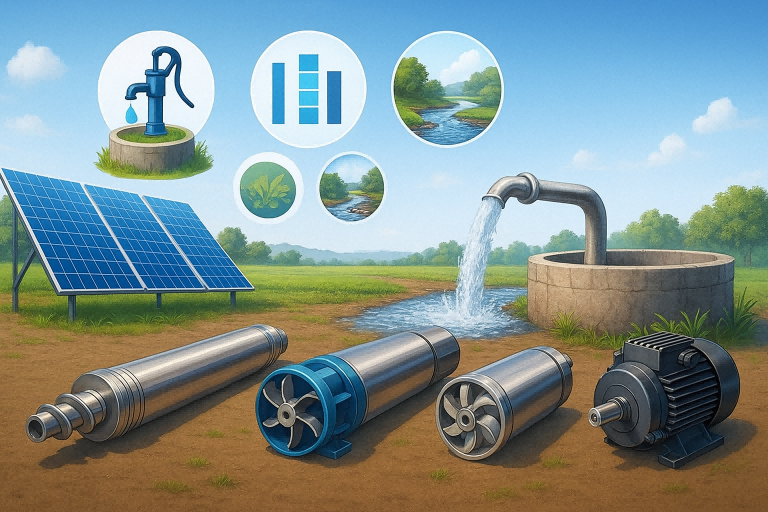
Solar water pumps have become a vital technology across the globe.
They provide clean water solutions in areas without reliable grid power.
With different types available, it can be challenging to know which one is right for you.
Understanding the specific features, advantages, and ideal applications of each pump type is the first step toward making a smart investment.
Let's explore the most popular options to help you find the perfect solar water pump for your needs.
This guide will break down everything you need to know.
The Solar Screw Pump: Your High-Head Specialist
Need to lift water from a very deep well?
Conventional pumps might struggle or fail.
This can leave you without a reliable water source when you need it most.
A solar screw pump is the perfect solution for deep wells.
It excels at pushing water from great depths (high head) even if the flow rate is low.
This makes it perfect for domestic use, livestock watering, and small-scale irrigation in off-grid areas.
The solar screw pump is a type of positive displacement pump.
It's uniquely designed for challenging well conditions.
Its primary strength lies in its ability to generate very high pressure.
This allows it to lift water from depths where many other pumps cannot operate effectively.
How a Screw Pump Mechanism Works
The pump's core consists of two main parts.
There is a single-helix metal rotor, often called a screw.
This rotor turns inside a double-helix rubber stator.
As the rotor spins, it creates a series of sealed cavities.
These cavities move progressively from the pump's inlet to its outlet.
Water is trapped in these cavities and pushed upwards.
This compression-based process is what generates the high head, or lifting power, of the pump.
It is a simple yet powerful design.
Ideal Applications for Low Flow and High Head
The screw pump's characteristics make it ideal for specific uses.
It is a go-to choice for domestic water supply from deep wells in rural homes.
It is also perfect for providing drinking water for livestock in remote pastures.
Small-scale irrigation projects, where high pressure is more critical than high volume, also benefit from this pump type.
Its reliability in electricity-scarce regions has made it extremely popular.
Unmatched Performance in Harsh Water Conditions
One of the most significant advantages of a screw pump is its exceptional resistance to sand.
The rubber stator can handle abrasive particles without a rapid decline in performance or lifespan.
This durability makes it suitable for wells with sandy or murky water.
Other pump types might clog or wear out quickly in such conditions.
The screw pump, however, continues to operate reliably.
Its ability to function in harsh water environments makes it a tough and dependable choice.
| Feature | Solar Screw Pump | Plastic Impeller Pump | Stainless Steel Pump |
|---|---|---|---|
| Best For | High Head, Deep Wells | High Flow, General Use | Corrosive Water, Durability |
| Flow Rate | Low | High | High |
| Sand Resistance | Excellent | Good | Moderate |
| Primary Use | Domestic, Livestock | Farm Irrigation, Pasture | Acidic/Alkaline Water |
The Plastic Impeller Pump: The High-Flow Workhorse
Need to move a large volume of water for irrigation?
Are you worried about fine sand wearing out your equipment?
A standard pump's lifespan and efficiency could be at risk, costing you time and money.
A solar plastic impeller pump offers a fantastic balance of performance and value.
This centrifugal pump delivers high flow rates and has great resistance to fine sand.
It's an economical and lightweight choice, making it ideal for farm irrigation and pasture water supply.
When the goal is moving a lot of water efficiently, the solar plastic impeller pump shines.
This pump is a type of multi-stage centrifugal pump.
It is designed specifically to maximize water output.
Its construction makes it a popular choice for agricultural and large-scale residential applications.
It balances initial cost with reliable performance.
Understanding the Multi-Stage Centrifugal Design
This pump works by using a series of impellers and diffusers.
Water enters the first stage at the center of a spinning impeller.
Centrifugal force throws the water outwards at high velocity.
The water then enters a stationary diffuser, which converts the velocity into pressure.
This pressurized water is guided to the center of the next impeller.
Each stage adds more pressure, increasing the overall head.
More stages mean the pump can lift water from greater depths while maintaining high flow.
Why Plastic Impellers Excel with Sandy Water
The impellers are made from durable, engineered plastics.
These materials are surprisingly wear-resistant, especially against fine sand and silt.
While metal impellers can be abraded by sandy water, these plastic impellers often show better durability in such conditions.
The material's slight flexibility helps it manage small particles without significant damage.
This makes the pump an excellent choice for wells or water sources known to have fine sediment.
This resistance to wear ensures a longer service life and consistent performance.
Key Advantages and Limitations
This pump offers several compelling benefits.
Its primary advantage is its high water output, making it perfect for irrigation.
It is also lightweight, simplifying installation and reducing shipping costs.
Furthermore, it is typically more economical than its stainless steel counterpart.
However, it does have limitations.
In highly corrosive water with high or low pH, the plastic components may degrade.
It is also not the best choice for extremely deep wells where very high pressure is needed.
Understanding these trade-offs is key to selecting the right pump.
The Stainless Steel Impeller Pump: The Premium Choice
Is your water source acidic or alkaline?
Corrosive water can quickly destroy a standard pump.
This leads to frequent, costly replacements and frustrating downtime for your operations.
For corrosive environments, always choose a solar stainless steel impeller pump.
It is built with premium SS304 stainless steel for maximum durability and corrosion resistance.
This pump delivers high flow and is the most reliable option for harsh water conditions and long-term use.
When durability and reliability are non-negotiable, the stainless steel impeller pump is the top-tier choice.
This pump combines the high-flow capabilities of a centrifugal design with superior materials.
Its construction is focused on withstanding the toughest water conditions.
This ensures a long and trouble-free service life.
It represents a long-term investment in your water infrastructure.
Built for the Toughest Water Conditions
The key feature of this pump is its material.
The impellers, diffusers, and pump body are all crafted from SS304 stainless steel.
This grade of stainless steel has excellent resistance to corrosion from both acidic and alkaline water.
This makes it the only viable option in regions with aggressive water chemistry.
Areas with alkaline soils or industrial runoff often require this level of durability.
It prevents the rapid degradation that other pumps would suffer.
High Performance for Demanding Applications
This pump is not just about durability; it also delivers impressive performance.
It offers both high flow rates and a good medium-to-high head capability.
This makes it versatile for a range of demanding applications.
It is ideal for water supply to high-end homes and large ranches where reliability is paramount.
It's also used in agricultural settings where water quality is a known issue.
Its robust performance ensures a consistent and powerful water supply.
A Look at Cost Versus Value
The primary drawback of the stainless steel impeller pump is its higher initial cost.
The premium materials and construction make it more expensive than a plastic impeller model.
It is also heavier, which can add to installation complexity and cost.
However, it's crucial to consider the total cost of ownership.
In corrosive environments, its long service life means fewer replacements.
This reduced downtime and replacement cost often make it the more economical choice in the long run.
It is a premium product aimed at a market that values longevity and an uninterrupted water supply above all else.
The BLDC Motor: The Efficient Heart of the System
Are your solar panels underperforming?
An inefficient motor wastes precious solar energy.
This means you need more panels to run your pump, increasing your costs and system complexity.
Every powerful solar pump relies on a high-efficiency Brushless DC (BLDC) motor.
With efficiency over 90%, these motors use less power, reducing the number of solar panels needed.
This cuts upfront costs, simplifies installation, and ensures your pump performs reliably every day.
The pump type is only one part of the equation.
The motor that drives it is the true core of the system's power and efficiency.
Modern solar water pumps are powered by advanced BLDC permanent magnet motors.
These motors are a major technological leap forward from older motor types.
They are the key to unlocking the full potential of solar energy for water pumping.
This high efficiency is what makes a solar pumping system financially viable.
Key Technical Advantages of BLDC Motors
BLDC motors offer several significant technical benefits.
Their efficiency routinely exceeds 90%.
This is a massive improvement over traditional AC or brushed DC motors.
This efficiency comes from the use of a permanent magnet rotor and an electronic controller.
There are no brushes to wear out, which eliminates a common point of failure and maintenance.
They also deliver high torque across a wide speed range.
This provides the strong starting power needed to get water moving.
The design is also more compact and lightweight, simplifying the overall pump design.
How High Efficiency Reduces System Costs
The market value of a high-efficiency motor is substantial.
Because the motor wastes very little energy, it requires less power to operate the pump.
This directly translates to needing fewer solar panels.
Solar panels are often one of the most expensive components of a water pump system.
Reducing the number of panels needed can lower the total upfront investment by a significant amount.
This makes the entire system more affordable and accessible.
Lower operating costs and simplified installation are direct results of a better motor.
| Motor Technology | Efficiency | Lifespan | Maintenance | Key Feature |
|---|---|---|---|---|
| BLDC Motor | > 90% | Long | None | High torque, compact |
| Brushed DC Motor | 60-75% | Shorter | Brush replacement | Simple, low cost |
| AC Motor | 70-85% | Long | Low | Requires an inverter |
The Strategic Role of the Motor
The motor is the central driver of the entire system's performance and competitiveness.
A superior motor elevates the performance of any pump it is paired with.
When combined with an intelligent Maximum Power Point Tracking (MPPT) controller, the system can maximize its use of available sunlight.
The MPPT controller adjusts the electrical load to extract the most power possible from the solar panels throughout the day.
This combination of an efficient motor and smart controller ensures the pump works effectively even in low-light conditions.
It is this synergy that creates a truly reliable and efficient off-grid water solution.
Hybrid AC/DC Systems: Water, Day or Night
What happens on cloudy days or at night?
A standard solar pump stops working without sun.
This leaves you without water, disrupting your home, farm, or business operations until the sun returns.
**Hybrid AC/DC solar pump systems solve this problem completely.
They automatically switch from solar power to a backup AC source, like the grid or a generator.
This guarantees you have a reliable, 24/7 water supply, no matter the weather or time of day.**
The ultimate goal of any water system is uninterrupted access.
While solar power is clean and cost-effective, its availability is limited to daylight hours.
To overcome this, advanced hybrid AC/DC systems provide a comprehensive solution.
These systems are designed for total water security.
They ensure that you are never left without water.
This technology represents the next step in reliable off-grid water management.
How Dual-Power Input Works
Hybrid controllers are designed with two power inputs.
One input connects to your solar panel array.
The other input connects to an AC power source.
This AC source can be the main electrical grid or a backup generator.
The intelligent controller manages these two power sources automatically.
There is no need for manual switching or complex wiring.
The system is designed for seamless, worry-free operation.
Smart Power Management
The controller's primary logic is to prioritize solar power.
Whenever there is sufficient sunlight, the system runs entirely on free energy from the solar panels.
The controller constantly monitors the solar input.
If the sunlight weakens due to clouds, the controller can activate a hybrid function.
It will blend AC power with the available solar power to maintain pump performance.
This maximizes the use of every bit of solar energy.
When there is no solar input at all, such as at night, it switches completely to the AC source.
The transition is automatic and seamless, ensuring the pump continues to run as needed.
This smart management guarantees an uninterrupted water supply 24 hours a day.
Unlocking True Water Security
The ability to use either DC or AC power provides ultimate flexibility.
You get the daytime cost savings and environmental benefits of solar.
You also get the 24/7 reliability of a grid-connected pump.
This is the ideal solution for critical applications where water access cannot be compromised.
These applications include residential homes, large-scale commercial farms, and community water supply projects.
It removes all dependency on weather conditions for your water needs.
It is the best of both worlds.
Conclusion
Choosing the right solar pump depends on your specific needs.
Match your flow, head, and water quality to a screw, plastic, or stainless steel pump.
Pair it with a high-efficiency BLDC motor to ensure a reliable and cost-effective system.
Frequently Asked Questions
What are the two main types of solar pumps?
The two main types are submersible pumps, which are placed underwater in a well, and surface pumps, which are located on the ground.
How deep can a solar water pump go?
A solar screw pump can lift water from over 200 meters, while centrifugal pumps are typically used for depths up to 150 meters.
How many solar panels are needed to run a water pump?
This depends on the pump's power rating and local sunlight. A small residential pump might need 2-4 panels, while a large irrigation pump could require 20 or more.
Can solar pumps work without batteries?
Yes, most modern solar pump systems are designed to work without batteries. They pump water during the day and store it in a tank.
How long do solar water pumps last?
A quality solar water pump system can last for 15-20 years. The motor and pump may last over 10 years, while solar panels can last 25 years.
Do solar pumps work on cloudy days?
Yes, they can work on cloudy days but at a reduced flow rate. A hybrid AC/DC controller ensures full performance by adding AC power when needed.