You want to install a solar pump and save on labor costs.
But a single mistake could damage the pump, void the warranty, or be unsafe.
Understand the process first to ensure a successful DIY installation.
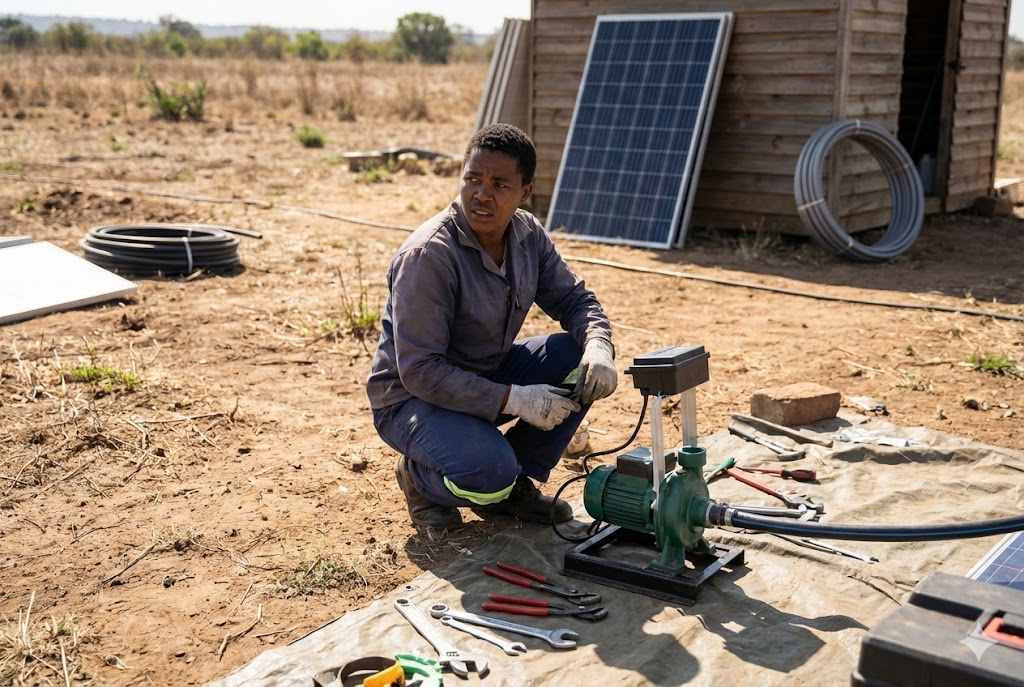
Yes, you can install a solar pump yourself if you have basic plumbing and electrical skills. Surface pumps are simpler. Deep well pumps are more complex and may require specialized equipment. Always prioritize safety and follow the manufacturer's instructions carefully.
The answer is not a simple yes or no.
It depends heavily on the type of pump and your specific site conditions.
A surface pump for a garden is very different from a deep well pump for a remote ranch.
Understanding what each installation truly involves is the key to deciding if this is a project for you or a professional.
Let’s break down the essential steps.
Step 1: Planning and Site Assessment
You are eager to start installing your new pump.
But without a proper plan, you risk placing components incorrectly, resulting in poor performance.
A few hours of planning saves days of rework and frustration.
Before you begin, assess your site. Identify the best location for the solar panels (maximum sun, minimal shade) and the controller (dry, ventilated). For well pumps, confirm the well depth and diameter to ensure the pump will fit.
Proper planning is the most critical phase of a DIY solar pump installation.
It will dictate the success and efficiency of your entire system.
Rushing this step is a common mistake that leads to poor water output and potential equipment damage.
First, you must understand your water source.
Is it a shallow well, a deep borehole, a river, or a pond?
This determines whether you need a submersible pump or a surface pump.
For wells and boreholes, you must know the key measurements.
Critical Well Measurements
- Total Well Depth: The distance from the ground surface to the bottom of the well.
- Static Water Level: The level of the water when the pump is not running.
- Well Diameter: The internal diameter of the well casing. The pump must be smaller than this to fit.
Next, focus on the solar array location.
The panels are the engine of your system.
Their placement directly impacts how much water you can pump.
Use a compass and a sun chart app to find the optimal location.
You need an area that receives at least 6-8 hours of direct, unshaded sunlight per day.
Watch out for shadows from trees, buildings, or hills that may appear at different times of the day or year.
The mounting structure must be robust.
It needs to withstand the worst weather your region experiences, especially high winds.
Finally, plan the location for the pump controller.
This vital electronic component needs protection.
Ideal Controller Location
- Keep it Dry: Mount it in a waterproof enclosure or a shed.
- Keep it Cool: It must be out of direct sunlight and have good ventilation to prevent overheating.
- Keep it Close: Minimize the wire length between the controller and the pump to reduce voltage drop, but keep a safe distance from the wellhead itself.
Planning the trenching for pipes and wires now will make the physical installation much smoother.
Step 2: Mounting the Solar Panels and Controller
You have a spot for your panels, but mounting them seems daunting.
An insecure mount can be a major hazard in a storm, risking damage to the panels.
Take the time to build a solid, correctly angled foundation for your system's powerhouse.
Assemble your mounting rack according to the instructions. Securely fasten it to the ground or roof, ensuring it is angled correctly to face the sun. Mount the panels onto the rack, and install the controller in its pre-planned, protected location.
The physical installation begins with the power source.
This step requires basic mechanical and assembly skills.
Most solar panel mounting kits come with detailed instructions.
Follow them precisely.
Whether you are using a ground mount or a roof mount, the foundation is everything.
For a ground mount, this often means setting posts in concrete.
Ensure the posts are level and square before the concrete sets.
The stability of the entire array depends on this footing.
The angle of the panels is crucial for maximizing energy capture.
General Angle Guidelines
- For year-round performance: Set the angle equal to your location's latitude.
- For maximizing winter sun: Latitude angle + 15 degrees.
- For maximizing summer sun: Latitude angle - 15 degrees.
Once the rack is secure, you can mount the solar panels.
This is often a two-person job, as panels can be large and awkward to handle.
Make sure all bolts and clamps are tightened to the manufacturer's specified torque.
Loose connections can lead to panels shifting or vibrating in the wind.
Next, mount the pump controller.
Choose a vertical surface in a shaded, well-ventilated area.
This prevents moisture from collecting on the terminals and allows heat to dissipate effectively.
Never install the controller in a sealed box without ventilation, as it can overheat and shut down, reducing its lifespan.
Ensure the enclosure is weatherproof if it is located outdoors.
Finally, run electrical conduit from the panel array to the controller location.
This protects the wiring from physical damage and UV degradation.
Leave a "drip loop" in the wires before they enter the controller box.
This small loop forces any water running down the wire to drip off before it can enter the enclosure.
Step 3: Preparing and Lowering the Pump (Deep Wells)
You have your panels up and now face the well.
Lowering an expensive pump hundreds of feet on a pipe is intimidating.
Dropping the pump down the well is a costly and preventable disaster.
For deep wells, securely attach the drop pipe, safety rope, and waterproof power cable to the pump. Carefully lower the assembly into the well, using a rig or help from others to manage the weight. Do not let the power cable support the pump's weight.
This is the most physically demanding and high-risk step for deep well installations.
Surface pumps do not require this step.
For submersible pumps, meticulous preparation is essential.
Lay out the pump, the drop pipe, the safety rope, and the power cable in a straight line from the wellhead.
This prevents tangling during the lowering process.
First, attach the initial section of drop pipe to the pump's outlet.
Use Teflon tape on all threaded fittings to ensure a watertight seal.
Next, securely attach the stainless steel or nylon safety rope.
This rope is a critical backup.
It is not meant to hold the pump's weight during normal operation but will save it if a pipe joint fails.
Now, you begin connecting the power cable.
The connection between the pump's motor lead and the main power cable is the most critical electrical joint in the system.
It will be submerged in water for years.
It must be 100% waterproof.
Use a high-quality waterproof splice kit, which typically involves solder, heat-shrink tubing, and waterproof mastic tape.
Follow the kit's instructions perfectly.
A failed splice will cause the pump to fail.
As you lower the pump assembly, attach the power cable and safety rope to the drop pipe every 3 meters (10 feet) with cable ties or specialized clips.
This prevents the cable from abrading against the well casing or wrapping around the pump.
Lowering the Pump
- For shallow wells (<30m / 100ft): This can often be done by one or two strong people.
- For deep wells (>30m / 100ft): The combined weight of the pump, pipe, and water inside the pipe becomes immense. A tripod hoist, derrick rig, or a dedicated pump hoist is highly recommended for safety and control.
Once the pump is at the correct depth (well below the static water level), secure the pipe at the top using a pitless adapter or well seal.
Attach the safety rope to a secure anchor point.
Leave a little slack in the power cable.
Step 4: Wiring the System and Final Connections
The components are in place, but connecting them has you worried.
Incorrect wiring can instantly destroy the pump's controller or motor.
This is the final hurdle where precision prevents permanent damage.
Connect the solar panel wires to the controller's PV input terminals. Connect the pump's power cable to the controller's motor output. Double-check all polarity (+ to +, - to -). An incorrect connection can cause irreversible damage to the electronics.
This final step brings your system to life.
It requires careful attention to detail, but not advanced electrical expertise for most DC systems.
The mantra here is: check twice, connect once.
Before making any connections, ensure the solar panels are disconnected or covered with an opaque blanket.
You do not want the system to be live while you are working on it.
The controller will have clearly marked terminals.
Primary Controller Terminals
- PV (+ and -): This is where the power from the solar panels connects.
- Motor (U, V, W): This is where the 3-phase power cable from the pump connects. For BLDC motors, the order typically does not matter.
- Sensors: Terminals for well probes (to prevent dry running) and tank full sensors.
- AC Input (L, N): On AC/DC hybrid controllers, this is for the grid or generator backup.
First, connect the grounding wires.
Attach a copper ground wire from the solar panel frames, the mounting rack, and the pump controller chassis to a dedicated grounding rod driven deep into the earth.
This is a critical safety step.
Next, connect the wires from the solar panels to the PV input terminals on the controller.
Pay close attention to polarity.
Connecting positive to negative can instantly destroy the controller's MPPT circuit.
Use a multimeter to verify the voltage and polarity of the panel array before you connect it.
After that, connect the pump's power cable to the U, V, and W motor output terminals.
Finally, install any sensors you are using.
The most common is a set of well probes to detect a low water level.
This dry-run protection is crucial for protecting the pump from damage if the well's water level drops too low.
Once all connections are made and double-checked, you can perform the initial test.
Uncover the solar panels.
The controller's indicator lights should turn on.
The pump should start smoothly (a soft start) and ramp up to speed.
You should have water!
Conclusion
You can install a solar pump if you have the right skills and plan carefully.
Surface pumps are a great DIY project.
Deep well pumps require more skill, strength, and caution to install safely.
Frequently Asked Questions
How do I choose a solar water pump?
Choose based on your required flow rate (gallons per minute) and total dynamic head (the vertical lift plus friction loss). Match these needs to the pump's performance curve.
Can a solar pump work at night?
A standard solar pump only works with sunlight. To run at night, you need an AC/DC hybrid system connected to the grid or a generator, or a DC system with a battery bank.
How long do solar water pumps last?
A quality solar pump system can last for 15-20 years. The BLDC motor and pump end are very durable. The controller may need replacing every 10 years, and panels last 25+ years.
Do solar pumps need batteries?
No, most solar pumps do not need batteries. They are designed to pump water into a storage tank when the sun is out. The tank acts as the "battery" by storing water.
What maintenance does a solar water pump require?
Solar water pumps require very little maintenance. You should periodically clean the solar panels and check electrical connections. The brushless motor itself is maintenance-free.
How deep can a solar pump go?
Solar pumps can go very deep. Solar screw pumps are designed for high head and can pump from depths of over 200 meters (650 feet), though with lower flow rates.
Can a solar pump run on cloudy days?
Yes, a solar pump will run on cloudy days, but at a reduced speed and flow rate. The integrated MPPT controller maximizes output from the available diffuse sunlight.