Choosing the "best" borehole pump is a critical decision.
A wrong choice leads to poor performance, high costs, and premature failure, leaving you without a reliable water supply.
The best pump depends entirely on your specific needs.
The best borehole pump is the one that matches your well's depth, required water volume, and water quality. Screw pumps are best for very deep wells, while centrifugal impeller pumps are best for high water volume.
The term "best" is not about a single brand or model.
It is about finding the perfect match for the unique conditions of your borehole.
Factors like the depth of your well, the amount of water you need daily, and even the chemical makeup of your water play a crucial role.
A pump that is perfect for a shallow, high-volume irrigation well would be completely unsuitable for a deep, domestic borehole with sandy water.
Understanding the fundamental pump types and their specific strengths is the first step toward making an informed decision.
Let's break down the best options for the most common borehole scenarios.
Best for Deep Wells: The Solar Screw Pump
Your borehole is extremely deep, and standard pumps can't lift the water.
This leaves your valuable water source completely inaccessible.
Solar screw pumps are engineered for high head, making them the best choice for deep well applications.
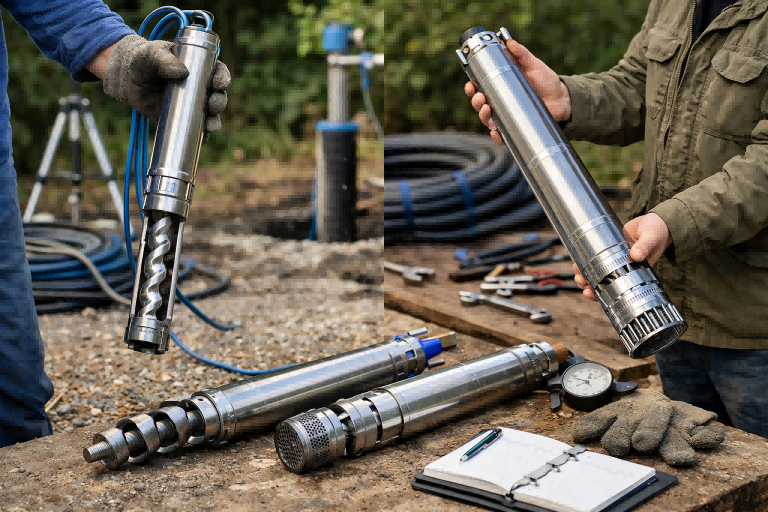
For very deep boreholes where high lifting power (head) is critical, the solar screw pump is the best option. Its positive displacement design creates immense pressure to reliably pump water from great depths.
When you measure your well depth in hundreds of feet or meters, your primary challenge is overcoming gravity.
This requires a pump technology that excels at creating pressure.
The solar screw pump, also known as a progressing cavity pump, is the undisputed champion in this category.
It does not use impellers like a centrifugal pump.
Instead, it features a helical metal rotor (the "screw") that spins inside a flexible rubber stator.
This unique mechanism creates a series of sealed pockets of water.
As the rotor turns, these pockets are pushed steadily up the pump column.
This method is called positive displacement, and it generates very high pressure efficiently.
Unmatched Lifting Capability
The core strength of the screw pump is its ability to generate high head at low flow rates.
It can effectively lift water from depths that are impossible for many centrifugal pumps to reach.
This makes it the ideal solution for domestic water supply, livestock watering troughs, and small-scale drip irrigation systems connected to deep boreholes.
This technology is particularly vital in the arid, electricity-scarce regions of Africa and Latin America, where deep wells are common.
Superior Sand Handling
Another significant advantage that makes it the "best" for many boreholes is its remarkable tolerance for sand and silt.
The flexible rubber stator can pass small abrasive particles without the damage that would quickly destroy the tight tolerances of a centrifugal impeller.
This durability in harsh water conditions significantly extends the pump's service life and reduces maintenance needs, making it a reliable long-term investment.
| Feature | Solar Screw Pump | Typical Centrifugal Pump |
|---|---|---|
| Primary Strength | High Head (Lifting Power) | High Flow (Volume) |
| Best Application | Deep Wells (>80m / 260ft) | Shallow to Medium Wells |
| Flow Rate | Low to Medium | Medium to Very High |
| Sand Tolerance | Excellent | Fair to Good |
| Mechanism | Positive Displacement | Centrifugal Force |
Best for High Water Volume: The Solar Centrifugal Pump
You need to move a large volume of water for irrigation or filling a reservoir.
A low-flow pump would be too slow, wasting valuable time and resources.
Solar centrifugal pumps are designed for high flow, making them the best choice for bulk water transfer.
When the goal is moving the maximum volume of water, a multi-stage solar centrifugal pump is the best. Equipped with plastic or stainless steel impellers, it excels at farm irrigation and pasture water supply.
For applications like farm irrigation, livestock operations, or filling large tanks, the key metric is "gallons per minute" or "liters per hour".
In this scenario, a centrifugal pump is the superior choice.
These pumps use a motor to spin one or more impellers at high speed.
The rotation flings water outwards, creating pressure and moving a high volume of water efficiently.
A pump that uses several impellers in a series is known as a multi-stage pump.
Each stage builds upon the pressure of the last, allowing the pump to move large volumes of water to moderate heights (medium head).
The best choice within this category depends on your water quality and budget.
The Economical Workhorse: Plastic Impeller Pumps
For general high-flow needs with non-corrosive water, the solar plastic impeller pump is often the best value.
It uses impellers made from durable, wear-resistant engineered polymers.
This makes the pump lightweight, easy to install, and highly cost-effective.
It offers excellent resistance to fine sand, a common issue in agricultural boreholes.
These features make it a top seller for farm irrigation and home gardens across Africa and the Americas.
Its limitation is in very deep or corrosive water environments, where a more robust material is needed.
The Premium Performer: Stainless Steel Impeller Pumps
When dealing with corrosive water (acidic or alkaline), the best and most durable option is the solar stainless steel impeller pump.
It utilizes impellers and a pump body made from corrosion-resistant SS304 stainless steel.
This premium construction is specifically designed to withstand harsh water conditions, such as those found in the alkaline soils of Australia or certain parts of the Americas.
While the initial cost is higher, its superior longevity and reliability in aggressive water environments provide a lower total cost of ownership for high-end homes and ranches.
The Secret to the Best Pump: The BLDC Motor
You believe the pump itself is the only important component.
But without an efficient motor, even the best pump will underperform and waste energy.
The motor's efficiency determines the entire system's performance and cost-effectiveness.
The best borehole pumps are all powered by a high-efficiency BLDC permanent magnet motor. With efficiency over 90%, this motor makes the system powerful, reduces solar panel costs, and ensures a long service life.
Whether you choose a screw pump for depth or a centrifugal pump for volume, the component that truly defines its performance is the motor.
The motor is the heart of the system, responsible for converting solar energy into the mechanical power that moves water.
An inefficient motor acts as a bottleneck, wasting precious energy generated by your solar panels.
The best modern borehole pumps have moved beyond outdated motor technologies.
They are powered by advanced Brushless DC (BLDC) permanent magnet motors.
This technology is the key to achieving a truly efficient and powerful water pumping system.
A high-quality BLDC motor can convert over 90% of the incoming electrical energy into useful mechanical power.
In contrast, older brushed DC or standard AC motors might only achieve 60-70% efficiency.
How Motor Efficiency Multiplies Performance
This efficiency gap of 20-30% has massive real-world implications.
A 90% efficient system requires significantly fewer solar panels to pump the same amount of water as a 70% efficient system.
This directly translates to a lower initial investment in panels, racking, and wiring.
These BLDC motors utilize powerful 40SH grade neodymium iron boron permanent magnets in the rotor.
This eliminates the energy losses that occur in traditional motors, which have to use power to create their own internal magnetic fields.
The result is a motor that produces more power and higher torque from a smaller, lighter package.
A modern BLDC motor can be up to 47% smaller and 39% lighter than a traditional motor with the same power output.
The Market Value of an Efficient Motor
- Lower Upfront Cost: Reduces the required size of the solar array by 20% or more.
- Easier Installation: Lighter and more compact motors are easier to handle and lower into a borehole.
- Maintenance-Free: The brushless design means there are no parts to wear out and replace.
- Increased Lifespan: High efficiency means the motor runs cooler, which extends the life of all its components.
The BLDC motor is the core technology that makes the best borehole pumps both powerful and economical.
The Best Solution for 24/7 Water: The AC/DC Hybrid
Your solar pump works great, but what about cloudy days or at night?
An inconsistent water supply is not an option for homes or critical livestock operations.
An AC/DC hybrid system provides the ultimate reliability by blending solar with a backup power source.
For a guaranteed, uninterrupted water supply, the best system is an AC/DC hybrid borehole pump. It automatically uses solar power when available and switches to grid or generator power when it is not, ensuring 24/7 operation.
The definition of the "best" pump system often comes down to reliability.
While a standard DC solar pump provides free water during sunny hours, it stops working when the sun goes down or during extended overcast weather.
For many users, this is a significant limitation.
The best solution to this problem is an AC/DC hybrid system.
This advanced setup uses an intelligent controller that can manage two different power sources.
It provides all the cost-saving benefits of solar power without sacrificing the 24/7 reliability of a traditional electric pump.
How Smart Hybrid Power Works
The hybrid controller is the brain of the system, engineered with inputs for both DC power from solar panels and AC power from the grid or a generator.
- Full Sun Operation: The pump runs exclusively on 100% free solar energy. The system does not draw any AC power.
- Low Sun Operation: On cloudy or overcast days, the controller performs a blending function. It draws as much power as possible from the solar panels and supplements it with just enough AC power to keep the pump running at the desired speed. This maximizes solar energy usage.
- No Sun Operation: At night or during heavy storms, the controller seamlessly and automatically switches to the AC power source, ensuring the pump can run at any time.
This intelligent power management guarantees that you have water whenever you need it, regardless of the weather or time of day.
The Ultimate in Reliability
The AC/DC hybrid capability elevates a solar pump system from a supplemental water source to a primary, mission-critical utility.
It is the best choice for anyone who cannot afford to be without water.
This includes residential homes, remote communities, and high-value agricultural operations where consistent livestock watering is essential.
It offers complete peace of mind, delivering the best of both worlds: sustainable solar energy and unwavering grid-like reliability.
Conclusion
The best borehole pump is not a single product.
It is a system tailored to your well’s depth, water volume needs, and water quality, powered by an efficient motor.
Frequently Asked Questions
What are the two main types of borehole pumps?
The two main types are centrifugal pumps, which use impellers for high flow, and positive displacement pumps (like screw pumps), which are designed for high pressure and deep wells.
How do I choose a borehole pump?
Choose based on your total dynamic head (well depth plus friction), required flow rate (liters per day), borehole diameter, and water quality (sandy or corrosive).
How long does a borehole pump last?
A quality borehole pump, particularly one with a brushless motor, can last 15 to 20 years. The accompanying solar panels often have a performance warranty of over 25 years.
What size pump do I need for a 100m borehole?
For a 100m (328 ft) deep borehole, a solar screw pump is often the best choice due to its high head capability. The specific model size depends on your required water volume.
Can a borehole pump run dry?
Most modern borehole pumps have run-dry protection sensors built into the controller, which will shut the pump off to prevent damage if the water level drops too low.
Which is better, a submersible or surface pump?
For a borehole, a submersible pump is always better as it pushes water up from inside the well. Surface pumps can only pull water from shallow depths (typically less than 7 meters).
Is a 3-inch or 4-inch borehole pump better?
A 4-inch pump generally offers higher flow rates. The best choice depends on your borehole's diameter; you must select a pump that fits comfortably inside the casing.