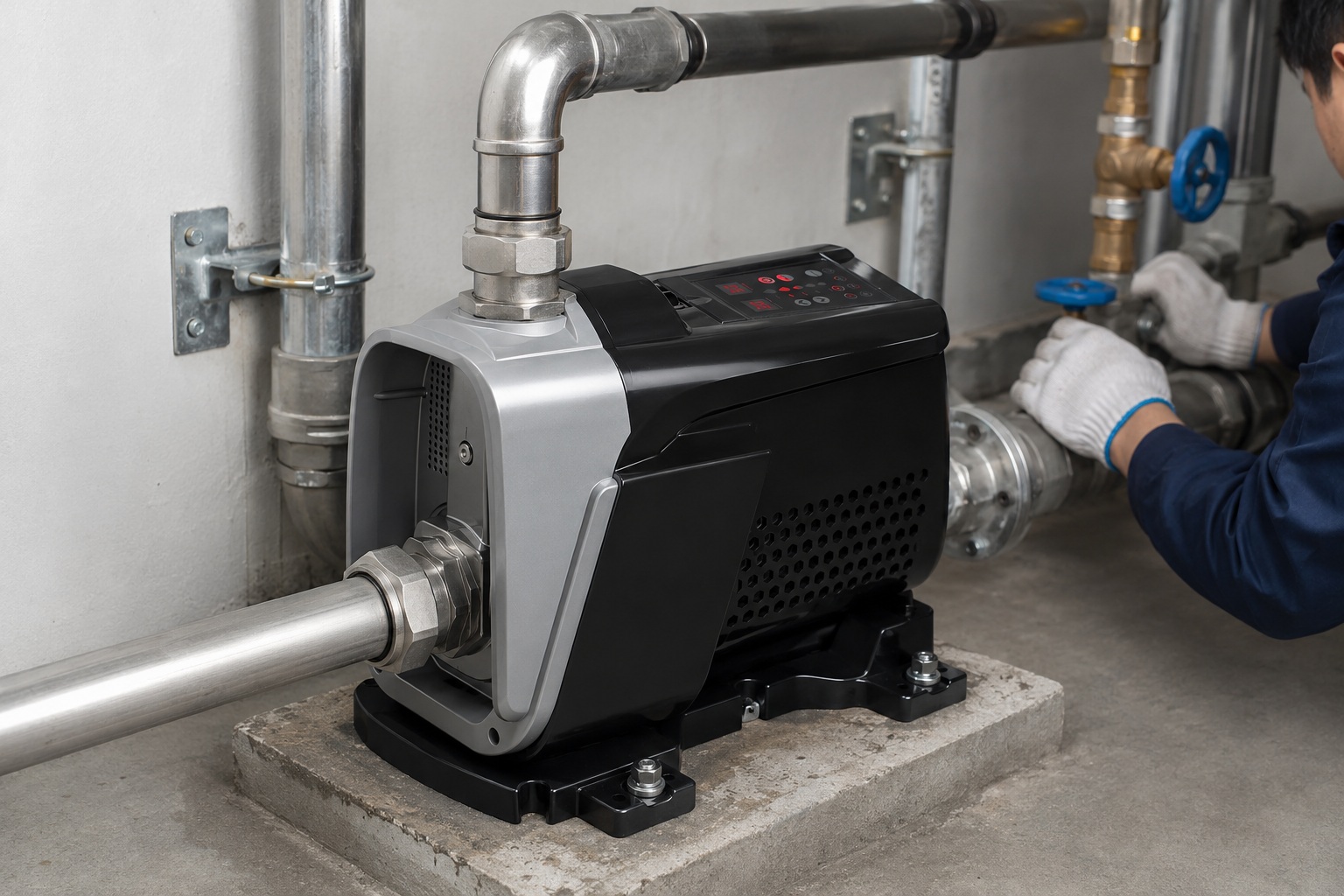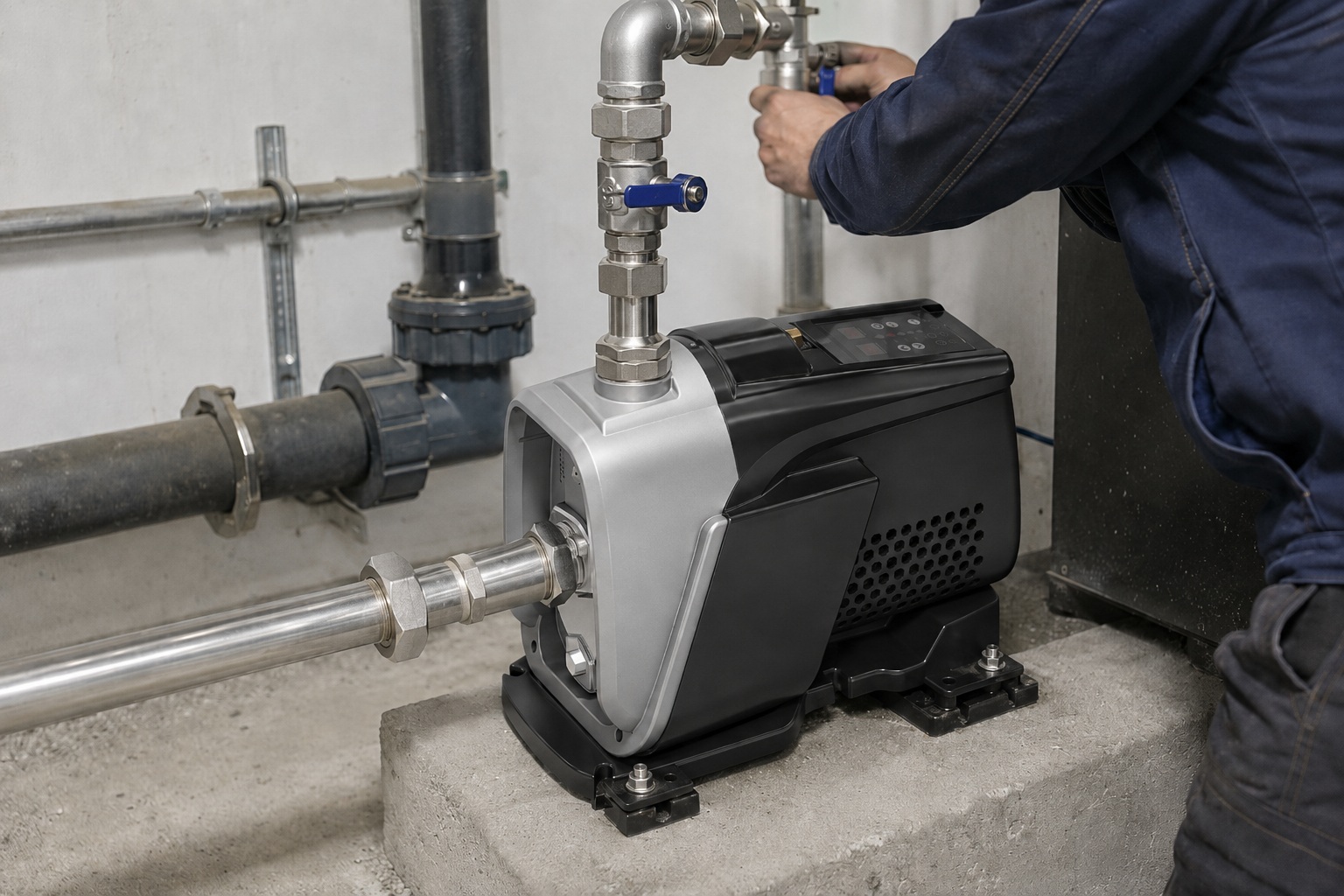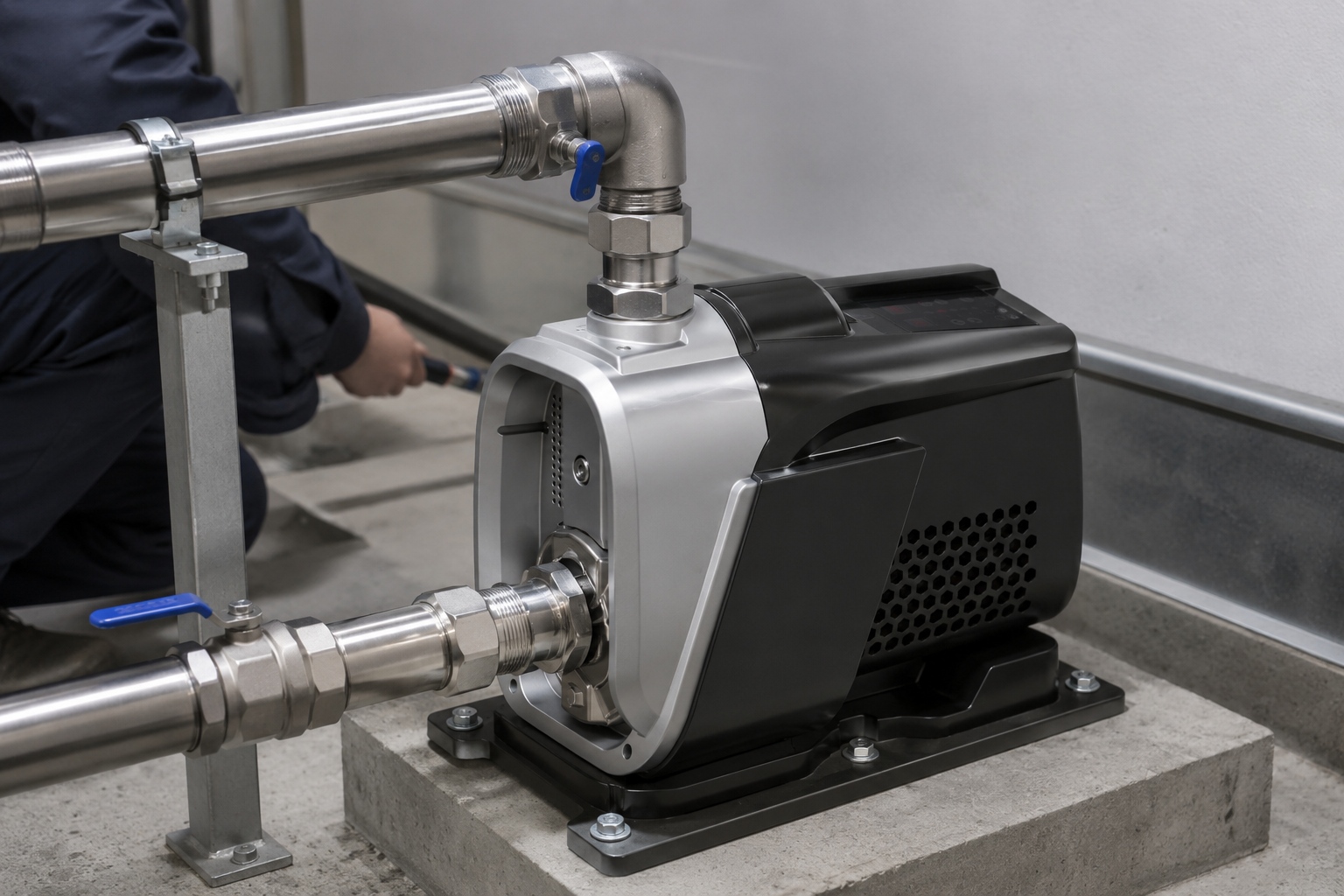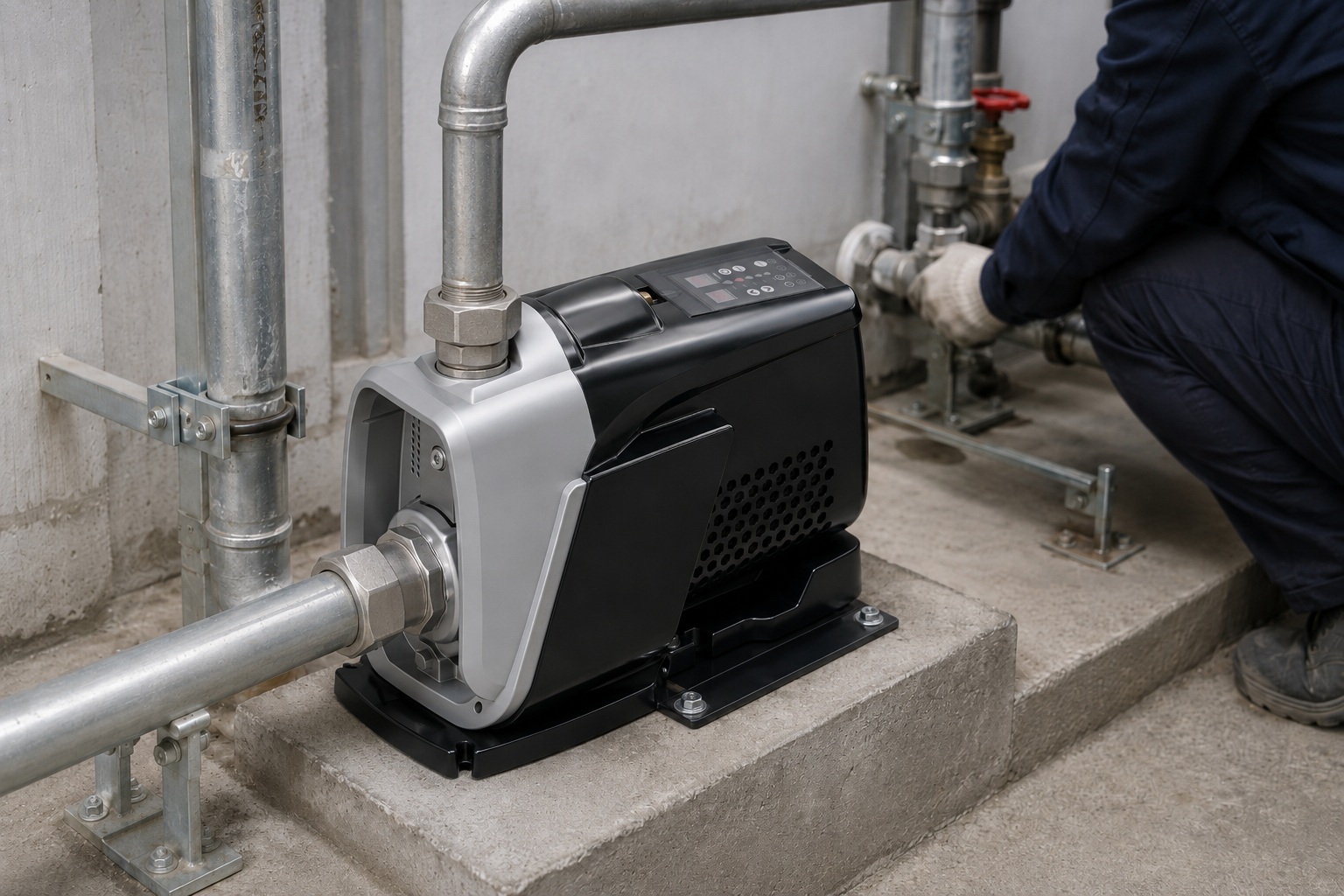
Tired of weak water pressure ruining your shower?
You need a powerful, efficient booster pump, but choosing the right one is confusing.
A smart VFD pump is the modern solution for perfect pressure.
The top 3 permanent magnet variable speed (VFD) booster pumps / Best Smart Water Booster Pumps Reviewed for 2025 are the :
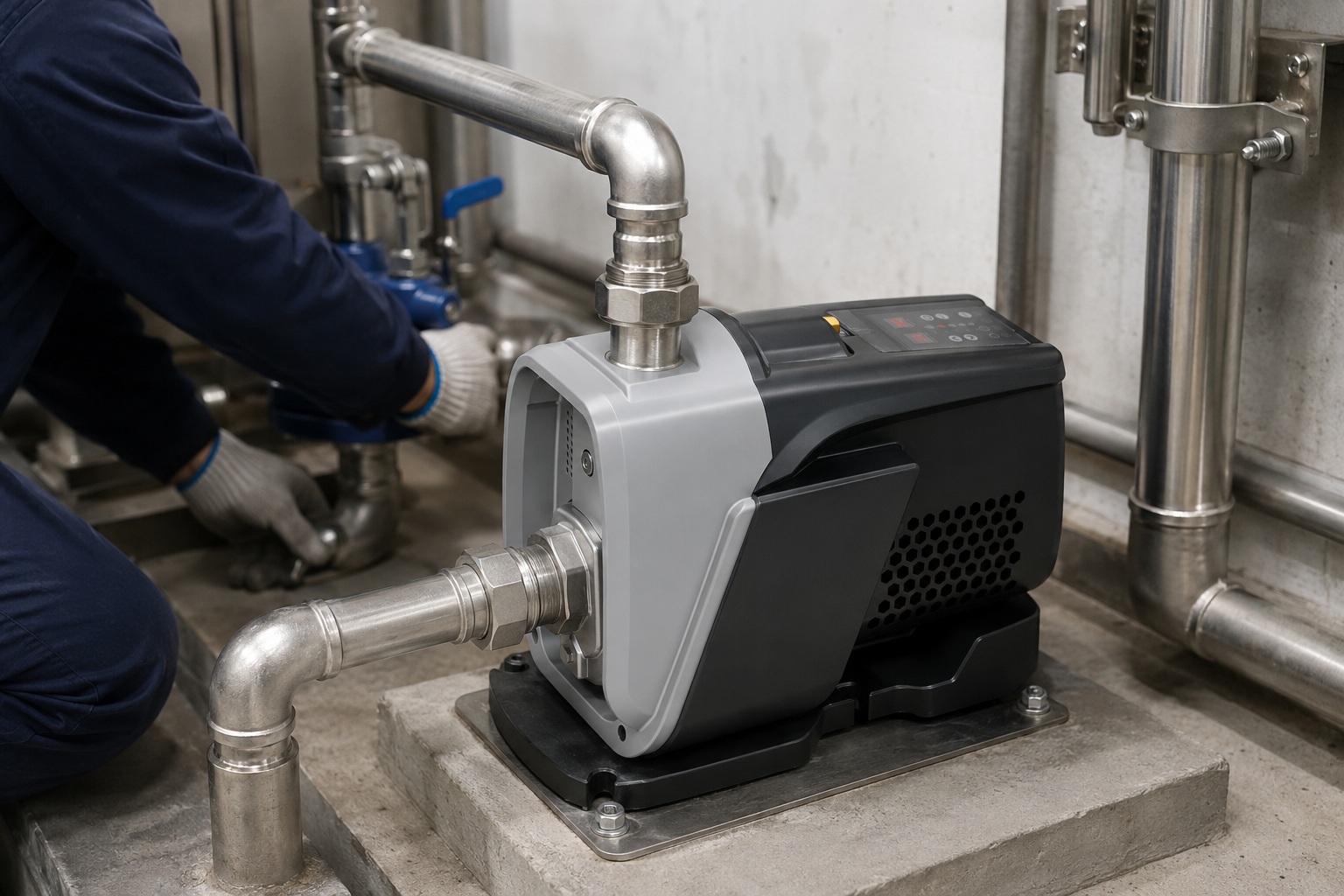
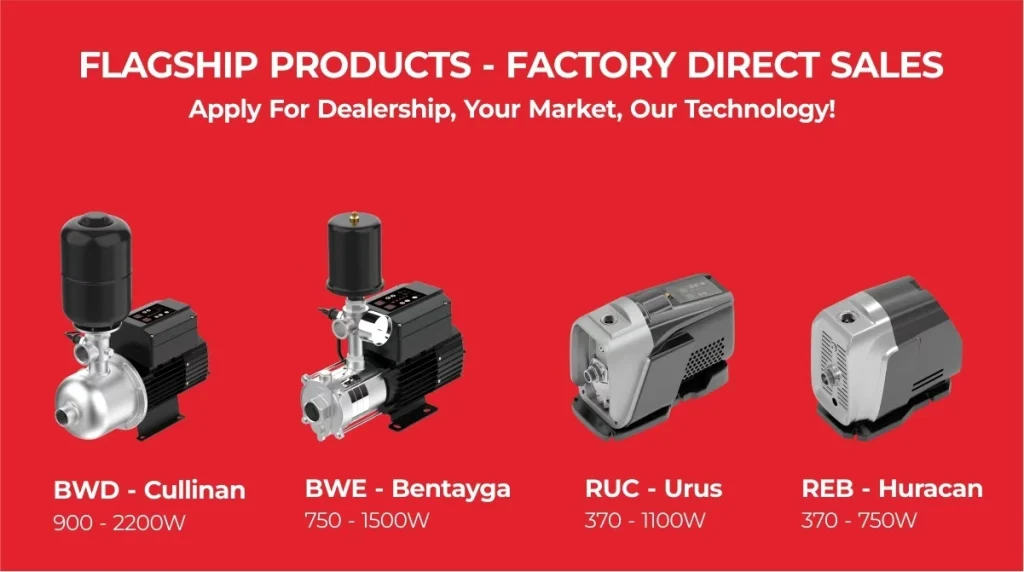
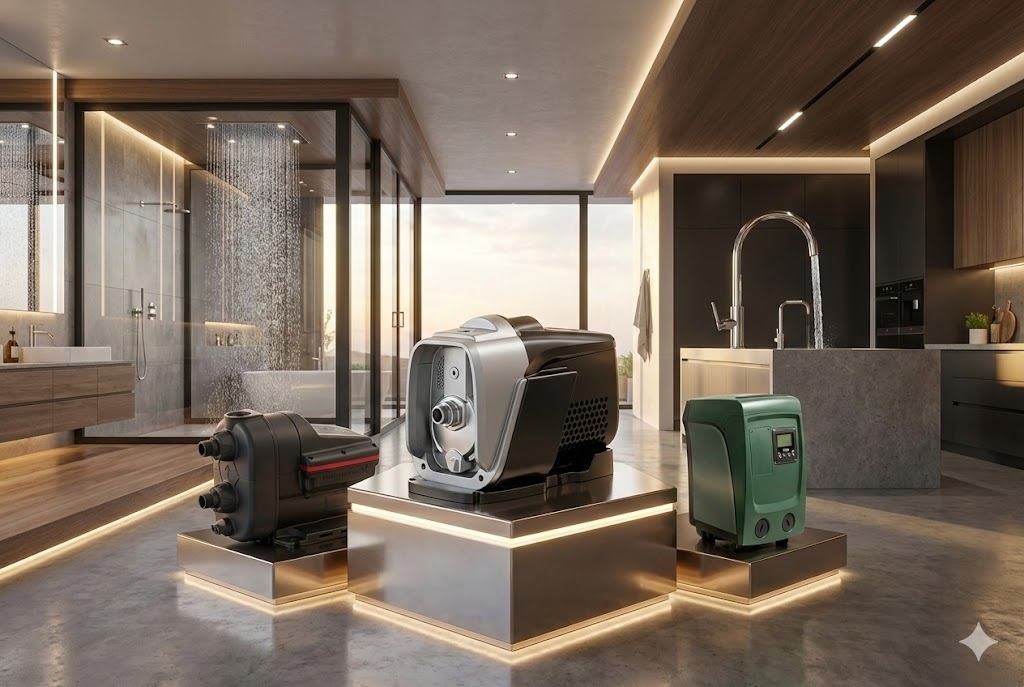
RAFSUN RUC-Urus
Grundfos SCALA2
DAB ESYBOX MINI³
While all are leaders, the RAFSUN RUC-Urus is engineered as the most globally
capable system, excelling in unstable power grids and offering superior overall value.
Choosing a booster pump is a major investment for your home or business.
It’s about more than just water pressure.
You need to consider energy efficiency, noise level, durability, and whether it will even work with your local power supply.
This guide provides a comprehensive comparison to help you understand which of the top three global benchmarks is the right choice for your specific needs, ensuring you get the best performance and value.
Let's dive into the details.
Why Smart Booster Pumps are a Must-Have in 2025
Are rising electricity bills and unstable power making you anxious?
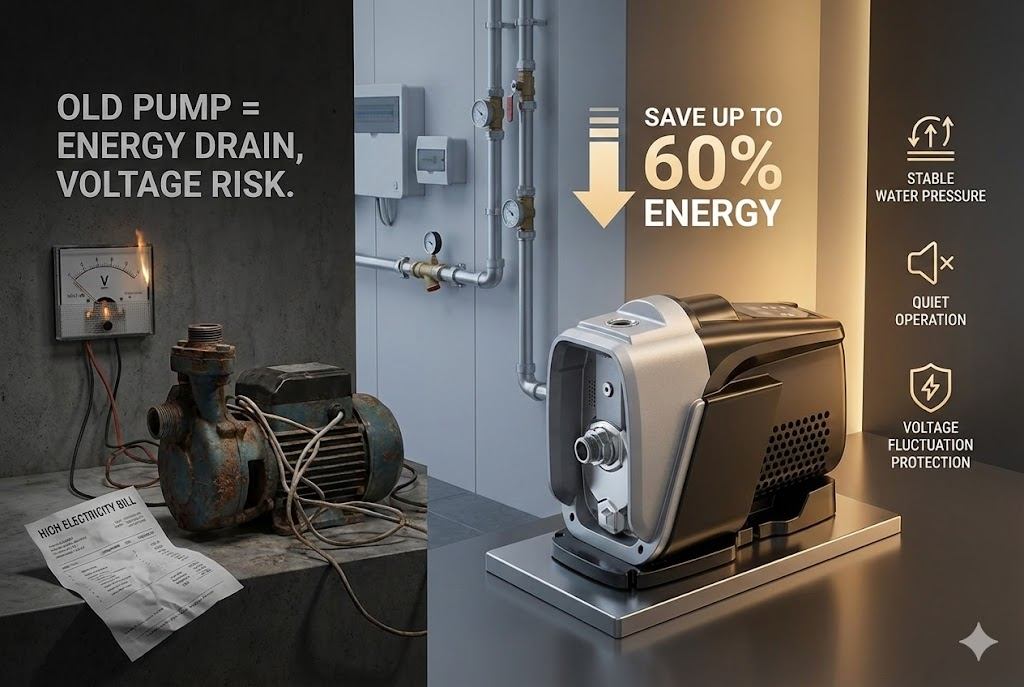
Your old water pump could be a major energy drain and might fail when the voltage fluctuates.
Smart VFD pumps are the answer.
Modern VFD booster pumps are in high demand because they provide stable water pressure while cutting energy use by up to 60%. They are essential in areas with rising energy costs and fluctuating voltage, and users now prioritize quiet operation and low-maintenance systems.
The world is changing, and so are the demands on our home utilities.
The need for intelligent, efficient, and reliable water pressure systems has never been greater.
Several key global trends are driving the shift from traditional pumps to advanced VFD booster systems.
Understanding these trends is crucial to appreciating why one pump might be a better long-term investment than another.
Rising Demand for Stable Household Water Pressure
Modern homes are no longer simple structures.
They often feature multiple bathrooms, each equipped with high-flow rain showers.
Appliances like washing machines, dishwashers, and high-tech refrigerators all demand a steady supply of water to function correctly.
A traditional pump struggles to keep up when multiple taps are open, leading to frustrating pressure drops.
Intelligent pressure control, a core feature of VFD pumps, solves this by constantly adjusting motor speed to maintain the exact pressure you set, no matter the demand.
Worldwide Electricity Prices Continue to Rise
Energy cost is a major concern for households and businesses globally.
Regions like Europe, the Middle East, Southeast Asia, and Latin America are seeing significant increases in electricity prices.
A VFD (Variable Frequency Drive) pump is a game-changer for energy savings.
Instead of running at full power all the time, it adjusts its speed to the current water demand.
This intelligent operation can reduce energy consumption by 20% to 60%.
This translates to substantial savings on your utility bills over the pump's lifetime.
Voltage Instability Affects 40% of Countries
Not everyone has access to a perfectly stable power grid.
In fact, over 40% of global markets suffer from significant voltage instability.
Common issues include:
- Low Voltage: Power dropping to levels between 90V and 160V.
- Overvoltage: Spikes reaching 220V to 280V.
- Grid Fluctuations: Constant and unpredictable changes in power supply.
Most standard European or American pumps are not designed to handle these conditions and can fail prematurely.
This is a critical factor to consider if you live in a region with an unreliable power grid.
Noise Performance Becomes a Major Buying Factor
Gone are the days when a noisy pump was an acceptable part of a home's mechanical system.
Users now demand silent operation, especially for pumps installed inside or near living spaces.
A loud pump can be a constant source of irritation.
The quietest pumps on the market operate at a noise level similar to a library or a quiet conversation.
Manufacturers are now investing heavily in acoustic engineering to meet this demand, making noise level a key point of comparison.
Product Positioning & Structural Design
Confused by the different models and what they're for?
Choosing the wrong pump for your environment can lead to poor performance and early failure.
It's vital to match the pump's design to your needs.
RAFSUN RUC-Urus is positioned as a global flagship for any environment, Grundfos SCALA2 is a European domestic standard for stable conditions, and DAB ESYBOX MINI³ is a premium residential pump for high-end homes. Their structural designs reflect these different target markets.

A pump's physical design and market position tell you a lot about its intended use and durability.
The materials used, the integration of components, and the overall architecture determine how well it will perform and how long it will last, especially in challenging conditions.
Let's break down how these three leading products are built and positioned.
Market Position Comparison
The target market for each pump dictates its core features.
A pump designed for a stable European home has very different requirements than one built for a developing market with unstable power and harsh weather.
This table clarifies the intended position of each model.
| Feature | RAFSUN RUC-Urus | Grundfos SCALA2 | DAB ESYBOX MINI³ |
|---|---|---|---|
| Position | Global flagship | European domestic | High-end residential |
| Voltage Suitability | 90–260V universal | Region-specific | Region-specific |
| Outdoor Durability | UV-resistant ABS | Indoor preferred | Semi-outdoor with protection |
| Sensor Architecture | Dual sensors | Single sensor | Single sensor |
| Target Market | Global | Stable European households | Premium homes |
Structural System Breakdown
The internal architecture is where you see the biggest differences in engineering philosophy.
RAFSUN's Exclusive 4-in-1 Architecture combines the pump, VFD, a large 1.5L pressure tank, and an acoustic chamber into one serviceable unit.
It's built with UV-resistant ABS plastic, designed to last over 10 years outdoors.
This focus on serviceability and durability makes it unique.
The SCALA2 Structure is famous for its compact, all-in-one design, which is great for tight indoor spaces.
However, its internal pressure tank is very small, and its IPX4D rating suggests it's best kept away from direct weather exposure.
The MINI³ Structure also features a compact, premium design with a 1L internal tank.
Its focus is on aesthetics and quiet operation, fitting perfectly into high-end residential installations where space and noise are primary concerns.
The Critical Role of the Pressure Tank
The pressure tank is an unsung hero in a booster pump system.
Its job is to reduce pump cycling—the number of times the motor has to start and stop.
Fewer cycles mean less wear and tear and longer motor life.
| Feature | RAFSUN 1.5L Tank | SCALA2 Tank | MINI³ Tank |
|---|---|---|---|
| Volume | 1.5 L (industry leading) | ~0.2–0.3 L | ~1 L |
| Membrane | Butyl rubber | Standard rubber | Standard rubber |
| Pump Cycling Reduction | Up to 70% | 30–40% | 30–40% |
| Life Cycles | 300,000+ | Not published | Not published |
| Maintenance | Refillable | Not refillable | Not refillable |
The RAFSUN's larger, refillable tank provides a clear advantage in system longevity and maintenance, significantly reducing motor stress compared to the smaller, non-serviceable tanks in the other models.
The Brains of the Pump: VFD & Electronics Architecture
Worried about your expensive pump failing due to a power surge?
The electronic components are the most vulnerable part of a smart pump, and standard protection isn't always enough.
You need electronics built for the real world.
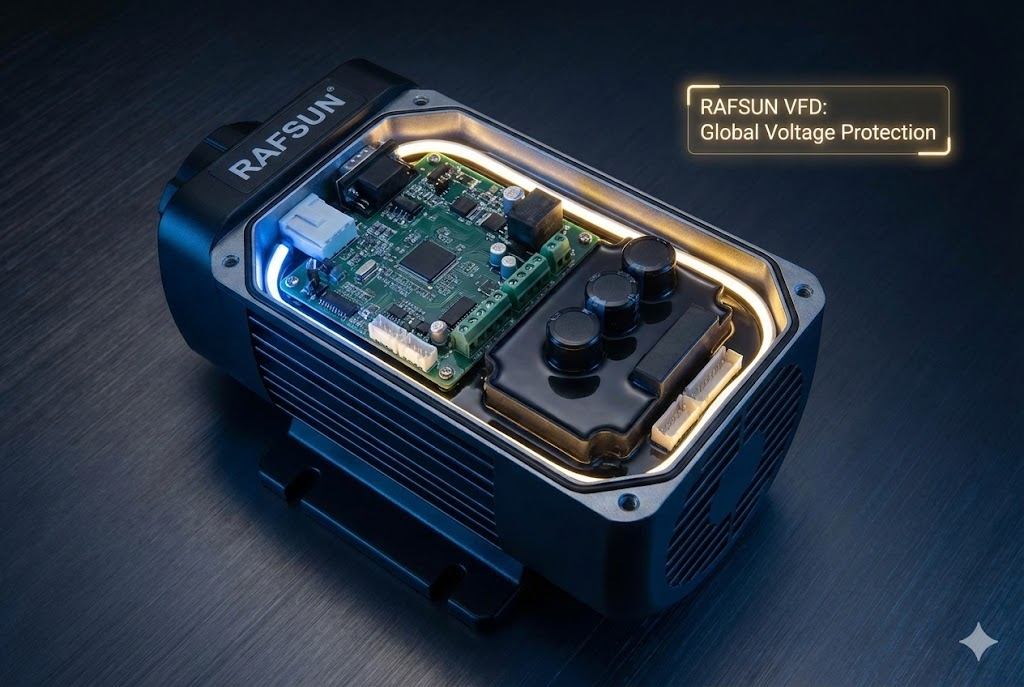
The VFD and electronics in the RAFSUN are designed for global voltage instability (90-260V) with fully potted, protected circuit boards. In contrast, the SCALA2 and MINI³ offer region-specific voltage models with less robust PCB protection, making them more vulnerable in harsh electrical environments.
The Variable Frequency Drive (VFD) and its associated electronics are the heart and brain of a modern booster pump.
This technology is what allows the pump to be smart, efficient, and quiet.
However, the durability of these electronic systems varies dramatically between models.
The robustness of the electronics directly impacts the pump's reliability and lifespan, especially in areas with unpredictable power.
VFD Platform and Voltage Handling
A pump's ability to handle a wide range of voltages is what separates a truly global product from a regional one.
The RAFSUN platform is unique in its universal approach.
It offers a single DV model that automatically recognizes and adapts to any voltage from 90V to 260V.
This eliminates the need for distributors to stock multiple versions and ensures the pump works anywhere.
The SCALA2 and MINI³ require you to purchase a specific voltage version for your region (e.g., a 115V model for North America or a 230V model for Europe).
This makes them less flexible and susceptible to damage if used on the wrong grid or during severe voltage fluctuations.
Advanced PCB and Component Protection
The Printed Circuit Board (PCB) is the pump's command center.
Protecting it from moisture, dust, and vibration is critical for long-term reliability.
The RAFSUN pump uses a method called "fully potted" electronics.
The entire PCB is encased in a solid block of protective resin (UltraShield), making it virtually immune to environmental factors.
This is a military-grade protection standard.
The SCALA2 and MINI³ use a standard surface coating on their PCBs.
While this offers some protection, it leaves the components far more exposed to humidity and potential corrosion over time, increasing the risk of failure.
The Unseen Advantage: A Redundant Sensor System
A pump needs sensors to know what's happening.
All three pumps use a pressure sensor to maintain the set pressure.
However, the RAFSUN adds a critical second sensor: a temperature sensor.
| Sensor | RAFSUN | SCALA2 | MINI³ |
|---|---|---|---|
| Pressure Sensor | ✔ | ✔ | ✔ |
| Temperature Sensor | ✔ (critical safety) | ✘ | ✘ |
| Protection Level | Dual redundancy | Single | Single |
Why is a temperature sensor so important?
It protects the pump from two common and deadly scenarios: running dry and hot water backflow.
If the pump runs without water or if hot water accidentally flows back into it from a faulty water heater, the internal temperature will skyrocket, leading to catastrophic failure.
The RAFSUN's temperature sensor will detect this and shut the pump down safely.
The SCALA2 and MINI³ lack this protection, creating a significant reliability gap.
Power and Flow: Real-World Hydraulic Performance
Does your pump struggle to deliver strong pressure to the top floor?
A pump that looks good on paper might not have the real-world power you need for your home.
You need to look at maximum head and flow rate.
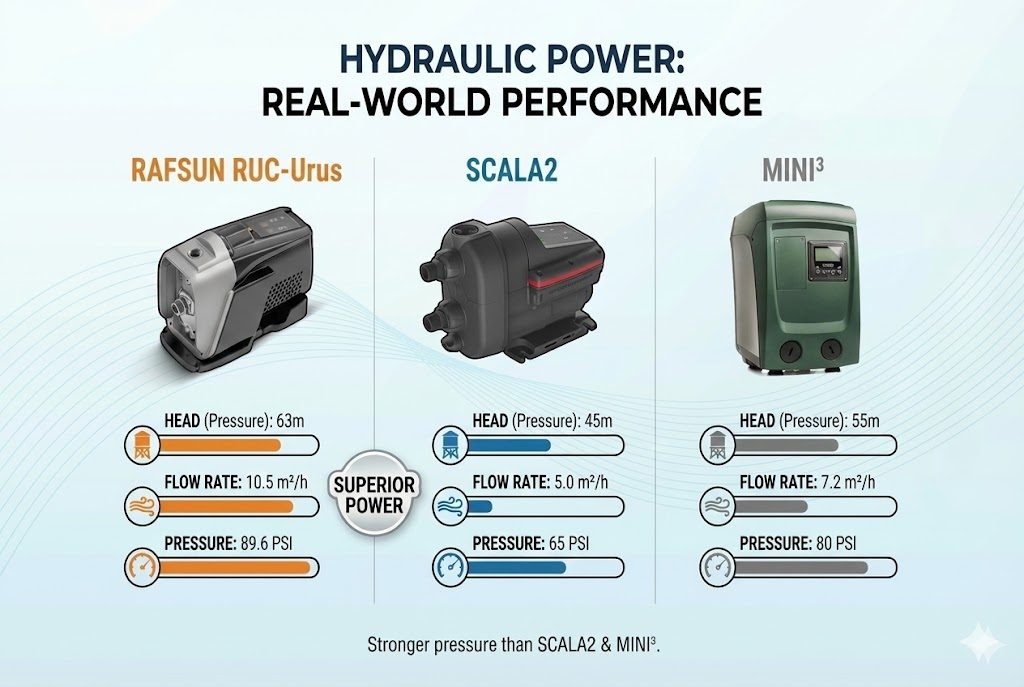
The RAFSUN RUC-Urus series delivers the highest hydraulic performance with a maximum head of up to 63 meters (207 ft) and a maximum flow of up to 10.5 m³/h(46.2 GPM). This outperforms both the SCALA2 and MINI³ in raw power, ensuring strong pressure even in tall buildings.
Hydraulic performance is the true measure of a pump's muscle.
It's defined by two key metrics: head and flow.
"Head" is the maximum vertical height the pump can push water, which translates to pressure.
"Flow" is the volume of water the pump can move in a given amount of time.
A pump with superior head and flow can serve more taps simultaneously and reach higher floors with strong, consistent pressure.
These are not just numbers; they directly impact your daily experience.
Maximum Head (Pressure)
Maximum head is arguably the most important specification for a booster pump, as it determines the maximum pressure the system can generate.
Higher head is essential for multi-story homes, buildings with long pipe runs, or applications requiring high-pressure outlets.
Let's compare the raw pressure capabilities.
| Brand | Head (m) | Head (ft) | Pressure (PSI) |
|---|---|---|---|
| RAFSUN | 63 m | 207 ft | 89.6 PSI |
| SCALA2 | 45 m | 148 ft | 65 PSI |
| MINI³ | 55 m | 180 ft | 80 PSI |
As the data shows, the RAFSUN Urus series offers a significantly higher maximum head.
This capability ensures it can overcome the pressure loss from tall buildings and complex plumbing, delivering robust pressure where other pumps might falter.
The MINI³ also provides a strong head, making it suitable for many premium residential applications, while the SCALA2 is more aligned with standard two-to-three-story homes.
Maximum Flow Rate
Flow rate determines how many fixtures can be used at once without a noticeable drop in performance.
A high flow rate means you can run a shower, a dishwasher, and a washing machine simultaneously without any of them sputtering.
This is crucial for busy households and light commercial use.
| Brand | m³/h | L/min | GPM | GPH |
|---|---|---|---|---|
| RAFSUN | 10.5 m³/h | 175 L/min | 46.2 GPM | 2772 GPH |
| SCALA2 | 5.0 m³/h | 83 L/min | 21.9 gpm | 1310 GPH |
| MINI³ | 7.2 m³/h | 120 L/min | 31.7 gpm | 1903 GPH |
Again, the RAFSUN demonstrates superior capacity, moving a significantly higher volume of water.
This high flow rate makes it the most suitable option for larger homes with multiple bathrooms or for light commercial applications like small hotels or office buildings.
Suction Lift Capability
Suction lift is the ability of a pump to draw water up from a source below it, like an underground tank or well.
All three pumps are rated for an excellent suction lift of 8 meters (26 feet).
However, there's a crucial real-world difference.
Under low voltage conditions, which are common in many parts of the world, pumps with less advanced electronics can struggle to maintain suction power.
The RAFSUN's robust, wide-voltage VFD ensures that it can maintain consistent suction performance even when the grid voltage drops, a critical advantage for reliability in challenging environments.
Price vs. Value: Which Pump Offers the Best ROI?
Are you wondering if a high-end pump is worth the money?
The initial purchase price is only part of the story.
A cheaper pump that fails early or a pricey one that's over-engineered can both be a waste of money.
You need to look at the total cost of ownership.
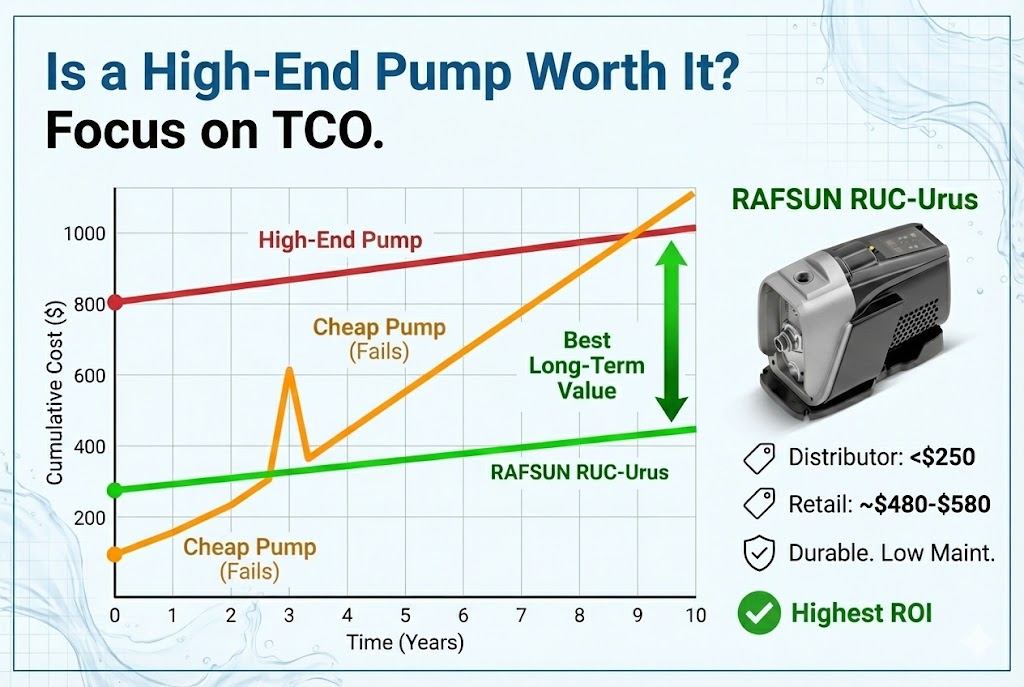
The RAFSUN RUC-Urus offers the highest Return on Investment (ROI) with a distributor price under $250 and a retail price around $480-$580. This aggressive pricing, combined with its durability and low maintenance, provides significantly better long-term value than the more expensive SCALA2 and MINI³.
For both distributors and end-users, the financial equation is critical.
A successful product must not only perform well but also make financial sense.
This involves analyzing the initial cost, potential profit margins for distributors, and the total cost of ownership for the customer, which includes purchase price, energy savings, and maintenance costs.
A lower price tag doesn't always mean better value if it comes with higher failure rates or lower efficiency.
Price and Margin Comparison
The price structure of these three pumps reveals their different market strategies.
RAFSUN has adopted an aggressive pricing model to capture global market share, offering a high-performance product at a price point that is dramatically lower than its European competitors.
This creates an exceptional opportunity for distributors.
| Brand | Distributor Price | Retail Price | Potential ROI for Distributor |
|---|---|---|---|
| RAFSUN | < $250 | $480–580 | Highest (100%+) |
| SCALA2 | $420–640 | $940–1070 | Medium |
| MINI³ | $580–780 | $1295 | Low |
The data is clear.
Distributors can achieve over a 100% return on investment with RAFSUN, a margin that is unheard of with the established premium brands.
This pricing strategy makes it a highly attractive product for businesses looking to grow their market share in the booster pump category.
Total Cost of Ownership for the End User
For the homeowner or business owner, the calculation extends beyond the initial retail price.
Total Cost of Ownership (TCO) is a more accurate measure of a pump's long-term value.
TCO = Initial Price + Energy Costs - Energy Savings + Maintenance/Repair Costs
Let's break down how RAFSUN minimizes TCO:
- Lower Initial Price: It starts with a retail price that is nearly half that of its main competitors.
- Highest Energy Savings: With savings of 30-60%, it reduces operating costs more effectively than the others.
- Lower Maintenance Costs: Features like the durable potted PCB, dual-sensor protection, and a large, serviceable pressure tank are specifically designed to minimize failures and the need for service calls.
In contrast, the higher initial prices of the SCALA2 and MINI³, combined with their vulnerability to voltage issues and lack of temperature protection, can lead to a much higher total cost of ownership over the product's lifespan, especially if a costly replacement is needed.
The RAFSUN RUC-Urus is engineered not just to be a better pump, but to be a better investment.
Conclusion
The RAFSUN RUC-Urus is the most advanced, universal, and valuable booster pump for 2025, outperforming its rivals in global adaptability, durability, safety, and commercial ROI for any market.
FAQs
What is the main purpose of a booster pump?
A booster pump increases low water pressure and flow. It provides the extra boost needed to move water from a storage tank or to upper floors of a building.
How do I know if I need a booster pump?
If you experience weak showers, slow-filling toilets, or poor appliance performance, you likely have low water pressure. A simple pressure gauge can confirm if your pressure is below the ideal 40-60 PSI.
Can a booster pump be used for a well?
Yes, but typically as part of a larger system. A submersible well pump brings water to a surface storage tank, and a booster pump then pressurizes the water for household use.
Are VFD booster pumps noisy?
Modern VFD booster pumps are exceptionally quiet. Top models from RAFSUN, DAB, and Grundfos operate around 45 dB, which is comparable to the sound level in a quiet library.
How much electricity does a booster pump use?
Energy use varies, but VFD pumps are very efficient. They only run as fast as needed, potentially cutting electricity consumption by 20-60% compared to traditional, fixed-speed pumps.
What maintenance does a booster pump require?
Most modern pumps are low-maintenance. Key tasks include checking for leaks and, for models like the RAFSUN, periodically checking and refilling the air pressure in the external tank to ensure optimal performance.
How long does a booster pump last?
A well-maintained, high-quality booster pump can last for 8 to 15 years. Longevity depends on build quality, electronic protection, and the number of start-stop cycles the motor endures.
Can I install a booster pump myself?
While some DIY-savvy homeowners can install one, it is generally recommended to have a professional plumber do it. This ensures proper setup, safety, and compliance with local plumbing codes.