Worried about your well running dry?
A pump failure from dry running means costly downtime and repairs, jeopardizing your entire water supply system.
A pump can be damaged by running dry in as little as 30 seconds to a few minutes.
The specific time depends on the pump type, materials, and built-in protections.
Water is essential for lubrication and cooling, and its absence causes rapid overheating and catastrophic failure.
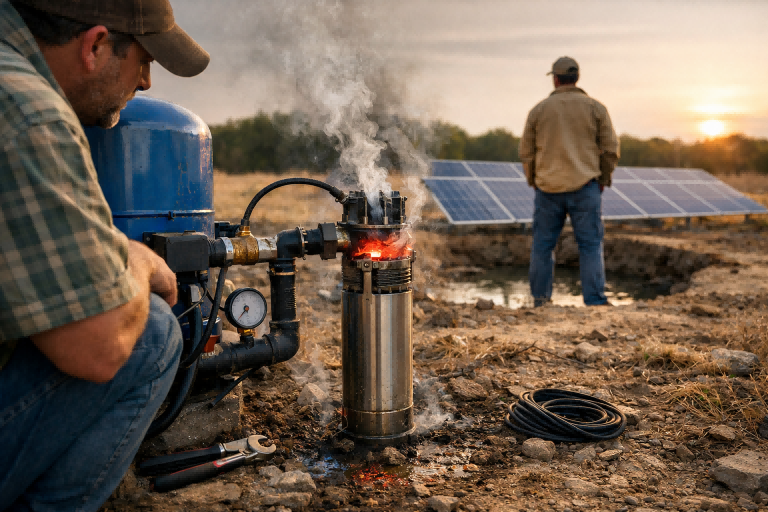
Understanding why dry running is so destructive is the first step toward preventing it.
Different pumps react differently to a lack of water.
Knowing these differences can save you a fortune.
Let’s explore the mechanics of pump damage and see how modern technology offers a powerful defense.
Understanding Dry Run Damage in Screw Pumps
Struggling with a deep well but worried about inconsistent water levels?
Screw pumps excel at high-head applications but are extremely vulnerable to dry running, which can destroy them instantly.
A solar screw pump can suffer irreversible damage in under 60 seconds of dry running.
The pump’s rubber stator requires constant water lubrication for cooling.
Without it, friction from the rotating stainless steel screw generates intense heat, melting the stator and causing immediate seizure.
A solar screw pump, also known as a progressive cavity pump, is a marvel of engineering for low-flow, high-head applications.
It operates by using a helical stainless steel rotor that turns inside a flexible rubber stator.
This action creates sealed cavities of water that "progress" through the pump, pushing the water up from extreme depths.
This design is highly effective for domestic water supply and livestock watering in regions with deep water tables.
It boasts excellent resistance to sand and can operate efficiently in challenging water conditions.
However, this design has a critical vulnerability: its reliance on water as a lubricant.
The Mechanism of Failure
The primary point of failure during a dry run is the interface between the rotor and the stator.
When water is present, it forms a thin lubricating film that also dissipates the significant heat generated by friction.
When the water disappears, this cooling and lubricating effect vanishes instantly.
The metal rotor spinning at high speed against the dry rubber stator creates friction levels that can increase the temperature by over 150°C (302°F) in seconds.
This intense heat causes the stator’s rubber to melt, deform, and even burn.
The pump seizes, the motor overloads, and the system experiences a catastrophic failure.
Protection Strategies for Screw Pumps
Given their extreme sensitivity, screw pumps absolutely require robust dry-run protection.
This is not an optional feature; it is essential for the pump’s survival.
Modern intelligent pump controllers are the first line of defense.
They use sophisticated algorithms to monitor the motor’s load.
A motor pumping water has a consistent and predictable electrical load.
When the pump runs dry, the load drops significantly and erratically.
The controller can detect this change within 2-3 seconds and immediately shut down the motor, preventing damage to the stator.
In addition to electronic monitoring, physical sensors offer another layer of protection.
- Low-Level Well Probes: These sensors are placed inside the well at a safe minimum water level. If the water drops below the probes, the circuit is broken, and the controller stops the pump.
- Flow Switches: Installed in the outlet pipe, a flow switch detects the actual movement of water. If flow stops for a predetermined period, it signals the controller to halt operation.
The table below summarizes the protection methods.
| Protection Method | How It Works | Response Time | Effectiveness |
|---|---|---|---|
| Intelligent Controller | Monitors motor load for anomalies | 2-5 seconds | Very High (99%) |
| Well Probes | Detects physical water level | Near-instant | High (95%) |
| Flow Switch | Confirms water is moving | 10-30 seconds | Moderate (85%) |
For distributors, emphasizing these integrated protection systems is a key selling point.
It transforms a potentially fragile product into a reliable, long-term water solution.
How Plastic Impeller Pumps Handle Dry Conditions
Need high water volume for irrigation but face fluctuating water sources?
Plastic impeller pumps deliver high flow but can overheat and warp if left running dry for too long.
A multi-stage plastic impeller pump may tolerate dry running for 2 to 5 minutes before damage occurs.
The plastic impellers and diffusers rely on water flow for cooling.
Without water, friction and motor heat can cause these components to melt, deform, or crack, leading to a total loss of pressure.
Solar plastic impeller pumps are a type of multi-stage centrifugal pump.
They are the workhorses of farm irrigation, pasture water supply, and larger domestic applications.
Their design uses a series of stacked impellers and diffusers made from durable, engineered plastics like Noryl.
Each stage incrementally boosts the water pressure, allowing the pump to achieve medium head while delivering a high flow rate.
These pumps are popular because they are lightweight, economical, and offer excellent resistance to fine sand.
While more resilient to dry running than screw pumps, they are far from immune.
The danger comes from heat buildup.
The Physics of Overheating
Unlike a screw pump where failure is from direct friction, a centrifugal pump’s failure is from ambient overheating.
The motor itself generates a substantial amount of heat during operation, typically around 70-90°C (158-194°F).
Flowing water constantly circulates around the motor and through the pump stack, effectively carrying this heat away and keeping the system within its safe operating temperature range.
When the pump runs dry, this cooling mechanism is lost.
The heat from the motor begins to soak into the pump’s wet end.
Simultaneously, the impellers spinning at high RPMs (often 3,000+ RPM) in the air generate their own frictional heat.
This combined thermal load rapidly raises the temperature of the plastic components beyond their melting point.
Stages of Plastic Impeller Damage
The damage from a dry run occurs progressively.
- Stage 1: Deformation (2-3 minutes): The close tolerances between the impellers and diffusers begin to shrink as the plastic softens. The pump’s efficiency and pressure drop noticeably.
- Stage 2: Melting (3-5 minutes): The impellers and diffusers start to physically melt and fuse together. The pump may seize at this point, causing the motor to stall and trip its thermal overload protection.
- Stage 3: Catastrophic Failure (5+ minutes): Severe melting leads to complete destruction of the pump’s internal components. The pump will no longer build any pressure, and a full replacement of the wet end is required.
These pumps also benefit immensely from intelligent controllers that monitor for under-load conditions.
A controller can shut the system down during Stage 1, preventing permanent damage.
Many systems also incorporate a timed restart feature.
After a dry-run fault, the controller will wait for a set period (e.g., 30 minutes) before attempting to restart, allowing time for the well to potentially recover.
This automated process ensures water is available as soon as possible without requiring manual intervention.
The Durability of Stainless Steel Impeller Pumps
Do you operate in corrosive water environments or demand the highest reliability?
Stainless steel pumps offer superior durability, but even their robust construction can’t withstand dry running indefinitely.
A stainless steel impeller pump provides the best resistance, potentially surviving 5 to 10 minutes of dry running.
While the SS304 impellers won’t melt, extreme heat can damage shaft seals, gaskets, and motor bearings, leading to leaks and eventual mechanical failure.
The premium choice in the solar deep well pump market is the stainless steel impeller model.
This pump utilizes an SS304 stainless steel impeller, diffuser, and pump body.
It is specifically engineered for longevity in harsh conditions, such as acidic or alkaline water.
These pumps are ideal for high-end homes, critical livestock operations, and regions with aggressive water chemistry.
Their inherent corrosion resistance translates to a longer service life and higher reliability, with an operational lifespan often exceeding other types by 30-50%.
The robust metal construction gives this pump type a significant advantage when it comes to surviving dry run events.
Why Stainless Steel Lasts Longer
The primary advantage is the material’s high melting point.
Stainless steel can withstand temperatures far greater than those generated during a dry run, so the impellers and diffusers will not melt or deform.
This prevents the immediate, catastrophic failure seen in plastic models.
However, the pump is not invincible.
The heat generated by the motor and spinning impellers still needs to go somewhere.
This heat travels to the most vulnerable components of the system.
Points of Failure in Stainless Steel Pumps
Even with metal impellers, other parts can fail due to excessive heat.
- Mechanical Shaft Seals: These seals prevent water from entering the motor. They are often made of carbon, ceramic, and rubber components that can crack or degrade when overheated, causing leaks that will destroy the motor over time.
- O-rings and Gaskets: Rubber gaskets used to seal the pump stages can become brittle and fail after being exposed to extreme heat, leading to internal pressure loss.
- Motor Bearings: The motor’s bearings are packed with grease for lubrication. Excessive heat conducted up the shaft can liquefy this grease, causing it to run out. This results in premature bearing failure and a noisy, inefficient motor.
The table below shows a comparison of heat tolerance for key pump components.
| Component | Plastic Impeller Pump | Stainless Steel Impeller Pump | Critical Temperature |
|---|---|---|---|
| Impellers | Noryl Plastic | SS304 Stainless Steel | ~150°C (302°F) |
| Mechanical Seal | Carbon/Ceramic/NBR | Carbon/Ceramic/Viton | ~120°C (248°F) |
| Motor Bearings | Steel (Grease Lubricated) | Steel (Grease Lubricated) | ~110°C (230°F) |
| Stator | (N/A) | (N/A) | N/A |
As the table shows, even in a stainless steel pump, the non-metallic components remain the weak link.
Therefore, dry-run protection through intelligent controllers and sensors is still highly recommended to maximize the pump’s lifespan and protect the investment.
The Brains of the Operation: BLDC Motors and Smart Controllers
Want to maximize efficiency and protect your pump investment?
The core of a modern solar water system is not just the pump, but the high-efficiency motor and its intelligent controller.
The combination of a BLDC motor and an MPPT controller with dry-run protection is the ultimate defense.
The controller’s ability to detect under-load conditions and shut down the pump within seconds prevents damage across all pump types, turning a potential disaster into a minor, recoverable event.
The real competitive advantage in today’s solar pump market lies beyond the pump head itself.
It is found in the synergy between the driving motor and the control system.
All three pump types—screw, plastic impeller, and stainless steel impeller—are powered by the same core technology: a Brushless DC (BLDC) permanent magnet motor.
This motor is the heart of the system, delivering unmatched performance.
The Power of the BLDC Motor
BLDC motors represent a significant leap forward in pump technology.
Their efficiencies regularly exceed 90%, compared to the 60-75% efficiency of traditional AC motors.
This high efficiency is crucial in solar applications.
It means the pump can do more work with less power.
This directly reduces the number of solar panels required for a given task by up to 25%, lowering the initial system cost and simplifying installation.
These motors use powerful 40SH neodymium iron boron permanent magnets in their rotors.
This design provides high torque and strong power in a compact package.
A typical BLDC motor for a solar pump can be up to 47% smaller and 39% lighter than a comparable AC motor, making it easier to transport and install.
Their brushless nature also means there are no brushes to wear out, resulting in a maintenance-free design with a very long service life.
The Intelligence of the Controller
The BLDC motor is controlled by an intelligent MPPT (Maximum Power Point Tracking) controller.
This controller serves two critical functions.
-
Energy Optimization: The MPPT algorithm constantly adjusts the electrical load on the solar panels. It finds the perfect balance of voltage and current to extract the maximum amount of power available at any given moment of sunlight. This can boost the daily water output by as much as 30% compared to a system without MPPT.
-
System Protection: The controller is the system’s guardian. It provides comprehensive protection against a range of issues:
- Dry-Run Protection: As discussed, it monitors motor load to detect a lack of water and shuts the pump down.
- Over-Voltage/Under-Voltage Protection: Shields the motor from damaging fluctuations from the solar array.
- Over-Current/Overload Protection: Protects the motor if the pump becomes jammed or stalled.
- Phase Loss Protection: Ensures the motor runs smoothly and efficiently.
Furthermore, advanced controllers offer AC/DC hybrid functionality.
They can accept power from both solar panels and an AC source like the grid or a generator.
The controller prioritizes solar power, blending in AC power only when needed on cloudy days or for nighttime operation.
This ensures a reliable, 24/7 water supply.
This intelligent ecosystem of a high-efficiency motor and a protective controller is what defines a modern, competitive solar water pump solution.
Conclusion
Preventing dry run damage depends on the pump type and its control system.
Modern intelligent controllers offer the best protection, safeguarding your investment and ensuring a reliable water supply.
Frequently Asked Questions
What happens if a pump runs without water?
Running without water causes rapid overheating due to friction.
This can melt plastic components, destroy seals, and burn out the motor in minutes.
How do I know if my pump is running dry?
Signs include a sudden drop in water pressure, sputtering from the faucet, and unusual noises from the pump.
A smart controller will also report a dry run fault.
Can a pump recover from running dry?
Minor dry running may not cause permanent damage if stopped quickly.
However, prolonged events often require component replacement or a full pump replacement.
What is the best dry run protection for a well pump?
The best protection is an intelligent pump controller that monitors motor load.
Combining this with low-level well probes offers a redundant and highly reliable solution.
How long should you run a well pump after it runs dry?
You should not run it at all.
Turn it off immediately.
Allow the well to recover for at least 30-60 minutes before attempting to restart the pump.
Will a pump shut off automatically if it runs dry?
Only pumps equipped with dry-run protection features, such as modern smart controllers or external sensors, will shut off automatically.
Older, simpler systems will not.
Can I add dry run protection to my existing pump?
Yes, aftermarket dry-run protection devices are available.
These include controllers that monitor motor current and flow switches that can be installed in the plumbing.
How much does it cost to replace a burnt-out pump?
Replacement costs vary widely based on the pump type, size, and labor rates.
It can range from a few hundred to several thousand dollars, making prevention highly cost-effective.