Your submersible pump has failed again, causing costly downtime.
You’re frustrated with repeated repairs and replacements, which hurt your bottom line and your reputation.
Understanding the root cause is key.
The most common problems with submersible pumps include motor failure due to overheating, clogging from sand or debris, and accelerated wear caused by corrosive water.
Choosing a pump designed for your specific water conditions is the most effective way to prevent these issues.
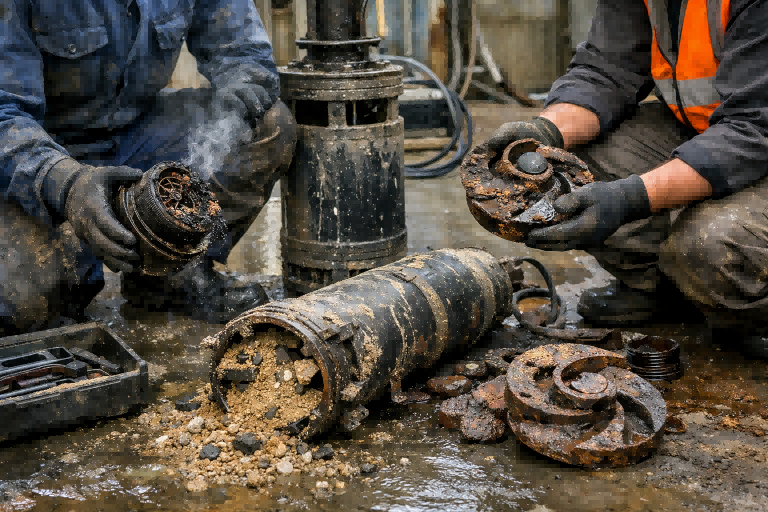
Most submersible pump failures are not random.
They are the predictable result of a mismatch between the pump’s design and its operating environment.
A standard pump placed in a sandy well is destined to fail.
Similarly, a pump made from basic materials will quickly degrade in corrosive water.
These issues are compounded by inefficient motors that waste energy and are prone to overheating, leading to a complete system breakdown.
The good news is that these common problems have engineered solutions.
By diagnosing the specific challenges of your water source—whether it’s depth, debris, or water chemistry—you can select a pump system built to thrive in those exact conditions.
This proactive approach moves you from a cycle of reactive repairs to a strategy of long-term reliability.
Let’s examine these common problems one by one and explore the specific pump technologies designed to solve them.
Problem 1: Pumping from Extreme Depths and Sandy Wells
Your well is very deep, and the water is full of sand.
Standard centrifugal pumps struggle to lift water from such depths and their impellers are quickly destroyed by abrasive particles.
For deep wells with sandy water, the most reliable solution is a solar screw pump.
Its unique design creates very high pressure (head) and is inherently resistant to the wear and clogging caused by sand.
Extreme well depth presents a significant engineering challenge.
It requires a pump that can generate immense pressure, known as "head," to push the water column all the way to the surface.
Many conventional submersible pumps, particularly centrifugal types, lose efficiency dramatically as the head requirement increases.
They simply lack the mechanical force to overcome the immense weight of the water.
This problem is severely worsened by the presence of sand and silt.
Abrasive particles act like sandpaper on the fast-spinning impellers of a centrifugal pump.
This constant wear erodes the impellers, reducing their tight tolerances and causing a rapid decline in performance.
Eventually, the pump can no longer build sufficient pressure, or the particles cause the impellers to jam completely, leading to motor burnout.
The Screw Pump Solution
The solar screw pump, also known as a progressing cavity pump, is specifically designed to overcome both of these challenges simultaneously.
Instead of using impellers, it employs a single helical rotor made of stainless steel that turns inside a flexible rubber stator.
-
High Head Generation: As the rotor turns, it forms a series of sealed cavities that "progress" from the pump’s inlet to its outlet. This mechanism acts like a piston, positively displacing the water and pushing it upwards with tremendous force. This allows screw pumps to achieve exceptionally high head, making them perfect for wells exceeding 100 meters deep.
-
Inherent Sand Resistance: The rubber stator provides a flexible seal around the steel rotor. When sand particles enter the pump, the stator can deform slightly to let them pass through the cavities without causing significant abrasion or jamming. This makes the screw pump far more durable in harsh water conditions than any impeller-based pump.
-
Consistent Flow: Unlike centrifugal pumps whose flow rate drops sharply with increasing depth, the flow from a screw pump remains relatively constant, ensuring a reliable water supply.
| Pump Characteristic | Centrifugal Impeller Pump | Solar Screw Pump |
|---|---|---|
| Primary Mechanism | High-speed spinning impellers | Slow-speed rotating screw |
| Best For | High flow, moderate depth | High head, extreme depth |
| Sand Handling | Poor (leads to rapid wear/jamming) | Excellent (flexible stator allows particles to pass) |
| Typical Application | Farm irrigation from shallow wells | Domestic water from deep boreholes |
While its flow rate is generally lower than that of impeller pumps, the screw pump’s ability to reliably deliver water from deep, sandy sources makes it the ideal choice for domestic and livestock water supply in regions like electricity-scarce Africa and Latin America.
Problem 2: High Water Demand with Abrasive Particles
You need to move a lot of water for irrigation, but fine sand in your well wears out standard pumps.
You need a solution that balances high flow, durability, and cost-effectiveness.
A multi-stage centrifugal pump with wear-resistant plastic impellers offers the best solution.
It delivers very high flow rates and is engineered to withstand fine sand, providing an economical and lightweight workhorse for agricultural use.
Many agricultural and livestock operations do not require extreme head.
Instead, their primary problem is sourcing a high volume of water reliably and affordably.
The main challenge in these applications is often the presence of fine sand and sediment, which can still cause significant wear on pump components over time.
While a screw pump is excellent for deep, sandy wells, its lower flow rate makes it unsuitable for large-scale irrigation.
Conversely, using a heavy-duty stainless steel pump might be overkill and too costly for this type of application.
The goal is to find a pump that can sustain high output day after day without quickly succumbing to abrasive wear, all while keeping initial and operational costs low.
This is a common scenario for farms and ranches across the Americas and Africa.
The Plastic Impeller Solution
The solar plastic impeller pump is a multi-stage centrifugal pump engineered to hit this perfect balance of performance, durability, and value.
It uses a series of impellers stacked on top of each other.
Each impeller and diffuser combination is a "stage" that adds more pressure to the water, allowing the pump to achieve a useful head while prioritizing high flow.
-
High Flow by Design: The centrifugal design is inherently suited for moving large volumes of water. The shape and speed of the impellers are optimized to discharge a high flow rate, perfect for irrigating fields or watering large herds of livestock.
-
Advanced Wear Resistance: The term "plastic" can be misleading. These are not ordinary plastics but advanced, abrasion-resistant polymers. These materials are specifically chosen for their toughness and ability to withstand the erosive effects of fine sand far better than softer metals, leading to a longer service life.
-
Lightweight and Economical: Using polymer components makes the pump significantly lighter than an all-metal equivalent. This simplifies transportation and installation, reducing labor costs. Furthermore, the manufacturing process for these components is more cost-effective, making the pump more affordable for a wider range of users.
Application Sweet Spot
This pump type is not intended for the harshest conditions.
It is less suited for the extreme abrasion of coarse sand (where a screw pump excels) or highly corrosive water (where stainless steel is needed).
However, for the vast majority of agricultural applications requiring high water volume from wells with fine sediment, the plastic impeller pump offers an unbeatable combination of performance and economic value, making it a market leader.
Problem 3: Aggressive and Corrosive Water Conditions
Your water is acidic, alkaline, or has high salinity.
This corrosive water eats away at standard pumps, causing leaks, contamination, and complete failure in a short time.
For corrosive water, the only long-term solution is a pump built from premium materials.
A solar pump with stainless steel impellers and a full SS304 body provides maximum corrosion resistance and the longest possible service life.
Water is not always pure.
In many regions, groundwater contains dissolved minerals and chemicals that make it chemically aggressive.
This "corrosive" water can be acidic (low pH) or alkaline (high pH), or it can have a high concentration of dissolved salts, as found in coastal areas or regions with alkaline soil like parts of Australia.
When a standard pump made from cast iron or lower-grade materials is placed in this environment, a chemical reaction called corrosion begins immediately.
The metal components literally dissolve into the water.
This process weakens the pump structure, causes impellers to disintegrate, and can lead to leaks that allow motor oil to contaminate the water supply.
The pump’s performance degrades rapidly, and catastrophic failure is inevitable, often within a year or two.
This creates a costly cycle of frequent replacement.
The Stainless Steel Solution
The solar stainless steel impeller pump is engineered specifically to solve the problem of corrosion.
The key is the material choice: SS304 stainless steel.
-
Superior Corrosion Resistance: SS304 is a high-grade stainless steel alloy containing significant amounts of chromium and nickel. This composition allows it to form a passive, non-reactive layer on its surface when exposed to water. This layer acts as a shield, preventing the underlying steel from reacting with the corrosive elements in the water.
-
Exceptional Durability and Lifespan: By preventing corrosion, the pump’s structural integrity is maintained for many years. The impellers, pump body, and shaft retain their original shape and strength, ensuring consistent performance and preventing premature failure. This results in a much longer service life, often exceeding other pump types by a factor of 3 to 5 in aggressive water.
-
High Reliability for Critical Applications: Because it is so resistant to chemical attack, the stainless steel pump offers the highest level of reliability. This makes it the preferred choice for high-end homes, premium ranches, and commercial operations where water supply failure is not an option.
While the initial purchase price is higher due to the cost of the materials, the total cost of ownership is often lower.
This is because it eliminates the expense and labor of replacing cheaper pumps every few years.
For anyone dealing with difficult water chemistry, investing in stainless steel is the most logical and cost-effective long-term decision.
Problem 4: Inefficient Motors and High Energy Costs
A major hidden problem is the pump motor itself.
Traditional AC motors or older DC motors are inefficient, wasting a significant amount of precious energy and requiring oversized, expensive solar systems.
Modern solar pumps solve this with a high-efficiency Brushless DC (BLDC) motor.
With over 90% efficiency, this motor pumps more water per watt, reducing solar panel requirements and lowering overall system costs.
The pump end—whether it’s a screw, plastic impeller, or stainless steel—is only half of the system.
The motor that drives it is the other half, and it is often the source of significant hidden problems and costs.
A pump system is only as efficient as its weakest link, and in many older systems, that weak link is the motor.
A motor with low efficiency acts like a leak in your power system.
For example, a motor with 70% efficiency wastes 30% of all the energy it receives as useless heat.
When using solar power, this waste has a direct financial impact.
To compensate for a 30% energy loss, you must build a 30% larger solar array.
This means buying more panels, more mounting hardware, and more wiring, significantly increasing the initial investment.
Furthermore, inefficient motors running on a limited power source like solar will result in lower water output and poor performance, especially in low-light conditions.
The BLDC Motor Solution
The core of every modern, high-quality solar pump is a Brushless DC (BLDC) permanent magnet motor.
This technology directly addresses the problem of inefficiency.
-
Efficiency Exceeding 90%: BLDC motors are fundamentally more efficient than their AC or brushed DC counterparts. The use of powerful permanent magnets (like 40SH neodymium iron boron) in the rotor and the elimination of friction-causing brushes allow them to convert over 90% of the electrical energy they receive into mechanical work. This dramatic efficiency gain means a smaller, less expensive solar array can power the same pump.
-
Maintenance-Free and Long Life: The absence of brushes, which are the primary wear component in older motors, means BLDC motors are virtually maintenance-free. There is no brush dust to contaminate bearings and no parts to replace, leading to a much longer and more reliable operational life.
-
Compact Power: The high power density of a BLDC motor means it can be significantly smaller and lighter than an AC motor of equivalent power—up to 47% smaller and 39% lighter. This makes the pump easier to handle and install, saving time and money on site.
By adopting BLDC motor technology as the universal driver for all pump types, the system’s overall competitiveness is decided.
It ensures that regardless of whether the application calls for a screw, plastic, or stainless steel pump end, the entire system will operate at peak efficiency.
This reduces the capital cost for end-users and establishes a brand reputation for "efficiency, durability, and environmental friendliness."
Conclusion
Common submersible pump problems stem from a mismatch with the environment.
Solving these issues requires selecting the right pump—screw for depth, plastic for flow, or stainless for corrosion—powered by an efficient BLDC motor.
Frequently Asked Questions
What causes a submersible pump to stop working?
The most common causes are a seized motor from overheating, clogged impellers from sand or debris, or electrical issues in the power supply or controller.
How do I know if my submersible pump motor is bad?
Signs of a bad motor include the pump tripping the circuit breaker, humming without pumping water, or failing to start at all despite having power.
Can a submersible pump get clogged?
Yes, submersible pumps frequently get clogged by sand, silt, weeds, or other debris in the water, which can stop the impellers from spinning.
Why does my submersible pump keep running?
If a pump runs continuously, it likely means the pressure switch is faulty, there is a significant leak in your plumbing, or the pump is worn out and can’t reach the shut-off pressure.
How do you protect a submersible pump from sand?
To protect a pump, use a sand-resistant model like a screw pump, install a sand shroud around the pump, or set the pump higher off the bottom of the well.
How often should a submersible pump be serviced?
A quality solar submersible pump with a brushless motor is nearly maintenance-free. However, it’s good practice to check system performance and wiring annually.
Does a submersible pump need a check valve?
Yes, a check valve is essential. It is installed in the pipe above the pump to prevent water from flowing back down the well, which protects the pump from damage.