Need reliable water in a remote location?
Grid power is expensive or unavailable, leaving your well useless.
Solar power offers a cost-effective, independent solution for your water needs.
Yes, not only can a submersible pump run on solar power, but a dedicated category of pumps is engineered specifically for it.
These systems use high-efficiency DC motors and intelligent controllers to provide reliable off-grid water for agriculture, livestock, and homes.
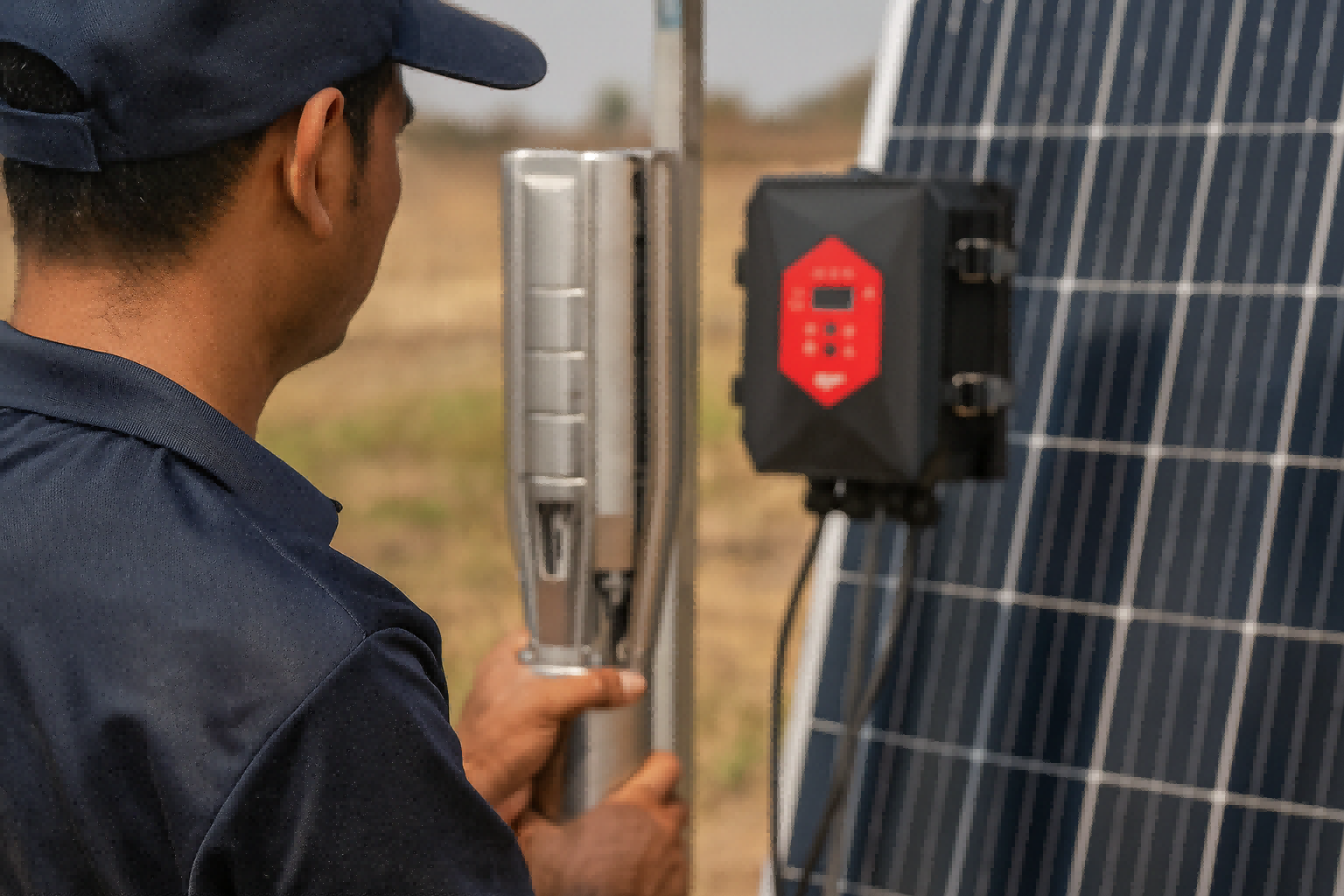
Running a pump on solar is more than just connecting it to a panel.
While it is technically possible to use inverters to run a standard AC pump, that approach is notoriously inefficient and expensive.
A truly effective solar pumping system is designed from the ground up to maximize every watt of energy produced by the sun.
The game-changer wasn't just the solar panel; it was the development of a pump and motor built to thrive on DC power.
This integration of pump mechanics with advanced motor technology unlocks the potential for sustainable water solutions anywhere the sun shines.
Understanding how these components work together is key to selecting a system that delivers water reliably and cost-effectively for years to come.
Let's dive into the core technologies that make solar pumping not just possible, but powerful.
What Makes a Submersible Pump Solar-Ready?
Using a standard AC pump with solar is complex and inefficient.
You need bulky inverters and lose significant power in the conversion process.
The solution is a pump designed for DC solar power.
A true solar-ready submersible pump uses a high-efficiency Brushless DC (BLDC) motor.
This motor directly uses DC power from solar panels, maximizing water output and minimizing energy waste by over 20% compared to AC systems.
The heart of any modern solar water pumping system is its motor.
This is where the magic of efficiency happens.
A standard AC submersible pump is designed to run on the steady, high-voltage power from the electrical grid.
Solar panels, however, produce variable DC power that changes with the intensity of the sun.
Forcing these two different systems to work together requires a power inverter to change DC to AC, and this conversion process wastes a substantial amount of energy as heat.
It's like trying to fit a square peg in a round hole; it works, but it's clumsy and inefficient.
A solar-ready pump eliminates this problem entirely by using a motor that is purpose-built to run on the native DC power from solar panels.
The Efficiency of Brushless DC (BLDC) Motors
The key innovation is the Brushless DC (BLDC) permanent magnet motor.
Unlike older motor types, BLDC motors do not have brushes, which are components that create friction and wear out over time.
Instead, they use powerful permanent magnets and an intelligent electronic controller to turn the rotor.
This design offers several massive advantages for solar applications.
-
Extreme Energy Efficiency: BLDC motors convert over 90% of the electrical energy they receive into mechanical force. In contrast, a typical AC motor system with an inverter might only achieve 65-70% efficiency. This 20-25% efficiency gain means you can pump significantly more water with the same number of solar panels, or use a smaller, less expensive solar array to achieve the same water output.
-
Maintenance-Free Operation: The absence of brushes means there are no parts to wear down and replace. This is a critical advantage for pumps installed in remote or hard-to-access wells, eliminating a common point of failure and a recurring maintenance cost.
-
Compact and Powerful Design: Thanks to the use of high-strength permanent magnets like 40SH neodymium iron boron, BLDC motors are much more powerful for their size. They can be up to 47% smaller and 39% lighter than an AC motor with the same power output. This makes installation easier and less costly.
| Motor Technology | Typical System Efficiency | Maintenance Needs | Power Type Compatibility |
|---|---|---|---|
| BLDC Solar Pump | > 90% | None (Brushless) | Native DC (Solar) |
| AC Pump with Inverter | 65% - 70% | Brushes may require service | AC (Requires DC-AC Conversion) |
| Brushed DC Pump | 75% - 80% | Requires brush replacement | Native DC (Solar) |
The BLDC motor is the core reason why modern solar submersible pumps are so effective.
It serves as the high-efficiency universal drive, ensuring the entire system, from the panels to the pump outlet, operates with minimal energy waste.
How Do Solar Pumps Handle Deep and Sandy Wells?
Your water is hundreds of feet deep and full of sand.
A standard centrifugal pump lacks the power to lift it and will be quickly destroyed by the abrasive particles.
For deep or sandy wells, a solar screw pump is the ideal solution.
Its progressing cavity design generates extremely high pressure (head) and is inherently resistant to wear from sand, ensuring reliable water flow from harsh environments.
The ability to simply run on solar power is not enough.
The pump itself must be mechanically suited to the specific challenges of the well.
Two of the most common and destructive challenges are extreme depth and the presence of sand or silt.
Extreme depth requires a pump that can generate enough pressure, known as "head," to overcome the immense weight of the water column.
Many pumps that produce high flow rates at shallow depths see their performance plummet as the well gets deeper.
Sand is even more problematic.
It acts as a powerful abrasive, grinding away at the internal components of a pump.
In a traditional centrifugal pump, sand quickly erodes the fast-spinning impellers, causing a rapid loss of pressure and eventual pump failure.
The common solution is a specialized pump mechanism designed to master both of these challenges at once.
The Power of the Progressing Cavity Design
A solar screw pump, also called a progressing cavity pump, does not use impellers.
Instead, it relies on a single helical rotor made from stainless steel that turns inside a durable rubber stator.
-
Unmatched High-Head Performance: As the steel rotor turns, it forms a series of sealed cavities within the rubber stator. These cavities "progress" from the pump's inlet to its outlet, positively displacing the water. This mechanism functions like an Archimedes' screw, pushing the water upwards with immense force and allowing the pump to achieve very high head, making it perfect for wells deeper than 100 meters.
-
Superior Sand and Silt Resistance: The flexible rubber stator is the key to the pump's durability. When abrasive particles like sand enter the pump, the stator can deform slightly to allow the particles to pass through the cavities without causing significant damage to either the rotor or the stator. This makes the screw pump far more resilient in sandy conditions than any impeller-based alternative.
-
Consistent Flow Rate: The positive displacement action of the screw pump ensures a steady and consistent flow of water, even as the solar power input fluctuates slightly throughout the day. It provides a reliable supply for domestic water, livestock troughs, and small-scale drip irrigation systems.
While a screw pump offers a lower flow rate compared to centrifugal pumps, its specialized ability to deliver that flow reliably from the most challenging wells makes it an essential tool for off-grid water access in regions like Africa and Latin America.
Can Solar Pumps Provide Enough Water for a Farm?
You need high volumes of water for irrigation, but your well has fine sand.
A standard pump either won't deliver enough water or will wear out far too quickly.
Yes, solar pumps can deliver high flow rates for farms.
A solar-powered multi-stage pump with durable plastic impellers is designed to provide high water output while resisting abrasion from fine sand, making it perfect for irrigation.
The water requirements for agriculture are vastly different from those for a single home.
Farm and ranch operations depend on high flow rates to irrigate crops and provide water for large herds of livestock.
For these users, the question isn't just "can it run on solar?" but "can it deliver the volume I need, day after day?".
In these applications, the well may not be extremely deep, but the demand for a high volume of water is constant.
This is where multi-stage centrifugal pumps excel.
However, even in wells that are not considered "sandy," the presence of fine sediment can still cause significant cumulative wear on pump components over time.
The challenge is to find a solar-powered solution that can sustain high output without being quickly degraded by these fine abrasives, all while remaining economically viable for the agricultural market.
High Flow Through Multi-Stage Engineering
A solar plastic impeller pump is a multi-stage centrifugal pump specifically engineered to meet these demands.
It consists of a series of impellers and diffusers stacked vertically.
Each set is a "stage," and each stage adds pressure to the water, collectively achieving a useful head while prioritizing a high flow rate.
-
Designed for High Volume: The centrifugal design is inherently superior for moving large quantities of water. The impeller shape is optimized to discharge a high volume, making it the ideal choice for applications like field irrigation, pasture water supply, and filling large storage tanks.
-
Advanced Wear-Resistant Materials: The impellers are not made from ordinary plastic. They are crafted from advanced, abrasion-resistant engineering polymers. These materials are chosen for their toughness and their ability to withstand the erosive effect of fine sand much more effectively than many metal alternatives, leading to a longer, more reliable service life.
-
Lightweight and Economical: Using polymer components makes the pump significantly lighter than an all-metal pump of the same size. This simplifies transportation and installation, which is a major benefit for agricultural settings. Furthermore, these advanced materials are more cost-effective to manufacture, resulting in a lower initial purchase price for the end-user.
This pump is the workhorse of the solar pumping world.
It is perfectly suited for the demands of farms and ranches across the Americas and Africa, providing an unbeatable combination of high performance, durability, and value for money.
What If a Solar Pump Fails on a Cloudy Day?
You need water 24/7, but solar pumps only work when the sun shines.
This reliance on sunlight makes sole solar power impractical for critical applications that require a constant water supply.
Modern solar pumps solve this with hybrid AC/DC controllers.
These intelligent controllers automatically switch to grid or generator power at night or on cloudy days, ensuring an uninterrupted 24-hour water supply without any manual intervention.
The most significant limitation of a purely solar-powered system is its dependence on the sun.
While many applications can work around this by pumping to a storage tank during the day, some users require water on demand, 24 hours a day, regardless of the weather.
Critical domestic water supplies, certain irrigation schedules, and industrial processes cannot afford downtime caused by a cloudy day or the setting of the sun.
This has historically been a major barrier to the adoption of solar pumping for mission-critical tasks.
The traditional solution was to install a completely separate, grid-powered backup pump, which is an expensive and complex approach.
A far more elegant and efficient solution is now available: a single pump system that can intelligently draw power from multiple sources.
The Power of Hybrid AC/DC Technology
The ultimate solution for 24/7 water reliability is a solar pump equipped with a hybrid AC/DC controller.
This advanced controller is the brain of the system, designed with inputs for both DC power from solar panels and AC power from the grid or a generator.
-
Automatic Power Switching: The controller constantly monitors the power coming from the solar panels. When sunlight is sufficient, it powers the pump using 100% free solar energy. As clouds pass over or as evening approaches, the solar input decreases. When it falls below a functional level, the controller seamlessly and automatically switches over to the AC power source to keep the pump running. The process is completely automatic.
-
Prioritizing Solar Energy: A key feature of hybrid controllers is that they are programmed to always prioritize solar power. If both solar and AC power are available, the controller will use the solar power first. Some advanced controllers can even blend power, using all available solar power and supplementing it with just enough AC power to meet the demand, maximizing the use of free energy.
-
Uninterrupted Water Supply: The primary benefit for the user is complete peace of mind. Water is available 24 hours a day, 7 days a week, exactly like a conventional grid-powered pump. However, the system ensures that this is achieved at the lowest possible energy cost by maximizing the use of solar power whenever it is available.
This hybrid technology transforms a solar pump from a daytime-only device into a full-time, ultra-efficient water solution.
It removes the final barrier for users who need absolute reliability, making solar a viable and intelligent choice for nearly any pumping application.
Conclusion
Yes, a submersible pump can run on solar power.
Modern systems use efficient BLDC motors, specialized pump ends, and hybrid controllers to provide reliable, cost-effective water anywhere, anytime.
Frequently Asked Questions
Can you run a 240v pump on solar?
Yes, by using a solar inverter to convert the DC power from the panels to 240v AC. However, a native DC solar pump is far more efficient.
How many solar panels are needed to run a submersible pump?
This depends on the pump's power rating and your location. A small 0.5 HP pump may need 3-4 panels, while larger pumps need a bigger array.
How deep can a solar water pump work?
Specialized solar screw pumps are designed for high head and can effectively pump water from depths exceeding 200 meters (over 650 feet).
Do solar pumps work on cloudy days?
Solar pumps produce less water on cloudy days. Systems with hybrid AC/DC controllers or battery storage can provide water regardless of the weather.
How long does a solar submersible pump last?
A quality solar pump with a brushless motor can last for 10-15 years or more, as there are no brushes to wear out, requiring minimal maintenance.
Do I need a battery for my solar water pump?
Batteries are not usually necessary. Most systems pump water to a storage tank during the day, which provides water pressure and supply on demand.
What is an MPPT controller in a solar pump?
An MPPT (Maximum Power Point Tracking) controller is an electronic device that optimizes the match between the solar panels and the pump motor, increasing water output by up to 30%.