You need a reliable water supply.
A submersible pump seems like the best solution.
But you worry about what happens when it fails deep inside your well, facing costly repairs.
The primary disadvantages of a submersible water pump are difficult maintenance, a higher initial cost, and vulnerability to poor water quality like sand or corrosive minerals.
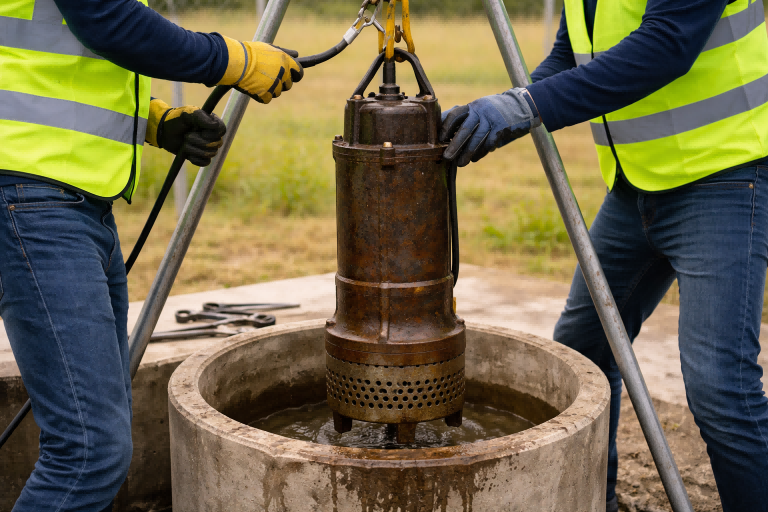
Repairing them often requires pulling the entire unit from the well, which can be a complex and expensive process.
These challenges have been the reality of submersible pumps for decades.
Many potential users, especially in remote locations, have been hesitant to adopt them because of these well-known drawbacks.
A pump failure can mean no water for days and an unexpected, significant expense.
However, modern pump technology does not just accept these disadvantages; it actively addresses them.
Advances in motor design, materials science, and intelligent control systems have created a new generation of submersible pumps.
These pumps are engineered specifically to mitigate or even eliminate these traditional weak points.
Let's examine each disadvantage in detail and discover how today's solutions turn these old problems into manageable considerations.
Disadvantage 1: Difficult and Costly Maintenance
Your pump stops working.
It is hundreds of feet underground.
The immediate thought is the nightmare of pulling it up for repair, a major job that means no water and a huge bill.
Maintenance is difficult because the pump is at the bottom of the well.
Access requires special equipment to lift the pump, pipe, and cable, making even minor repairs a complex, time-consuming, and expensive professional task.
The single biggest fear for any submersible pump owner is the day it needs to be serviced.
Unlike a surface pump where all components are easily accessible, the submersible pump's location is its greatest weakness from a maintenance perspective.
The process involves a service truck with a hoist or derrick.
The crew has to disconnect the power and plumbing at the wellhead.
Then, they begin the slow process of lifting the entire assembly—the heavy pump, connected to hundreds of feet of water-filled pipe and a power cable.
This entire procedure is labor-intensive and expensive.
The cost is not just in the repair itself, but in the labor and equipment required to simply get the pump to the surface and then reinstall it.
This inherent difficulty is why the reliability and longevity of the pump's internal components are not just features; they are the most critical factors in its total cost of ownership.
For an importer like Andrew, selling a pump that is less likely to need this service is a massive competitive advantage.
The Old Problem: Motors Designed to Fail
Historically, many DC pump motors used a brushed design.
These motors rely on carbon brushes to make physical contact with a commutator to transfer electricity to the spinning rotor.
By their very nature, these brushes are "wear parts."
They are designed to wear down over time from friction.
This means that after a certain number of operating hours, the motor is guaranteed to fail.
A brushed motor's lifespan is finite and predictable, forcing an inevitable and costly pump replacement.
This planned obsolescence is completely unacceptable for a device installed deep in a well.
The Modern Solution: Eliminating Wearable Parts
The most significant advancement in pump reliability is the widespread adoption of the Brushless DC (BLDC) permanent magnet motor.
This design completely eliminates the need for brushes.
Instead, an intelligent electronic controller creates a rotating magnetic field in the stator windings.
This field interacts with powerful permanent magnets on the rotor, causing it to spin without any physical contact.
- No Brushes, No Wear: By removing the single most common failure point, the motor's operational lifespan is dramatically extended. It's not uncommon for a BLDC motor to last for over a decade without any service.
- Higher Efficiency, Less Heat: These motors convert over 90% of electricity into rotational force, compared to 60-70% for older designs. This high efficiency means less energy is wasted as heat, which is a primary enemy of motor longevity. A cooler-running motor is a longer-lasting motor.
- Preventative Protection: Modern pumps are paired with an intelligent controller. This "brain" constantly monitors the pump's operation. If it senses a problem that could cause damage, like the well running dry or the pump getting jammed, it immediately shuts the motor down. This proactive protection prevents catastrophic failure, saving the owner from a costly repair job.
By focusing on a maintenance-free motor design and intelligent protection, the modern submersible pump turns the disadvantage of difficult access into a non-issue for the vast majority of its service life.
Disadvantage 2: Vulnerability to Water Quality
Your well water is sandy or has a strange taste.
You worry a new pump will quickly grind to a halt or corrode from the inside out.
This means you'd be paying for another expensive replacement in just a few years.
Standard submersible pumps can be quickly damaged by abrasive sand or corrosive water.
Sand wears down impellers, reducing performance, while aggressive minerals can eat away at the pump body and motor housing, leading to premature failure.
A pump is only as good as the environment it operates in.
Water is often assumed to be pure H2O, but groundwater is frequently filled with other substances that can be incredibly destructive to mechanical equipment.
The specific "disadvantage" of a submersible pump is that you cannot see the damage happening.
The destruction occurs slowly, deep underground, until the pump's performance degrades or it fails completely.
The first sign of a problem is often a reduced water flow or a complete stoppage, by which point the damage is already done.
This is why "one size fits all" is a dangerous approach to selling submersible pumps.
A pump that works perfectly in the clean water of one region could be destroyed in months by the sandy or acidic water of another.
A professional product portfolio must include different pump designs to counter these specific threats.
Providing a customized solution based on a customer's water quality is key to ensuring a long and reliable service life.
Matching the Pump to the Problem
Instead of viewing water quality as a single disadvantage, it is better to see it as a series of specific challenges, each with a specific engineering solution.
-
The Challenge: Abrasive Sand and Sediment
Sand and grit act like liquid sandpaper inside a pump. In a centrifugal pump, these particles rapidly wear down the precise, curved surfaces of the impellers. As the impellers erode, their ability to create pressure and move water diminishes, leading to a steady decline in performance. -
The Solutions for Sand:
- The Screw Pump: For wells with significant sand content, a progressing cavity pump (or screw pump) is the superior choice. Instead of impellers, it uses a hardened stainless steel screw rotating inside a rubber stator. This design can move sandy water without the rapid wear and tear seen in centrifugal models. It is highly sand-resistant.
- The Wear-Resistant Impeller Pump: For water with fine sand, a centrifugal pump with impellers made from high-quality, engineered plastic is an excellent, economical choice. These materials are surprisingly durable and can handle fine abrasives better than some lower-grade metals.
-
The Challenge: Corrosive Water
Water that is acidic (low pH) or alkaline (high pH) can be highly corrosive. It chemically attacks and eats away at the metal components of the pump and motor, particularly cast iron or standard steel. This corrosion weakens the pump structure and can eventually lead to leaks and total failure. -
The Solution for Corrosion:
- The Stainless Steel Pump: For aggressive water conditions, there is no substitute for a pump constructed from SS304 stainless steel. This material is used for the pump body, inlet, outlet, and, most importantly, the impellers. It offers exceptional resistance to a wide range of chemical corrosion, ensuring a very long service life even in the harshest water environments found in parts of Australia or the Americas.
| Water Quality Issue | Standard Pump Problem | Recommended Solution | Why It Works |
|---|---|---|---|
| High Sand Content | Rapid impeller wear, loss of pressure | Screw Pump (Progressing Cavity) | Design doesn't rely on tight tolerances that sand destroys. |
| Fine Sand/Silt | Gradual impeller erosion, reduced flow | Plastic Impeller Pump | Engineered plastic is economical and highly resistant to fine abrasives. |
| Corrosive/Salty Water | Corrosion of pump body and parts | Stainless Steel Impeller Pump | SS304 grade stainless steel is highly resistant to chemical attack. |
By correctly identifying the water quality challenge, this "disadvantage" is effectively neutralized by selecting the right tool for the job.
Disadvantage 3: Power Source Dependency and Cost
Your property is off-grid.
Running power lines would cost a fortune.
Using a generator means constant noise, refueling, maintenance, and high fuel costs, making it a poor long-term solution.
A submersible pump is useless without a reliable power source.
In remote areas, extending the power grid is often economically impossible, and relying on generators is expensive, inconvenient, and environmentally unfriendly.
The fundamental need for power is a submersible pump's most basic requirement.
For decades, this has tethered them to the electrical grid.
This dependency creates a massive barrier for agriculture, livestock, or residential use in the vast majority of the world's land area that does not have ready access to grid power.
The traditional alternative, a diesel or gasoline generator, solves the problem of access but introduces a host of new disadvantages.
Generators are loud, produce exhaust fumes, and require a constant supply of expensive fuel.
They also need regular maintenance like oil changes and filter replacements.
This turns the simple act of getting water into a daily chore involving high operational costs and logistical headaches.
This power dependency has historically been a deal-breaker for off-grid water projects.
However, the solar revolution has completely changed this dynamic, turning what was once the biggest disadvantage into a major opportunity.
The Solar and Hybrid Solution
The rise of high-efficiency solar pumps has transformed the power problem.
These systems are not just pumps connected to solar panels; they are integrated solutions designed from the ground up for off-grid reliability.
- Zero Operational Cost: A solar-powered pump runs on free energy from the sun. Once the initial investment is made, the operational cost is zero. There is no fuel to buy and no monthly electricity bill. A system can pay for itself in fuel and maintenance savings in as little as one to two years compared to a generator.
- Ultimate Reliability: A solar pump system has no moving parts except for the pump motor itself. With a high-quality BLDC motor and MPPT controller, the system can run for years with no maintenance other than occasionally cleaning the solar panels. It is far more reliable than a generator.
- The AC/DC Hybrid Advantage: The most advanced systems eliminate power dependency entirely by offering AC/DC hybrid capability. The controller is designed to accept two power inputs simultaneously—DC from the solar panels and AC from the grid or a generator. The system's intelligence automatically prioritizes solar power.
- During the day, it runs on 100% free solar energy.
- If clouds appear, it can blend solar and AC power to maintain steady flow.
- At night or during long periods of bad weather, it automatically switches to the AC source to ensure water is available 24/7.
This hybrid approach offers the best of all worlds: the free, clean energy of solar combined with the 24-hour assurance of a backup power source, all managed automatically.
It completely solves the power dependency problem, making a reliable water supply possible anywhere.
Conclusion
Modern submersible pumps turn disadvantages into advantages.
Maintenance, water quality, and power issues are effectively solved by brushless motors, specialized materials, and intelligent solar hybrid controllers.
Frequently Asked Questions
What happens if a submersible pump gets clogged?
An intelligent controller will detect the increased load and shut the pump off to prevent motor burnout, allowing the issue to be addressed without damaging the equipment.
Can running a submersible pump dry damage it?
Yes, running dry is a major cause of failure. However, modern solar controllers have dry-run protection that automatically stops the pump when the water level gets too low.
How do you protect a submersible pump from sand?
The best protection is to choose the right type of pump, such as a progressing cavity (screw) pump, which is specifically designed to handle abrasive materials.
What is the life expectancy of a submersible water pump?
A standard pump might last 5-7 years, but a modern brushless DC pump with a stainless steel body can last for 10-15 years or more due to fewer wear parts.
Is it expensive to replace a submersible pump?
The pump itself has a cost, but the main expense is often the labor to pull the old pump and install the new one, which can be significant.
Can a submersible pump freeze in the winter?
The pump itself, deep in the well, will not freeze. However, the water pipe leading from the well to the surface can freeze if not buried below the frost line.
How do I know if my submersible pump is bad?
Signs of a failing pump include low water pressure, the pump cycling on and off frequently, dirty water, or a sudden and significant increase in your electricity bill.