Worried about your well pump driving up your electricity bill?
You assume that powerful equipment must be expensive to run.
Modern submersible pumps are surprisingly energy-efficient, especially with new motor technology.
No, a modern submersible pump does not use a lot of electricity.
Thanks to high-efficiency brushless DC (BLDC) motors, they can be over 90% efficient, using significantly less power than older models. When paired with solar, they can even eliminate your electricity costs for water pumping entirely.
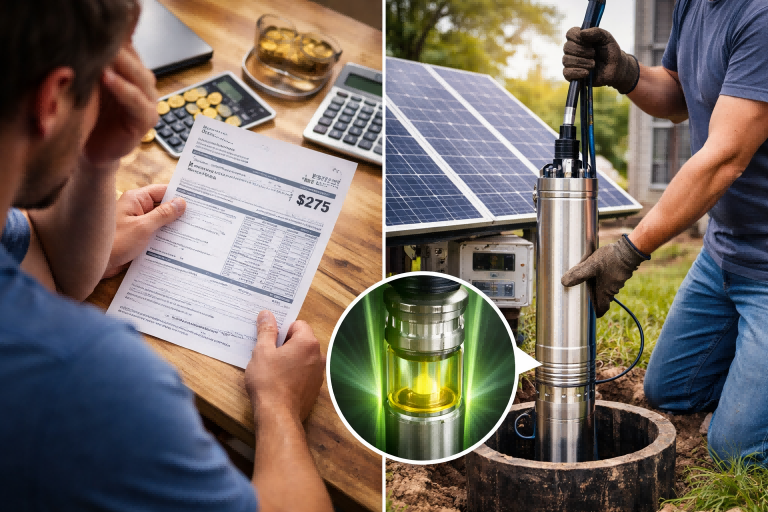
The question of a submersible pump’s electricity usage is a common and valid concern for homeowners and distributors alike.
For decades, the answer would have been a qualified "yes."
Older pumps relied on standard AC induction motors, which were a reliable but notoriously inefficient technology.
A large portion of the power they drew from the grid was lost as wasted heat, not converted into useful water flow.
This led to the widespread belief that running a well pump is a significant contributor to a high electricity bill.
However, the pump industry has undergone a quiet revolution.
The technology inside a modern submersible pump is vastly different and dramatically more efficient.
It is like comparing an old incandescent light bulb to a new LED.
Both produce light, but one does so using a fraction of the energy.
Understanding this technological shift is key to realizing the massive cost-saving potential that current-generation submersible pumps offer.
The Myth of the Power-Hungry Pump: Old vs. New Technology
High electricity bills make you question your well pump’s consumption.
You fear that providing water to your property is an unavoidable expense.
Modern pumps use advanced motors to cut energy use by up to 50%.
The idea that submersible pumps are power-hungry comes from outdated AC motor technology with 50-70% efficiency.
New pumps use BLDC motors that are over 90% efficient, drastically reducing electricity consumption and making the old reputation obsolete.
The reputation for high energy consumption is not entirely baseless; it is just outdated.
For a long time, the standard for submersible pumps was the AC (Alternating Current) induction motor.
While robust, these motors have inherent inefficiencies.
A typical AC motor might convert only 60% of the electrical energy it consumes into mechanical work.
The remaining 40% is lost, primarily as heat dissipated into the surrounding water.
This meant you were paying for 100% of the electricity, but only getting 60% of the work.
When you scale this inefficiency over months and years of daily operation, the financial cost adds up significantly.
This is the pump technology that created the "power-hungry" myth.
Modern pumps have left this legacy far behind by adopting a vastly superior motor design.
The Inefficiency of Traditional AC Motors
To understand the improvement, we first need to look at why old pumps were inefficient.
AC induction motors work by creating a rotating magnetic field in the stationary part (the stator), which "induces" a current and an opposing magnetic field in the rotating part (the rotor).
The push and pull between these magnetic fields is what creates the turning force.
This process has several sources of energy loss:
- Resistance Loss: Current flowing through the copper windings of both the stator and rotor generates heat.
- Iron Loss: The constant magnetization and demagnetization of the motor’s iron core creates energy loss (hysteresis loss).
- Mechanical Loss: Friction from bearings contributes to energy waste.
- Slip: The rotor in an AC induction motor must rotate slightly slower than the magnetic field to create torque. This "slip" is a fundamental source of inefficiency.
For a homeowner, these accumulated losses meant a 1-horsepower pump might draw over 1,000 watts from the wall but only deliver about 600 watts of actual pumping power.
The Modern Efficiency Standard
Today’s high-quality submersible pumps have moved away from this technology.
They utilize Brushless DC (BLDC) permanent magnet motors, which operate on an entirely different principle.
These motors have powerful rare-earth magnets built directly into the rotor, creating a permanent magnetic field.
An electronic controller then precisely energizes the stator windings to create a magnetic field that interacts with these permanent magnets, causing rotation.
This design eliminates the need to induce a current in the rotor, which immediately gets rid of a major source of energy loss.
The result is a motor that can achieve efficiencies of over 90%.
That same 1-horsepower pump with a BLDC motor might only need to draw 820 watts to deliver 746 watts (1 HP) of pumping power.
This represents a nearly 40% reduction in wasted energy compared to a typical old AC pump.
The Heart of Efficiency: Why the BLDC Motor Changes Everything
You want to offer customers cost-effective products.
High running costs make older pump models a hard sell.
Pumps with BLDC motors offer unmatched efficiency, providing a powerful competitive advantage for your business.
The BLDC permanent magnet motor is the key to a submersible pump’s low electricity use.
It converts over 90% of electricity into power, is 47% smaller, and 39% lighter than old motors, directly translating to lower energy bills and reduced installation costs.
If you take away only one piece of information, let it be this: the motor is the single most important factor in a pump’s energy consumption.
The shift from AC induction motors to Brushless DC (BLDC) permanent magnet motors is the primary reason why the answer to "Does a submersible pump use a lot of electricity?" has changed from "yes" to "no."
This isn’t just a minor improvement; it’s a fundamental leap in technology that redefines the efficiency and performance of the entire water system.
A BLDC motor is engineered from the ground up to minimize the energy losses that plague older designs.
By embedding powerful permanent magnets (often made from high-grade 40SH neodymium iron boron) into the rotor, the motor no longer has to expend energy creating a magnetic field in the rotating part.
This core design advantage leads to a cascade of benefits that directly impact the end user’s wallet and the distributor’s product offering.
By the Numbers: The BLDC Advantage
The superiority of BLDC motors is not just theoretical; it’s quantifiable and dramatic.
Let’s look at the technical specifications and what they mean in practical terms.
- Efficiency (>90%): As mentioned, this is the headline feature. A BLDC motor wastes less than 10% of the energy it consumes. An old AC motor could waste 30-50%. For an average household, this efficiency improvement can translate into hundreds of dollars in electricity savings over the life of the pump.
- Compact Design (47% Smaller): Because they are more efficient, BLDC motors generate less waste heat. This means they require less mass for heat dissipation and can be built much more compactly. A smaller motor is easier to handle and install, reducing labor time and costs.
- Lightweight Construction (39% Lighter): The compact design and use of modern materials make BLDC motors significantly lighter. This is a major benefit during transportation and, more importantly, during well installation, where a heavy pump can be difficult and dangerous to lower.
- High Torque: Permanent magnet motors deliver strong torque instantly, even from a standstill. This allows the pump to start smoothly and reliably against the full pressure of the water column in the pipe, reducing mechanical stress and improving longevity.
Strategic Value for Distributors and End Users
For a distributor like Andrew in Australia, these features are powerful selling points.
When you can show a customer a pump that will actively lower their monthly bills, it transforms the conversation from a simple price comparison to a long-term value proposition.
The lower power draw also means that if the pump is part of a solar water system, a smaller and less expensive solar panel array is required.
Offering a complete system with 4 solar panels instead of 6 to achieve the same water output makes your package far more competitive.
For the end user, the benefits are clear:
- Lower Operating Costs: Less electricity used means a lower monthly bill.
- Lower Initial System Cost (for Solar): The need for fewer solar panels reduces the upfront investment.
- Long, Maintenance-Free Life: The brushless design means no parts to wear out and replace, ensuring years of "set it and forget it" reliability.
| Feature | Traditional AC Motor | Modern BLDC Motor | Impact on User/Distributor |
|---|---|---|---|
| Efficiency | 50-70% | >90% | Lower electricity bills; smaller solar array needed. |
| Size | Large / Bulky | ~47% smaller | Easier, cheaper, and safer installation. |
| Weight | Heavy | ~39% lighter | Reduced shipping costs; easier handling. |
| Maintenance | Brushes may wear out | Maintenance-Free | Higher reliability; no service calls for brush replacement. |
| Power Factor | Lower (e.g., 0.8) | Higher (e.g., >0.99) | More efficient use of power from the grid or inverter. |
The Ultimate Solution: Eliminating Electricity Bills with Solar
You see growing demand for off-grid and green solutions.
Relying solely on grid power limits your market reach.
Offering solar pumps with hybrid AC/DC capability opens up new markets and meets modern customer demands.
Solar submersible pumps eliminate grid electricity costs entirely.
By pairing a high-efficiency BLDC motor with an intelligent MPPT controller and solar panels, the system runs for free on sunlight. Hybrid AC/DC options provide 24/7 reliability by automatically switching to grid power when needed.
While a high-efficiency BLDC motor dramatically reduces electricity consumption, an even more powerful solution exists: eliminating the electricity bill altogether.
This is where solar-powered submersible pumps become the ultimate answer to the energy question.
By harnessing the free and abundant power of the sun, these systems provide a sustainable, cost-effective, and reliable water supply, completely independent of the electrical grid.
This technology is no longer a niche or futuristic concept; it is a mainstream, competitive, and highly sought-after solution in markets across the globe, from rural Africa to ranches in the Americas and Australia.
The synergy between an ultra-efficient BLDC motor and modern solar technology creates a system that is more than the sum of its parts.
How Solar Pumping Achieves "Free" Water
A solar water pumping system consists of three core components:
- Solar Panels: These capture sunlight and convert it into DC electricity.
- An MPPT Controller: "MPPT" stands for Maximum Power Point Tracking. This intelligent electronic device is the brain of the system. It constantly optimizes the electrical load to extract the absolute maximum amount of power from the solar panels, regardless of changing sunlight conditions (e.g., passing clouds).
- The BLDC Submersible Pump: The high-efficiency motor is crucial. Because it requires so little energy to run, a smaller, more affordable solar array can power it effectively. Trying to run an old, inefficient AC pump on solar would require a prohibitively large and expensive number of panels.
During the day, the panels generate electricity, the MPPT controller perfects that power, and the BLDC motor efficiently pumps water.
This water can be used immediately or, more commonly, pumped into a storage tank.
Filling a large tank during the day provides a reserve of pressurized water that can be used at night or on cloudy days, creating a simple and effective energy storage system.
Overcoming the Solar Objection: 24/7 Water with Hybrid Controllers
The most common question about solar pumps is, "What happens when the sun isn’t shining?"
This is where advanced AC/DC hybrid controllers provide a definitive answer and a massive competitive advantage.
A hybrid system is designed with two power inputs: one for the DC electricity from the solar panels and another for AC power from the electrical grid or a backup generator.
The controller’s logic is designed for maximum efficiency and worry-free operation:
- Solar Priority: Whenever there is sufficient sunlight, the controller will exclusively use the free power from the solar panels.
- Hybrid Assist: If sunlight decreases (e.g., on a partly cloudy day), the controller can blend AC power with the available DC solar power to maintain pump operation, maximizing the use of free solar energy before drawing from the grid.
- Automatic Switchover: When there is no solar input at all (at night or during heavy storms), the controller automatically and seamlessly switches over to the AC power source.
This hybrid functionality guarantees a reliable, 24-hour water supply while still prioritizing the use of free solar energy whenever possible.
It offers the best of both worlds: the cost savings and environmental benefits of solar, combined with the absolute reliability of the grid.
Conclusion
Modern submersible pumps, powered by efficient BLDC motors and optional solar hybrid systems, use very little electricity, making them a cost-effective and reliable choice for any home.
Frequently Asked Questions
How many watts does a submersible pump use?
A typical 1/2 HP residential submersible pump with a modern BLDC motor uses about 300-500 watts, while older AC models can use significantly more to do the same work.
How much does it cost to run a well pump for 24 hours?
Running a 500-watt efficient pump for 24 hours would use 12 kWh.
At an average U.S. rate of $0.17/kWh, this would cost about $2.04 per day of continuous use.
Do well pumps use more electricity than refrigerators?
A well pump generally uses more power than a refrigerator when it is running, but it only runs intermittently.
A modern refrigerator, running efficiently, often uses less total energy per day.
Can a submersible pump be run on a generator?
Yes, a submersible pump can be run on a generator, especially with a hybrid AC/DC controller.
Ensure the generator’s running wattage is at least 1.5-2 times the pump’s wattage to handle the startup surge.
Is it cheaper to run a well pump at night?
It can be cheaper if your utility company offers "time-of-use" rates with lower prices during off-peak hours, which are typically overnight.
A hybrid solar system naturally avoids this by pumping during the day.
How can I make my well pump more efficient?
Ensure your pump is correctly sized for your well’s depth and your water needs.
Using a pressure tank also improves efficiency by reducing how often the pump needs to start and stop.