Is your pump failing to start?
You might think it is a complicated motor issue.
The problem could be a simple capacitor, but modern pumps do not even use them.
Yes, some submersible pumps can run without a capacitor.
Modern pumps using brushless DC (BLDC) or three-phase motors do not require capacitors because they are electronically controlled. However, traditional single-phase AC submersible pumps absolutely need a capacitor to start and run correctly.
The answer to this question depends entirely on the technology inside your pump.
It is a crucial distinction that separates older designs from modern, high-efficiency models.
For decades, the capacitor was an essential, non-negotiable part of most residential submersible pumps.
Its failure was one of the most common reasons for a service call.
Today, a technological shift has made capacitors obsolete in the most advanced pumping systems.
Understanding this difference is not just for troubleshooting; it is fundamental to choosing a reliable, efficient, and cost-effective water solution for the future.
This guide will explain which pumps need capacitors, why they need them, and how modern technology provides a superior, capacitor-free alternative.
Why Traditional AC Pumps Need a Capacitor
Your old AC pump hums but will not start.
You are worried about a costly motor replacement.
Often, the real culprit is a simple, inexpensive capacitor that has failed.
A capacitor in a single-phase AC pump creates a second, out-of-phase electrical current.
This generates a rotating magnetic field, which provides the necessary starting torque to spin the motor. Without it, the motor would just hum and overheat, unable to turn.
To understand why a capacitor is so vital in some pumps, you must first understand the motor they use.
Most older and many budget-friendly submersible pumps are powered by a single-phase AC induction motor.
This type of motor is popular for residential applications because most homes are supplied with single-phase alternating current (AC) power.
However, a single-phase power supply, by itself, cannot create the rotating magnetic field required to make a motor spin from a standstill.
It only creates a pulsing magnetic field that oscillates back and forth.
This is where the capacitor comes in.
It acts as a clever electrical trick, creating an "artificial" second phase of electricity.
This second phase is out-of-sync with the main phase, and the interaction between these two phases generates the twisting force, or torque, that kicks the motor into action.
The Physics of Starting a Motor
A single-phase AC motor has a primary set of windings (the "run" windings) connected directly to the power source.
When energized, these windings create a magnetic field that simply pulses in strength, changing direction 50 or 60 times per second (depending on your region's grid frequency).
This is not enough to get the rotor to start turning in a specific direction.
To solve this, a second set of windings, the "start" windings, are added.
The capacitor is placed in series with these start windings.
- Creating a Phase Shift: The capacitor causes the current flowing through the start windings to be out of phase with the current in the run windings. It essentially gives the electrical signal a "head start" or a "delay."
- Generating a Rotating Field: The result is two magnetic fields that peak at slightly different times. This time difference creates a magnetic field that appears to rotate around the motor's stator, pulling the rotor along with it and starting the pump.
Start vs. Run Capacitors
Depending on the pump's design, it may use one or two capacitors.
Understanding their roles is key to diagnosing problems.
| Capacitor Type | Primary Function | Characteristics | Common Failure Symptom |
|---|---|---|---|
| Start Capacitor | Provides high torque for a very short period (1-3 seconds) to get the motor spinning from a dead stop. | High capacitance value; designed for intermittent duty. Usually disconnected by a centrifugal switch once the motor reaches ~75% speed. | Motor hums loudly but will not start. May trip the circuit breaker. |
| Run Capacitor | Stays in the circuit to improve motor efficiency and power factor while it is running. Provides a smoother run. | Lower capacitance value; designed for continuous duty. Filled with oil for cooling. | Motor may start but runs loudly, overheats, has low power, or draws excessive current. |
The capacitor is a critical component, but it's also a frequent point of failure.
It is sensitive to heat, voltage fluctuations, and age.
When it fails, the pump stops working, even if the motor itself is perfectly fine.
The Capacitor-Free Revolution: BLDC Motor Technology
Are you frustrated with failing capacitors and inefficient pumps?
You feel stuck with old, unreliable technology that requires frequent fixes.
The future of pumping is capacitor-free, brushless, and incredibly efficient, delivering reliability you can count on.
Modern submersible pumps with Brushless DC (BLDC) motors do not need capacitors.
An intelligent electronic controller, not a mechanical capacitor, precisely manages the electrical signals to create flawless rotation. This offers superior efficiency (over 90%), unmatched reliability, and a longer service life.
The most significant advancement in submersible pump technology has been the move away from AC induction motors toward Brushless DC (BLDC) permanent magnet motors.
This shift fundamentally changes how the motor operates, making the capacitor entirely redundant.
A BLDC pump system does not need an external component to "trick" it into starting.
Instead, it uses sophisticated electronics to create a perfectly controlled, highly efficient rotational force from the start.
This technology is the core of all modern high-performance solar water pumps and is increasingly used in premium grid-tied applications as well.
The absence of a capacitor is not just a minor change; it is a symptom of a completely superior and more intelligent design.
How a BLDC Motor Works Without a Capacitor
Unlike an AC motor that needs to induce a magnetic field in its rotor, a BLDC motor has powerful permanent magnets (typically high-grade 40SH neodymium iron boron) built directly into the rotor.
This means the rotor has its own, permanent magnetic field.
The work is then done by the stator (the stationary part of the motor) and the electronic controller.
- Electronic Commutation: The controller acts as the brain. It uses sensors (or sensorless algorithms) to know the exact position of the rotor's magnets at all times.
- Precision Power Delivery: Based on the rotor's position, the controller sends precise DC electrical pulses to different sets of windings in the stator.
- Flawless Rotation: By energizing the stator windings in a perfect sequence, the controller creates a magnetic field that is always just ahead of the rotor's permanent magnets, pulling them along in a smooth, continuous, and highly efficient rotation.
This electronic process completely replaces the clumsy, mechanical, and failure-prone function of a start switch and capacitor.
The Inherent Advantages of a Capacitor-Free Design
Eliminating the capacitor by adopting BLDC technology brings a cascade of powerful benefits for distributors and end-users.
For a business owner like Andrew in Australia, these benefits are clear, marketable advantages that translate into a more competitive product line.
| Feature | AC Capacitor-Start Motor | BLDC Motor System | Market & User Benefit |
|---|---|---|---|
| Starting Mechanism | External Capacitor & Switch | Integrated Electronic Controller | Increased Reliability: Removes the #1 failure point (the capacitor). No moving start switches to wear out. |
| Efficiency | 50-70% | >90% | Lower Operating Costs: Uses significantly less electricity. Crucial for solar, as it requires up to 30% fewer panels. |
| Control | Fixed Speed | Full Variable Speed Control | Advanced Functionality: Allows for soft starts (reducing mechanical shock) and matching pump flow to demand, saving energy. |
| Size & Weight | Bulky and Heavy | ~47% Smaller, ~39% Lighter | Reduced Costs: Cheaper to ship, easier and safer to install, requiring less labor and equipment. |
| Maintenance | Capacitors can fail/degrade | Essentially Maintenance-Free | Peace of Mind: "Set it and forget it" operation for years, leading to higher customer satisfaction. |
The BLDC motor's capacitor-free design isn't just a feature; it's a paradigm shift that results in a pump that is more efficient, more reliable, smarter, and easier to handle.
Choosing the Right Pump for Your Needs
You need a reliable water source for your property.
You are unsure which pump technology is best for your application and budget.
Matching the pump type to your water needs ensures long-term performance and value.
For low flow and very deep wells, a solar screw pump is ideal.
For high-volume irrigation, a plastic impeller pump is economical. For corrosive water or premium applications, a stainless steel impeller pump offers the best durability. All modern versions use capacitor-free BLDC motors.
Now that we have established that modern pumps do not use capacitors, the choice of pump comes down to the specific application.
The pump's "wet end"—the part that actually moves the water—is designed for different conditions.
A high-quality pump system pairs the right wet end with an efficient, capacitor-free BLDC motor and an intelligent controller.
This combination allows for a tailored solution that meets the diverse water needs of customers in Africa, the Americas, Australia, and Asia.
Whether you are providing drinking water for a home, irrigating a farm, or watering livestock on a remote ranch, there is a specific pump configuration designed to do the job with maximum efficiency and reliability.
Let's break down the three most popular solar deep well pump types.
Solar Screw Pump: The Deep Well Specialist
This pump type is a progressing cavity pump.
It uses a single helical rotor (the "screw") made of stainless steel that rotates inside a rubber stator.
This action creates sealed cavities that move water upward.
- Best For: Low Flow, High Head (pressure). This pump excels at pushing water up from very deep wells where centrifugal pumps struggle.
- Applications: Domestic water supply for homes, filling livestock drinking troughs, and small-scale drip irrigation.
- Key Advantages:
- Handles Deep Wells: Can generate very high pressure to overcome the immense weight of water in deep well casings.
- Sand Resistant: The screw design is highly tolerant of sandy or silty water that would quickly damage other pump types.
- Consistent Flow: Provides a steady, non-pulsating flow rate regardless of the head.
- Limitations: The flow rate is inherently limited by the size of the screw cavities. It is not suitable for applications requiring high volumes of water, like flood irrigation for large farms.
Solar Plastic Impeller Pump: The High-Flow Workhorse
This is a multi-stage centrifugal pump.
It uses a series of stacked impellers and diffusers to accelerate water and build pressure.
Using durable, wear-resistant engineering plastic for the impellers makes it a lightweight and economical choice.
- Best For: High Flow, Medium Head. This pump is designed to move a lot of water efficiently at moderate depths.
- Applications: Farm irrigation, watering large pastures, replenishing ponds, and residential water supply in areas with shallower wells.
- Key Advantages:
- High Water Output: Delivers significantly more gallons or liters per minute than a screw pump.
- Economical: Less expensive to manufacture than an all-stainless steel model, providing a great balance of performance and price.
- Lightweight: Easier to handle and install.
- Limitations: Plastic components are not ideal for very deep wells where high pressures can cause wear, or in highly corrosive water conditions (acidic or alkaline).
Solar Stainless Steel Impeller Pump: The Premium Choice
This pump is functionally similar to the plastic impeller model but is constructed with superior materials.
The impellers, diffusers, and pump body are all made from SS304 or higher-grade stainless steel.
- Best For: High Flow, Medium-to-High Head, and Corrosive Environments. This is the top-tier option for durability and longevity.
- Applications: Water extraction in acidic or alkaline soil regions, supplying water for high-end homes and ranches, and any application where maximum reliability is paramount.
- Key Advantages:
- Superior Corrosion Resistance: Will not rust or degrade even in harsh water chemistries.
- Long Service Life: The robust stainless steel construction ensures maximum durability against abrasion and pressure.
- High Reliability: The premium choice for critical applications where pump failure is not an option.
- Limitations: These pumps are heavier and have a higher upfront cost, targeting niche and high-end segments of the market where longevity and resilience justify the investment.
Conclusion
A submersible pump can run without a capacitor if it uses a modern BLDC or three-phase motor.
This capacitor-free design offers higher efficiency, superior reliability, and a longer lifespan.
Frequently Asked Questions
Can a pump run without a run capacitor?
A single-phase motor designed with a run capacitor needs it to run efficiently and prevent overheating.
Running it without one will cause high amp draw and likely lead to motor damage.
What happens if you use the wrong size capacitor on a well pump?
A capacitor that is too small may not provide enough torque to start the motor.
One that is too large can cause excessive current in the start winding, leading to overheating and failure.
Do 3-phase submersible pumps have capacitors?
No, 3-phase motors do not require capacitors.
The three separate phases of AC power naturally create the rotating magnetic field needed for the motor to start and run efficiently.
How do I know if my pump capacitor is bad?
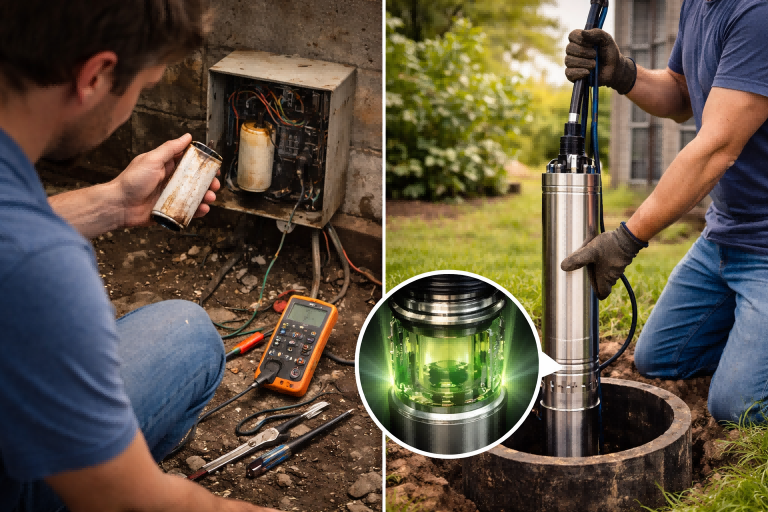
Symptoms include the pump humming but not starting, starting intermittently, or tripping the circuit breaker.
A visual inspection might show a bulging or leaking capacitor, but testing with a multimeter is definitive.
Is the capacitor in the well pump or control box?
In most submersible pump installations, the start and run capacitors are located above ground in the pump's control box for easy access and replacement.
They are not inside the submerged motor itself.
Can I replace a pump capacitor myself?
Yes, if you have basic electrical knowledge and follow safety precautions.
Always turn off the power at the breaker, and safely discharge the old capacitor before handling it to avoid electric shock.
How long should a pump capacitor last?
The lifespan of a pump capacitor typically ranges from 3 to 10 years.
Factors like heat, power quality, and the number of start/stop cycles can significantly affect its longevity.