Need to access water from a very deep well?
The depth can seem like an overwhelming challenge.
But the right pump is engineered to overcome these extreme depths with ease.
The depth a submersible pump can go depends entirely on its design, specifically its "max head" rating. Standard models reach 50-100 meters (165-330 ft), while specialized deep-well pumps, like screw pumps, can push water from over 300 meters (nearly 1000 ft).
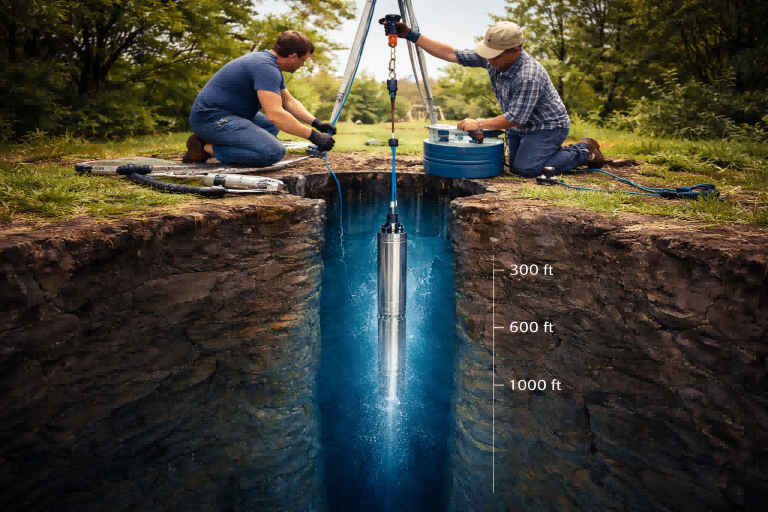
The maximum depth, or "head," is not just a single number.
It is a result of a powerful interplay between the pump’s mechanical design, its motor’s power, and the laws of physics.
A pump’s ability to go deep is a direct reflection of its power to build pressure.
Understanding which pump types are built for which depths is crucial.
This knowledge ensures you select a pump that will not just reach the water but will also deliver it reliably and efficiently to the surface for years to come.
The Role of "Head": The True Measure of Depth
Are you confused by pump specifications like "head"?
This technical term can be a barrier to choosing correctly.
Understanding it is the simple key to unlocking your well’s full potential and ensuring a reliable water supply.
"Max Head" or "Total Dynamic Head" is the most important specification for determining depth.
It represents the maximum vertical distance a pump can push water against gravity. A pump with a 150-meter head rating can effectively operate in a well up to that depth.
The concept of "head" is the foundation of pump selection for any well.
It is a measurement of pressure, expressed as an equivalent height of water.
Imagine a vertical pipe filled with water.
The pressure at the bottom of the pipe is directly related to its height.
A pump’s job is to create this pressure.
Therefore, its power is measured by the height of the water column it can support.
This is a much more accurate measure of capability than horsepower or wattage alone.
Choosing a pump with the correct head rating for your specific well depth and piping setup is not just recommended; it is essential for the system to function at all.
Breaking Down Total Dynamic Head (TDH)
Total Dynamic Head is the total workload placed on your pump.
It is the sum of two main components:
- Static Head: This is the vertical distance from the water level in the well to the final discharge point (e.g., the top of your storage tank). This is the primary component of head and is directly related to your well’s depth. If your well is 100 meters deep and your tank is 2 meters above ground, your static head is 102 meters.
- Friction Loss: As water moves through pipes, fittings, and valves, it encounters friction. This friction creates back-pressure that the pump must also overcome. Friction loss increases with longer pipe runs, smaller pipe diameters, and higher flow rates.
Your pump’s "Max Head" rating must be greater than your calculated Total Dynamic Head.
Reading a Pump Performance Curve
Every pump comes with a performance curve chart.
This chart is the most important tool for matching a pump to your well.
It shows the relationship between Total Head (vertical axis) and Flow Rate (horizontal axis).
- The curve starts high on the left and slopes down to the right.
- This shows that as the head (depth) increases, the flow rate the pump can deliver decreases.
- The point where the curve touches the vertical axis is the "Max Head" or "Shut-off Head." At this depth, the pump can no longer move any water, and the flow rate is zero.
- You must select a pump where your required TDH falls comfortably in the middle of the curve to get a good flow rate.
A Costly Mistake: Underestimating Head
Choosing a pump with a head rating that is too low for your well is a common and costly error.
The pump will run and consume power, but it will struggle.
It might deliver only a trickle of water.
In a worst-case scenario, if the Total Dynamic Head exceeds the pump’s maximum head, it will deliver no water at all.
The motor will run continuously without moving water, leading to wasted energy and eventual premature failure.
Accurately calculating your head requirement is the single most critical step in designing a successful deep well water system.
Screw Pumps: The Champions of Extreme Depth
Is your well exceptionally deep, perhaps over 150 meters?
Standard centrifugal pumps often cannot build enough pressure to work at these depths.
You need a specialist engineered for high-pressure applications.
Solar screw pumps are the go-to solution for extreme depths.
Their positive displacement design allows them to generate very high pressure (head), making them capable of lifting water from depths of 300 meters (nearly 1,000 ft) or more, far exceeding most centrifugal pumps.
When the challenge is extreme depth, the pump’s design principle matters more than anything else.
Unlike centrifugal pumps that use high-speed impellers to "throw" water upwards, a screw pump works on the principle of positive displacement.
It uses a helical stainless steel rotor turning inside a tough rubber stator.
This mechanism traps "pockets" of water and pushes them steadily up the pipe.
This method is incredibly effective at building high pressure, much like a screw jack is effective at lifting a heavy car.
It doesn’t rely on velocity.
It relies on direct, mechanical force.
This fundamental difference is why screw pumps excel where other designs fail, making them indispensable for accessing deep groundwater in regions like Africa and Latin America.
How Screw Pumps Achieve High Head
The power of a progressive cavity screw pump comes from its unique geometry.
- The Rotor and Stator: The pump consists of a single-helix metal rotor that rotates eccentrically inside a double-helix rubber stator.
- Cavity Formation: As the rotor turns, a series of sealed cavities (pockets) form between it and the stator wall.
- Progressive Movement: The rotation of the rotor causes these water-filled cavities to "progress" from the pump’s intake to its outlet.
- Pressure Building: Each cavity moves a fixed volume of water. Because the cavities are sealed, the pump can build immense pressure to overcome the static head of a very deep water column. The maximum head is determined by the length and precision of the rotor/stator assembly.
This design is also highly tolerant of sand and silt, as the abrasive particles are carried along in the cavities without the high-speed impact that damages centrifugal impellers.
Application and Performance Characteristics
Due to their design, screw pumps have a distinct performance profile.
They are defined by:
- Low Flow, High Head: They produce a relatively low volume of water compared to centrifugal pumps but can push it from incredible depths. This makes them perfect for domestic water supply, filling livestock tanks, and small-scale drip irrigation where a steady, reliable flow is more important than high volume.
- Ideal for Solar: Their performance is very efficient, especially when paired with a high-efficiency BLDC motor. They can start pumping with less solar power than larger centrifugal pumps, making them highly effective in off-grid solar applications.
| Feature | Solar Screw Pump | Standard Centrifugal Pump |
|---|---|---|
| Max Head Capability | Very High (150m to 300m+) | Medium (up to 150m) |
| Flow Rate | Low | High |
| Primary Mechanism | Positive Displacement | Centrifugal Force |
| Best Application | Extremely deep wells | Shallow to medium depth wells |
| Sand Tolerance | Excellent | Good to Poor (depends on model) |
When to Choose a Screw Pump
You should strongly consider a screw pump if your well meets these criteria:
- The static water level is deeper than 150 meters (500 feet).
- The water has a noticeable amount of sand or silt.
- Your application requires a steady, continuous supply rather than a high-volume burst (e.g., filling a storage tank).
- The system is powered by solar panels, where efficiency at various power levels is critical.
For water sources this deep, a screw pump is not just an option; it is often the only viable and reliable solution.
Centrifugal Pumps: The Masters of High Flow
Do you need to move a large volume of water for irrigation or livestock?
Your well is at a moderate depth, under 150 meters.
A screw pump’s low flow rate will not meet your needs.
Multi-stage centrifugal pumps are the ideal choice for high-flow applications at shallow to medium depths.
By stacking multiple impellers, these pumps can achieve a good balance of head and high volume, delivering the water needed for farms, ranches, and large gardens.
When the priority shifts from extreme depth to high volume, centrifugal force is the most efficient way to move water.
A centrifugal pump uses a motor to spin an impeller at high speed.
This spinning motion flings water outwards, creating pressure that drives the water up the pipe.
A single impeller can only generate a limited amount of head.
To overcome the depth of a well, these pumps are "multi-stage."
This means they have a series of impellers stacked on top of each other.
The water is passed from one impeller to the next, with each stage adding more pressure.
This multi-stage design allows centrifugal pumps to strike a powerful balance, achieving the head needed for most wells while delivering significantly higher flow rates than a screw pump.
The Power of Stacking Stages
The depth a centrifugal pump can reach is directly proportional to the number of stages (impellers) it has.
- Single-Stage Pump: A pump with one impeller. These are common for surface applications like pool pumps or boosters but lack the head for deep wells.
- Multi-Stage Pump: A pump with two or more impellers arranged in a series. The discharge from the first impeller chamber is the suction for the second, and so on.
- Pressure Boosting: Each stage acts as a separate pump, boosting the pressure it receives from the stage below. A 10-stage pump can generate roughly ten times the pressure (and thus, ten times the head) of a single-stage pump with the same impeller design.
This modular design allows manufacturers to create a wide range of pumps with different head and flow ratings to suit wells of various depths.
Material Choices for Different Depths and Water
The depth capability is also linked to the durability of the materials.
For centrifugal pumps, two main types are common in solar applications:
1. Solar Plastic Impeller Pump:
- Best for: Depths up to around 80-100 meters. They are excellent for farm and pasture water supply in the Americas and Africa.
- Advantages: These pumps use durable, wear-resistant engineering plastic for the impellers. They are lightweight, economical, and offer excellent resistance to fine sand. The flexibility of the plastic helps it withstand abrasion.
- Limitations: The plastic may not be suitable for the immense pressures of very deep wells or for highly corrosive water environments.
2. Solar Stainless Steel Impeller Pump:
- Best for: Medium to high-head applications, up to 150 meters or more. They are a premium choice for aggressive water conditions.
- Advantages: This model uses a robust SS304 stainless steel impeller and pump body. It offers superior longevity due to high corrosion resistance and strength. This makes it ideal for alkaline soils in Australia or acidic water in parts of the Americas.
- Limitations: They are heavier and have a higher initial cost, targeting a high-end market that prioritizes durability above all else.
The Motor: Powering the Pump to New Depths
A pump is just a mechanical device.
Its ability to reach any depth is ultimately determined by the motor that drives it.
A weak or inefficient motor will cripple even the best-designed pump.
High-efficiency BLDC permanent magnet motors are the core technology enabling modern deep-well pumps.
Delivering high torque and over 90% efficiency, these motors provide the raw power needed to overcome extreme head while minimizing the number of solar panels required for operation.
The motor is the heart of the water pump system.
It is responsible for converting electrical energy—from solar panels or the grid—into the rotational force that drives the pump.
The deeper the well, the more torque and power are required from the motor to turn the impellers or screw against the immense pressure of the water column.
Traditional AC motors or brushed DC motors are simply not as effective.
The development and adoption of Brushless DC (BLDC) permanent magnet motors have been a revolution for the solar pumping industry.
Their superior efficiency and power density are what make it economically and technically feasible to pump water from ever-increasing depths using a limited solar array.
Technical Advantages of BLDC Motors
BLDC motors outperform older motor technologies in every metric relevant to deep-well pumping.
Their design eliminates the brushes and commutators found in traditional DC motors, which were a common point of failure and energy loss.
- High Efficiency: BLDC motor efficiencies regularly exceed 90%. In contrast, traditional AC motors might operate in the 70-80% efficiency range. This 10-20% improvement means significantly less solar energy is wasted as heat, and more is converted into pumping power.
- High Torque: They produce high torque even at low speeds. This is crucial for starting the pump against the static pressure of a deep column of water, a common challenge in solar applications when the sun is not at its peak.
- Compact and Lightweight Design: By using powerful neodymium iron boron permanent magnets (like 40SH grade), BLDC motors can be made much smaller and lighter. They can be up to 47% smaller and 39% lighter than an AC motor of equivalent power, simplifying installation deep inside a narrow well bore.
- Long, Maintenance-Free Life: With no brushes to wear out, these motors are incredibly reliable and have a very long service life, which is essential for a device installed hundreds of feet underground.
The Market Value of an Efficient Motor
For both the distributor and the end-user, the choice of motor has profound financial implications.
An efficient BLDC motor directly reduces the overall cost and improves the reliability of the entire water system.
It reduces the required size of the solar array by 15-25% to achieve the same water output as a less efficient system.
This lowers the initial investment cost for the end-user.
The motor’s reliability and long life reduce the total cost of ownership, eliminating a major potential point of failure.
This superior efficiency is managed by an intelligent MPPT (Maximum Power Point Tracking) controller, which constantly adjusts the electrical load to extract the maximum possible power from the solar panels as sunlight conditions change throughout the day, further enhancing the pump’s ability to operate effectively from deep wells.
Conclusion
A submersible pump’s depth is set by its head rating, pump type, and motor.
Screw pumps excel at extreme depths, while centrifugal pumps offer high flow at moderate depths.
Choosing correctly ensures a reliable water supply.
Frequently Asked Questions
What is the maximum depth for a submersible well pump?
Specialized screw pumps can reach depths over 300 meters (1000 ft).
Standard centrifugal pumps typically have a maximum depth of around 150 meters (500 ft).
How do I know how deep my well is?
A professional well driller’s report will list the total depth.
Alternatively, you can measure it by lowering a weighted line into the well until it hits the bottom.
Can a pump be too powerful for a well?
Yes.
A pump with a much higher flow rate than your well’s recovery rate can run the well dry, causing damage to the pump.
What is the difference between head and PSI?
Head is the height a pump can lift water, measured in meters or feet.
PSI is a measure of pressure. 10 meters of head is equivalent to 1 bar or 14.5 PSI.
How deep should a pump be in a well?
The pump should be set at least 5-10 meters (15-30 ft) below the lowest expected water level (the dynamic water level) but always above the well bottom.
Does a deeper well require more horsepower?
Yes, a deeper well increases the Total Dynamic Head.
This requires a pump with a higher head rating, which is typically driven by a more powerful motor (higher horsepower or wattage).
What size submersible pump do I need for a 300 foot well?
For a 300-foot (approx. 90-meter) well, you need a pump with a head rating significantly greater than 90 meters to account for friction loss and desired pressure at the surface.