You want to slash your electricity bill by running your pool pump on solar.
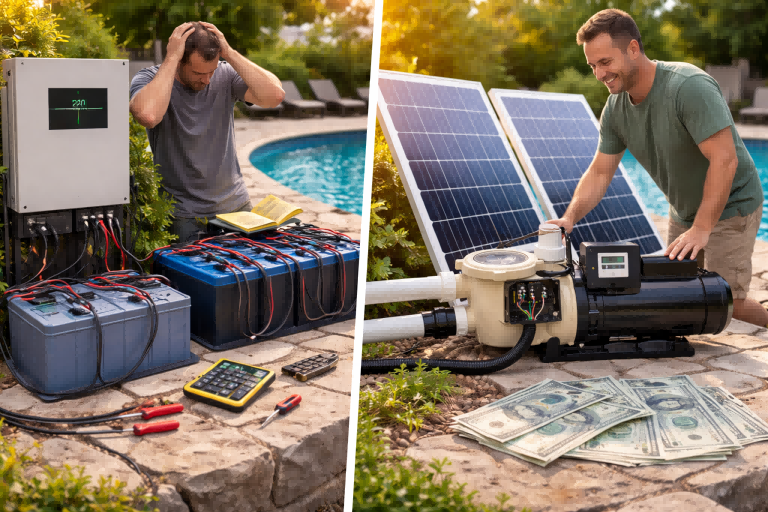
But the thought of a complex inverter, battery, and wiring setup is overwhelming and costly.
What if there's a simpler, more efficient way?
Yes, you can run a traditional AC pool pump off an inverter system.However, this is a highly inefficient method that wastes significant energy.A dedicated DC solar pool pump is far superior because it eliminates the need for an inverter, connecting directly to solar panels for maximum efficiency.
Technically, the answer to the question is yes.
An inverter's job is to convert DC power from a source like a solar-charged battery into AC power that can run standard household appliances, including a traditional AC pool pump.
For a completely off-grid home, this is a common approach.
However, just because you can do something doesn't mean you should.
When it comes to motor-driven appliances like pumps, this method introduces multiple points of energy loss.
It's a clunky, inefficient, and expensive way to achieve your goal of a solar-powered pool.
The real key to efficiency is not in how you convert the power, but in using a pump designed from the ground up to use DC power directly.
Let's explore why the inverter itself is the problem and what the superior alternative is.
Why is a traditional inverter setup so inefficient?
You've built a solar power system for your pump but the energy loss is frustrating.
The inverter gets warm, and your batteries drain faster than they should, even when the pump isn't running.
**An inverter constantly consumes energy, wasting 10-20% of your precious battery power just to convert DC to AC.
This "phantom load," combined with the high startup surge of an AC pump motor, makes it a very inefficient and expensive way to filter your pool using solar.
**
The primary issue with using an inverter is that it's a "middleman" for your electricity, and like any middleman, it takes a cut.
This energy conversion process from DC to AC is never 100% efficient.
A significant amount of a battery's stored energy is lost as heat within the inverter itself.
Furthermore, traditional AC pool pumps have a very demanding power profile that is particularly harsh on inverter systems.
The Inefficiency Breakdown
When you run an AC pump from an inverter, several layers of energy loss occur before any water is even moved.
This "stack" of inefficiencies makes the entire system wasteful.
-
Inverter Standby Loss: Even when the pump isn't running, the inverter must be on and ready.
During this standby time, it constantly draws power from your batteries.
This is often called a "phantom" or "idle" load and can drain a battery bank over time. -
Conversion Loss: When the pump is active, the inverter loses between 10% and 20% of the energy it draws from the batteries.
If your pump needs 1500 watts, the inverter might actually be pulling over 1800 watts from your batteries to compensate for its own inefficiency. -
Motor Inrush Current: An AC induction motor requires a massive surge of current to start—often 3 to 7 times its normal running wattage.
This means you need a much larger, more expensive inverter (and a more robust battery bank) just to handle this momentary startup surge, even though the pump runs at a lower wattage afterward.
This adds significant cost and complexity.
| System Component | Inefficiency Factor | Consequence |
|---|---|---|
| Power Inverter | 10-20% DC to AC conversion loss | Wastes stored battery power as heat |
| AC Pump Motor | Requires massive inrush current | Demands a larger, more expensive inverter |
| Overall System | Multiple points of failure | Complex, costly, and inefficient |
This setup turns a simple task—circulating water—into a complicated electrical challenge.
You're paying for a larger inverter and more batteries to power a system that wastes energy at every step.
A modern approach eliminates this entire problem.
What is the more efficient alternative?
You want the benefits of a solar pump without the hassle of an inverter.
An inefficient system that wastes your valuable solar energy is simply not an option for you.
**The modern alternative is a DC solar pool pump with a high-efficiency Brushless DC (BLDC) motor.
This design is over 90% efficient, connects directly to solar panels, and eliminates the need for a power-wasting inverter, cutting overall energy consumption by up to 90%.
**
Instead of converting DC power to AC, you use a pump that is designed to run on DC power from the start.
This is the core principle behind modern solar pool pumps.
These systems are not just an AC pump with a different plug; they are a complete re-imagining of pump technology, centered around a hyper-efficient motor.
The Brushless DC (BLDC) permanent magnet motor is the innovation that makes this possible.
It's a fundamentally different and superior technology compared to the century-old AC induction motor found in traditional pool pumps.
The Superiority of the BLDC Motor
A BLDC motor is the heart of a solar pump's efficiency.
It doesn't have the wearing parts (brushes) of older DC motors and operates on different principles than an AC motor, resulting in spectacular performance gains.
-
Exceptional Efficiency: BLDC motors convert over 90% of the electrical energy they receive directly into rotational force.
Traditional AC motors are often only 50-70% efficient, wasting the rest as heat and noise.
This means a BLDC motor does the same work with far less power. -
No Inverter Needed: Because it's a native DC motor, it can be powered directly by DC solar panels.
This removes the 10-20% energy loss from the inverter, meaning more of your solar energy goes directly to pumping water.
This also means you can use a smaller, less expensive solar panel array to achieve the same result. -
Intelligent Control: BLDC motors are controlled electronically.
This allows for variable speed control, which is the key to massive energy savings.
The pump can run slowly and efficiently for basic circulation, and then ramp up for tasks like cleaning or running a heater, all while maximizing the use of available solar power. -
Longevity and Reliability: The brushless design means there are no parts to wear out and replace.
These motors are renowned for their long, maintenance-free service life, making them a more reliable and cost-effective investment over time.
| Feature | DC Pump with BLDC Motor | AC Pump with Inverter |
|---|---|---|
| System Efficiency | Very High (>90%) | Low (~50-60% after losses) |
| Inverter Required? | No | Yes |
| Startup Current | Soft, controlled start | High inrush surge |
| Speed Control | Native variable speed | Single speed (or complex VFD) |
| Complexity | Simple: Panels > Controller > Pump | Complex: Panels > Charger > Battery > Inverter > Pump |
By choosing a system built around a BLDC motor, you are not just getting a solar-powered pump; you are getting a smarter, more efficient, and more reliable filtration system.
What if there's no sun?
You love the idea of using free solar energy, but you need your pool filtered every day.
The fear of a green, murky pool after a few cloudy days makes you hesitant to rely solely on the sun.
**A hybrid AC/DC controller solves this problem.
It automatically uses free solar power when available, but seamlessly switches to AC grid power on cloudy days or at night.
You get 24/7 reliability without ever compromising on the cost-saving benefits of solar.
**
The concern about reliability on overcast days or for nighttime operation is completely valid.
A purely DC system relies on sufficient sunlight to function.
For applications requiring guaranteed uptime, this can be a significant drawback.
Historically, the answer was a large, expensive, and high-maintenance battery bank.
However, modern solar pump systems offer a far more practical and intelligent solution: the hybrid AC/DC controller.
This device offers the best of both worlds—the free energy from solar and the unwavering reliability of the power grid, all in one smart package.
How the Hybrid Controller Works
A hybrid controller serves as the brain of the pump system, intelligently managing power from two different sources without any user intervention.
It ensures the pump runs when needed while always prioritizing the most cost-effective energy source.
-
Solar Priority: By default, the controller will always draw 100% of its power from the connected solar panels.
As long as the sun is providing enough energy, the pump is running for free, and zero power is being pulled from the electrical grid. -
Smart Blending: On partly cloudy days, when solar power might dip, the controller doesn't just shut off.
Instead, it will use all available solar power and "blend" in just enough AC power from the grid to maintain the set speed.
This maximizes your use of free energy while guaranteeing performance. -
Automatic AC Backup: When the sun goes down or during extended periods of bad weather, the controller detects the absence of DC input and automatically switches over to the AC power source.
The pump continues its filtration schedule without interruption.
The moment the sun returns, it seamlessly switches back to prioritizing solar power.
This functionality makes batteries obsolete for most pool pump applications.
You don't have to worry about battery lifespan, maintenance, or the high upfront cost.
The grid itself acts as your infinite, reliable "battery," but you only pay for it when you absolutely need it.
You get the peace of mind of 24/7 operation with the economic advantages of a solar-first system.
Conclusion
You can run a pump on an inverter, but it's inefficient.
A direct DC solar pump with a BLDC motor and a hybrid controller is smarter, saving energy and ensuring reliability.
Frequently Asked Questions
What size inverter do I need to run a 1.5 HP pool pump?
You'd need an inverter rated for at least 3,000-4,000 watts continuous and a surge capacity of 6,000+ watts to handle the startup current of the AC motor.
Can a generator run a pool pump?
Yes, a generator can run a pool pump, provided it can handle the large startup surge.
A DC solar pump with a hybrid controller can also use a generator as its AC backup source.
Is it cheaper to run a pool pump at night?
It can be if your utility offers lower "off-peak" electricity rates.
However, running it for free during the day on solar power is always the cheapest option.
How do you power a pool pump during a power outage?
A hybrid AC/DC solar pump system will not work during a power outage unless it is connected to a battery bank or a generator, as the grid-tied AC input will be off.
Do I need a battery for a solar pool pump?
No.
For grid-connected homes, a hybrid AC/DC controller is a more practical and cost-effective solution than a battery, using the grid as a backup instead.
Can you run a variable speed pump on an inverter?
While possible, it's not ideal.
A native DC variable speed solar pump is far more efficient as it doesn't suffer from the inverter's energy conversion losses.