Your water pump suddenly stopped working, leaving you without water.
You are frustrated by another expensive and unexpected repair.
Understanding the root cause is the key to preventing it from ever happening again.
The #1 cause of pump failure is a mismatch between the pump and its operating conditions.
This includes running dry, pumping abrasives like sand, or using a pump in corrosive water it wasn’t designed for, leading to rapid wear and burnout.
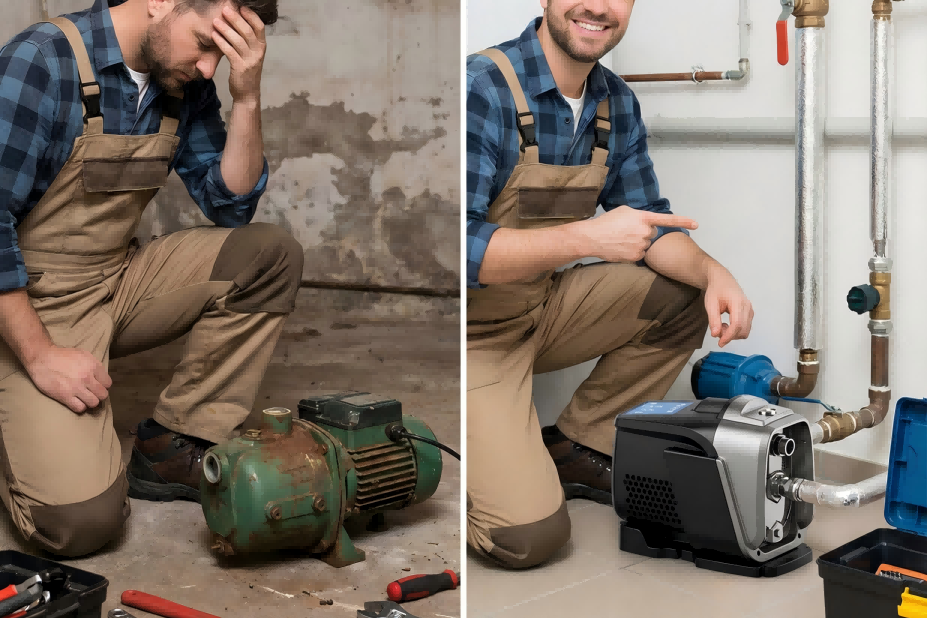
A water pump is a highly specialized piece of equipment.
It is designed for a specific job under specific conditions.
When a pump is forced to operate outside of its designed environment, it begins to destroy itself.
This fundamental mismatch is not a single event.
It is a persistent condition that causes nearly all premature pump failures.
Common symptoms like a worn-out impeller, a seized motor, or a corroded pump body are just the final signs of this underlying problem.
They are not the root cause.
The true cause was choosing the wrong tool for the job.
This guide will break down the most common types of pump-killing conditions.
We will explore how selecting the correct pump technology from the start can eliminate the #1 cause of failure.
This will ensure a long, reliable service life for your water system.
Part 1 | Abrasive Wear from Sand and Silt
Your water pump loses pressure and eventually fails.
You discover the internal parts have been ground away by sand.
This destructive cycle will repeat until you install a pump designed for abrasive conditions.
Abrasive wear is a leading cause of failure, especially in deep wells.
Sand and silt in the water act like liquid sandpaper, rapidly eroding the pump’s impellers and diffusers, causing a loss of performance and eventual breakdown.
Sand is one of a water pump’s greatest enemies.
Many water sources, from wells in Africa to agricultural sites in the Americas, contain suspended sand and silt.
A standard water pump is not built to handle these particles.
In a typical centrifugal pump, impellers spin at thousands of RPM.
They accelerate the water to create pressure.
When sand is present, these high-speed impellers turn the particles into tiny, destructive projectiles.
This process, known as abrasive wear, physically grinds away the pump’s internal components.
The first sign is a gradual loss of water pressure and flow.
The pump has to run longer to do the same amount of work.
Eventually, the wear becomes so severe that the pump can no longer build adequate pressure, and it fails completely.
This is not a defect in the pump.
It is a failure to match the pump’s design to the water quality.
The Mechanics of Abrasive Destruction
Understanding how sand destroys a pump highlights the importance of correct pump selection.
The damage is mechanical and progressive.
It primarily affects the components responsible for creating pressure.
How Standard Pumps Fail
In a multi-stage centrifugal pump, the close tolerances between the spinning impellers and the stationary diffusers are critical.
This is what allows the pump to build high pressure.
- Erosion: Sand particles get trapped in this high-velocity space and erode the edges of the impeller vanes.
- Increased Clearance: As material is worn away, the clearance between the impeller and diffuser widens.
- Performance Loss: A wider clearance allows water to leak backward within the pump, drastically reducing its efficiency and output pressure. The pump can no longer "grip" the water effectively.
- Final Failure: The pump continues to degrade until it is effectively useless, even though the motor may still run perfectly.
The Solution: Specialized Pump Designs
To combat abrasive wear, you need a pump that is either incredibly resistant to it or that operates in a way that minimizes its effects.
Two types of solar pumps excel in these conditions.
| Pump Type | Sand Handling Mechanism | Best Application |
|---|---|---|
| Solar Screw Pump | Uses a slow-turning stainless steel screw inside a rubber stator. It pushes water rather than flinging it, making it highly resistant to sand. | Deep wells with known sand problems, domestic water, and livestock watering. Ideal for high head, low flow needs. |
| Solar Plastic Impeller Pump | Employs impellers made from advanced, wear-resistant polymers. These materials can absorb impacts from fine sand better than brittle, low-grade metals. | Farm irrigation and pasture water supply where high flow is needed and fine sand is present. |
The solar screw pump is the ultimate solution for sandy wells.
Its design is fundamentally different and more robust.
For higher flow applications, the modern plastic impeller pump offers an excellent balance of performance, sand resistance, and cost-effectiveness.
Part 2 | Corrosion from Aggressive Water Chemistry
Your pump fails prematurely, and you see rust and pitting on the metal parts.
The water itself is eating your pump from the inside out.
Using a standard pump in this environment is a recipe for recurring failure.
Corrosion is a silent killer of water pumps.
Water with a high or low pH, or with high levels of salt or minerals, can chemically attack and dissolve the pump’s metal components, leading to leaks, structural failure, and contamination.
Not all water is created equal.
The chemical makeup of your water can determine the lifespan of your pump.
Water that is acidic (low pH) or alkaline (high pH) is aggressive.
It will actively corrode metals like cast iron and low-grade steel.
This is a common issue in many parts of the world, including agricultural regions in Australia and industrial areas in the Americas.
Corrosion is a chemical reaction that weakens the pump’s structure.
It can cause pitting on the pump body, dissolve impellers, and lead to seal failure.
The first signs might be discolored water or a gradual drop in performance.
In severe cases, the pump casing can be eaten through completely, causing major leaks and a total loss of water.
Using a pump made of the wrong materials in corrosive water is a guarantee of premature failure.
The pump may look fine on the outside, but it is being destroyed from within.
The Chemistry of Pump Destruction
Corrosion is an electrochemical process that returns refined metals to their more stable, oxidized state.
In a water pump, this process is accelerated by the constant flow of water, which continuously introduces new reactants.
Vulnerable Materials
- Cast Iron: Very common in pump housings, but highly susceptible to rust (iron oxide) in neutral or oxygenated water. It performs very poorly in acidic conditions.
- Bronze/Brass: Often used for impellers. These materials are generally more corrosion-resistant than iron but can be attacked by water with high levels of ammonia or certain salts.
- Low-Grade Steel: Used in shafts and hardware, it can rust quickly unless it is a specific, corrosion-resistant alloy.
The type of corrosion can vary.
You might see uniform thinning of the material or localized pitting, which can rapidly create holes in the pump casing.
The Premium Solution: Stainless Steel
To fight corrosion, you must use a material that is chemically resistant to your specific water type.
For a wide range of aggressive water conditions, stainless steel is the superior choice.
The Solar Stainless Steel Impeller Pump is a perfect example of this design philosophy.
- Material: The pump body, impellers, and other key parts are made from SS304 stainless steel.
- Corrosion Resistance: SS304 contains chromium, which forms an invisible, passive layer of chromium oxide on the surface. This layer protects the steel from a wide range of acidic and alkaline conditions.
- Durability and Purity: This high level of resistance ensures an extremely long service life, even in harsh water. It also ensures that the pump does not leach rust or other contaminants into the drinking water supply.
While a stainless steel pump has a higher initial cost, it is often the most economical choice in the long run.
It eliminates the cycle of buying and replacing cheaper pumps that are doomed to fail in corrosive environments.
It is the definition of choosing the right tool for the job.
Part 3 | Motor Burnout from Overheating
Your pump motor hums and then goes silent forever.
It has burned out from excessive heat, a frequent and final end for many pumps.
This failure is often preventable with modern motor and controller technology.
Motor burnout is a catastrophic failure caused by overheating.
This can result from running the pump dry, operating against a blocked pipe (dead-heading), rapid on/off cycling, or simply from an inefficient motor design that generates excessive heat.
The motor is the heart of your water pump.
If the heart fails, the entire system is dead.
Motor burnout is the terminal failure where the electrical windings inside the motor get so hot that their insulation melts.
This causes a short circuit, and the motor is permanently destroyed.
Heat is the ultimate enemy of an electric motor.
Several conditions can lead to a dangerous buildup of heat.
Running the pump without water is a major cause.
Submersible pumps rely on the surrounding water to cool them.
Without it, they overheat quickly.
Another cause is an inefficient motor.
An old or poorly designed motor might only be 60-70% efficient.
This means 30-40% of the electricity it consumes is wasted as heat, not motion.
Modern pump systems address this problem at its core.
They use advanced motor technology and intelligent controllers to both generate less heat and protect the motor from heat-generating conditions.
The Core of a Modern Pump: The BLDC Motor
The key to preventing overheating starts with motor efficiency.
Today’s advanced solar water pumps are powered by BLDC (Brushless DC) permanent magnet motors.
These motors represent a massive leap forward in technology.
- Extreme Efficiency: BLDC motors have efficiencies exceeding 90%. This means less than 10% of the energy is wasted as heat. They run significantly cooler than traditional AC or brushed DC motors.
- Powerful Design: The rotor is made from high-strength 40SH neodymium iron boron magnets. This creates a powerful magnetic field, delivering high torque and performance.
- Compact and Lightweight: Thanks to this efficiency, a BLDC motor can be 47% smaller and 39% lighter than a conventional motor with the same power output.
This inherent efficiency is the first line of defense against overheating.
The motor simply produces less waste heat to begin with.
The Brains of the System: The Intelligent Controller
The second line of defense is the pump’s electronic controller.
A modern solar pump system includes an MPPT (Maximum Power Point Tracking) controller.
This controller is the brain of the operation.
It does more than just convert solar power; it actively protects the motor.
- Dry-Run Protection: The controller constantly monitors the motor’s load. If the pump runs out of water, the load drops. The controller recognizes this signature and shuts the motor off before it can overheat.
- Stall Protection: If the pump is jammed by debris, the motor will stall. The controller detects the immediate spike in electrical current and cuts power, preventing an instant burnout.
- Soft Start: The controller gently ramps up the motor’s speed on startup. This reduces mechanical stress and prevents the large inrush of current that generates heat in simpler systems.
Together, the high-efficiency BLDC motor and the intelligent controller create a system that is highly resistant to motor burnout.
They eliminate the most common causes of overheating, ensuring the heart of the pump keeps beating for years.
Part 4 | Failure from Unreliable Power
Your solar pump works great on sunny days but stops when clouds appear.
This lack of water on demand is a system failure, not a pump failure.
A truly reliable system needs a way to provide water 24/7.
An unreliable power source can be considered a pump system failure.
A solar-only pump that cannot provide water at night or on cloudy days fails to meet the user’s needs, even if the pump itself is perfectly functional.
A solar water pump offers incredible freedom from the grid.
But this freedom comes with a condition.
It depends on the sun.
On a cloudy day, or at night, a standard DC solar pump will not run.
For many applications, like filling a large storage tank for livestock, this is not a problem.
The system is designed to work when the sun is out.
But for households or critical irrigation, water is needed on demand, 24 hours a day.
In these cases, a pump that stops working due to a lack of sun is a failed system.
It is unreliable.
The mechanical pump is fine, but the system’s design is not sufficient for the application.
This challenge has led to the development of more advanced and flexible power solutions.
The goal is to provide worry-free water access, regardless of the weather or time of day.
The Challenge of Intermittent Power
Solar power is fantastic, but it is inherently intermittent.
The output of a solar panel array changes constantly throughout the day.
- Peak Sun: Around noon, the panels produce maximum power.
- Cloud Cover: A passing cloud can cause power to drop by over 80% in a matter of seconds.
- Night: At night, power output is zero.
A standard MPPT controller does an excellent job of maximizing the power available at any given moment.
However, it cannot create power that is not there.
If the power from the panels drops below the minimum required to run the pump, the system shuts down.
The Solution: Hybrid AC/DC Power
To solve the problem of intermittent solar power, hybrid pump systems were created.
These systems can run on two different power sources, ensuring a completely reliable water supply.
An AC/DC hybrid controller is the key to this flexibility.
- Dual Inputs: The controller has separate inputs for DC power (from solar panels) and AC power (from the grid or a generator).
- Automatic Switching: The controller’s logic is designed to prioritize solar power. It will use 100% solar energy whenever it is available.
- Hybrid Function: When solar power is not sufficient to run the pump at full speed (e.g., on an overcast day), the controller can blend solar power with AC power. This maximizes the use of free solar energy while guaranteeing the required pump performance.
- AC Takeover: When there is no solar input at all (e.g., at night), the controller will automatically switch over to run the pump entirely on the AC power source.
This intelligent power management transforms a solar water pump from a daytime-only device into a 24/7 utility.
It eliminates power availability as a point of failure, providing true water security for homes, farms, and businesses.
Conclusion
The number one cause of pump failure is improper selection.
Matching the pump to your water’s sand, corrosion, and power needs is vital.
The right pump and motor technology ensures a long-lasting, reliable water supply.
Frequently Asked Questions
What are common causes of pump failure?
Common causes include running dry, abrasive wear from sand, corrosion from water chemistry, and motor overheating from electrical issues or overload.
What causes a pump motor to fail?
Motor failure is usually caused by overheating.
This can result from low voltage, rapid on/off cycling, or running the pump without water to cool it.
How do you diagnose a pump failure?
Look for symptoms like no water flow, low pressure, strange noises, or the pump not turning on.
Checking for power and testing the pressure switch are good first steps.
How can I make my pump last longer?
Ensure it is the correct type for your water conditions.
Install it correctly, perform regular maintenance, and use a controller with motor protection features.
What is pump cavitation and can it cause failure?
Cavitation is the formation of vapor bubbles due to low pressure at the pump inlet.
When these bubbles collapse, they create shockwaves that can severely damage impellers and cause failure.
Do I need a professional to install a well pump?
While some small pumps can be DIY projects, installing a submersible deep well pump is complex and often best left to a professional to ensure safety and proper operation.
What causes a pump to lose its prime?
A pump can lose prime from a leak in the suction line, a faulty foot valve that allows water to drain back into the well, or from running out of water.