Your water flow is just a trickle, frustrating your daily tasks or failing your crops.
This low pressure likely points to a problem you are ignoring, costing you time and money.
To fix low pressure, first diagnose your system for clogs, leaks, or a faulty pressure tank.
If the system is sound, your pump may be undersized or worn, requiring a high-pressure replacement or the addition of a booster pump.
Low water pressure is a common headache for homeowners, farmers, and businesses.
It can stem from many sources.
Before you rush to replace your pump, a systematic check is necessary.
We will guide you through a step-by-step process of diagnosing the root cause.
This process will save you time and money.
It ensures you apply the correct solution.
This solution could be a simple cleaning, a plumbing repair, or a strategic equipment upgrade.
Let's start by looking at the most common culprits in your water system.
Part 1 | Diagnosing System-Wide Pressure Problems
You suspect your pump is failing due to low pressure.
You are considering a costly replacement.
The real problem could be a simple clog or a hidden leak anywhere in your plumbing, which is much cheaper to fix.
Check for system-wide issues first.
Inspect all filters for clogs, search for leaks in the plumbing line, and test the pressure tank's air charge.
These common problems can mimic a failing pump and are easier to resolve.
Your water pump is the heart of your water system, but it doesn't work alone.
It relies on a network of pipes, fittings, and components to deliver water to your taps.
A problem in any of these parts can reduce water pressure, making the pump seem weak.
It is crucial to rule out these simpler issues before you decide to service or replace the pump itself.
This diagnostic approach is the most efficient way to solve your pressure problems.
You start with the easiest and most common fixes first.
This saves you from the unnecessary expense and labor of pulling a pump from a well or foundation.
We will explore the three main areas to investigate: blockages, leaks, and the pressure tank.
Identifying and Clearing Blockages
Clogs are the most frequent cause of pressure loss.
Sediment, rust, or mineral buildup can choke the flow of water.
- Check Water Filters: Start with your whole-house sediment filter or any point-of-use filters. A clogged filter cartridge can reduce pressure by 20 PSI or more. If the pressure returns to normal when the filter is bypassed or a new cartridge is installed, you have found your problem.
- Inspect Faucet Aerators and Showerheads: These small screens can easily become clogged with mineral deposits, especially in areas with hard water. Unscrew them and clean them thoroughly.
- Foot Valve and Intake Screen: For well pumps, the foot valve or intake screen at the bottom of the pump can become clogged with sand or debris. This restricts the amount of water the pump can draw, reducing both flow and pressure. This is a more involved check but is critical if other steps fail.
Locating and Repairing Leaks
Even a small leak can cause a significant and constant drop in pressure.
The pump has to work harder to compensate for the lost water.
- Visual Inspection: Carefully check all accessible plumbing for signs of moisture, drips, or water stains. Pay close attention to joints and fittings.
- The Pump Cycling Test: Turn off all water outlets in your home or on your property. Listen to your pump. If it cycles on and off intermittently when no water is being used, it's a sure sign that water is escaping from a leak somewhere in the system. The pump is repressurizing the system to compensate for the pressure drop caused by the leak.
- Water Meter Test: If you have a water meter, you can use it to detect leaks. Note the reading, avoid using any water for an hour or two, and then check the reading again. If it has changed, you have a leak.
Testing the Pressure Tank
The pressure tank acts as a reservoir and helps regulate system pressure.
If it fails, it can cause rapid pump cycling and pressure fluctuations.
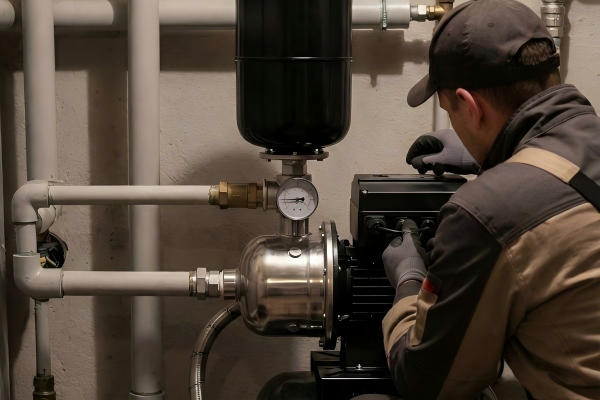
- Check Air Pressure: Turn off power to the pump and drain the system by opening a faucet. Use a tire pressure gauge to check the air pressure at the valve on the tank. The pre-charge pressure should be 2 PSI below the pump's cut-in pressure setting (e.g., 38 PSI for a 40/60 PSI switch).
- Waterlogged Tank: If water spurts out of the air valve when you press it, the internal bladder has failed, and the tank is waterlogged. A waterlogged tank cannot properly buffer pressure and must be replaced.
| Component | Symptom of Problem | Solution |
|---|---|---|
| Water Filter | Gradual pressure loss over time | Clean or replace the filter cartridge |
| Plumbing Leak | Pump cycles for no reason | Locate and repair the leaking pipe or fitting |
| Pressure Tank | Rapid pump cycling, fluctuating pressure | Adjust air pre-charge or replace the tank if bladder is ruptured |
Part 2 | Selecting a Pump Designed for Optimal Pressure
Your system is clear of clogs and leaks, but the pressure is still weak.
Your current pump simply cannot meet your demands.
Buying another underpowered pump will only repeat the problem.
If your system is healthy, your pump is the issue.
Choose a pump designed for your specific pressure needs.
A screw pump provides very high pressure for deep wells, while multi-stage centrifugal pumps offer high flow and strong pressure for irrigation.
When you have confirmed that your plumbing and pressure tank are functioning correctly, the focus naturally shifts to the pump itself.
A water pump may be working perfectly according to its design, but its design may not be suitable for your application.
This is a common issue when a property's water needs change.
For example, a new irrigation system is installed or a home is expanded.
Pumps are engineered to perform within a specific range of flow and pressure (head).
If your pressure requirement, or "Total Dynamic Head," exceeds the pump's capability, the result will always be low pressure at the tap.
In this case, the only true fix is to upgrade to a pump that is specifically designed to produce the pressure you need.
Let’s explore the different types of pumps available and how their designs are tailored for high-pressure applications.
Understanding Your Pressure Requirement (Total Dynamic Head)
Before you can choose a new pump, you must calculate your pressure needs.
This is known as the Total Dynamic Head (TDH).
TDH is the total equivalent pressure the pump must overcome.
It is calculated as follows:
- Vertical Lift: The vertical distance from the water level in the well to the highest point of use.
- Friction Loss: The pressure lost to friction as water moves through your pipes. This depends on pipe length, diameter, and flow rate.
- Operating Pressure: The desired pressure at the faucet or sprinkler head (e.g., 40-50 PSI).
You must select a pump with a head rating that exceeds your calculated TDH.
Pump Types for High-Pressure Applications
Different pump designs are optimized for different pressure and flow combinations.
For solar applications, three types stand out.
- Solar Screw Pump (Low Flow, High Head): This pump uses a helical stainless steel rotor inside a rubber stator. It acts like a screw, pushing trapped pockets of water upward. This positive displacement mechanism creates extremely high pressure. It is ideal for very deep wells, common in electricity-scarce regions of Africa and Latin America, where water needs to be lifted hundreds of meters. Its advantage is high sand resistance and an ability to operate in harsh water, but its flow rate is limited.
- Solar Plastic Impeller Pump (High Flow, Medium Head): This is a multi-stage centrifugal pump. It uses a series of durable plastic impellers to add pressure in stages. It delivers excellent water volume and is highly resistant to fine sand. This makes it a cost-effective and lightweight choice for farm irrigation and pasture water supply in Africa and the Americas. Its limitation is lower durability in very deep wells or corrosive water.
- Solar Stainless Steel Impeller Pump (High Flow, High Head): This is a premium multi-stage centrifugal pump. It features SS304 stainless steel impellers and a stainless steel pump body. This design is built for longevity and reliability, especially in corrosive water conditions like those found in alkaline soil regions of Australia or parts of the Americas. It offers high flow with medium-to-high head, making it suitable for high-end homes, ranches, and demanding applications where reliability is paramount. Its main limitation is a higher initial cost.
| Pump Type | Best For | Flow Rate | Pressure (Head) | Key Advantage |
|---|---|---|---|---|
| Screw Pump | Deep wells, domestic use | Low | Very High | Extreme depth capability, sand resistance |
| Plastic Impeller | Farm irrigation, general use | High | Medium | High volume output, economical |
| Stainless Steel Impeller | Corrosive water, high-end use | High | Medium to High | Corrosion resistance, long service life |
Part 3 | The Power and Intelligence Behind the Pump
You have a powerful pump, but it still underperforms on cloudy days.
You think pressure is all about the pump's mechanics.
You are overlooking the motor and controller, which dictate how well your pump actually performs in the real world.
To fix low pressure consistently, look beyond the pump to its motor and controller.
A high-efficiency BLDC motor provides the necessary torque for high-pressure pumps.
An MPPT controller maximizes solar power to maintain pump speed and pressure.
A pump's potential pressure rating is only a theoretical value.
Achieving that pressure in a real-world application, especially with a solar-powered system, depends entirely on the quality of its power source.
The motor and the controller are the components that deliver this power.
The motor is the muscle that drives the pump's impellers or screw.
The controller is the brain that manages the flow of energy from the solar panels to the motor.
In modern systems, these two components have a massive impact on overall performance and efficiency.
A high-head pump design is useless without a motor that can supply enough torque to run it under load.
A powerful motor is useless without a controller that can intelligently harvest enough energy to power it.
For anyone looking to fix low pressure permanently, understanding the role of these core technologies is essential.
The BLDC Motor: The High-Efficiency Engine
The Brushless DC (BLDC) permanent magnet motor is the core technology driving modern solar pumps.
It offers significant advantages over older motor types.
- Superior Efficiency: BLDC motors convert electricity into rotational force with efficiencies exceeding 90%. Traditional motors often operate at 60-75% efficiency. This 15-30% improvement means more of your solar energy goes directly to pumping water, resulting in better pressure and flow.
- High Torque: They produce high torque across a wide range of speeds. This is critical for starting a pump against the high back-pressure of a deep well and for keeping the pump running at a pressure-producing speed even in lower light.
- Reliability and Longevity: The brushless design eliminates the most common failure point in DC motors: the brushes. This results in a virtually maintenance-free motor with a much longer operational lifespan. They are also more compact, being up to 47% smaller and 39% lighter than older motors of the same power rating.
The MPPT Controller: The Intelligent Brain
The controller is what makes a solar pump "smart."
A Maximum Power Point Tracking (MPPT) controller is the industry standard for performance.
- Maximizing Solar Harvest: Solar panels have a specific voltage at which they produce maximum power. This "maximum power point" changes with sunlight intensity and temperature. An MPPT controller constantly tracks this point and adjusts the electrical load to harvest up to 30% more energy over the course of a day compared to simpler controllers.
- Ensuring Consistent Performance: More energy harvested means the controller can provide a more stable power supply to the motor. This allows the pump to run at a higher and more consistent speed throughout the day, which directly leads to better and more reliable water pressure.
- Hybrid Power Solutions: Advanced solar controllers offer AC/DC hybrid functionality. These smart controllers can be connected to solar panels and an AC power source (grid or generator) simultaneously. The controller prioritizes solar power. When sunlight is insufficient, it automatically blends in or switches completely to the AC source. This guarantees you have the water pressure you need 24 hours a day, a critical feature for residential and agricultural users who cannot afford downtime.
Conclusion
To fix low water pressure, first diagnose your system for clogs and leaks.
If needed, upgrade to a pump designed for high pressure.
Power it with an efficient motor and a smart controller for ultimate reliability.
Frequently Asked Questions
Can a bad pressure switch cause low water pressure?
Yes, if a pressure switch is set too low or is faulty, it will turn the pump off before it can build adequate pressure in the system.
How do you test a water pump for pressure?
Install a pressure gauge on a tap close to the pump.
Close all other taps and run the pump to see the maximum pressure it can build (the cut-off pressure).
Will a larger pressure tank increase water pressure?
No, a pressure tank only stores pressurized water.
A larger tank will reduce pump cycling but will not increase the maximum pressure set by the pressure switch.
Why is my water pressure suddenly low?
A sudden drop in pressure often indicates a major leak in your plumbing line, a severely clogged filter, or a complete failure of the pump motor.
What are the symptoms of a bad well pump?
Symptoms include low or no water pressure, dirty water, strange noises from the pump, high electric bills, and the pump cycling on and off frequently.
Can I just turn up the pressure switch?
You can, but only within the pump's operating limits.
Setting the pressure too high can overwork the motor, leading to premature failure and potentially damaging your plumbing.
Does a well pump lose pressure over time?
Yes, impellers and other internal components can wear down over years of use, especially with sandy or abrasive water, causing a gradual loss of pressure.