Struggling with high electricity bills from your pool pump?
These energy costs keep rising, eating into your budget.
Switching to a solar-powered system can eliminate this expense entirely.
To run a 1.5 hp pool pump, you will typically need between 1300 and 1500 watts of solar panels.
This calculation accounts for the pump's 1119-watt power draw and potential energy losses.
The exact number depends on your location's peak sun hours and panel efficiency.
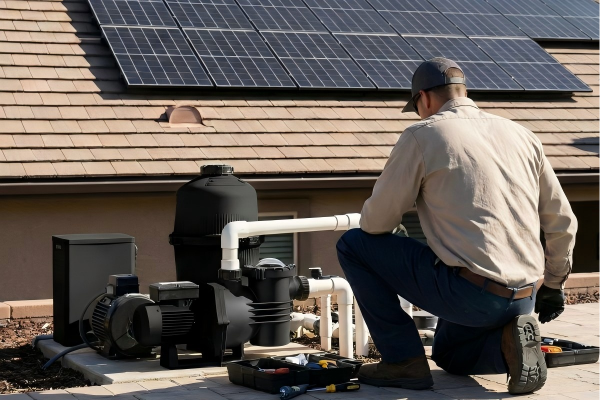
Calculating the right number of solar panels is the first step.
However, building an efficient and reliable solar water pumping system involves more than just watts.
The true performance of your system depends on a combination of a high-efficiency motor, the correct pump type, and intelligent controls.
Understanding these components is crucial for maximizing your investment and ensuring a consistent water supply.
Let's dive into what makes a solar pump system truly effective.
Why the Motor is the Heart of Your Solar Pump System
Choosing an inefficient motor wastes solar energy.
This forces you to buy more panels, increasing initial costs.
A high-efficiency motor is the key to an optimized, cost-effective system.
The core of any modern solar pump is the Brushless DC (BLDC) motor.
Its efficiency, often exceeding 90%, directly reduces the number of solar panels you need.
This saves money on both the initial purchase and long-term operating costs, making it a smarter investment.
The motor acts as the engine of your entire solar water pump setup.
Its ability to convert electrical energy from your solar panels into mechanical power determines the system's overall performance.
A less efficient motor is like a leaky bucket.
It wastes a significant portion of the precious solar energy it receives, forcing the entire system to work harder.
This inefficiency must be compensated for by adding more solar panels, which increases the total system cost and physical footprint.
Conversely, a highly efficient motor maximizes every watt of power generated.
Understanding the BLDC Permanent Magnet Motor
A Brushless DC (BLDC) permanent magnet motor is an advanced piece of engineering.
It operates without the physical "brushes" found in traditional motors, which reduces friction and wear.
This design choice dramatically increases its operational efficiency to levels above 90%.
The core of its power comes from a rotor made of high-strength materials like 40SH neodymium iron boron magnets.
These powerful magnets create a strong magnetic field, allowing the motor to generate high torque and power with minimal energy input.
This technology is the cornerstone of modern, high-performance solar water pumping solutions.
Technical Advantages that Reduce Panel Count
The strategic value of a BLDC motor lies in its tangible benefits.
These advantages translate directly into lower costs and better performance for the end-user.
Its compact design makes it significantly smaller and lighter than older motor types, simplifying transportation and installation.
A maintenance-free design eliminates the need for regular service, saving time and money over the pump's lifespan.
Most importantly, its high efficiency means you need less power to achieve the same result.
| Feature | BLDC Motor | Conventional AC Motor |
|---|---|---|
| Efficiency | > 90% | 60% - 75% |
| Maintenance | None (Brushless) | Requires brush replacement |
| Size & Weight | Up to 47% smaller | Larger and heavier |
| Lifespan | Long | Shorter due to wear |
| Torque | High at all speeds | Lower at low speeds |
Real-World Impact on Solar Panel Requirements
Let's apply this to our 1.5 hp (1119 watts) pool pump.
To get 1119 watts of output power, the motor must receive more input power to account for its own inefficiency.
If you use a BLDC motor with 90% efficiency, you would need approximately 1243 watts of input power (1119 W / 0.90).
However, if you used an older motor with only 70% efficiency, you would need around 1598 watts of input power (1119 W / 0.70).
That's a difference of over 350 watts.
This means you would need at least one extra high-wattage solar panel just to make up for the motor's wasted energy.
Choosing a high-efficiency BLDC motor is the single most effective way to reduce the required size of your solar array from day one.
Matching the Pump Type to Your Specific Water Needs
Using the wrong pump type leads to poor performance.
This can cause system failure or an inadequate water supply.
Understanding the three main solar pump types ensures you get the right tool for the job.
Your application dictates the best pump type.
A solar screw pump is ideal for deep wells with low flow needs.
A plastic impeller pump offers high flow for farm irrigation.
A stainless steel impeller pump provides durability for corrosive water conditions.
Once you have an efficient motor, the next step is selecting the right pump mechanism.
The pump is the part of the system that actually moves the water.
Different designs are engineered to perform best under specific conditions.
A pump designed for high pressure in a deep well will be inefficient if used for moving large volumes of water on a farm.
Similarly, a pump built for high-volume irrigation will struggle to lift water from a great depth.
Choosing the correct pump ensures that the motor's power is used effectively to meet your exact water requirements.
This synergy between motor and pump is essential for a reliable and long-lasting solar-powered water solution.
For Deep Wells: The Solar Screw Pump
The solar screw pump, also known as a progressing cavity pump, is a specialist for high-head, low-flow applications.
It uses a single stainless steel screw (rotor) that turns inside a rubber casing (stator).
This action traps water in cavities and pushes it upward with steady pressure.
It is the perfect solution for domestic water supply, lifting water from very deep wells, or providing drinking water for livestock.
Its robust design makes it highly resistant to sand and other abrasives found in harsh water conditions.
This durability makes it a popular choice in regions with challenging well environments.
However, its design limits its flow rate, making it unsuitable for applications requiring large volumes of water, such as large-scale farm irrigation.
For High Volume: The Solar Plastic Impeller Pump
When the goal is to move a lot of water, the solar plastic impeller pump is the answer.
This is a type of multi-stage centrifugal pump.
It uses a series of durable, wear-resistant plastic impellers that spin at high speed.
Each impeller adds pressure to the water, pushing it to the next stage.
This design delivers high flow rates at medium head, making it ideal for farm irrigation, garden watering, and filling livestock troughs.
Its lightweight construction and economical price point make it accessible for a wide range of agricultural and domestic users.
While it offers excellent resistance to fine sand, its plastic components may have a shorter lifespan in very deep wells or highly corrosive water.
For Harsh Conditions: The Solar Stainless Steel Impeller Pump
The solar stainless steel impeller pump is the premium choice for durability and longevity.
This model is built with SS304 stainless steel impellers, a stainless steel pump body, and other corrosion-resistant components.
It is specifically designed to operate in challenging water environments, such as those with acidic or alkaline properties.
This pump provides high flow rates at medium-to-high head, making it versatile for demanding applications.
It is the go-to solution for regions with alkaline soil, coastal areas with brackish water, or high-end residential properties that demand maximum reliability.
Its primary advantage is its superior corrosion resistance, which ensures a very long service life.
The trade-off is a higher initial cost and greater weight compared to plastic impeller models, positioning it for niche and high-end markets where durability is the top priority.
| Pump Type | Best For | Flow Rate | Head/Pressure | Sand Resistance |
|---|---|---|---|---|
| Solar Screw Pump | Deep wells, domestic use | Low | Very High | Excellent |
| Plastic Impeller Pump | Farm irrigation, gardens | High | Medium | Good |
| Stainless Steel Pump | Corrosive water, high-end use | High | Medium-High | Good |
The Smart Brains Behind the System: Controllers
Without a controller, your solar pump system is inefficient.
It can't adapt to changing sunlight, leading to poor performance.
An intelligent controller optimizes power usage for consistent water flow.
A solar pump controller with Maximum Power Point Tracking (MPPT) acts as the system's brain.
It constantly adjusts the electrical load to extract the maximum possible power from the solar panels.
This intelligence can boost your system's output by up to 30%.
The motor and pump are the muscle of your system, but the controller is the brain.
This electronic device sits between the solar panels and the motor.
Its primary job is to manage the flow of power, ensuring the motor runs as efficiently and safely as possible under all conditions.
A simple controller might just turn the pump on and off.
However, an advanced controller plays a much more active and crucial role.
It protects the motor from electrical damage, optimizes energy harvesting, and can even switch between power sources.
Investing in a high-quality controller is just as important as choosing the right motor and pump.
It is the key to unlocking the full potential of your solar array and achieving reliable, all-day water pumping.
Maximizing Every Ray of Sunlight with MPPT
The most critical feature of a modern solar pump controller is Maximum Power Point Tracking (MPPT).
Solar panels do not produce a fixed amount of power.
Their output voltage and current change constantly depending on sunlight intensity, temperature, and shading.
MPPT technology intelligently monitors the panel's output in real-time.
It then adjusts the electrical load to find the "sweet spot" or "maximum power point" where the panels produce the most watts.
This continuous optimization process ensures that no
solar energy is wasted.
Systems equipped with MPPT can harvest up to 30% more power from the same solar array compared to systems without it.
This boost in efficiency means the pump can start earlier in the day, run later in the evening, and perform better even on cloudy days.
Hybrid Power: Ensuring Water 24/7
For applications where a constant water supply is non-negotiable, a hybrid controller is essential.
These advanced controllers are designed with multiple power inputs.
They can accept power from both your solar panels (DC) and the electrical grid or a generator (AC).
The controller's internal logic prioritizes using free solar power whenever it is available.
If the sunlight fades due to clouds or nighttime arrives, the controller automatically and seamlessly switches to the AC power source.
Some hybrid models can even blend power, using a small amount of AC power to supplement weak sunlight and keep the pump running.
This dual-power capability guarantees a worry-free water supply 24 hours a day, providing the reliability of the grid with the cost savings of solar.
Essential Protection Features
Beyond power optimization, a quality controller serves as a vital bodyguard for your pump motor.
It provides a suite of protection features that safeguard your investment from damage.
- Dry-Run Protection: It senses when the well or water source is empty and shuts off the pump to prevent it from overheating and burning out.
- Over-Voltage/Under-Voltage Protection: It shields the motor from damaging voltage spikes or sags from the solar array.
- Over-Current Protection: It prevents the motor from drawing too much current, which could cause it to overheat.
- Reverse Polarity Protection: It protects the electronics from damage if the solar panels are accidentally wired backward during installation.
These built-in safety mechanisms significantly extend the life of the pump motor and provide peace of mind.
Conclusion
To run a 1.5 hp pump, you need about 1300-1500 watts of panels.
But true efficiency comes from a high-quality BLDC motor, the right pump, and an MPPT controller.
FAQs
How many solar panels for a 2 hp pump?
A 2 hp pump requires about 1500 watts.
You would need approximately 1800-2000 watts of solar panels to run it effectively, depending on your location and system efficiency.
Can I run a pool pump directly from solar panels?
Yes, a DC solar pool pump can run directly from panels.
You need a controller to manage the power flow from the panels to the pump motor for efficiency and protection.
How long will a solar pool pump last?
A well-maintained solar pool pump system can last for many years.
The solar panels are typically warrantied for 20-25 years, and the brushless DC motor can last over 10 years.
Do solar pool pumps work on cloudy days?
Yes, they can work on cloudy days but at a reduced speed.
Systems with efficient MPPT controllers are better at extracting power from low-light conditions to keep water circulating.
What size solar system do I need to run a pool pump?
Calculate the pump's wattage (e.g., 1.5 hp ≈ 1119W).
Add a 25% margin for efficiency losses, so you would need a solar array of about 1400 watts.
Is it worth getting a solar pool pump?
Yes, it is worth it for most pool owners.
The upfront cost is higher, but it eliminates the pump's electricity consumption, leading to significant savings over the system's lifespan.
How do you oversize a solar pump?
Oversizing involves choosing a pump or solar array larger than your minimum needs.
This ensures better performance on cloudy days and can help meet future increases in water demand.
Can you run a solar pump at night?
You can run a solar pump at night by using a battery bank to store energy or by using a hybrid controller that can switch to AC grid or generator power.