Your borehole pump is a critical asset.
A dry-running pump can lead to catastrophic failure, costing you time and money.
Understanding the risks is the first step toward effective prevention.
When a borehole pump runs dry, it loses the water needed for cooling and lubrication.
This causes rapid overheating. The motor, bearings, and impellers can suffer severe damage within minutes. Ultimately, this leads to premature and costly pump failure, interrupting the water supply for your clients.
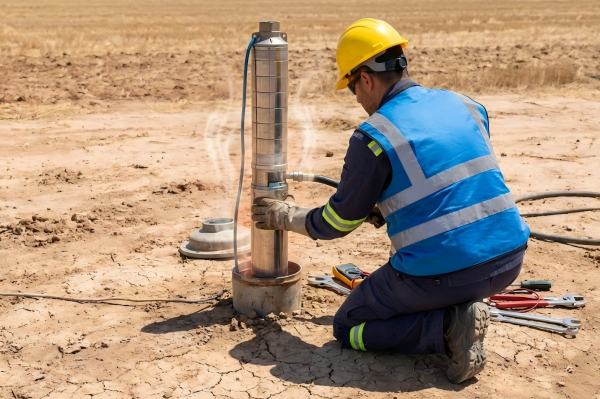
The consequences of a pump running without water are swift and severe.
Mechanical and electrical systems inside the pump begin to fail almost immediately.
Understanding these specific failure points is crucial for any distributor or importer.
This knowledge empowers you to provide better products and more valuable advice to your customers.
Let's explore the precise sequence of events that unfolds when a borehole pump runs dry.
The Immediate Mechanical Damage from Overheating
A dry pump is a ticking time bomb.
The resulting high temperatures can destroy precision components in moments, leading to expensive, irreversible damage and operational downtime for your customers.
Preventing this is key.
Overheating from dry running immediately damages key mechanical parts.
Water lubricates the bearings and cools the shaft seals. Without it, friction skyrockets. This can cause bearings to seize, seals to melt, and impellers to warp or even break apart from the intense heat.
The mechanical failure cascade begins the second water stops flowing through the pump.
Water serves a dual purpose in any submersible pump.
It is the medium being moved, but it is also the primary lubricant and coolant.
Without it, internal temperatures can rise dramatically, often by over 150°C in less than five minutes.
This extreme heat is the direct cause of catastrophic mechanical failure.
The Role of Bearings and Shafts
Bearings are designed to operate within a specific temperature range, lubricated by the surrounding water.
When dry, friction between the bearing surfaces and the pump shaft increases exponentially.
This generates intense localized heat.
The bearing materials can degrade, deform, or even weld themselves to the shaft.
A seized bearing places immense stress on the motor, leading to further damage.
| Component | Function in Normal Operation | Consequence of Dry Running | Failure Time (Approx.) |
|---|---|---|---|
| Bearings | Reduce friction for rotating shaft | Overheat, deform, and seize due to friction. | 2-5 Minutes |
| Mechanical Seal | Prevents water from entering the motor | Faces crack or melt from high heat. | 1-3 Minutes |
| Impellers | Propel water through the pump | Warp, melt, or crack from thermal stress. | 3-7 Minutes |
| Diffusers | Guide water flow between stages | Can deform, blocking flow and increasing load. | 5-10 Minutes |
The Fate of Impellers and Diffusers
Impellers, especially those made from engineered thermoplastics like Noryl, are highly susceptible to heat.
Without the cooling effect of water, they can warp, melt, or crack under the thermal stress.
Damage to even one impeller in a multi-stage pump can unbalance the entire rotating assembly.
This imbalance creates vibrations that accelerate wear on the newly-seized bearings and the shaft itself, leading to complete pump destruction.
Approximately 70% of premature borehole pump failures can be traced back to dry-running incidents that caused initial impeller or bearing damage.
The cost of replacing a multi-stage impeller stack can often exceed 50% of the cost of a new pump, making prevention far more economical than repair.
Electrical Failure and Motor Burnout
Dry running doesn't just damage mechanical parts.
It places an extreme load on the pump's motor, leading to electrical failure and a potential fire hazard.
This is a critical safety and reliability issue.
A dry-running pump forces the motor to work harder without any cooling.
The motor windings overheat, causing the insulation to melt and leading to a short circuit. This electrical failure, known as motor burnout, is irreversible and requires a complete motor replacement, representing a significant financial loss.
The relationship between mechanical stress and electrical failure is direct and unforgiving.
As mechanical components like bearings begin to seize, the motor must draw more and more current to try and maintain its rotational speed.
This process is governed by fundamental electrical principles.
The increased current draw leads directly to a rapid and destructive rise in the temperature of the motor windings.
It is a vicious cycle that ends in complete motor burnout.
The Overheating of Motor Windings
Every electric motor has a maximum rated operating temperature.
Submersible pump motors are designed to be cooled by the water flowing past the motor housing.
When this flow stops, the motor's only method of heat dissipation is lost.
At the same time, the increased mechanical load causes a surge in amperage.
The heat generated in the windings is proportional to the square of the current (Heat ∝ I²).
This means even a small increase in current leads to a much larger increase in heat.
- Insulation Breakdown: The enamel insulation on the copper windings is typically rated for a specific temperature class (e.g., Class F, 155°C). Exceeding this temperature, even briefly, causes the insulation to become brittle, crack, and eventually melt.
- Winding Short Circuit: Once the insulation fails, the copper windings make direct contact with each other or the motor casing. This creates a short circuit.
- Catastrophic Failure: The short circuit results in a massive and near-instantaneous current draw, which trips breakers or blows fuses. However, the damage is already done. The motor windings are permanently destroyed. It is estimated that over 85% of submersible motor burnouts are linked to overheating caused by abnormal operating conditions like dry running.
Why Your Motor Controller Isn't Enough
Many installations rely on a standard motor controller with thermal overload protection.
However, these devices have limitations.
They are designed to protect against gradual overheating from sustained high-load conditions.
The temperature rise from dry running is often too rapid.
| Protection Device | Detection Method | Effectiveness Against Dry Running |
|---|---|---|
| Standard Thermal Overload | Senses high current over time. | Low. The temperature rise is often too fast for the overload to react before damage occurs. |
| Dry-Run Protection Relay | Senses low current (underload) when the pump is not moving water. | High. Directly detects the cause of dry running and shuts down the motor. |
| VFD with Underload Protection | Senses a drop in power consumption (kW) or amperage. | Very High. Provides sophisticated and programmable protection based on real-time motor performance. |
A standard controller may not trip the motor until after the winding insulation has already been compromised.
This is why dedicated dry-run protection is not a luxury.
It is an essential component for ensuring the longevity of any borehole pump installation.
Advanced Protection: Preventing Dry Running
You know the devastating costs of pump failure.
Downtime and replacement expenses anger your clients and damage your reputation.
There is a better way to ensure reliability and protect your investment.
The most effective solution is a pump system with integrated dry-run protection.
Modern solutions like Variable Frequency Drives (VFDs) and dedicated control panels monitor the pump's power consumption. If the pump runs dry, the load drops, and the system automatically shuts it down before damage occurs.
Preventing dry running is far more cost-effective than dealing with its consequences.
Modern pump technology has moved beyond simple thermal overloads.
Today's protection systems are intelligent, proactive, and highly reliable.
For B2B distributors and importers, offering solutions with advanced protection is a significant competitive advantage.
It demonstrates a commitment to quality and long-term reliability that discerning customers, like those in Australia or the United States, value highly.
Let's break down the most effective technologies available today.
The Power of Underload Sensing
The core principle behind modern dry-run protection is "underload" detection.
A pump moving water consumes a predictable amount of electrical power.
If the well runs dry, the pump is no longer doing work.
The impellers are just spinning in the air.
This causes a significant and measurable drop in the current (amps) and power (watts) drawn by the motor.
Intelligent controllers are programmed to recognize this drop.
- Amperage Monitoring: The system monitors the amperage drawn by the motor. If the current falls below a pre-set threshold for a specified duration, the controller diagnoses a dry-run event and shuts off the pump.
- Power Factor Monitoring: Some advanced systems also monitor the power factor. A change in the power factor can also indicate an abnormal load condition like dry running.
- Auto-Restart Timers: After a shutdown, the system can be programmed to wait for a set period (e.g., 30 minutes) before attempting a restart. This allows time for the well water level to potentially recover. If the pump runs dry again, it will shut down again, protecting it from repeated damage.
VFDs: The Ultimate Protection
Variable Frequency Drives (VFDs) offer the most sophisticated level of protection.
A VFD doesn't just turn a pump on or off.
It precisely controls the motor's speed and torque.
This provides a wealth of real-time data that can be used for advanced diagnostics.
| Feature | Standard Controller | VFD Controller |
|---|---|---|
| Protection Method | Overcurrent (thermal) | Underload, Overcurrent, Phase Loss, Voltage Imbalance |
| Response Time | Slow (seconds to minutes) | Fast (milliseconds) |
| Diagnostic Data | None | Real-time Amps, Voltage, Power, Fault History |
| Soft Start/Stop | No (hard start) | Yes (reduces mechanical stress) |
VFDs are constantly monitoring the motor's performance.
They can be programmed with a precise "underload curve."
If the pump's power consumption deviates from this curve, the VFD can shut down the motor in milliseconds — long before any thermal damage can occur.
For a wholesale distributor, supplying VFD-integrated pumps or VFD control panels as a package means offering a product with a failure rate up to 90% lower than conventionally controlled pumps.
This translates to fewer warranty claims, higher customer satisfaction, and a stronger brand reputation in the market.
Conclusion
Dry running destroys borehole pumps by causing rapid overheating.
This leads to severe mechanical and electrical failures.
Using pumps with built-in electronic protection is the most reliable prevention method.
FAQs
How long can a submersible pump run dry before damage?
Damage can begin in under a minute. Significant, irreversible failure like bearing seizure or seal melting often occurs within 2-5 minutes of running completely dry.
Can a dry-running pump be repaired?
Sometimes, but it is often not economical. If the motor has burned out or the impeller stack is destroyed, the repair cost can exceed the price of a new pump.
What is the best way to protect a well pump from running dry?
The best method is an electronic controller with underload protection, such as a Variable Frequency Drive (VFD) or a dedicated dry-run protection relay, which shuts the pump off automatically.
Does a pressure switch protect a pump from running dry?
No. A pressure switch only responds to pressure in the system. It cannot tell if the pump is running without water and will not protect it from dry-run damage.
What are the signs of a pump running dry?
Signs include a complete loss of water flow despite the pump running, sputtering from faucets, and the pump cycling on and off rapidly if a pressure tank is installed.
How does a dry-run protection relay work?
It monitors the motor's electrical current. When the pump runs dry, the current drops significantly, which the relay detects and uses to shut down the pump, preventing burnout.
Is VFD dry-run protection better than a relay?
Yes. A VFD offers more sophisticated and faster-acting protection by constantly monitoring the motor's full performance curve, not just a single amperage threshold.
Why does my pump run but no water comes out?
This is a classic symptom of a dry well. Other causes could be a major leak in the pipe, a clogged intake, or a completely failed pump impeller stack.