Thinking bigger is better for your pond pump?
This common mistake can turn your tranquil oasis into a turbulent mess, stressing fish and damaging your landscape.
Yes, a pond pump can absolutely be too powerful. An oversized pump stresses fish, erodes pond features, wastes energy, and can shorten the pump’s lifespan. The ideal pump is balanced, matching the flow rate and pressure to your specific pond's volume and features.
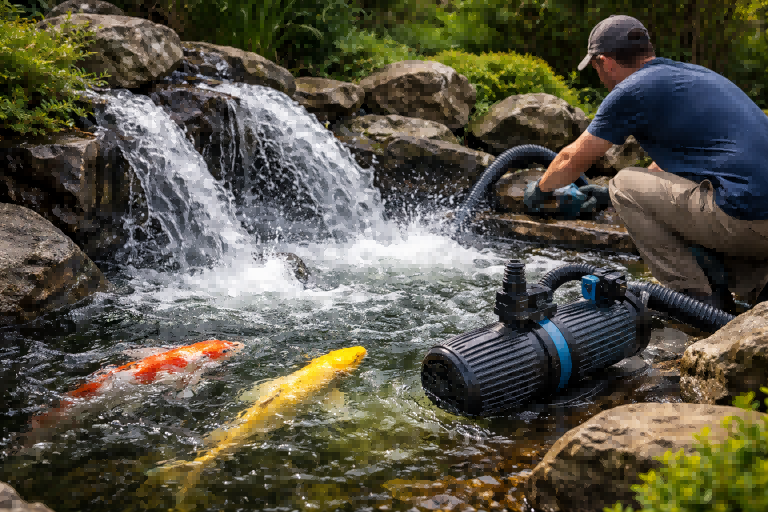
The allure of "more power" is strong.
However, in the world of pond ecosystems, balance is far more important than brute force.
A pump that is too strong disrupts this delicate equilibrium, creating a cascade of problems that are often expensive and difficult to fix.
Instead of guessing, the key is to understand the specific needs of your pond and choose a pump that meets them precisely.
This means looking beyond a single "horsepower" number and diving into the two critical factors that define a pump's performance: flow rate and head pressure.
Finding the Right Balance: Head vs. Flow Rate
Choosing a pump based on one number is a recipe for disaster.
You might get a pump that can't lift water to your waterfall, or one that creates a useless trickle.
A pump's power is defined by two factors: flow rate (volume) and head (pressure). An overpowered pump is one where either or both are excessively high for the pond's needs, creating imbalance.
The term "power" is misleading when it comes to pumps.
True performance is a careful balance between two distinct, interconnected metrics.
Understanding them is the first step to selecting the right pump and avoiding the "too powerful" problem.
Deconstructing Power: The Two Key Metrics
Every pump has a performance curve that shows the relationship between these two factors.
You must consider both to make an informed choice.
- Flow Rate (GPH/LPH): This is the volume of water the pump can move in a given amount of time, measured in gallons per hour (GPH) or liters per hour (LPH). High flow is needed for good circulation and wide, full waterfalls. A pump with a high-flow centrifugal design, like one with a plastic or stainless steel impeller, is built for this.
- Head (Feet/Meters): This is the amount of vertical pressure the pump can generate. It represents its ability to push water upwards. High head is essential for tall waterfalls or pumping water over long distances. A pump with a low-flow, high-head design, like a screw pump, excels at this task but would be unsuitable for simple pond circulation.
An oversized pump is one where the flow rate is too high for the pond's volume, or the head pressure is much greater than what's needed to lift the water.
This imbalance is where the problems begin.
Matching the Pump to the Pond
To avoid an overpowered system, you must match the pump's capabilities to your pond's specific requirements.
- For Circulation: A good rule of thumb is to choose a pump that can circulate the entire volume of your pond at least once every one to two hours. For a 2,000-gallon pond, you would want a pump with a flow rate of at least 1,000-2,000 GPH.
- For Waterfalls: You need to calculate the "Total Dynamic Head." This includes the static head (the vertical height from the pump to the top of the waterfall) plus the friction loss from the pipes. The pump you choose must be able to provide your desired flow rate at that specific head height.
A pump that provides 4,000 GPH at zero head might only provide 2,000 GPH at a 10-foot head.
Failing to account for head pressure is a common reason people accidentally buy a pump that is either too weak or far too powerful for their setup.
| Pond Task | Required Metric | Pump Type Example | Consequence of Being "Too Powerful" |
|---|---|---|---|
| General Circulation | High Flow Rate | Plastic/SS Impeller Pump | Creates a whirlpool effect, stressing fish. |
| Tall Waterfall | High Head Pressure | Screw Pump (for very high head) | Can create excessive splashing and noise. |
| Small Fountain | Low Flow, Low Head | Small Centrifugal Pump | Can empty a small basin quickly; wastes energy. |
The Hidden Dangers of an Oversized Pond Pump
You think a bigger pump is a smart investment for a cleaner pond.
But soon you notice your fish hiding, plants uprooted, and your electricity bill climbing, turning your investment into a liability.
An oversized pump is actively harmful. It causes chronic stress in fish, erodes pond liners and landscapes, wastes a significant amount of energy, and wears itself out prematurely, costing you more money.
The phrase "too much of a good thing" perfectly describes an overpowered pond pump.
While water circulation is vital, excessive circulation is destructive.
The consequences go far beyond a little extra splashing.
They impact the health of your pond life, the structural integrity of your pond, and your finances.
Let's break down the specific dangers.
The "Tornado Effect" on Fish and Plants
A pond should be a calm sanctuary, not a constant workout.
- Chronic Stress on Fish: Fish like koi and goldfish are not built to fight strong, continuous currents. A too-powerful pump creates a relentless flow that forces fish to constantly struggle to stay in one place. This chronic stress weakens their immune systems, making them more susceptible to diseases and parasites, and it can ultimately shorten their lifespan. They will often hide in calmer corners, unable to enjoy the full space of the pond.
- Uprooting Aquatic Plants: The powerful jet of water from an oversized pump can act like a pressure washer. It will dislodge and uproot lilies, reeds, and other aquatic plants, destroying the look of your pond and disrupting the ecosystem. The constant current can also tear delicate leaves and stems.
Structural Damage and Erosion
The force of water is relentless and will find the weakest point in your pond's construction.
- Liner and Landscape Erosion: An overly strong current can get underneath the folds of a pond liner, causing it to lift and shift. It can erode the soil and substrate around the pond's edges and wash away gravel and decorative stones, leading to costly repairs and a messy appearance.
- Feature Damage: Waterfalls and streams are designed for a certain flow. Too much volume can cause water to jump outside the designated channel, leading to water loss and erosion of the surrounding landscape.
Financial and Mechanical Costs
The damage isn't just ecological; it's mechanical and financial.
- Wasted Energy: A larger pump uses significantly more energy. This is especially critical for solar-powered systems. An oversized pump might require 30-50% more solar panel capacity and a larger battery bank to run, dramatically increasing system cost. Even on grid power, this translates directly to a higher monthly electricity bill.
- Premature Pump Failure: Pumps are designed to operate most efficiently within a specific range of their performance curve. Restricting the flow of a very powerful pump (e.g., with a small-diameter pipe) can cause cavitation—the formation of damaging vapor bubbles—or make the motor run hot. This strain causes excessive wear on bearings and impellers, leading to a much shorter operational lifespan.
Choosing the Right Power Source: The BLDC Motor Advantage
Your pump is oversized, wasting energy every minute it runs.
For solar pumps, this means you need more panels, raising costs and complexity, and the pump may not even run on cloudy days.
A high-efficiency BLDC motor is the solution. It uses over 90% of a solar panel's energy for pumping, reducing waste, lowering the number of panels needed, and ensuring reliable operation even in low light.
The problem of an overpowered pump is fundamentally a problem of inefficiency.
It's about applying more force—and using more energy—than is necessary.
The smartest way to avoid this is to start with the most efficient technology available.
In the world of solar pumps, this is the Brushless DC (BLDC) permanent magnet motor.
It's a core component that directly impacts whether your pump is well-matched or simply overpowered.
Why Motor Efficiency Is Non-Negotiable
A motor's job is to convert electrical energy into mechanical motion.
How well it does this is called its efficiency rating.
- Old Technology (Brushed Motors): Many standard or cheap pumps use brushed motors with an efficiency of only 50-60%. This means for every 100 watts of power from your solar panel, 40-50 watts are wasted as heat. This is raw, unusable power that contributes to an "overpowered" system in the worst way—by generating heat, not flow.
- Modern Technology (BLDC Motors): A premium solar pump uses a BLDC motor. These motors use powerful magnets and advanced electronics to achieve efficiencies of over 90%. That same 100 watts of solar power now delivers 90+ watts of pumping power.
The Practical Benefits of 90%+ Efficiency
This massive leap in efficiency translates directly into a more appropriately sized and cost-effective system.
- Smaller Solar Array Needed: Because a BLDC motor does more with less, it requires a smaller, less expensive solar panel array to achieve the same flow rate as a less efficient pump. A system that might have needed a 300-watt panel with a brushed motor may only need a 200-watt panel with a BLDC motor, representing a 33% cost saving on panels alone.
- Better Performance in Low Light: The high efficiency means the motor needs less of a "jolt" of power to start and run. As a result, BLDC-powered pumps start earlier in the morning, run later in the evening, and continue to operate on overcast days when inefficient pumps would have stopped. This provides more consistent circulation without being "overpowered."
- Longer Lifespan and Reliability: The brushless design has no parts that physically wear out, unlike the brushes in older motors. This not only makes the motor virtually maintenance-free but also significantly extends its operational lifespan, ensuring your correctly sized pump runs reliably for years.
Choosing a pump with a high-efficiency BLDC motor is the first step in smart sizing.
It ensures that the power you're paying for—whether in panels or electricity—is being used to move water, not to generate waste heat.
| Motor Type | Energy Efficiency | Benefit for Sizing | Cost Implication |
|---|---|---|---|
| Standard Brushed Motor | 50% - 60% | Requires more power, leading to oversized panels. | Higher initial panel cost, higher running cost. |
| High-Efficiency BLDC Motor | > 90% | Achieves target flow with less power. | Lower panel or electricity cost, better value. |
The Ultimate Solution: A Controller for Total Power Management
You bought a solar pump, but on rainy weeks your pond is stagnant.
Or, you have a powerful pump that you can't turn down, creating a constant whirlpool.
The ultimate solution is an intelligent controller, especially an AC/DC hybrid model. It lets you adjust pump speed to prevent overpowering, and it guarantees 24/7 operation by automatically using grid power when solar is unavailable.
Sizing a pump correctly is crucial, but what if your needs change?
What if you want a gentle flow during spawning season but a powerful waterfall when guests are over?
And what if you need guaranteed circulation 24/7, regardless of the weather?
The answer isn't to buy multiple pumps.
The answer is to have total control over a single, high-quality pump.
This control is provided by an intelligent pump controller.
From On/Off to Smart Management
A basic solar setup connects a panel directly to a pump.
A superior system places a controller in between.
- MPPT (Maximum Power Point Tracking): Every modern solar controller should have MPPT. This technology acts like an intelligent transmission, constantly adjusting the electrical load to extract the maximum possible wattage from the solar panel as sun conditions change. A system with an MPPT controller can be up to 30% more effective than one without, meaning more water is pumped throughout the day.
- Variable Speed Control: The most empowering feature for preventing an "overpowered" situation is variable speed control. Many advanced controllers allow the user to dial the pump's speed up or down. This means you can run the same pump at 100% for a dramatic waterfall effect, but turn it down to 50% for quiet, gentle, energy-saving circulation overnight or for delicate fish.
The Game-Changer: AC/DC Hybrid Capability
The most advanced controllers solve the final problem of solar power: its intermittency.
An AC/DC hybrid controller provides the ultimate peace of mind and flexibility.
It features two power inputs: one for the DC power from solar panels and another for AC power from the grid or a generator.
The controller's logic is designed for maximum efficiency and reliability:
- Solar Priority: It will always use 100% free solar power first when available.
- Smart Hybrid Blending: If clouds reduce solar input, it will draw the maximum available power from the panels and supplement it with just enough AC power to maintain the desired speed.
- Automatic AC Backup: At night or during extended bad weather, it automatically switches entirely to AC power, ensuring your pond never goes without circulation.
This system gives you the best of all worlds: the low running cost of solar with the 24/7 reliability of a traditional electric pump.
It is the final piece of the puzzle, transforming a standalone pump into a fully managed, perfectly sized water circulation system.
Conclusion
Yes, a pump can be too powerful.
The solution is a balanced system: a high-efficiency BLDC motor, the right pump type, and an intelligent controller for total power management.
Frequently Asked Questions
What happens if my pond pump is not strong enough?
A weak pump leads to poor water circulation, oxygen depletion, algae growth, and an inability to run features like waterfalls, creating a stagnant and unhealthy pond.
How big of a solar panel do I need for a pond pump?
This depends on the pump's wattage and your location. A pump with a high-efficiency BLDC motor will require a smaller, less expensive panel than an inefficient pump of the same flow rate.
Should I run my pond pump 24/7?
Yes, running your pump 24/7 is crucial for maintaining stable oxygen levels and water quality, especially in ponds with fish. An AC/DC hybrid system is perfect for this.
Can I use a fountain pump for a pond filter?
Generally, no. Fountain pumps are often designed for low flow and can't provide the high volume needed to push water through most biological and mechanical pond filters effectively.
How do I reduce the flow of my pond pump?
The best way is with a variable speed controller. Partially closing a valve on the output side can also work, but this puts extra strain on the pump and wastes energy.
Does a bigger pump use more electricity?
Yes, absolutely. A pump with a higher flow rate and head pressure will have a higher wattage and will consume more electricity, increasing your monthly bill.
How often should a pond pump turn over the water?
The general rule is to turn over the entire volume of your pond at least once every two hours. For heavy fish loads or hot climates, once every hour is better.