You need a reliable off-grid water solution.
You worry about the cost and complexity of batteries.
This hesitation stops you from adopting a simpler, more effective solar setup.
Yes, a solar pump can and absolutely should work without a battery. Modern systems are designed for direct-drive operation from solar panels, storing pumped water in a tank instead of storing electricity. This is a far more reliable, cost-effective, and efficient approach.
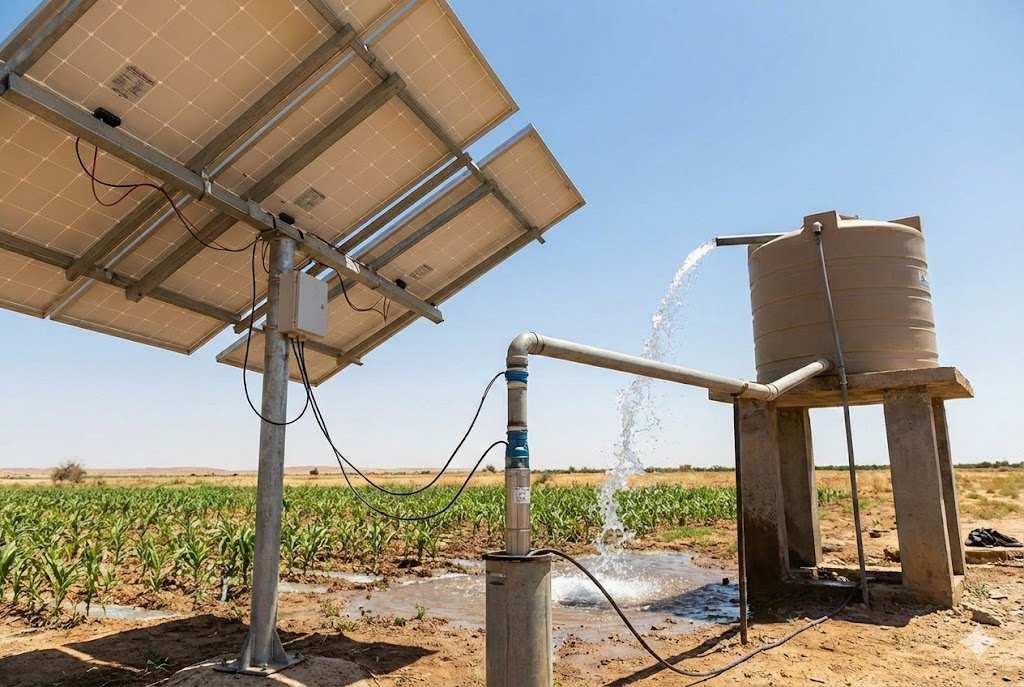
This battery-free design represents a major advancement in solar pumping technology.
In the past, the unstable power from solar panels often necessitated batteries to provide a smooth, consistent electrical supply for inefficient motors.
That is no longer the case.
The innovation lies in a complete system overhaul, starting with the motor itself.
By pairing hyper-efficient motors with intelligent controllers, modern solar pumps can expertly manage the variable power of the sun.
This elegant solution shifts the focus from storing failure-prone electricity to storing the valuable end product: water.
Let's explore the core technologies that make this simple and robust approach the industry standard.
The Power Core: Understanding Direct-Drive Technology**
You need maximum efficiency from your solar array investment.
Inefficient motors waste precious solar energy, forcing you to buy more panels.
A smarter, more efficient motor is the solution.
The heart of a battery-free solar pump is the high-efficiency Brushless DC (BLDC) permanent magnet motor. Its ability to operate effectively on variable DC power directly from solar panels eliminates the need for a battery to stabilize the energy supply.
The BLDC motor is the game-changing technology that makes direct-drive solar pumping possible.
It is purpose-built for solar applications.
Unlike older motor types that struggle with fluctuating voltage and current, the BLDC motor excels.
It achieves efficiencies of over 90%, whereas a typical AC motor paired with an inverter might only reach 75% system efficiency.
This massive 15%+ efficiency gain is critical.
It means the pump can start working earlier in the morning with less intense sunlight and continue working later in the afternoon.
This extended daily runtime directly translates into more water pumped.
The motor is paired with an intelligent Maximum Power Point Tracking (MPPT) controller.
This controller acts as the brain of the system.
It constantly analyzes the output from the solar panels and adjusts the electrical load to extract the absolute maximum power available at any given moment.
It then finely tunes the motor's speed to match this available power, ensuring smooth, continuous operation from dawn until dusk without stalling.
The Technical Edge of Brushless DC Motors
For a distributor, understanding the technical superiority of BLDC motors is key to explaining the value proposition to customers.
- Unmatched Efficiency: A BLDC motor converts over 90% of electrical energy into mechanical power. This high efficiency can reduce the required number of solar panels by up to 25%, significantly lowering the initial system cost.
- Variable Speed Operation: The MPPT controller allows the motor to run at variable speeds. It will run slower in low light (e.g., cloudy conditions) and at full speed in bright sun, maximizing water pumped throughout the day instead of needing a fixed power level from a battery.
- Superior Reliability and Lifespan: BLDC motors have no brushes, which are the primary wear component in traditional DC motors. This maintenance-free design leads to an operational lifespan that often exceeds 25,000 hours, providing years of dependable service.
Comparing Motor Technologies
The advantages become clear when compared directly to older technologies.
| Feature | BLDC Permanent Magnet Motor | Traditional AC Induction Motor |
|---|---|---|
| System Efficiency | >90% | ~75% (with inverter) |
| System Cost | Lower (fewer panels needed) | Higher (more panels, inverter) |
| Maintenance | None (brushless design) | Varies, potential for failure |
| Lifespan | Very Long (25,000+ hours) | Good |
| Solar Optimization | Excellent (with MPPT) | Poor (requires stable power) |
The BLDC motor isn't just a component; it's the core enabler of the modern, efficient, battery-free solar pumping system.
The Smart Strategy: Storing Water, Not Electricity**
You need water at night or on cloudy days.
You assume this requires a complex battery bank.
Storing water is a much simpler, cheaper, and more reliable alternative.
Instead of storing electricity in failure-prone batteries, the best practice is to pump extra water into a storage tank during peak sun hours. This "water battery" provides a reliable supply 24/7 without electronic complexity or maintenance.
The concept of using a water tank as a storage system is brilliant in its simplicity.
The solar pump runs during the day, filling the tank.
The water in the tank is then available on demand, day or night, through gravity or a small pressure pump.
This method completely decouples water availability from direct sunlight.
This simple mechanical solution is vastly superior to the complex and costly electrochemical solution of a battery bank.
Batteries are a system's weakest link.
They are expensive, have a limited lifespan of only 3 to 5 years, require a separate charge controller, and their performance degrades in extreme temperatures.
They also introduce significant energy losses, as up to 20% of the power can be lost during the charge and discharge cycles.
A water tank, by contrast, is a robust, passive component.
It has no electronics to fail, can last for over 20 years with minimal maintenance, and has zero energy loss.
The water stored is 100% available when needed.
The Economic Case for Water Storage
For a business owner like Andrew in Australia, presenting a clear cost-benefit analysis is crucial.
- Lower Upfront Cost: While a large tank has an initial cost, it is often comparable to or less than a properly sized battery bank and charge controller system designed to provide the same level of water security.
- Massively Reduced Total Cost of Ownership: The primary economic advantage is the elimination of battery replacement costs. Over a 20-year period, a battery-based system would require 4-6 full battery replacements, costs that a tank-based system completely avoids.
- Increased System Simplicity: Fewer components mean lower installation costs and fewer potential points of failure, reducing long-term service and warranty claims for distributors.
Comparing Storage Methods
The superiority of storing water is evident across every important metric.
| Feature | Battery Storage | Water Tank Storage |
|---|---|---|
| Initial Cost | High | Moderate |
| Lifespan | 3-5 Years | 20+ Years |
| Maintenance | High (monitoring levels, connections) | Very Low (occasional cleaning) |
| Reliability | Moderate (sensitive to temperature, cycles) | Extremely High (passive system) |
| Energy Efficiency | ~80-90% (charge/discharge losses) | 100% (gravity-fed use) |
For virtually all agricultural, livestock, and domestic off-grid water applications, storing water is the technically and financially superior strategy.
The Hybrid Option: When You Need 24/7 Pumping**
Your application cannot rely on stored water.
You might need continuous pumping for industrial processes or emergency systems.
You believe this forces you back to using batteries.
In rare cases requiring continuous, non-stop pumping, a hybrid AC/DC controller offers a sophisticated, battery-free solution. This controller automatically switches between solar power and a grid or generator source, ensuring uninterrupted operation.
For those specific, critical applications where water must be pumped around the clock, there is a solution that is still far better than batteries.
This is the hybrid or AC/DC solar pump system.
This advanced setup uses a special controller with inputs for both DC power from solar panels and AC power from the electrical grid or a generator.
The controller's intelligence lies in its ability to prioritize solar power.
Whenever there is sufficient sunlight, the system runs exclusively on free energy from the sun.
As the sun fades or clouds roll in, the controller can blend in AC power to maintain the required flow rate.
When there is no sunlight at all, such as at night, it will automatically switch over to run entirely on the AC source.
This "solar-first" logic ensures that the more expensive grid or generator power is only used when absolutely necessary.
This provides the 24/7 operational guarantee that some applications demand without the cost, maintenance, and reliability issues associated with battery banks.
How Hybrid Systems Maximize Efficiency
The hybrid controller is a strategic tool for optimizing both performance and cost in mission-critical scenarios.
- Prioritizing Free Energy: The control logic is designed to maximize the use of solar energy. It will use 100% solar whenever possible, reducing operational electricity costs by up to 80% or more compared to a standard AC pump.
- Seamless Power Blending: On partly cloudy days, the controller can intelligently mix solar and AC power. If the panels are providing 70% of the needed power, it will only draw the remaining 30% from the grid, ensuring no solar energy is wasted.
- Uninterrupted Reliability: The automatic switchover function guarantees that the water supply will never be interrupted due to a lack of sunlight. This is essential for applications like community water supply, critical irrigation cycles, or industrial cooling processes.
Choosing the Right System for the Job
Understanding when to recommend a hybrid system is key for a distributor serving a diverse market.
| Application Need | Standard Direct-Drive System | Hybrid AC/DC System | Battery System |
|---|---|---|---|
| Farm & Livestock (Tank Storage) | Ideal Solution | Overkill | Not Recommended |
| Domestic Water (Tank Storage) | Ideal Solution | Overkill | Not Recommended |
| Non-stop Industrial Process | Not Suitable | Ideal Solution | Possible but less reliable |
| Critical Community Water Supply | Not Suitable | Ideal Solution | Possible but high maintenance |
The AC/DC hybrid pump is the professional's choice for applications that demand both the economic benefits of solar and the absolute certainty of 24/7 operation.
Conclusion
A solar pump can work without a battery.
In fact, for over 99% of applications, a direct-drive system that stores water in a tank is the superior technical and financial solution.
Frequently Asked Questions
What are the disadvantages of solar water pumps without batteries?
The main disadvantage is that they only pump water when the sun is shining. This is easily solved by pumping into a water storage tank for 24/7 water access.
How do I store water from a solar pump?
The best method is to use the solar pump to fill a large, elevated water tank during the day. Water can then be gravity-fed out of the tank whenever it's needed.
Can solar panels run a pump directly?
Yes, modern solar pump systems with high-efficiency BLDC motors and MPPT controllers are designed to run directly and efficiently from the variable DC power produced by solar panels.
How long will a solar water pump last?
A high-quality solar pump system can last for decades. The solar panels are typically warrantied for 20-25 years, and the brushless motor can operate for over 25,000 hours.
Do I need an inverter for a solar water pump?
No, a DC solar water pump does not need an inverter. Its DC motor runs directly from the DC power produced by the solar panels, making the system simpler and more efficient.
Can a solar pump run an AC motor?
You can run a standard AC pump with solar panels, but it requires a large solar array and a specialized, expensive solar pump inverter. A native DC pump is far more efficient.