Struggling with unreliable power for your water needs?
A direct connection seems simple, but it often leads to pump damage and poor performance, wasting your investment.
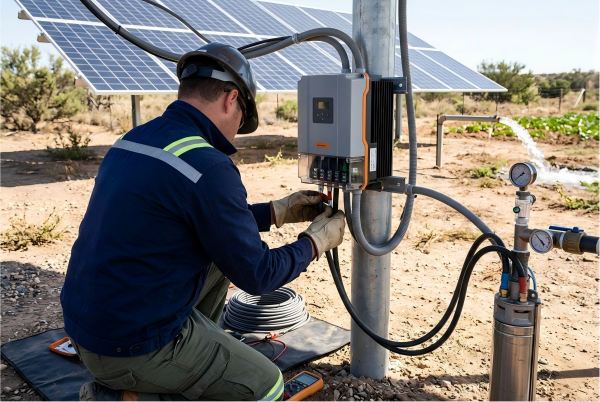
No, you should not connect a solar panel directly to a pump.
It requires a controller, specifically an MPPT (Maximum Power Point Tracking) controller.
This device regulates voltage and current from the panels, protecting the pump motor and maximizing water output by optimizing power usage.
Connecting a solar panel straight to a pump motor is a common idea.
It seems like the most direct way to get water flowing.
However, this approach misses a critical component that ensures both efficiency and longevity.
The sun's intensity changes throughout the day, causing power fluctuations that can harm your pump.
Understanding the complete system, from panel to motor, is key to building a reliable and cost-effective water solution.
Let's explore the essential components that make solar pumping not just possible, but highly effective for various needs.
Understanding the Core: The BLDC Motor
Tired of inefficient motors that inflate your solar panel requirements?
High energy consumption means buying more panels and bigger systems, driving up initial project costs significantly.
The heart of a modern solar pump is the high-efficiency BLDC motor.
This permanent magnet brushless motor boasts efficiencies over 90%.
It converts more solar energy into pumping power, reducing the number of solar panels needed and lowering overall system costs from day one.
The motor is the engine of your solar water pump system.
Its performance directly dictates the entire system's efficiency and cost-effectiveness.
While the pump head moves the water, the motor provides the power to do so.
Choosing an inefficient motor is like building a high-performance car with a weak engine; you'll never get the results you expect.
A superior motor not only delivers more power but also does so with less energy.
This is where the Brushless DC (BLDC) permanent magnet motor changes the game for solar water pumping.
Let's dive deeper into why this technology is so crucial for distributors and end-users aiming for reliability and long-term value.
What Makes BLDC Motors Superior?
The design of a BLDC motor eliminates the need for brushes, which are a common point of failure in traditional DC motors.
This brushless design drastically reduces maintenance needs and extends the motor's operational lifespan.
The use of powerful permanent magnets, often made from materials like 40SH neodymium iron boron, is another key factor.
These magnets create a strong and consistent magnetic field, enabling the motor to generate high torque even at low speeds.
Key Technical Advantages
A closer look reveals several technical benefits that translate into real-world market value.
The efficiency of these motors, often exceeding 90%, is a standout feature.
This means that for every 100 watts of power generated by your solar panels, over 90 watts are converted into mechanical energy to drive the pump.
This is a significant improvement over older motor technologies.
Furthermore, BLDC motors have a superior power-to-weight ratio.
They are remarkably compact and lightweight for the power they produce.
For instance, they can be up to 47% smaller and 39% lighter than traditional motors of similar output.
This simplifies transportation and installation, which is a major advantage in remote or off-grid locations where heavy equipment is difficult to manage.
Market and Strategic Value
For a distributor, offering products with high-efficiency BLDC motors is a powerful competitive advantage.
Your customers can achieve their water pumping goals with a smaller, more affordable solar array.
This lowers the barrier to entry and makes the entire solution more attractive.
For the end-user, the benefits are clear: lower initial investment, reduced operating costs, and a system that is virtually maintenance-free.
The motor's long service life ensures a reliable water supply for years, whether for a household, a farm, or livestock.
| Feature | Technical Advantage | Value Proposition |
|---|---|---|
| Efficiency | Exceeds 90% conversion of electricity to mechanical power. | Reduces the number of solar panels needed, lowering total system cost. |
| Design | Brushless with 40SH neodymium iron boron permanent magnet rotor. | Maintenance-free operation and a significantly longer service life. |
| Power Density | High torque output in a compact form. | Up to 47% smaller and 39% lighter, simplifying logistics and installation. |
| Reliability | No brushes to wear out; robust construction. | Ensures dependable water supply in critical off-grid applications. |
Ultimately, the BLDC motor is the strategic core of a modern solar pump.
It elevates the entire system's performance, making it a foundational element for any brand aiming to build a reputation for efficiency, durability, and environmental responsibility in the global market.
Choosing the Right Pump: Solar Screw Pumps
Need to get water from a very deep well but have limited power?
Many high-head pumps require massive energy inputs, making them unsuitable for small-scale solar systems in remote areas.
A solar screw pump is the ideal solution for low-flow, high-head applications.
It uses a stainless steel screw to efficiently push water from great depths.
This design makes it perfect for domestic water, livestock, and small irrigation, especially in electricity-scarce regions.
When your water source is hundreds of feet below ground, lifting that water to the surface becomes a major challenge.
You need a pump specifically engineered for high pressure, or "high head."
This is where the unique design of a progressing cavity pump, commonly known as a screw pump, truly shines.
Its mechanism is fundamentally different from a centrifugal pump, allowing it to generate immense pressure with minimal flow.
This makes it a go-to choice for specific but critical applications across the globe.
Let's examine how it works and where it fits best in a product portfolio.
How Does a Screw Pump Work?
A screw pump operates on the principle of positive displacement.
It contains two main components: a helical metal rotor (the "screw") and a resilient rubber stator.
As the rotor turns within the stator, it forms a series of sealed cavities that progress from the inlet to the outlet of the pump.
These cavities trap a fixed volume of water and push it upward.
This compression action is what allows the pump to build up very high pressure, overcoming the gravitational force of deep wells.
Ideal Applications and Environments
The screw pump's ability to deliver high head with low flow makes it exceptionally well-suited for several key scenarios.
Its primary use is in providing water for homes and livestock from deep boreholes.
In many parts of Africa and Latin America, where water tables are low and grid electricity is unavailable, these pumps are a lifeline.
They ensure a steady supply for drinking, cooking, and sustaining animals, even when powered by a modest solar array.
Strengths and Limitations
One of the most significant advantages of a solar screw pump is its exceptional resistance to sand and silt.
The rubber stator can flex to allow small abrasive particles to pass through without causing significant damage to the pump.
This durability is critical in areas with poor water quality or newly drilled wells.
In contrast, other pump types can quickly wear down and fail in such conditions.
However, the design does have limitations.
The primary one is its low flow rate.
The same mechanism that generates high pressure restricts the volume of water it can move.
Therefore, a screw pump is not suitable for applications requiring large volumes of water, such as irrigating large commercial farms.
It is a specialized tool, not a general-purpose one.
| Aspect | Solar Screw Pump (Progressing Cavity) |
|---|---|
| Primary Function | Low Flow, High Head |
| Mechanism | Stainless steel screw rotor and rubber stator create pressure. |
| Best For | Domestic water supply, livestock watering from deep wells. |
| Key Markets | Electricity-scarce regions like Africa and Latin America. |
| Advantages | Handles very deep wells, highly resistant to sand, reliable in harsh water. |
| Limitations | Limited flow volume, not suitable for large-scale irrigation. |
For a distributor, including a solar screw pump in your product range allows you to cater to customers with deep wells and modest water needs.
It fills a crucial niche that centrifugal pumps cannot, offering a robust and reliable solution where others would fail.
For High Volume Needs: Solar Plastic Impeller Pumps
Need to irrigate a farm or water a large pasture efficiently?
Many pumps can't deliver the high volume of water required for agriculture, or they wear out quickly in sandy conditions.
A solar plastic impeller pump provides a high-flow, wear-resistant solution.
This multi-stage centrifugal pump is built for volume.
Its durable engineered plastic impellers are excellent at handling fine sand, making it perfect for farm irrigation and pasture water supply.
When the goal is moving a large quantity of water, a different type of pump technology is required.
Applications like farm irrigation, filling large tanks, or watering extensive pastures prioritize flow rate over extreme pressure.
This is where multi-stage centrifugal pumps excel.
Among them, models equipped with plastic impellers offer a unique combination of performance, durability, and affordability.
They have become a popular choice in markets across Africa and the Americas for good reason.
Let's break down the features that make these pumps so effective for high-volume applications.
The Centrifugal Pumping Action
Unlike a screw pump, a centrifugal pump uses rotational energy to move water.
It features a series of impellers, which are like spinning turbines.
As the impellers rotate at high speed, they fling water outward through centrifugal force, increasing its velocity.
A diffuser then converts this velocity into pressure, pushing the water up and out of the pump.
In a multi-stage pump, water passes through several impeller-diffuser sets in sequence, with each stage adding more pressure.
This design is ideal for producing high flow rates at a medium head.
The Role of the Plastic Impeller
The choice of impeller material is critical to a pump's performance and longevity.
Modern solar pumps often use high-strength, engineered plastic (like PPO) for their impellers.
This might seem counterintuitive, as metal is often associated with strength.
However, these specialized polymers offer several distinct advantages.
First, they are highly resistant to abrasion from fine sand.
The material has a degree of flexibility that allows it to withstand the impact of small particles without chipping or wearing down quickly.
This makes plastic impeller pumps a more durable choice than many metal alternatives in slightly sandy water conditions.
Second, plastic is lightweight.
This reduces the overall weight of the pump, making it cheaper to ship and easier to install.
Finally, manufacturing impellers from plastic is generally more economical, which helps keep the final product cost-competitive.
Strengths and Limitations
The main strength of this pump type is its ability to deliver high water output.
It's the workhorse for agricultural and ranching applications where volume is king.
Its excellent resistance to fine sand, combined with its lightweight and economical nature, makes it a highly practical choice for a broad range of customers.
It is widely adopted in major agricultural regions in Africa and the Americas for these very reasons.
However, it is not a universally perfect solution.
The durability of plastic impellers can be a limitation in certain environments.
They are not well-suited for highly corrosive water with high acidity or alkalinity.
Furthermore, in very deep wells that require extremely high pressure, the structural integrity of plastic may be less reliable than stainless steel over the long term.
| Aspect | Solar Plastic Impeller Pump (Centrifugal) |
|---|---|
| Primary Function | High Flow, Medium Head |
| Mechanism | Multiple rotating plastic impellers create centrifugal force. |
| Best For | Farm irrigation, pasture water supply, filling large tanks. |
| Key Markets | Agricultural regions in Africa and the Americas. |
| Advantages | High water output, excellent fine sand resistance, lightweight, economical. |
| Limitations | Not ideal for highly corrosive water or extremely deep wells. |
For distributors, the solar plastic impeller pump is a core product.
It addresses the largest segment of the market: agriculture.
By offering a reliable, high-flow, and cost-effective pump, you can meet the needs of a huge customer base.
The Premium Choice: Solar Stainless Steel Impeller Pumps
Facing corrosive water that destroys standard pumps?
Acidic or alkaline water can quickly corrode and ruin pump components, leading to frequent, costly replacements and system downtime.
A solar stainless steel impeller pump is designed for maximum durability.
Built with SS304 stainless steel impellers and casings, it offers superior corrosion resistance.
This makes it the premium choice for harsh water conditions, ensuring a long service life and high reliability.
For some applications, standard durability is not enough.
When water conditions are aggressive—either highly acidic or alkaline—or when a project demands the utmost reliability and longevity, a premium solution is required.
This is the niche filled by solar pumps constructed with stainless steel components.
These pumps are engineered to withstand environments that would quickly degrade lesser materials.
They represent the top tier of solar pumping technology, targeting high-end and specialized markets.
Let's explore why stainless steel makes a critical difference.
The Power of Stainless Steel
The key component in these premium pumps is SS304 grade stainless steel.
This material is used for both the impellers and the pump body (wet end).
SS304 is an alloy renowned for its exceptional resistance to a wide range of corrosive agents.
Unlike standard steel or even some plastics, it does not rust or degrade when exposed to acidic or alkaline water.
This inherent corrosion resistance is the primary reason for its use in demanding water pumping scenarios.
Where is This Pump Essential?
These pumps are not for every customer, but for some, they are the only viable option.
Consider the alkaline soil regions found in parts of Australia, where groundwater can be highly corrosive.
Or think of areas with industrial or agricultural runoff that alters the water's pH.
In these environments, a standard pump might fail in a matter of months.
A stainless steel pump, however, can provide reliable service for many years.
They are also the preferred choice for high-end homes, exclusive ranches, and commercial operations where system failure is not an option and long-term reliability justifies a higher initial investment.
Strengths and Limitations
The standout advantage is unmatched durability.
High corrosion resistance directly translates to a longer service life and greater system reliability.
For an end-user in a harsh water environment, this means peace of mind and a lower total cost of ownership over the pump's lifespan, despite the higher upfront price.
These pumps can also handle high flow rates and medium-to-high head requirements, making them versatile performers.
The main limitations are cost and weight.
Stainless steel is a more expensive raw material than engineered plastic, and it is more difficult to manufacture.
This results in a higher purchase price.
It is also significantly heavier, which can add to shipping costs and make installation more labor-intensive.
Because of these factors, the stainless steel impeller pump targets a more niche, high-end segment of the market that prioritizes long-term performance and durability above all else.
| Aspect | Solar Stainless Steel Impeller Pump (Centrifugal) |
|---|---|
| Primary Function | High Flow, High Durability |
| Mechanism | Multiple rotating SS304 stainless steel impellers create centrifugal force. |
| Best For | Corrosive (acidic/alkaline) water, high-end homes, critical applications. |
| Key Markets | Australia (alkaline soil), parts of the Americas, premium residential. |
| Advantages | Superior corrosion resistance, very long service life, high reliability. |
| Limitations | Higher initial cost, heavier weight compared to plastic models. |
For a distributor, offering a stainless steel option positions your brand as a provider of comprehensive, high-quality solutions.
It allows you to capture high-value projects and serve sophisticated customers who demand the best, cementing your reputation as a market leader.
Ensuring 24/7 Water: AC/DC Hybrid Systems
Worried about having no water on cloudy days or at night?
Solar-only systems are fantastic, but their reliance on sunlight means water access stops when the sun goes down or is obscured.
An AC/DC hybrid controller solves this problem entirely.
It automatically switches between solar power and a grid or generator source.
This ensures a seamless, 24/7 water supply, giving you complete peace of mind and operational certainty, day or night.
The single greatest limitation of a standard solar water pump is its dependence on the sun.
While perfect for many off-grid applications, what happens when you need water after sunset, during a string of overcast days, or for an operation that must run around the clock?
This is where the next evolution in solar pumping technology comes into play: the AC/DC hybrid system.
This innovative solution combines the best of both worlds—the free, clean energy of solar and the constant availability of AC power.
It transforms a solar pump from a daytime-only tool into a 24-hour workhorse.
How AC/DC Hybrid Controllers Work
The magic behind this system is the intelligent hybrid controller.
This device is designed with two separate power inputs: one for the DC power from your solar panels and another for AC power from the utility grid or a backup generator.
The controller's internal logic constantly monitors the available power sources.
Automatic and Intelligent Switching
Its primary mode is to use solar power whenever it is available.
The controller's MPPT function ensures it extracts the maximum possible energy from the panels at any given moment.
When sunlight is strong, the pump runs entirely on solar.
If clouds reduce the solar input, the controller can initiate its hybrid function.
It seamlessly blends AC power with the available DC power to maintain pump operation without interruption, always prioritizing the use of free solar energy.
When the sun sets and solar input drops to zero, the controller automatically switches over to the AC power source completely.
The entire process is automated, requiring no manual intervention.
The Value of Uninterrupted Water Supply
The ability to guarantee a 24/hour water supply is a game-changer for many users.
- For homes: It means you can take a shower, do laundry, or water your garden at any time, just as you would with a conventional grid-powered pump.
- For agriculture: Critical irrigation schedules can be maintained overnight or during rainy seasons, protecting crops and maximizing yields.
- For livestock: Animals have constant access to drinking water, which is essential for their health, especially in hot climates.
This technology bridges the gap between off-grid energy independence and on-grid reliability.
| Scenario | Power Source Logic | User Benefit |
|---|---|---|
| Bright Sunlight | Uses 100% DC solar power. | Zero-cost, environmentally friendly water pumping. |
| Partial Clouds | Blends available DC solar with AC grid/generator power. | Maintains consistent pump speed and water flow, maximizes solar use. |
| Nighttime / No Sun | Automatically switches to 100% AC grid/generator power. | Uninterrupted, 24/7 water supply for guaranteed access. |
By offering AC/DC hybrid pumps, distributors provide a premium solution that eliminates the primary concern associated with solar energy: intermittency.
It delivers true energy security and water supply confidence, making it a powerful upgrade for any critical water pumping system.
Conclusion
A solar pump, motor, and controller form a complete system.
Choosing the right combination ensures an efficient, durable, and cost-effective water solution tailored to your specific environmental and application needs.
FAQs
Do you need an inverter for a solar water pump?
Not for DC pumps.
They run directly on DC power from the panels via a controller.
An inverter is only needed for AC pumps or AC/DC hybrid systems using grid power.
What happens if you connect a solar panel directly to a DC motor?
The inconsistent voltage can damage the motor and lead to poor performance.
A controller is essential to regulate power, protect the pump, and maximize efficiency.
Does a solar pump need a controller?
Yes, absolutely.
A controller, especially an MPPT controller, optimizes the power from the solar panels and protects the pump motor from voltage fluctuations, ensuring longevity and efficiency.
Can a solar pump work without a battery?
Yes.
Most modern solar water pump systems are designed to operate without batteries.
They pump water when the sun is shining and stop when it's not, storing water in a tank.
How many solar panels do I need to run a water pump?
This depends on the pump's power rating (watts), the daily water volume needed, and your location's solar irradiance.
A professional can calculate the exact number for your system.
Can a 12V pump run on a solar panel?
Yes, a 12V pump can be powered by a 12V solar panel setup.
However, a charge controller is still highly recommended to protect the pump and stabilize the power supply.
What are the 3 main components of a solar pumping system?
The three core components are the solar panels (to generate electricity), the controller (to manage power), and the pump unit (motor and pump end) to move the water.
What is the difference between a solar submersible pump and a surface pump?
A submersible pump is placed underwater in a well or borehole.
A surface pump is located on the ground and pulls water from a source like a pond, river, or shallow well.