Irrigating your land with unreliable and costly grid power is a constant struggle.
These fluctuating expenses and power outages can severely impact your crop yields.
Solar water pumps provide a stable, cost-free energy source for your irrigation needs.
Yes, solar water pumps are exceptionally well-suited for irrigation.
From small-scale gardens to large commercial farms, there is a solar pump designed for the task.
Success depends on selecting the right pump type for your specific water source, field size, and irrigation method.
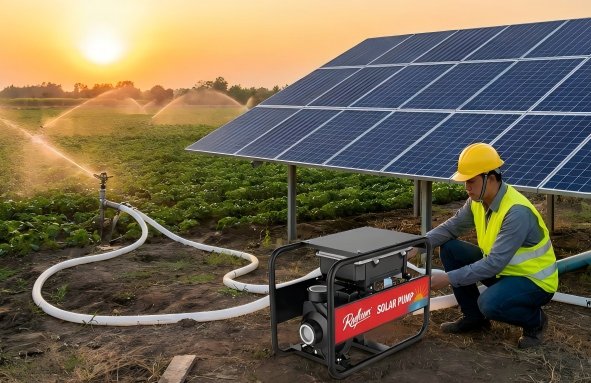
The answer is a definitive yes, but simply knowing that solar pumps work for irrigation isn't enough to guarantee success.
An effective solar irrigation system is more than just panels and a pump; it's a precisely engineered solution.
You must match the pump's capabilities to the unique demands of your land, the depth of your water source, and the type of crops you cultivate.
To ensure your investment delivers a reliable water supply and a strong return, you need to understand the different technologies available and how each one serves a very specific agricultural purpose.
Matching the Pump to Your Irrigation Needs
All irrigation systems are not created equal.
A pump that works for a small vegetable garden will fail on a large commercial farm.
Choosing the wrong technology leads to crop-damaging water shortages or wasted money on an oversized, underutilized system.
The solution is to understand the fundamental difference between water flow and pressure to select the perfect pump.
**Your choice depends on the scale and type of irrigation.
For drip systems or small plots drawing from a deep well, a high-pressure screw pump is best.
For large-scale sprinkler or flood irrigation requiring massive water volume, a high-flow impeller pump is the correct tool.
**
The two most critical factors in selecting an irrigation pump are flow rate and head.
Getting this balance right is the first step toward a successful solar-powered agricultural project.
Flow rate, measured in gallons per minute (GPM) or cubic meters per hour (m³/h), is the volume of water the pump can move.
Think of it as the 'how much' of your water supply.
Large-scale flood or pivot irrigation systems require a very high flow rate to cover vast areas quickly.
Head, measured in feet or meters, is the vertical distance the pump can lift water, also accounting for pressure lost to friction in the pipes.
Think of it as the 'how high' or 'how hard' the pump can push.
A deep well or a high-pressure drip irrigation network requires a high-head pump.
For High-Pressure, Low-Volume Needs: The Solar Screw Pump
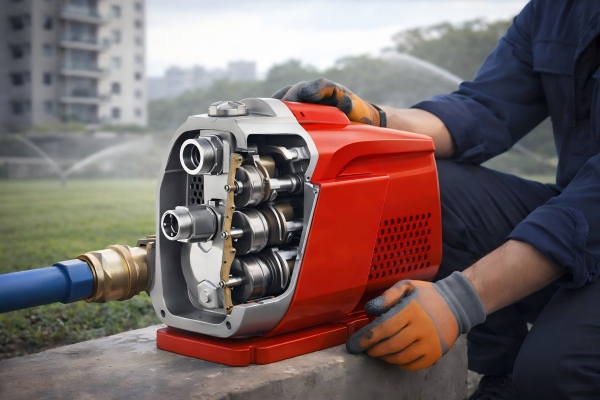
A solar screw pump, also known as a progressing cavity pump, is a specialist tool for high-head applications.
It doesn't use impellers to throw water.
Instead, it uses a helical stainless steel rotor spinning inside a rubber stator.
This action creates sealed cavities of water that are pushed 'progressively' up the pipe, generating immense pressure with very low pulsation.
This design is perfect for:
- Drip Irrigation: Drip systems require consistent pressure (high head) to ensure every emitter along the line delivers the same amount of water, but the total volume (flow) may be relatively low.
- Deep Well Sourcing: When your water source is a borehole hundreds of feet deep, you need a pump that can overcome that massive vertical lift.
A screw pump excels at this.
A key advantage is its exceptional resistance to sand and solids.
Because it pushes water rather than spinning it, it is less susceptible to wear from abrasive particles, making it extremely durable for use with unfiltered well water.
While its flow rate is limited, making it unsuitable for flooding acres of land, its ability to deliver high-pressure water from great depths is unmatched.
For High-Volume, Medium-Pressure Needs: The Solar Impeller Pump
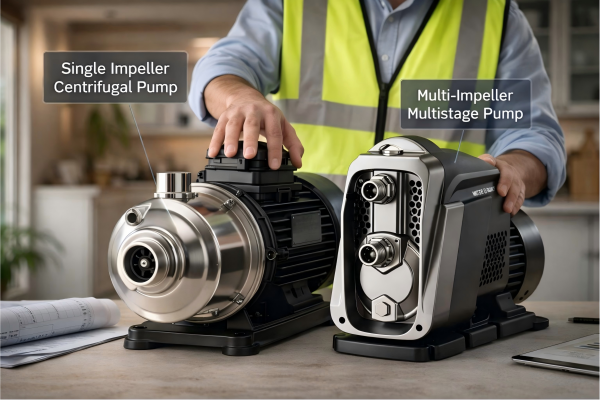
When the goal is to move the largest possible volume of water, a centrifugal impeller pump is the standard.
These pumps use one or more spinning impellers to accelerate water and generate flow.
They are the workhorses of agriculture.
For irrigation, they are available in two main configurations.
Plastic Impeller Pumps: These are multi-stage centrifugal pumps that offer an excellent balance of performance and cost.
They are designed to produce a high flow rate at a medium head, making them ideal for:
- Sprinkler and Pivot Systems: These methods need to move a lot of water to cover a wide area.
- Flood Irrigation: The primary need is maximum water volume to quickly inundate a field.
- Water Transfer: Moving water from a river or pond to a holding tank or directly to fields.
Their engineered plastic impellers are lightweight and surprisingly wear-resistant against fine sand.
This makes them a cost-effective choice for general farm and pasture irrigation in regions like Africa and the Americas.
Stainless Steel Impeller Pumps: This is the premium option for challenging water conditions.
The pump's internal components, including the impellers and casing, are made from SS304 stainless steel.
This provides superior defense against corrosion, making them essential for:
- Acidic or Alkaline Water Sources: Standard pumps would quickly degrade in these environments.
- Regions with Saline Soil: Common in parts of Australia and the Americas, where water can be corrosive.
- High-Reliability Applications: When system failure is not an option, the durability of stainless steel offers peace of mind and a longer service life.
While heavier and more expensive, the stainless steel pump is a long-term investment in durability for high-value agricultural operations.
| Feature | Solar Screw Pump | Solar Plastic Impeller Pump | Solar Stainless Steel Impeller Pump |
|---|---|---|---|
| Primary Function | High Pressure (Head) | High Volume (Flow) | High Volume (Flow) & Durability |
| Best For | Deep wells, Drip irrigation | Sprinkler/Flood irrigation | Corrosive water, Sprinkler/Flood |
| Flow Rate | Low | High | High |
| Head (Pressure) | Very High | Medium | Medium to High |
| Sand Resistance | Excellent | Good (fine sand) | Good (fine sand) |
| Cost | Mid-Range | Economical | Premium |
The Engine Driving Your Irrigation: BLDC Motor Efficiency
You want to power your irrigation with solar, but you worry about the high cost of large solar panel arrays.
The problem is that inefficient pumps waste a tremendous amount of precious solar energy.
The solution is a pump powered by a hyper-efficient motor, which drastically reduces the number of solar panels you need to buy.
**A Brushless DC (BLDC) permanent magnet motor is the core of a modern solar pump.
With an efficiency exceeding 90%, it turns more sunlight into water flow, allowing you to run your irrigation system with a 30-40% smaller and less expensive solar array.
**
An irrigation pump is only as good as the motor that drives it.
The single most important factor determining the overall cost and performance of your solar irrigation system is motor efficiency.
An inefficient motor acts like a tax on your solar array, wasting a huge portion of the energy it generates before it even does any work.
This is why the transition from old AC induction motors to modern Brushless DC (BLDC) permanent magnet motors has been a revolution for solar pumping.
Traditional motors might only be 65-75% efficient.
This means for every 1000 watts of solar power generated, up to 350 watts are immediately lost as waste heat.
You have to overbuild your solar array by up to 35% just to power this waste.
High-quality BLDC motors flip this equation.
They utilize powerful rare-earth magnets and an intelligent electronic controller to achieve efficiencies of over 90%.
Less than 10% of your solar energy is wasted.
The Market Value of High Efficiency
This efficiency translates directly into a lower total system cost and better performance.
-
Reduced Solar Panel Requirement: This is the biggest financial benefit.
A pump using a 90% efficient BLDC motor may require only a 3 kW solar array.
A less efficient pump doing the same work might need a 4.5 kW array.
This saving on panels and mounting hardware can be substantial. -
Improved Low-Light Performance: Because the motor requires fewer watts to start and run, the pump can begin operating earlier in the morning and continue later in the evening.
It can also perform better during periods of light cloud cover, extending your daily pumping window and increasing the total volume of water moved. -
Longer Lifespan and No Maintenance: BLDC motors have no brushes to wear out.
This eliminates the most common failure point in older DC motors, resulting in a maintenance-free design with a significantly longer operational lifespan. -
Smaller and Lighter: The high power density of BLDC motors means they are more compact and lightweight (up to 47% smaller and 39% lighter) than AC motors of equivalent power.
This simplifies transportation and installation, especially in remote locations.
When you invest in a solar pump, you are not just buying the pump head; you are investing in the motor.
Choosing a pump with a high-efficiency BLDC motor is the most critical decision for ensuring your irrigation system is both effective and financially viable.
Guaranteeing Water Flow: The AC/DC Hybrid Solution
You need to irrigate on a fixed schedule, but the sun is not always reliable.
What happens on cloudy days or if you need to run your system at night?
A system that depends only on the sun can be a major liability.
The answer is a hybrid controller that blends solar and grid power automatically.
**An AC/DC hybrid controller ensures your irrigation pump runs 24/7, regardless of the weather.
It prioritizes free solar energy but will automatically switch to or supplement with grid power when sunlight is insufficient, guaranteeing your crops always get water.
**
For any serious agricultural operation, reliability is non-negotiable.
While a pure DC solar pump is great for applications like filling a livestock trough where timing is flexible, crop irrigation often requires water at specific times, every single day.
A week of cloudy weather cannot mean a week without water.
This is where a hybrid AC/DC solar pumping system becomes an essential tool for modern agriculture.
It offers the best of both worlds: the cost-free energy of solar and the absolute reliability of the electric grid.
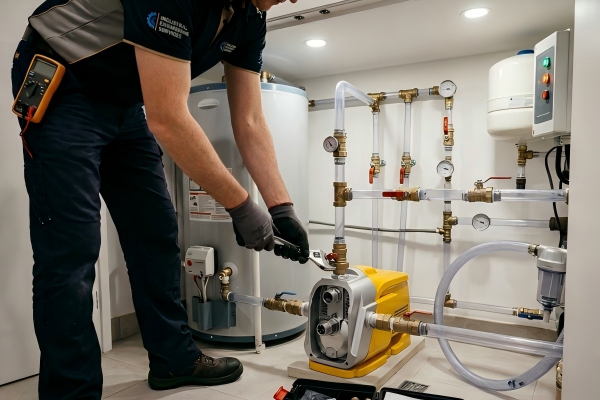
The system is built around an intelligent hybrid controller, or inverter, that acts as the system's brain.
This controller has two power inputs: one for the DC electricity from your solar panels and another for the AC electricity from the grid or a generator.
How a Hybrid System Ensures Reliability
The controller's software is designed to maximize your savings while guaranteeing uptime.
Its operation is completely automatic.
-
Solar-First Operation: The controller's default setting is to use 100% of the pump's power requirement from the solar panels.
On a clear, sunny day, your irrigation is running for free, and the grid connection is idle. -
Smart Power Blending: This is the most advanced feature.
If the clouds roll in and your solar array can only produce, for example, 70% of the power the pump needs to maintain its speed and pressure, the controller doesn't shut down.
Instead, it seamlessly draws the remaining 30% from the AC grid.
This ensures you use every single watt of free solar energy available before spending any money on paid electricity. -
Automatic AC Takeover: When the sun goes down or during prolonged heavy cloud cover, the solar input will drop to zero.
The controller detects this instantly and switches over to the AC input to power the pump.
This allows you to run irrigation schedules at night to reduce evaporation or simply keep to a strict watering schedule mandated by your crop type.
This hybrid approach removes all risk from solar irrigation.
You can confidently invest in a solar-powered system, knowing that it will deliver water whenever it is needed, automatically using the most cost-effective power source available at any given moment.
Conclusion
Solar pumps are a powerful and cost-effective tool for any irrigation project.
Your success hinges on matching the right pump technology and motor efficiency to your specific agricultural needs for a reliable water supply.
Frequently Asked Questions
What are the disadvantages of solar water pumps for irrigation?
The main disadvantages are the high initial investment cost and the dependence on sunlight.
A hybrid AC/DC system solves the sunlight issue by using grid power as a backup.
How many solar panels are needed for an irrigation pump?
This depends entirely on the pump's wattage, not its horsepower.
An efficient 1500-watt pump might need a 2 kW array (5-7 panels), while an inefficient pump needs more.
How deep can a solar pump pull water for irrigation?
Solar submersible pumps are designed for wells hundreds of feet deep.
High-pressure screw pumps are specifically made for these deep-well, high-head agricultural applications.
Can solar pumps work for drip irrigation?
Yes, they are ideal.
A solar screw pump is perfectly suited for drip irrigation, as it provides the high, consistent pressure needed for drip emitters to function correctly.
Which motor is best for a solar water pump?
A Brushless DC (BLDC) permanent magnet motor is the best.
Its high efficiency (over 90%) means you need fewer solar panels, and it offers a longer, maintenance-free life.
How much does a solar irrigation system cost?
Costs vary widely from a few thousand dollars for a small system to tens of thousands for a large farm.
The price depends on pump size, well depth, and required solar array size.
Do I need batteries for a solar irrigation pump?
Generally, no.
It's more cost-effective to pump water into a storage tank during the day and use gravity-fed irrigation, or to use a hybrid AC/DC system for nighttime operation.