Tired of running expensive, noisy power lines to your pond?
This can limit your design freedom and add to your monthly utility bills, making your water feature a burden.
Yes, you can absolutely run a pond pump on solar power. Modern systems use highly efficient motors and intelligent controllers, making them powerful and reliable enough for aeration, filtration, and waterfalls.
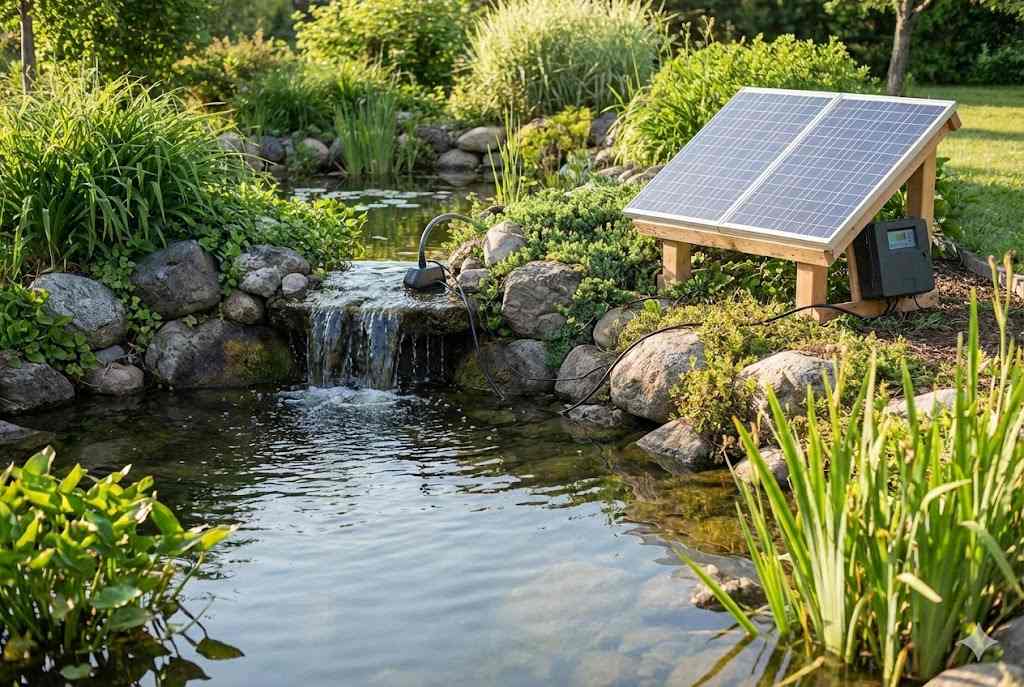
The idea of a solar-powered pond often brings to mind small, weak fountains that barely bubble.
Those days are long gone.
The technology that drives industrial-grade solar water pumps for deep wells in Africa and agricultural irrigation in Australia is now available for residential and commercial ponds.
This means you are no longer limited by the grid.
You can place your pond anywhere you like, powered by a clean, free, and silent energy source.
The key is understanding the components that make up a modern, high-performance solar pump system.
It's not just about the panel; it's about the motor, the pump mechanism, and the controller that work together to provide consistent and powerful water circulation.
Let's explore how these systems deliver the performance you need.
Understanding the Power Core: The High-Efficiency Solar Motor
Do you worry that a solar pump won't be powerful enough for your pond?
Old solar pumps used inefficient motors that wasted energy, requiring huge panels for weak performance.
This made them impractical for anything more than a small birdbath.
Modern solar pumps are powered by advanced Brushless DC (BLDC) permanent magnet motors. With an efficiency of over 90%, they convert nearly all solar energy into raw water-moving power.
The single biggest reason you can now confidently run a powerful pond pump on solar is the motor technology.
This isn't just a minor improvement; it's a complete technological shift.
The move from old, wasteful brushed motors to sophisticated Brushless DC (BLDC) permanent magnet motors is the game-changer.
This is the same core technology used in demanding off-grid applications worldwide.
It provides the efficiency and power needed to make solar a viable and often superior choice for pond circulation.
Understanding this motor is the first step to appreciating the capability of modern solar pumps.
The 90%+ Efficiency Revolution
Motor efficiency measures how much electrical energy is converted into useful mechanical motion.
The rest is lost as heat.
-
Old Brushed Motors: These typically operated at 60-70% efficiency. This means for every 100 watts of solar power, up to 40 watts were simply wasted, generating heat instead of moving water.
-
Modern BLDC Motors: These consistently achieve efficiencies greater than 90%. Now, for every 100 watts of solar power, less than 10 watts are lost.
This translates to a massive real-world performance gain of over 30%.
A pump with a BLDC motor will deliver significantly more water flow and pressure using a smaller, more affordable solar panel array compared to an older model.
Key Technical Advantages of BLDC Motors
The superior performance of a BLDC motor comes from its intelligent and robust design.
Frictionless and Maintenance-Free:
Unlike traditional motors that use physical carbon brushes to conduct electricity, BLDC motors are electronically commutated.
This eliminates friction, which is a major source of energy loss and wear.
The result is a motor that is virtually maintenance-free and has a dramatically longer service life.
Powerful Permanent Magnets:
The rotor is constructed with high-grade rare-earth magnets (like Neodymium iron boron).
These magnets provide a powerful and constant magnetic field without consuming any electricity, further boosting overall efficiency and torque.
Compact and Powerful Design:
Because they waste so little energy as heat, BLDC motors run cool.
This allows them to be designed up to 47% smaller and 39% lighter than traditional motors of the same power output.
This makes the pump itself easier to install and handle.
Choosing a solar pond pump equipped with a BLDC motor ensures you get the maximum performance from your solar investment.
It is the foundational technology that makes solar a powerful and reliable solution for any pond.
Matching the Pump Mechanism to Your Pond's Needs
Is your pond unique, with a deep waterfall or special water chemistry?
A one-size-fits-all pump can't meet specific demands, leading to poor performance and a short lifespan.
You need a solution tailored to your pond's flow and pressure requirements.
Different solar pump mechanisms are available for various pond applications. Whether you need high flow for filtration or high pressure for a waterfall, there is a solar pump design that fits.
While the motor provides the power, the pump's mechanical design—the part that actually moves the water—determines its specific performance characteristics.
The same solar technologies used for deep wells can be adapted for surface applications like ponds, offering a range of options to match any need.
From gentle circulation in a koi pond to powering a tall, dramatic waterfall, the right pump mechanism is crucial for success.
Let's look at the three main types and what they mean for your pond.
High Flow for Healthy Ponds: The Plastic Impeller Pump
This is the most common and versatile type for ponds.
It is a multi-stage centrifugal pump designed for moving large volumes of water at low to medium pressure.
- How it Works: Water is drawn into the center of a spinning impeller and thrown outward by centrifugal force. Multiple stages (stacked impellers) increase the final pressure.
- Best Pond Application: This pump is the ideal choice for general pond circulation, filtration systems, and low-to-medium height waterfalls. Its primary strength is providing high Gallons Per Hour (GPH) to keep the entire pond ecosystem aerated and healthy.
- Advantages: It delivers the highest water output, is lightweight, economical, and offers excellent resistance to the fine sand or grit often found in ponds.
High Pressure for Water Features: The Solar Screw Pump
For ponds with a very tall waterfall or a fountain that needs to shoot water high into the air, a screw pump (or progressive cavity pump) is a specialized solution.
- How it Works: A corkscrew-shaped stainless steel rotor spins inside a rubber stator. This action creates sealed cavities of water that are pushed progressively forward, generating very high pressure.
- Best Pond Application: Powering high-lift water features where pressure (head) is more important than sheer volume (flow).
- Advantages: It can generate extremely high head pressure, far more than a standard centrifugal pump. It is also highly resistant to sand and debris.
- Limitations: Its flow rate is lower, so it may need to be paired with a separate circulation pump for large ponds.
Durability for Demanding Conditions: The Stainless Steel Impeller Pump
This pump is functionally similar to the plastic impeller model but built for ultimate durability and longevity.
- How it Works: It uses the same centrifugal principle, but the impellers and pump body are constructed from corrosion-resistant SS304 stainless steel.
- Best Pond Application: In ponds with acidic water (from decaying leaves), hard water with high mineral content, or for high-end installations where longevity is the top priority.
- Advantages: It offers exceptional corrosion resistance and a very long service life. Its reliability is unmatched in challenging water environments.
- Limitations: This premium construction comes at a higher cost and weight.
| Pump Mechanism | Primary Strength | Best For... | Key Advantage |
|---|---|---|---|
| Plastic Impeller | High Flow (GPH) | General circulation, filters, small waterfalls | Lightweight & economical |
| Solar Screw | High Pressure (Head) | Tall waterfalls, high-pressure fountains | Pushes water to great heights |
| Stainless Steel Impeller | Extreme Durability | Ponds with poor water quality, premium builds | Corrosion-proof, long lifespan |
By understanding these options, you can select a solar pump system that is perfectly engineered for the specific demands of your water feature.
Ensuring Non-Stop Operation: The Intelligent Control System
Are you worried your solar pump will be useless on cloudy days or at night?
A basic solar pump that is wired directly to a panel is unreliable, shutting down when you need it most and leaving your pond stagnant and unaerated.
Modern solar pumps use intelligent controllers to maximize solar energy and provide backup power. An MPPT controller boosts performance in low light, while an AC/DC hybrid design guarantees 24/7 operation.
A truly robust solar pond pump system is more than just a pump and a panel.
The controller is the brain of the operation, ensuring you get the most power possible from the sun and providing the reliability needed to keep a sensitive pond ecosystem alive.
This intelligent management is what elevates a solar pump from a simple daytime novelty to a serious, full-time piece of equipment.
Two key technologies in the controller make this possible: Maximum Power Point Tracking (MPPT) and AC/DC hybrid capability.
Getting More Power from Every Sunbeam: MPPT Technology
Maximum Power Point Tracking (MPPT) is a sophisticated electronic function that acts as a smart energy manager between the solar panels and the pump motor.
- The Challenge: A solar panel's voltage and current output fluctuate constantly throughout the day depending on the sun's intensity and angle. A direct connection is rarely optimized for these conditions.
- The MPPT Solution: The controller continuously monitors the panel's output and adjusts the electrical load to find the "maximum power point"—the perfect balance of voltage and current that extracts the absolute most wattage possible at any given moment.
- The Real-World Benefit: An MPPT controller can increase the total energy harvested from your solar panels by up to 30%. This means your pump starts earlier in the morning, runs later into the evening, and performs significantly better on overcast days, dramatically increasing its daily runtime and reliability.
The Ultimate in Reliability: AC/DC Hybrid Controllers
For critical applications like a koi pond that requires constant aeration, a solar-only system presents a risk at night or during long stretches of bad weather.
An AC/DC hybrid controller solves this problem completely.
- Dual Power Inputs: The controller is designed with inputs for both your DC solar panels and your standard AC grid power. You connect both power sources at the same time.
- Solar-First Priority: The system is programmed to always use the free solar energy first. As long as the sun is providing enough power, the pump will run 100% on solar, costing you nothing.
- Smart Power Blending: If solar power drops due to clouds, the controller will automatically blend in just enough AC power to maintain the required pump speed, ensuring performance while still maximizing the use of any available solar energy.
- Automatic AC Takeover: When the sun sets, or if there is no solar input, the controller seamlessly switches to 100% AC power. This guarantees your filtration and aeration run uninterrupted 24 hours a day, 7 days a week.
This hybrid technology offers the perfect combination: the unbeatable cost savings of solar energy with the complete peace of mind of grid-tied reliability.
Conclusion
You can run a pond pump on solar with incredible results.
Modern systems with efficient motors, tailored pump designs, and intelligent controllers offer powerful, reliable, and cost-free operation.
Frequently Asked Questions
What size solar panel do I need for a pond pump?
This depends on the pump's wattage. A simple rule is to have a solar panel array with a wattage rating at least 1.5 times the pump's wattage rating.
Do solar pond pumps work without sun?
Solar-only pumps do not work without direct sunlight. However, systems with an AC/DC hybrid controller or a battery backup can run 24/7, even at night.
Can you upgrade a solar pond pump?
Yes, you can often upgrade the solar panels to increase runtime or performance on cloudy days. You can also add a battery or an AC/DC hybrid controller to an existing DC pump system.
How deep can a solar pump be in a pond?
Most pond pumps are submersible and can be placed at the bottom of the pond. The pump's specifications will list its maximum submersion depth.
How do you maintain a solar pond pump?
Maintenance is minimal. The pump's intake screen should be cleaned periodically to prevent clogging, and the solar panels should be wiped clean of dust or debris a few times a year.
Do solar aerators work for ponds?
Yes, solar aerators work very well. They use a solar-powered air pump to diffuse oxygen into the water, which is crucial for fish health and preventing algae.
Is a bigger solar pond pump better?
Not necessarily. It's best to size the pump to your pond's volume. A pump that is too powerful can create excessive currents and waste energy.