Your solar pump works, but only when the sun shines.
You lack reliable water pressure on cloudy days or at night.
You worry about wearing out your pump motor with constant cycling.
Yes, you can and often should use a pressure tank with a solar well pump. A pressure tank stores pressurized water, providing instant access on-demand, dramatically reducing pump cycling, and extending the motor's lifespan by up to 50%.
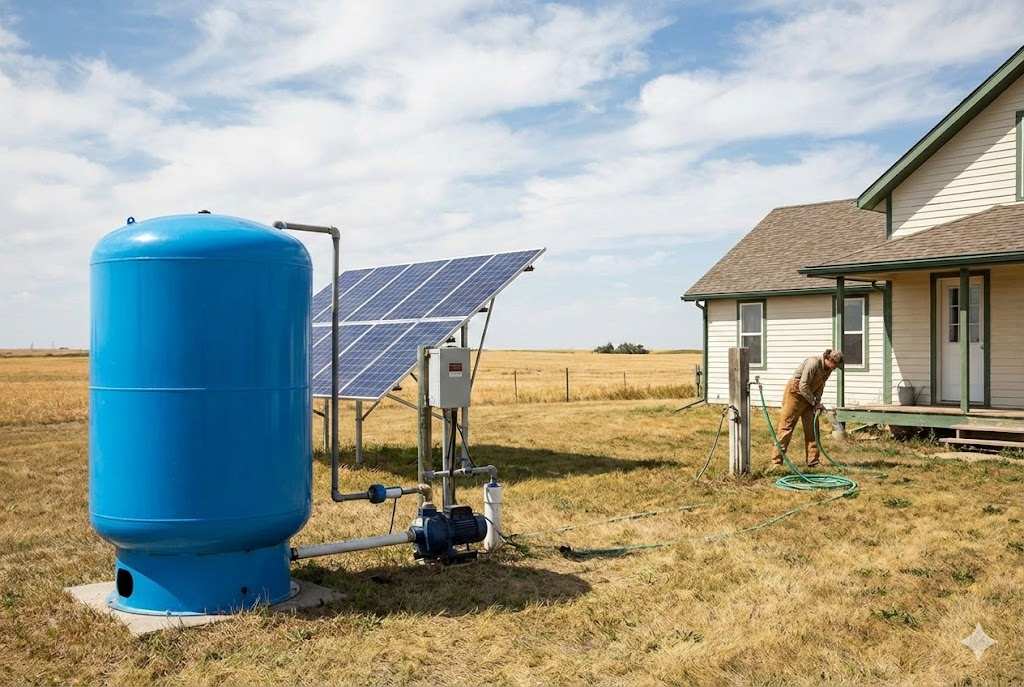
A solar well pump is a powerful tool for off-grid water solutions.
However, its performance is directly tied to the sun's intensity.
This means water flow can be inconsistent throughout the day.
For many applications, especially household or livestock water systems, this variability is a significant drawback.
You need water pressure when you turn on the tap, not just when the sun is at its peak.
This is where a pressure tank transforms the entire system.
By adding a pressure tank, you create a water storage buffer that decouples water availability from immediate sunlight.
The tank stores water under pressure, so it is ready for immediate use.
This simple addition turns a variable solar pump into a reliable, on-demand water system that functions just like a conventional grid-powered setup.
Let's explore how this works and why the right pump and controller are critical for success.
Why a Pressure Tank is a Game-Changer for Solar Pumps
You installed a solar pump for its efficiency.
But its constant starting and stopping to fill small demands is causing premature wear.
You fear an expensive motor burnout is just around the corner.
A pressure tank acts as a buffer. It allows the pump to run for longer, less frequent cycles to fill the tank, rather than short, damaging bursts every time a tap is opened. This significantly reduces motor wear.
The number one enemy of any electric motor is excessive starting and stopping.
Each startup draws a large inrush of current, which generates heat in the motor windings.
Frequent starts cause thermal stress that degrades the motor's insulation and leads to premature failure.
A solar pump used directly for on-demand water without a pressure tank is highly susceptible to this "short cycling."
Imagine someone washing their hands.
The pump turns on for 10 seconds.
Then it turns off.
Someone flushes a toilet.
The pump turns on for 15 seconds.
Then it turns off.
This cycle could repeat hundreds of times a day, placing enormous strain on the motor and the controller.
A pressure tank completely solves this problem.
How a Pressure Tank System Works
A pressure tank system includes the tank itself and a pressure switch.
The process is simple but effective:
- Filling Cycle: The solar pump turns on and fills the pressure tank with water. As water enters the tank, it compresses a bladder of air, building pressure inside the system.
- Pump Cut-Out: Once the pressure inside the tank reaches a pre-set high limit (e.g., 60 PSI), the pressure switch sends a signal to the controller, and the pump shuts off.
- Water on Demand: When you open a faucet, the compressed air in the tank pushes the stored water out into your pipes. This provides instant and consistent water pressure without the pump needing to run.
- Pump Cut-In: As water is used, the pressure in the tank drops. When it reaches a pre-set low limit (e.g., 40 PSI), the pressure switch signals the controller to turn the pump back on, and the filling cycle begins again.
The Benefits of Reduced Cycling
By installing a pressure tank, the pump might only run for a few minutes to fill the tank and then stay off for an extended period while the stored water is used.
Instead of hundreds of short cycles, the pump might only have a dozen longer, more efficient cycles per day.
- Extended Motor Life: Reducing the number of starts dramatically lowers thermal stress on the motor, which can double its operational lifespan.
- Energy Efficiency: Motors run most efficiently during continuous operation, not during startup. Longer run times can improve the overall energy efficiency of the system.
- Improved Reliability: Fewer starts and stops mean less wear on the controller's electronic components, such as relays and capacitors, leading to a more reliable system overall.
| System Component | Without Pressure Tank | With Pressure Tank |
|---|---|---|
| Pump Cycles (per day) | 100+ (High Frequency) | 10-20 (Low Frequency) |
| Motor Stress Level | Very High | Low |
| Water Pressure | Variable (depends on sun) | Stable and On-Demand |
| Estimated Motor Lifespan | Standard | Up to 2x Longer |
Matching Your Pump Type to Your System's Needs
You need a reliable water supply for your home.
But you are unsure if a low-flow screw pump or a high-flow centrifugal pump is better for a pressure tank system.
Choosing the wrong one could lead to poor performance.
For filling a pressure tank, a pump's ability to build pressure (head) is often more important than its maximum flow rate. Solar screw pumps, with their high-head capabilities, are exceptionally well-suited for these applications.
Not all solar pumps are created equal.
The design of the pump's "wet end" determines its performance characteristics.
When used with a pressure tank, the pump must be able to overcome both the well's depth (static head) and the back-pressure from the tank itself.
A standard pressure switch operates in a range like 40-60 PSI.
To reach 60 PSI, the pump must be able to generate an additional 138 feet of head (1 PSI = 2.31 feet of head).
Therefore, a pump for a pressure system needs to have a strong head rating to work effectively.
This makes the choice between different pump types a critical decision for system designers and distributors.
Solar Screw Pumps: The High-Pressure Specialists
Solar screw pumps, also known as progressive cavity pumps, are ideal for pressure tank systems, especially in deep wells.
- Operating Principle: They use a helical stainless steel rotor spinning inside a rubber stator. This action creates sealed cavities that move water upward, creating positive displacement.
- Performance: This design inherently produces very high pressure (head) even at low flow rates. A screw pump can easily overcome the back-pressure from a tank and continue to operate efficiently.
- Application: They are the perfect choice for domestic water supply in off-grid homes, livestock watering systems connected to pressure tanks, and deep wells where high lift is required. Their superior sand handling is also a major advantage in many regions of Africa and Latin America.
Solar Centrifugal Pumps: The High-Flow Solution
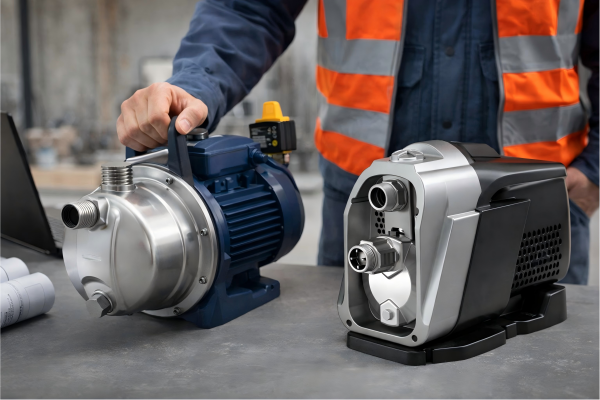
Multi-stage centrifugal pumps, available with plastic or stainless steel impellers, are designed for high flow rates.
- Operating Principle: These pumps use a series of spinning impellers to throw water outward by centrifugal force, converting velocity into pressure.
- Performance: They excel at moving large volumes of water but their pressure output is highly dependent on flow. As back-pressure increases from a filling tank, their flow rate can drop significantly.
- Application: While they can be used with pressure tanks in shallower wells, their primary strength is in applications where high volume is the priority, such as farm irrigation or filling a storage tank at atmospheric pressure. The choice between a wear-resistant plastic impeller for sandy conditions or a corrosion-resistant stainless steel impeller for harsh water chemistry allows for specialization.
The Powerhouse: Why a High-Efficiency Motor Matters
You have the perfect pump and tank.
But a weak or inefficient motor struggles to start under load and consumes too much power.
Your system underperforms, especially on cloudy days.
The motor is the heart of the system. A high-efficiency Brushless DC (BLDC) permanent magnet motor provides the high starting torque and energy efficiency needed to reliably run a pump against the back-pressure of a tank.
Powering a pump in a pressurized system requires more than just raw horsepower.
It requires a motor that is both powerful and intelligent in its use of energy.
When a pump starts, it must overcome inertia and system pressure, a moment that requires a huge amount of torque.
Conventional motors can struggle with this, drawing excessive current and generating waste heat.
The technology inside the motor is a key differentiator in the performance and reliability of a modern solar pumping system.
This is especially true when a pressure tank is involved.
The efficiency of the motor directly impacts how many solar panels are needed, the system's performance in low-light conditions, and its overall operational cost and lifespan.
For a distributor like Andrew in Australia, offering pumps with superior motor technology is a clear competitive advantage.
The BLDC Motor Advantage
BLDC permanent magnet motors have become the industry standard for premium solar pumps for several key reasons.
- Exceptional Efficiency: With efficiencies exceeding 90%, BLDC motors convert more precious solar energy into water movement and less into wasted heat. This means a smaller, less expensive solar array is needed to achieve the same performance.
- High Starting Torque: Unlike brushed motors, BLDC motors deliver maximum torque from a standstill. This allows them to start reliably under the heavy load of a pressurized tank, reducing strain and the risk of stalling.
- Durability and Longevity: The brushless design eliminates the most common failure point in conventional DC motors—the brushes. With no brushes to wear out, these motors are virtually maintenance-free and have a significantly longer service life.
- Compact and Lightweight: Advanced designs using powerful neodymium magnets result in motors that are up to 47% smaller and 39% lighter than older technologies. This simplifies logistics, handling, and installation.
System-Wide Impact
The choice of motor technology has a cascading effect on the entire system.
A high-efficiency BLDC motor allows the intelligent controller to better manage power, enabling the pump to start and run even on days with less-than-perfect sun.
This wider operational window means more water pumped over the course of a year and a more resilient, reliable water supply for the end-user.
It is the core component that enables the entire system to perform at its peak.
Intelligent Controllers: The Brains of the Pressurized System
Your system has a pump, panels, and a tank.
But without smart controls, the pump cannot manage the variable solar power or interact with the pressure switch.
The system is incomplete and unreliable.
An intelligent controller is essential. It uses Maximum Power Point Tracking (MPPT) to optimize solar energy and integrates seamlessly with a pressure switch. Advanced AC/DC hybrid models guarantee 24/7 operation.
The controller is the critical link between the variable power from the solar panels and the mechanical demands of the pump and pressure tank.
A basic controller simply passes power to the pump, leaving it vulnerable to voltage fluctuations and incapable of responding to system controls.
An intelligent controller, however, acts as a sophisticated power-management computer.
It constantly makes decisions to protect the equipment, maximize water output, and ensure the system operates as an integrated whole.
For a pressurized system that needs to operate reliably around the clock, the controller's intelligence is non-negotiable.
It is the component that delivers true water security.
Core Functionality: MPPT and Pressure Switch Integration
A modern solar pump controller must have two key features for use with a pressure tank.
- Maximum Power Point Tracking (MPPT): The MPPT algorithm constantly adjusts the electrical load on the solar panels to extract every available watt of power. This allows the pump to run faster in full sun and continue to run, albeit slower, in hazy or cloudy conditions. This technology can increase daily water output by up to 30% compared to non-MPPT systems.
- Pressure Switch Input: The controller must have dedicated terminals to connect a pressure switch. When the switch opens (at high pressure) or closes (at low pressure), the controller interprets this signal to smoothly stop and start the pump motor, preventing the electrical arcing that can destroy a standard switch.
The Ultimate Solution: AC/DC Hybrid Controllers
For applications where water is mission-critical, such as a family home or a large livestock operation, relying on solar power alone creates a vulnerability.
What happens on a week of cloudy days, or at night?
This is where AC/DC hybrid controllers provide a complete solution.
- Dual Power Inputs: These controllers connect to both the DC solar array and a backup AC source (grid power or a generator) simultaneously.
- Solar-First Priority: The controller's logic is programmed to always use the free energy from the sun first. It will only draw AC power when absolutely necessary.
- Automatic Blending and Switching: If solar power is insufficient to run the pump at the required speed, the controller will blend in AC power to make up the difference. If solar power drops to zero, it seamlessly and automatically switches to 100% AC power.
- 24/7 Water Security: This ensures the pressure tank remains full and the water supply is uninterrupted, regardless of the weather or time of day. This provides total peace of mind for the end-user.
Conclusion
Using a pressure tank with a solar pump is highly recommended.
It enhances reliability, extends motor life, and provides on-demand water.
Success depends on an integrated system: the right pump, motor, and intelligent controller.
Frequently Asked Questions
What size pressure tank do I need for a solar pump?
The tank size depends on your pump's flow rate and desired cycle time. A common rule is to size the tank for 1-2 minutes of pump runtime.
Can a solar pump run without a battery?
Yes, modern solar pump systems are designed to run directly from solar panels during the day without batteries. A pressure tank provides storage for on-demand water.
How do you pressure a well tank?
The tank's air pressure should be set to 2 PSI below the pump's cut-in pressure setting. This must be done when the tank is empty of water.
What is the ideal pressure for a well pump?
A common and effective setting for residential wells is a 40-60 PSI range. The pump turns on at 40 PSI and turns off at 60 PSI.
How long should a solar water pump last?
A quality solar pump system with a BLDC motor can last 10-15 years or more. Using a pressure tank to reduce cycling can significantly extend this lifespan.
Do you need a separate controller for a solar pump?
Yes, a specialized controller is essential. It optimizes the variable DC power from solar panels and protects the pump motor from damage due to under-voltage or dry running.