Your water pump's flow has slowed to a trickle due to mineral buildup.
Harsh chemicals seem risky and expensive.
Vinegar is a tempting, natural alternative, but using it without understanding your pump's materials could cause irreversible damage.
Yes, you can use vinegar to clean some water pumps, but it's critical to know what your pump is made of.
Vinegar is effective at dissolving mineral scale and is generally safe for stainless steel components.
However, it can damage rubber stators and certain types of plastic impellers.
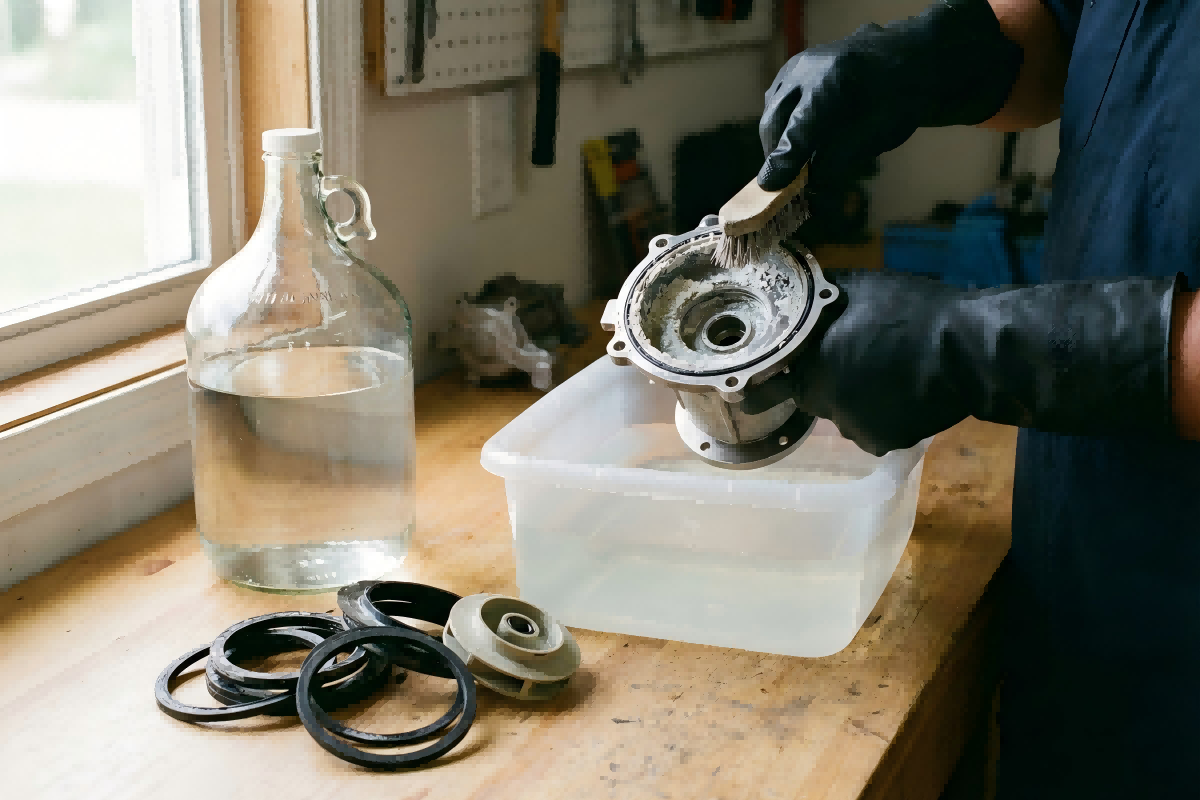
When your water pump loses efficiency, the cause is often a buildup of minerals like calcium and lime.
This scale constricts water passages and reduces performance.
Vinegar, which is a mild acetic acid, is excellent at dissolving these specific types of deposits.
It's a common household item, it's cheap, and it's less toxic than many commercial descaling agents.
But a water pump is not a simple coffee pot.
It is a precisely engineered machine made of various materials.
The metal parts, plastic components, rubber seals, and motor housing all react differently to acid.
What might safely clean one part could destroy another.
Before you pour vinegar down your well, you must understand the specific type of pump you have and how its materials will stand up to an acid bath.
Let's explore which pumps can be safely cleaned with vinegar and which ones you should never expose to it.
Part 1 | Cleaning a Stainless Steel Impeller Pump with Vinegar
Your premium stainless steel pump is clogged with mineral deposits.
You want to restore its performance without using harsh chemicals on your investment.
Is vinegar a safe and effective way to clean this high-quality equipment?
Yes, vinegar is an excellent and safe choice for cleaning solar pumps with SS304 stainless steel impellers and bodies.
The acetic acid effectively dissolves mineral buildup without harming the corrosion-resistant stainless steel, making it an ideal maintenance solution.
Pumps with stainless steel impellers are built for the toughest conditions.
They are designed to resist corrosion from acidic or alkaline water sources.
This inherent durability makes them the best candidates for cleaning with a mild acid like vinegar.
The key is the material itself: grade SS304 stainless steel.
This alloy contains a high percentage of chromium, which forms a passive, invisible, and corrosion-resistant chromium oxide film on the surface.
This protective layer is what makes stainless steel "stainless."
When hard water leaves calcium and lime deposits on the impellers and inside the pump housing, it creates a layer of scale that obstructs water flow and reduces efficiency by up to 20-30%.
Vinegar's acetic acid specifically targets and breaks down these alkaline mineral deposits without compromising the steel's protective layer.
For owners of high-quality stainless steel pumps, this makes vinegar a perfect tool for routine maintenance, helping to preserve both performance and the longevity of their investment.
Why is Vinegar Safe for Stainless Steel?
The chemistry is straightforward.
Stainless steel's resilience comes from its chromium oxide layer.
This layer is very stable and self-repairing in the presence of oxygen.
White vinegar is typically about 5% acetic acid, which is strong enough to dissolve alkaline deposits like calcium carbonate but too weak to damage the robust chromium oxide film on SS304 steel.
- Targeted Action: Acetic acid reacts with the calcium carbonate (limescale), turning it into a water-soluble salt that can be easily flushed away.
- Material Integrity: The acid does not react with the chromium oxide or the underlying iron, chromium, and nickel alloy. This means the pump's structural integrity remains completely unaffected.
- Environmental Benefit: Vinegar is biodegradable and far less harmful to the environment than many powerful industrial descaling agents.
Step-by-Step Cleaning Guide for Stainless Steel Pumps
To safely clean your pump, you must first remove it from the well.
Never pour cleaning agents directly into your water source.
- Safety First: Disconnect all power to the pump from the controller. Follow proper procedures to safely pull the pump from the well.
- Prepare the Solution: Create a cleaning solution of 50% white vinegar and 50% water. For a standard submersible pump, you may need a 5-gallon bucket or a small tank.
- Circulate the Solution: Submerge the pump end in the solution. Connect the pump to a temporary power source (like a battery or generator, following the pump's voltage requirements) and use a hose to circulate the vinegar solution from the bucket, through the pump, and back into the bucket. Let it circulate for 1-2 hours.
- Inspect and Repeat: After an hour, stop the pump and inspect the intake and outlet. If significant scale remains, let it soak longer or circulate for another hour.
- Thoroughly Rinse: Once the pump is clean, flush it thoroughly with fresh, clean water for at least 15-20 minutes to remove all traces of the vinegar solution. This is a critical step to prevent any residual acid from affecting other system components.
- Reinstall: Reinstall the pump in the well and reconnect it to your main controller.
This process can restore your pump's flow rate and pressure to near-factory levels.
Part 2 | The Risks of Using Vinegar on Plastic Impeller Pumps
Your cost-effective plastic impeller pump is clogged with scale.
You want to use a simple solution like vinegar to clear it.
But can this common household acid damage the pump's essential plastic parts?
You should use extreme caution when cleaning plastic impeller pumps with vinegar.
While it dissolves minerals, the acetic acid can make some engineering plastics brittle, cause swelling, or lead to premature cracking and failure over time.
Plastic impeller pumps are a popular and economical choice for high-flow applications like farm irrigation.
They use durable "engineering plastics" for their impellers, which are designed to be lightweight and resistant to abrasion from fine sand.
However, "plastic" is a very broad term.
Different polymers have vastly different levels of chemical resistance.
While some high-grade plastics used in industrial settings can handle a wide range of acids, the materials chosen for cost-effective water pumps are optimized for wear resistance and price, not necessarily acid resistance.
The acetic acid in vinegar can be an aggressive agent against certain polymer chains.
Prolonged exposure can lead to a process called acid hydrolysis, which breaks down the long-chain molecules that give the plastic its strength and flexibility.
This doesn't happen instantly.
The damage is cumulative and may not be apparent after a single cleaning.
But repeated cleanings with vinegar can shorten the life of the impellers, leading to unexpected failures and the need for a costly pump replacement.
How Acid Affects Pump Plastics
The effect of acid on plastic depends on the type of polymer, the concentration of the acid, the temperature, and the duration of exposure.
- Embrittlement: The acid can weaken the bonds within the plastic, making it brittle and prone to cracking under the high-stress conditions of pumping water. An impeller spinning at thousands of RPMs needs to be flexible; a brittle one will shatter.
- Swelling: Some plastics can absorb the vinegar solution, causing them to swell. In a pump with very tight tolerances, even a tiny amount of swelling (1-2%) can cause the impellers to rub against the pump housing, leading to high friction, motor overload, and catastrophic failure.
- Chemical Degradation: The acid can chemically alter the surface of the plastic, making it rougher and more susceptible to future abrasion and mineral buildup.
| Plastic Type | Acid Resistance | Potential Risk with Vinegar |
|---|---|---|
| Polyoxymethylene (POM) | Fair to Good | Low to Moderate. Short-term exposure is likely fine. |
| Noryl (PPO) | Good | Low Risk. Generally resistant to weak acids. |
| Polycarbonate (PC) | Poor | High Risk. Very susceptible to acid attack. |
Since most pump manufacturers do not specify the exact type of engineering plastic used, it is safest to assume a moderate to high risk.
Safer Cleaning Alternatives for Plastic Components
Given the risk, using vinegar should be a last resort.
Consider these safer methods first:
- Mechanical Cleaning: After pulling the pump, use brushes and a pressure washer to physically remove scale from the pump intake and accessible parts.
- Mild Detergents: A solution of soapy water can sometimes help loosen newer, softer mineral deposits without the chemical risk of acid.
- Specialized Cleaners: Look for commercial descalers that are explicitly rated as "safe for plastics." These products use different chemical actions to remove scale without harming polymers.
- Minimal Vinegar Exposure: If you must use vinegar, use a highly diluted solution (1 part vinegar to 10 parts water) and limit the cleaning time to less than 30 minutes. Follow this with an extensive freshwater flush.
Part 3 | Cleaning a Screw Pump: The Stator and Vinegar Problem
Your reliable screw pump isn't producing the pressure it used to.
You suspect mineral buildup is the culprit and are considering vinegar.
But this pump has a critical rubber component that could be destroyed by acid.
Do not use vinegar to clean a solar screw pump.
While the stainless steel screw rotor is safe, the acetic acid in vinegar can cause the pump's essential rubber stator to swell, soften, or become brittle, leading to a rapid and complete failure of the pump.
A solar screw pump is a masterpiece of simple, effective design.
It uses a single helical stainless steel rotor that spins inside a tight-fitting rubber stator.
This creates sealed cavities of water that are progressively "pushed" up the pipe.
This design is fantastic for creating high pressure (high head) and handling sandy water.
The entire principle of operation relies on the precise, interference fit between the metal rotor and the rubber stator.
There is no room for error.
The rubber stator is the pump's single most critical component, and it is also the most vulnerable to chemical attack.
Exposing this rubber component to vinegar's acetic acid is a recipe for disaster.
Unlike stainless steel, rubber is a highly complex organic polymer that can be easily damaged by chemicals.
The acid can attack the bonds in the rubber, fundamentally changing its physical properties in ways that will quickly destroy the pump's functionality.
The Critical Role of the Rubber Stator
The stator is not just a simple rubber sleeve.
It is an engineered component with specific properties of elasticity and durometer (hardness).
- Precision Seal: The stator must be flexible enough to form a perfect seal against the rotor to create the pumping cavities, but firm enough to withstand the immense pressure and abrasive wear.
- Lubrication and Cooling: Water acts as a lubricant and coolant between the rotor and stator. If the fit is too tight, it will generate excessive heat and friction.
- Resilience: The stator needs to handle sand and small solids by temporarily deforming and then returning to its original shape.
Why Vinegar and Rubber Don't Mix
When you introduce acetic acid to the stator, several destructive things can happen.
- Swelling: The most common reaction is that the rubber will absorb the liquid and swell. Even a 1-2% increase in size is catastrophic. A swollen stator will grip the rotor too tightly, dramatically increasing friction. This will cause the motor to draw excessive current, potentially tripping the controller or burning out the motor. In a best-case scenario, the pump will seize up completely.
- Softening: The acid can break down the rubber's vulcanization, causing it to lose its hardness and become soft and gummy. A soft stator cannot maintain the pressure needed for pumping and will wear out in a matter of hours.
- Embrittlement: Alternatively, the acid can make the rubber hard and brittle. A brittle stator will crack, chip, and fall apart under the rotational force of the rotor, sending rubber chunks up your pipes and destroying the pump.
Because of this guaranteed damage, you should use only water-based, pH-neutral, and non-petroleum-based substances with a screw pump.
For cleaning, rely on mechanical methods focused on the pump's intake screen and the associated plumbing.
Conclusion
Vinegar can be a useful tool, but only for the right pump.
It is safe and effective for stainless steel models but poses a significant risk to the rubber and plastic components found in other types.
Frequently Asked Questions
What can I use to clean my water pump?
For stainless steel pumps, a 50/50 vinegar-water solution works well.
For plastic or rubber components, use mild detergents or specialized, material-safe descalers.
How do you get rid of calcium deposits in a water pump?
Circulating a mild acidic solution, like vinegar for stainless steel pumps, is highly effective.
Mechanical scrubbing is a safer alternative for pumps with plastic or rubber parts.
Can you clean a submersible pump without removing it?
No, you should never pour cleaning agents directly into a well.
This can damage the pump, well casing, and contaminate your aquifer. Always pull the pump for cleaning.
How do I increase my solar water pump pressure?
First, clean your solar panels and check for any clogs in the pump intake or pipes.
If it's a chronic issue, your pump may be undersized for the well depth.
Will CLR (Calcium Lime Rust) damage a submersible pump?
CLR contains acids that can be very aggressive.
Like vinegar, it is likely safe for stainless steel but could severely damage plastic impellers, rubber seals, and stators. Always check the manufacturer's recommendations.
Does vinegar damage rubber seals?
Yes, prolonged exposure to acetic acid will degrade most common types of rubber seals used in pumps, causing them to swell, soften, or crack.