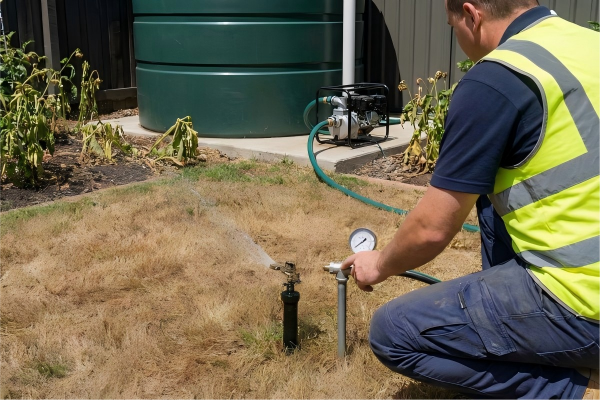
Your sprinklers sputter weakly, and your garden has dry patches.
You're wasting water and your plants are suffering from inconsistent watering.
An irrigation pump can solve this by providing reliable pressure.
Yes, you likely need an irrigation pump if your home's water pressure is too low for your sprinklers (below 40 PSI), or if you are using an alternative source like a well, rainwater tank, or pond that has no natural pressure.
Knowing whether you need a pump is the first step toward a healthy, efficient garden.
The answer depends entirely on where your water comes from and how strong its pressure is.
If you rely on your home's main water line, the pressure might not be enough to power a full sprinkler system.
If you plan to use a well or a tank, a pump is not optional—it's essential.
Let's explore the signs that show you need a pump and the types of pumps that fit each situation.
This will help you make the right choice for a lush and thriving landscape.
Assessing Your Municipal Water Pressure | Is It Strong Enough?
You installed a new sprinkler system, but the heads won't pop up.
The water just bubbles at the surface, leaving you frustrated.
A simple pressure test can reveal if your home's water supply is the problem.
If your home's static water pressure is below 40 PSI, you will probably need a booster pump. Most sprinkler systems require at least 30-40 PSI (pounds per square inch) of dynamic pressure to operate as designed.
Many homeowners assume their city water pressure is sufficient for any task.
This is often not the case for irrigation.
A standard sprinkler system places a high demand on your water line.
The pressure available at your tap might be enough for a shower, but it can drop significantly when multiple sprinkler heads open at once.
If the pressure is inadequate, your sprinklers will fail to throw water the intended distance, leading to poor coverage and dry spots in your lawn.
The only way to know for sure is to measure it.
How to Easily Test Your Water Pressure
You don't need to be a plumber to check your water pressure.
It's a simple, five-minute task.
All you need is a water pressure test gauge, which is available at any hardware store.
- Find an outdoor tap: Choose a faucet, like a hose bibb, that is close to the water meter or where your irrigation system will connect.
- Ensure no water is running: Turn off all taps, washing machines, and dishwashers inside and outside your house.
- Attach the gauge: Screw the pressure gauge tightly onto the faucet's threads.
- Turn the tap on fully: Open the faucet all the way.
- Read the dial: The needle will point to your static water pressure in PSI.
This number is your baseline.
If it's below 40 PSI, you are a clear candidate for a booster pump.
Static Pressure vs. Dynamic Pressure
The reading you just took is your Static Pressure.
This is the pressure in your pipes when no water is moving.
However, the more important number for irrigation is Dynamic Pressure.
This is the water pressure while water is actively flowing through the pipes and out of your sprinklers.
Dynamic pressure will always be lower than static pressure due to friction loss inside the pipes.
A system with a static pressure of 50 PSI might only have a dynamic pressure of 35 PSI when the sprinklers are running.
This is why having a static pressure reading above 40-50 PSI is a good starting point.
The Solution: A Booster Pump
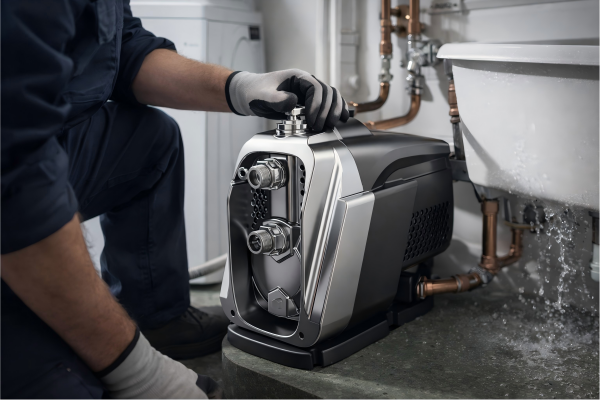
If your pressure test confirms your supply is too weak, the solution is an irrigation booster pump.
A booster pump does not create water; it takes the existing flow from your municipal line and increases its pressure.
It's installed on your main line after the water meter but before your irrigation valves.
When your irrigation controller turns a zone on, the booster pump automatically activates, ensuring your sprinklers get the high pressure they need to function correctly.
It guarantees consistent and efficient watering, regardless of fluctuations in the city's supply.
Pumping from a Well, Tank, or Pond | Going Off-Grid
You have access to a well or rainwater tank.
But that free water is just sitting there, unable to reach your garden.
This valuable resource is completely wasted without the right equipment.
Yes, you must have a pump to use water from a well, tank, pond, or river for irrigation. These non-pressurized sources require a pump to lift the water and create the flow and pressure needed for a sprinkler or drip system.
Using a private water source is a fantastic way to save money and conserve municipal water.
Whether it’s a deep well, a large rainwater harvesting tank, or a nearby pond, these sources represent self-sufficiency.
However, unlike city water, they have no inherent pressure.
The water will not move on its own.
A pump is the heart of any irrigation system that relies on these sources.
It provides the power to pull or push water from the source and deliver it across your property.
The type of pump you need depends entirely on the water source itself.
For Deep Wells: Submersible Pumps
If your water source is a well bore, you will need a submersible pump.
These long, cylindrical pumps are designed to be lowered directly into the well and submerged below the water level.
This is a highly efficient method because the pump uses its energy to push water up the pipe, rather than trying to pull it from the surface.
There are different types of submersible pumps designed for various well conditions:
- Solar Screw Pumps: These are ideal for very deep wells with low water yields. They create extremely high pressure (head) but deliver a lower volume of water (flow rate). They are perfect for drip irrigation systems drawing from wells over 80 meters (260 feet) deep.
- Solar Centrifugal Pumps (Plastic Impeller): This is the most common choice for residential wells. They offer a great balance of high flow rates and good pressure, making them perfect for running standard sprinkler systems. They are best suited for wells less than 80 meters deep and are highly economical.
- Solar Centrifugal Pumps (Stainless Steel Impeller): If your well water is acidic, alkaline, or has a high mineral content, this is the premium choice. The stainless steel construction resists corrosion, ensuring a very long service life in harsh water conditions.
For Tanks and Ponds: Surface Pumps
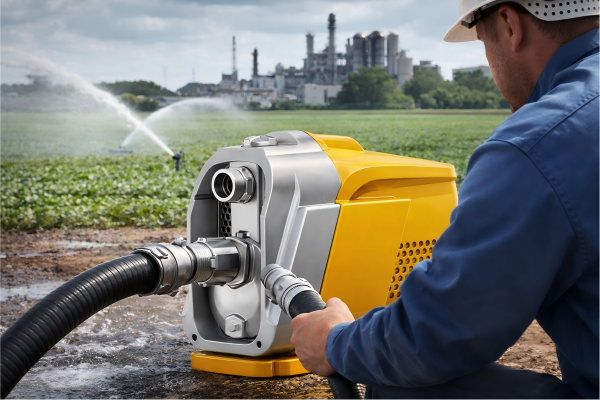
If your water source is a surface body like a rainwater tank, pond, or lake, you will need a surface pump.
These pumps are installed on dry land near the water's edge.
They use a suction hose to draw water from the source.
Surface pumps are great for applications where the vertical lift (the distance from the water surface to the pump) is less than 7 meters (about 23 feet).
If the lift is greater than this, the pump will struggle to create enough suction, and a submersible pump would be a better choice.
These pumps are also a good option for boosting pressure from a gravity-fed tank system.
Choosing a Modern, Efficient Pump | The Power of Solar
Your electric bill skyrockets every summer.
Running a traditional irrigation pump for hours each week is expensive and inefficient.
This high cost makes you want to water less, hurting your garden.
A solar-powered irrigation pump is the most efficient and cost-effective choice. Paired with a high-efficiency BLDC motor, it operates for free using sunlight, offers long-term reliability, and is independent of the power grid.
Once you've determined you need a pump, the next question is what kind of power it should use.
For decades, AC electric pumps were the only option.
Today, solar water pump technology has advanced so dramatically that it is now the superior choice for most irrigation applications, especially in off-grid or rural areas.
Modern solar pumps are not just an eco-friendly alternative; they are a smarter financial investment.
The core of this revolution is the motor technology.
The BLDC Motor: A Game Changer
The key to the high performance of modern solar pumps is the Brushless DC (BLDC) permanent magnet motor.
This is a massive leap forward from older AC motors or brushed DC motors.
These motors can achieve efficiencies of over 90%, compared to the 60-70% efficiency of many traditional AC pump motors.
What does this mean for you?
- Less Power Needed: A more efficient motor requires fewer solar panels to achieve the same water output. This reduces the initial system cost by up to 30%.
- Longer Lifespan: With no brushes to wear out, BLDC motors are virtually maintenance-free and have a significantly longer operational life.
- Compact & Powerful: BLDC motors are smaller and lighter than their AC counterparts. A modern BLDC motor can be 47% smaller and 39% lighter while delivering the same power, making installation far easier.
- Smart Control: They are designed to work seamlessly with MPPT (Maximum Power Point Tracking) controllers. This intelligent device constantly adjusts the pump's operation to extract the maximum amount of power from the solar panels, even in cloudy or low-light conditions.
Hybrid Systems: The Best of Both Worlds
What happens when you need to water on a cloudy day or at night?
This is where advanced AC/DC hybrid systems come in.
These systems are designed with two power inputs, allowing you to connect both solar panels and a backup AC power source (like the grid or a generator) at the same time.
The intelligent controller automatically prioritizes solar power.
When sunlight is abundant, the pump runs entirely on solar energy.
If clouds roll in and solar power decreases, the controller can blend in AC power to maintain pump performance.
If there is no solar input at all, it automatically switches over to the AC source.
This ensures you have worry-free watering 24 hours a day, while still maximizing your use of free solar energy.
This hybrid capability provides ultimate reliability and flexibility for any irrigation need.
Conclusion
You need an irrigation pump for low municipal pressure or non-pressurized sources like wells.
A solar pump with a BLDC motor offers the most efficient, cost-effective, and reliable solution.
Frequently Asked Questions
What happens if your irrigation pump is too big?
An oversized pump wastes electricity, causes rapid on-off cycling which damages the motor, and can create excessive pressure that damages sprinkler heads and fittings.
Can I use a sprinkler on a well?
Yes, you can use sprinklers with a well, but you must have a properly sized submersible well pump to provide adequate water pressure and flow.
At what PSI should irrigation sprinklers work?
Most pop-up spray heads work best between 30 and 40 PSI.
Rotary sprinkler heads often require a higher pressure, typically between 40 and 65 PSI.
How do I increase water pressure for my sprinkler system?
The best way is to install a booster pump on your main water line before the irrigation system.
This is the only effective method.
How much does it cost to run an irrigation pump?
The cost depends on horsepower and electricity rates.
A 1 HP pump may cost 10-20 cents per hour.
A solar-powered pump runs for free.
Does an irrigation pump use a lot of electricity?
Yes, conventional AC irrigation pumps can be one of the higher electricity consumers in a household during the summer watering season.
How long should an irrigation pump last?
A quality, properly sized submersible well pump can last 8 to 15 years.
A booster pump's lifespan is typically around 5 to 10 years.