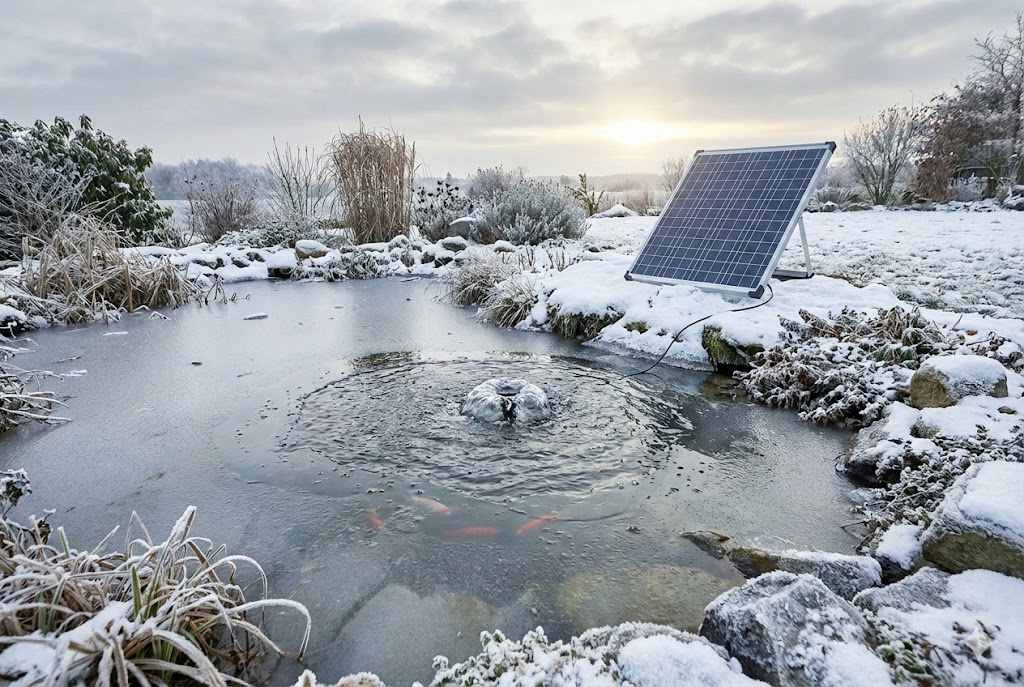
Worried your pond will freeze over this winter?
Low sunlight can cause pump failure, creating a serious risk for your fish and the pond's ecosystem.
Yes, solar pond pumps can work effectively in winter, but their performance is reduced by less sunlight. Success depends on using a high-efficiency motor, properly sized solar panels, and strategies to maintain an ice-free area for gas exchange.
Understanding how to optimize your system for colder, darker months is key.
It isn't about just having a pump; it's about having the right technology.
With the correct components, a solar pump can be a reliable, cost-free solution for winter pond care.
Let's explore the factors that ensure your pump performs when you need it most.
The Challenge of Winter Sunlight and Reduced Performance
Shorter days and constant cloud cover can starve your solar panels of essential energy.
This means your pump may not run long enough or consistently enough to prevent a total freeze.
Winter significantly reduces a solar pump's runtime due to fewer daylight hours, a lower sun angle, and increased cloud cover. This directly impacts its ability to circulate water and aerate the pond, requiring system adjustments for reliability.
The primary function of a pond pump in winter changes dramatically from summer.
In warm months, the goal is full circulation for filtration and algae control.
In freezing climates, the goal is much more specific and critical: maintaining a small, ice-free hole on the pond's surface.
This opening is vital.
It allows harmful gases, like ammonia and methane from decaying organic matter at the bottom, to escape.
Simultaneously, it allows essential oxygen from the air to enter the water.
Without this gas exchange, fish can suffocate under the ice, even in a large pond.
A solar pump achieves this by moving slightly warmer water from deeper in the pond up to the surface.
The constant water movement at one spot prevents ice from forming there.
However, this vital task is compromised when the power source—the sun—is at its weakest.
The challenge isn't the cold itself, but the lack of sufficient solar energy to reliably power the pump throughout the day.
Understanding the Drop in Solar Energy
Several factors conspire to reduce your solar panel's output in winter.
- Shorter Daylight Hours: The most obvious factor is that there are simply fewer hours of sunlight. A system that runs for 8-10 hours in summer might only receive 4-6 hours of usable light in winter.
- Lower Sun Angle: The sun sits much lower in the sky during winter. This means the sunlight has to travel through more of the Earth's atmosphere, which weakens its intensity. It also means the light strikes the panels at a less direct angle, reducing power generation by up to 30% even in full sun.
- Increased Cloud Cover: Many regions experience significantly more overcast days in winter. Cloud cover can dramatically cut a solar panel's output, often by 50-90% or more, which may not be enough to start the pump's motor.
The Direct Impact on Your Pump
This reduction in available power has a direct, observable effect on your solar pump.
The motor may struggle to start in the morning, only beginning to run in the late morning when the sun is strongest.
It will also shut off much earlier in the afternoon.
On heavily overcast days, the pump may not start at all, or it may cycle on and off repeatedly.
This intermittent operation is often insufficient to keep a hole open in the ice during a hard freeze.
Therefore, a standard solar pump system sized for summer will almost certainly underperform in winter, putting your pond's inhabitants at risk.
The solution lies in building a system with technology designed to overcome this energy deficit.
| Season | Average Daily Sun Hours | Sun Angle | Typical Power Output | Primary Goal |
|---|---|---|---|---|
| Summer | 8 - 10+ hours | High / Direct | 100% of Rating | Full Circulation / Filtration |
| Winter | 4 - 6 hours | Low / Indirect | 25% - 50% of Rating | Maintaining Ice-Free Hole |
Core Technology for Winter: The High-Efficiency Motor
An inefficient motor wastes precious winter sun, converting it to useless heat.
This means your pump needs intense sunlight just to start, leaving your pond unprotected on many winter days.
A Brushless DC (BLDC) permanent magnet motor is the key to winter performance. Its efficiency, often exceeding 90%, allows the pump to start earlier and run longer on the limited solar energy available during winter.
The single most important component for a reliable winter solar pump is not the panel, but the motor driving the pump.
The motor's job is to convert electrical energy from the solar panel into the mechanical force that moves water.
Older or cheaper pump motors can be incredibly wasteful, with efficiencies as low as 50-60%.
This means nearly half of the hard-won solar energy is lost as heat before it ever moves a drop of water.
In the abundant sun of summer, this inefficiency is often masked.
But in winter, it's a critical failure point.
Modern solar pump systems solve this problem by using advanced Brushless DC (BLDC) permanent magnet motors.
This technology represents a massive leap in efficiency.
By utilizing powerful permanent magnets (often made of neodymium iron boron) and eliminating friction-inducing brushes, these motors convert more than 90% of the incoming electricity directly into pumping power.
This efficiency advantage is what makes winter operation possible.
The Low-Light Performance Advantage
The practical benefit of a >90% efficient motor is its ability to operate in low-light conditions.
Because it wastes so little energy, a BLDC motor requires significantly less wattage to start up and maintain operation.
- Early Starts: The pump can begin running earlier in the morning as the sun rises.
- Late Finishes: It can continue to run later into the afternoon as the sun sets.
- Cloudy Day Operation: Most importantly, it can often continue to run during periods of light to moderate cloud cover, when a less efficient motor would have already stalled.
This extended daily runtime is crucial for preventing an ice hole from freezing over.
A pump that runs for 4 hours on a winter day is far more effective than one that only manages 2 hours.
Choosing a Pump Built for the Cold
While the motor is key, the pump materials also matter.
The pump will be submerged in near-freezing water for months.
- High-Flow Plastic Impeller Pumps: These are the most common choice for pond circulation. They are designed to move a high volume of water, which is effective for surface agitation. Look for models made from durable, wear-resistant engineered plastics that will not become brittle in the cold.
- Premium Stainless Steel Impeller Pumps: For ponds that may have acidic water from decaying autumn leaves or other harsh conditions, a pump with an SS304 stainless steel impeller and body offers superior durability and corrosion resistance. Stainless steel is impervious to cold and ensures maximum service life.
Ultimately, the competitive advantage in winter lies in the core technology.
A system built around a high-efficiency BLDC motor has a fundamental, measurable advantage, ensuring the solar energy you capture is put to work protecting your pond.
Optimizing the Power System for Winter
Even the best motor is useless without enough power.
Relying on a summer-sized solar array in winter will lead to inconsistent performance and a frozen-over pond.
To ensure winter reliability, "over-panel" by using a solar array with a wattage at least 1.5 to 2 times the pump's rating. For guaranteed operation, an AC/DC hybrid controller provides the ultimate backup.
Having an efficient motor is the first step, but you must still provide it with enough energy to do its job.
Given the drastic reduction in solar availability during winter, the power system supporting your pump must be specifically optimized for low-light conditions.
Simply using the same solar panel setup that worked perfectly in July will lead to disappointment in January.
There are two primary strategies for creating a robust winter power system: maximizing solar capture and providing a reliable backup.
Strategy 1: Maximize Solar Capture ("Over-Paneling")
Since each individual solar panel will produce significantly less power in winter, the logical solution is to add more panels.
This practice is known as "over-paneling."
The goal is to create a solar array that generates enough wattage to reliably run the pump, even on days that are not perfectly sunny.
- The Winter Rule: For summer operation, a solar array of 1.3 times the pump's wattage rating is often sufficient. For reliable winter operation, you should increase this to 1.5x to 2.0x the pump's wattage.
- Example: A 50-watt pump would need a 65W panel for summer. For winter, that same 50W pump should be paired with a 75W to 100W solar array.
This extra wattage provides the power surplus needed to overcome the challenges of low sun angle and cloud cover.
It allows the smart pump controller to draw enough power to keep the motor running smoothly.
You should also adjust the angle of your panels.
Laying them at a steeper angle (50-60 degrees from horizontal) helps them face the low winter sun more directly, further boosting energy capture.
Strategy 2: The Ultimate Solution—An AC/DC Hybrid System
For pond owners who cannot accept any downtime—especially those with valuable koi—the most reliable solution is an AC/DC hybrid controller.
This advanced device is the brain of a truly all-weather system.
It has two power inputs: one for your solar panels (DC) and another for your standard household grid power (AC).
The controller's smart logic is designed to prioritize free solar energy first.
- Sunny Conditions: The system runs 100% on solar power, costing you nothing.
- Low Sun / Clouds: When solar input drops, the controller's hybrid function seamlessly blends in just enough AC power to keep the pump running at a consistent speed. It maximizes the use of every available solar watt.
- No Sun / Night: When there is no solar input, the controller automatically switches over to 100% AC power.
This ensures your pond aerator runs 24/7 if needed, providing absolute peace of mind.
The pond stays protected during multi-day snowstorms, long stretches of cloudy weather, or overnight hard freezes.
It offers the energy savings of a solar pump with the complete, unwavering reliability of a traditional electric pump.
This technology eliminates all weather-related guesswork from winter pond management.
Conclusion
Solar pumps work in winter with an efficient motor, oversized panels, and an AC/DC backup.
This ensures vital gas exchange for a healthy pond, even in freezing conditions.
Frequently Asked Questions
Can a solar pump run 24 7?
A standard solar pump only runs when there is sunlight. To run 24/7, it requires a battery bank system or an AC/DC hybrid controller connected to grid power.
Can a pond aeration pump be too strong?
Yes. In winter, you want gentle circulation to create an ice-free hole. A pump that is too strong can super-cool the entire water column, stressing or harming fish.
Should I turn my pond pump off in the winter?
You should turn off waterfalls to prevent ice dams, but you should run a small pump or aerator to maintain an opening in the ice for gas exchange to protect your fish.
How do I keep my pond pump from freezing in the winter?
Submersible pumps used for aeration will not freeze as long as they are running and placed below the pond's freezing level. Keep external tubing clear and insulated.
Do solar aerators work on cloudy days?
High-efficiency solar aerators can work on bright, overcast days but will have reduced output. They may not run on very dark, stormy days without a battery or AC/DC backup.
At what temperature should I turn off my pond pump?
Turn off large waterfall pumps when air temperatures consistently drop near freezing. Continue to run a smaller aeration pump or system throughout the entire winter.
How do you winterize a solar pump?
For aeration, simply ensure the pump is deep enough in the water. If shutting the system down, remove the pump from the pond, clean it, and store it indoors in a bucket of water.