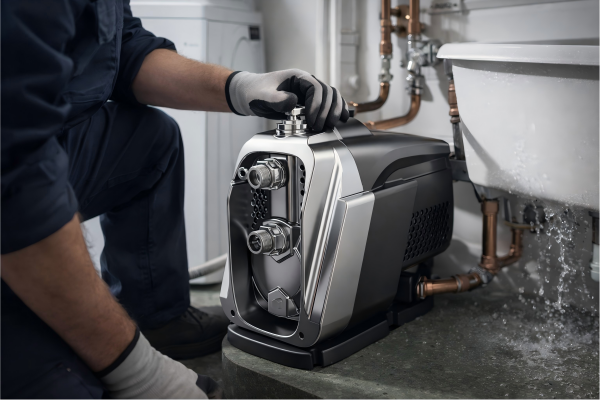
Low water pressure turns simple tasks like showering or washing dishes into frustrating chores.
This issue is surprisingly common, but modern technology offers a reliable fix.
Domestic water pressure boosting uses a specialized pump system to increase the force of water in your pipes. These systems draw water from your mains or a tank, pressurize it to a specific level, and deliver strong, consistent flow to every tap, shower, and appliance in your home, regardless of demand.
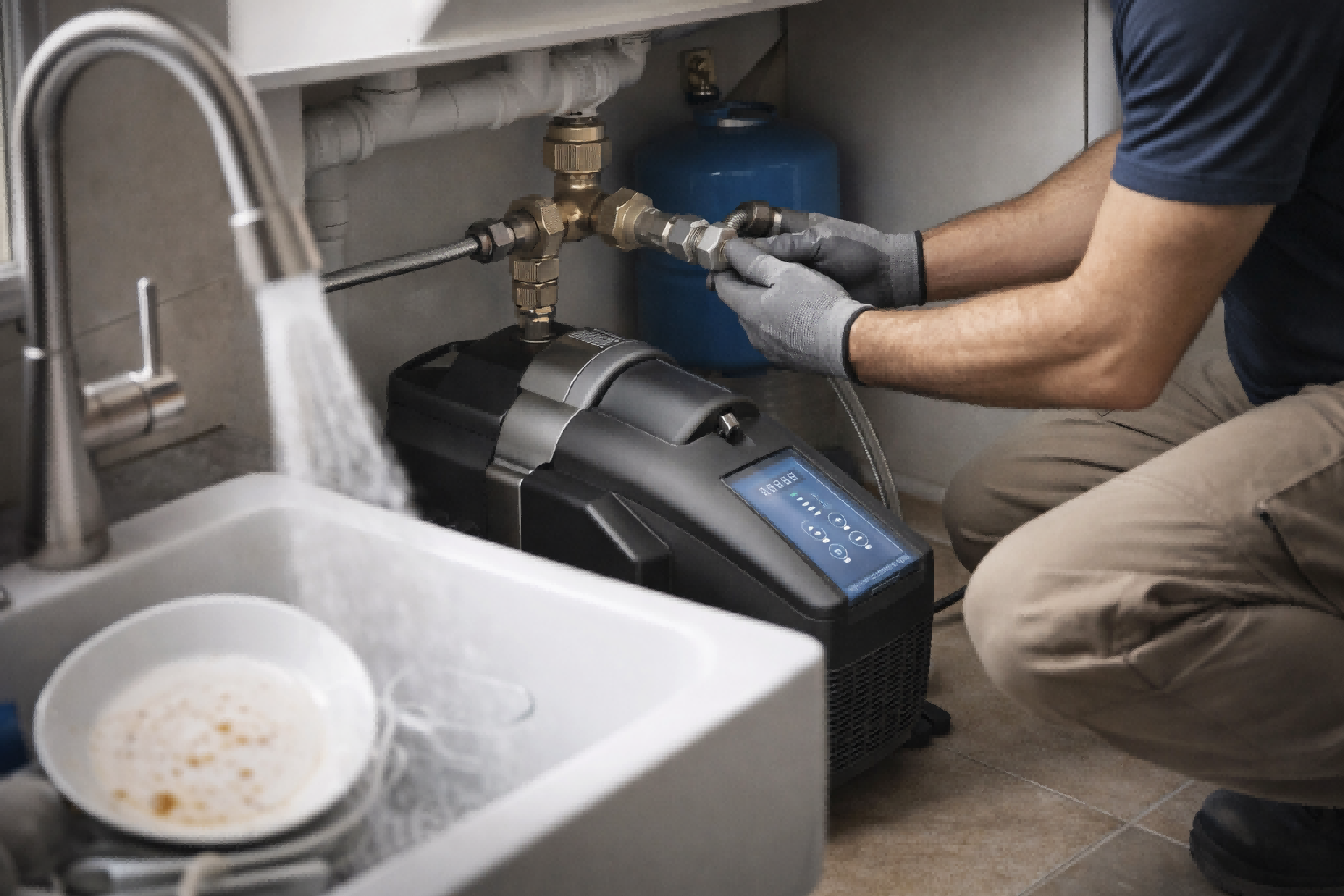
If you are tired of weak showers, it is time to understand exactly how these systems transform your plumbing.
Let's explore why pressure drops happen and the engineering behind the solution.
Why Do You Need Domestic Water Pressure Boosting?
Weak water flow is not just an annoyance; it signals an inefficiency in your water delivery system.
Understanding the root cause is the first step toward fixing it permanently.
Pressure boosting is necessary when municipal supply is weak, demand in the home is high, or building height restricts flow. It solves issues caused by distance from the water source, low-recovery wells, or simply trying to use multiple fixtures simultaneously, ensuring every floor gets adequate pressure.
Many homeowners assume low pressure is something they just have to live with.
However, the problem usually stems from specific physical limitations that a booster pump is designed to overcome.
Here is a deeper look at the common scenarios where boosting is essential:
The Impact of Municipal Supply and Distance
Sometimes, the problem originates outside your property.
If your home is located at the end of a municipal supply line, friction loss reduces the pressure before it even reaches your meter.
Similarly, if your water source is a distant well or reservoir, the physical distance causes a natural drop in force.
A booster pump acts as a relay station, re-pressurizing this water before it enters your internal plumbing.
Vertical Challenges in Multi-Story Homes
Gravity is a constant enemy of water pressure.
For every meter water travels vertically, it loses pressure.
In multi-story homes or flats, the top floor often suffers the most, resulting in "trickling" showers while the ground floor kitchen tap works fine.
Boosting systems provide the extra "push" needed to fight gravity and deliver consistent pressure to upper levels.
The "Peak Hour" Problem
Modern homes have high water demands.
Running a dishwasher, a washing machine, and a shower at the same time splits the available pressure.
Without boosting, this simultaneous usage causes a noticeable drop in performance across all fixtures.
A pressure boosting system compensates for this by dynamically increasing output when it detects multiple open taps.
| Scenario | Cause of Low Pressure | How Boosting Helps |
|---|---|---|
| End of Line | Friction loss in long city pipes | Re-pressurizes water at entry |
| High Demand | Too many appliances running | Increases flow to match usage |
| Tall Buildings | Gravity fights upward flow | Pushes water to upper floors |
| Weak Wells | Low natural ground pressure | Stabilizes flow from the source |
How Does a Domestic Water Pressure Booster Work?
The mechanics behind pressure boosting are sophisticated yet straightforward in principle.
It is about taking water, adding energy, and controlling the release.
A booster system works by drawing water from the supply line or a tank and pressurizing it using an impeller driven by a motor. Advanced systems use Variable Frequency Drives (VFDs) to adjust the motor speed automatically, ensuring the pressure remains constant regardless of how many taps are open.
The days of simple "on/off" pumps that create pressure spikes are largely over.
Modern domestic boosting relies on smart control systems that prioritize efficiency and comfort.
Here is a breakdown of the technical process:
1. Intake and Pressurization
The process begins when the pump draws water from your source, which could be the municipal main line or a break tank.
Inside the pump housing, an impeller spins at high speed.
This spinning action imparts kinetic energy to the water, forcing it outward and increasing its pressure.
In high-quality units like the RAFSUN series, these impellers are often made of AISI304 stainless steel for durability and hygiene.
2. Intelligent Delivery via VFD
This is where modern technology shines.
A Variable Frequency Drive (VFD) acts as the brain of the operation.
Instead of running at full blast constantly, the VFD monitors the water demand in real-time.
If you open one tap, the motor runs slowly.
If you turn on the shower and the laundry, the motor speeds up instantly.
This ensures "Constant Pressure Supply," eliminating the annoying temperature fluctuations in showers when someone flushes a toilet.
3. The Role of the Expansion Tank
Most systems include a small pressure tank (often 1.5L to 5L).
This tank holds a cushion of pressurized water and air separated by a bladder.
It handles small leaks or very brief water uses (like filling a glass) without needing to start the main pump motor.
This significantly reduces wear and tear on the motor by preventing rapid cycling.
4. Quiet and Efficient Operation
Advanced motors, specifically Permanent Magnet Synchronous Motors (PMSM), work with the VFD to keep noise down.
Because the pump rarely runs at full 100% capacity, it operates much quieter than traditional pumps—often under 50dB.
This makes them suitable for installation inside the home without causing noise pollution.
Core Drive Technology and Performance
At the heart of a superior boosting system lies the motor and its control drive.
This combination dictates the efficiency and the user experience.
The core technology typically pairs a high-efficiency Permanent Magnet Synchronous Motor (PMSM) with a Variable Frequency Drive (VFD). This synergy allows for precise pressure customization (20% to 95%), ultra-silent operation (≤50dB), and soft start/stop functions that protect your plumbing from hydraulic shock.
The difference between a standard pump and a VFD-driven pump is like the difference between a light switch and a dimmer.
One is abrupt, while the other is smooth and controlled.
This technology offers specific technical benefits:
Soft Start and Soft Stop
Traditional pumps slam on and off.
This creates "water hammer," a shockwave that bangs pipes and can damage joints over time.
The RAFSUN VFD system gradually ramps the motor speed up and down.
This gentle approach eliminates hydraulic shock, protecting your home's plumbing infrastructure and extending the life of the pump itself.
Energy Efficiency through PMSM
Permanent Magnet Synchronous Motors are far more efficient than standard induction motors.
They generate less heat and use less electricity to produce the same amount of power.
Combined with the VFD, which ensures the motor only uses the energy required for the current demand, homeowners can see significant reductions in energy consumption compared to older pump styles.
Customizable Pressure Settings
Not every home needs the same pressure.
Some older plumbing systems cannot handle high pressure, while modern rain showers require it.
The control interface allows users to set the target pressure exactly where they need it.
Whether you need a gentle boost or a powerful flow, the system adapts to your specific parameters.
Operational Silence
Noise is a major concern for indoor installations.
The coordination between the magnetic motor and the electronic drive results in exceptionally low noise levels.
Operating at under 50dB is quieter than a typical conversation or a library setting.
This is achieved through precise rotor balancing and high-quality bearings (like NSK or C&U) that reduce friction and vibration.
Excellence in Mechanical and Material Engineering
A pump is a mechanical device that endures constant stress and water exposure.
Therefore, the materials used in its construction determine its lifespan.
Durability is achieved through premium components like AISI304 stainless steel impellers, advanced stator designs with Class F insulation, and high-temperature resistant ferrite magnets. These materials resist corrosion, manage heat efficiently (temperature rise ≤50K), and ensure the pump handles harsh operating conditions for years.
Cheap pumps fail because they use inferior plastics or metals that corrode.
Professional-grade boosters are built to withstand the chemical properties of water and the heat of operation.
Here is why material selection matters:
Stainless Steel Hydraulics
The impeller is the part that pushes the water.
RAFSUN pumps utilize AISI304 stainless steel for this critical component.
Unlike plastic, it does not warp under heat.
Unlike cast iron, it does not rust and contaminate the water supply.
This ensures that the water remains clean and the pump performance does not degrade over time due to erosion.
Advanced Thermal Management
Heat is the enemy of electronics and motors.
The stator design uses 600-grade silicon steel to reduce core energy losses.
This keeps the operating temperature low (low temperature rise).
Furthermore, the wire insulation is Class F, which provides high thermal resistance.
This means the pump can run harder and longer without overheating and burning out the windings.
Bearing Precision
The bearings support the spinning shaft.
Using premium bearings from brands like NSK or C&U improves precision by 16%.
This results in 40% quieter operation and extends the bearing lifespan by 11%.
Smooth rotation means less vibration, which is the primary cause of mechanical seal failure in pumps.
Robust Rotor Magnets
The rotor uses high-performance ferrite magnets.
These are designed to withstand temperatures up to 150°C.
Even under extreme load or heat conditions, the magnets will not lose their magnetism (demagnetization).
This reliability is crucial for maintaining consistent torque and performance throughout the pump's life.
Uncompromising Electronic Reliability
Electronics in a damp environment usually spell trouble.
However, specialized protection methods can waterproof the brain of the pump.
To ensure longevity, the main controller board undergoes "UltraShield PCB Potting," a process where the electronics are completely sealed in a waterproof compound. This achieves an IP67 rating, blocking moisture, dust, and insects, and is projected to extend the controller's lifespan by 3 to 5 years.
The number one cause of failure in variable speed pumps is usually the circuit board, not the motor.
Humidity and condensation naturally form on cold metal pumps, which can short-circuit exposed electronics.
Here is how the UltraShield technology solves this:
100% Environmental Isolation
Potting involves pouring a solid, non-conductive compound over the entire Printed Circuit Board (PCB).
Once cured, this creates a solid block.
Water, humidity, and even dust simply cannot reach the sensitive components.
This effectively eliminates 95% of moisture-related failures that plague standard inverter pumps.
Vibration Resistance
Beyond waterproofing, potting adds mechanical strength.
The solid compound secures capacitors and chips in place.
Since pumps naturally vibrate, this prevents components from shaking loose or soldering joints from cracking over time.
It acts as a shock absorber for the microscopic parts of the computer board.
Enhanced Heat Dissipation
Interestingly, certain potting compounds also help move heat away from hot components.
They act as a thermal bridge, transferring heat from the processor to the pump's aluminum casing.
This helps keep the electronics cool, further contributing to the system's overall reliability.
The "14-Shield" Protection System
A smart pump must be able to protect itself from external anomalies.
It needs to know when to stop to prevent self-destruction.
The "14-Shield" system is a comprehensive suite of safety protocols that monitors voltage, current, and temperature. It includes intelligent Dry Run protection with a multi-stage self-priming recovery algorithm, antifreeze functions, and specific sensor diagnostics to prevent damage from water shortages or electrical faults.
You do not want your expensive pump burning out just because the city water turned off for an hour.
Intelligent protection systems act as an insurance policy for your equipment.
Here is a detailed look at the critical protections:
Intelligent Dry Run Protection
Running without water is the fastest way to destroy a pump.
The RAFSUN system detects water shortage immediately.
It does not just shut off; it enters a smart recovery mode.
First, it attempts to self-prime for 360 seconds.
If that fails, it sleeps for 5 minutes before trying again.
It extends this sleep time progressively (2 hours, then 6 hours) to save energy while periodically checking if the water supply has returned.
Electrical Safeguards
Power grids can be unstable.
The system includes:
- Over/Under Voltage Protection: Stops the pump if voltage spikes or drops too low.
- Overcurrent Protection: Prevents the motor from drawing too much power.
- Phase Loss Protection: Essential for ensuring the motor runs smoothly.
These guards prevent electrical fires and damage to the internal drive components.
Thermal and Environmental Safety
If the water gets too hot (up to 75°C is supported, but higher can be dangerous), the system warns you.
It also features Antifreeze Protection to prevent the housing from cracking in winter.
Additionally, it monitors the driver board temperature to prevent electronics overheating.
It even includes a Pipeline Leak Warning to alert you if your home plumbing has a small, continuous leak that is wasting water.
Intuitive User Interface and Monitoring
Advanced technology should not be difficult to use.
A clear display allows homeowners to understand their water system at a glance.
The user interface features a simple layout with 5 buttons and 7 LED indicators for easy operation. It allows for quick pressure adjustments and provides real-time data display on critical metrics like power consumption, motor RPM, voltage, and water temperature, offering complete transparency into the system's status.
You do not need to be an engineer to operate a modern booster pump.
The interface is designed for "set and forget" convenience, but with deep diagnostics available if you need them.
Here is how the interface empowers the user:
Simple Daily Controls
For 99% of users, interaction is minimal.
- ON/OFF: A simple short press of the power button.
- Pressure Setting: Up and Down arrows allow you to choose your desired bar/psi.
- Reset: A long press resets the system if a fault occurs.
The LED indicators show you instantly if the system is running normally (Constant Pressure Mode) or if there is an issue (Leakage, Water Shortage).
Real-Time Diagnostic Cycle
For installers or curious homeowners, a long press cycles through live data.
This is incredibly useful for troubleshooting.
You can see:
- A.xx: Water temperature (helps detect overheating).
- P.xxx: Power consumption (shows energy usage).
- xxxx: Motor Speed (RPM) (confirms the VFD is working).
- U.xxx: Input Voltage (checks your home's power stability).
- t.xx: PCB Temperature (ensures electronics are cool).
Visual Status Feedback
The LED lights act as an early warning system.
If the "Water Shortage" light is blinking, you know the issue is the supply, not the pump.
If the "Pipeline Leakage" light triggers, you know to check your toilets or taps for drips.
This immediate visual feedback saves time and money on unnecessary plumber call-outs.
Conclusion
Domestic water pressure boosting transforms your home's water experience by combining powerful PMSM motors with intelligent VFD control. With features like the "14-Shield" protection and waterproof electronics, systems like the RAFSUN booster provide a reliable, quiet, and energy-efficient solution to low water pressure challenges.
Frequently Asked Questions
1. What causes low water pressure in a house?
Low pressure is often caused by clogged pipes, corroded plumbing, distance from the municipal water source, or high water demand during peak usage times.
2. Can a booster pump damage my pipes?
Properly installed VFD pumps are safe. They have soft-start features and adjustable pressure settings to ensure the pressure remains within the safe limits of your plumbing.
3. Do I need a plumber to install a booster pump?
Yes, professional installation is highly recommended. It involves cutting into water lines and electrical work, which requires compliance with local building codes.
4. How much electricity does a booster pump use?
Modern VFD pumps are very efficient. They only consume the energy needed to meet the current water demand, often saving up to 50% compared to traditional pumps.
5. Is a water tank necessary for a booster pump?
While some pumps can draw directly from the mains, a break tank is often recommended (and sometimes legally required) to ensure a consistent supply and protect the municipal grid.
6. Why is my booster pump making a humming noise?
A hum is normal for motors, but loud noises may indicate trapped air or vibration. VFD pumps are designed to be ultra-quiet, usually under 50dB.
7. How long does a domestic booster pump last?
With proper maintenance and features like dry-run protection, a high-quality booster pump can last 10 to 15 years or more.