Struggling with pump selection can halt your project.
You have limited space or specific pressure needs, and the wrong choice leads to inefficiency and costly rework.
Finding the right multistage pump feels complex.
The best choice depends on your specific needs for space, pressure, and flow rate.
Horizontal pumps are ideal for high flow and easy maintenance where floor space is ample.
Vertical pumps are perfect for high-pressure applications in tight spaces, like tall buildings.
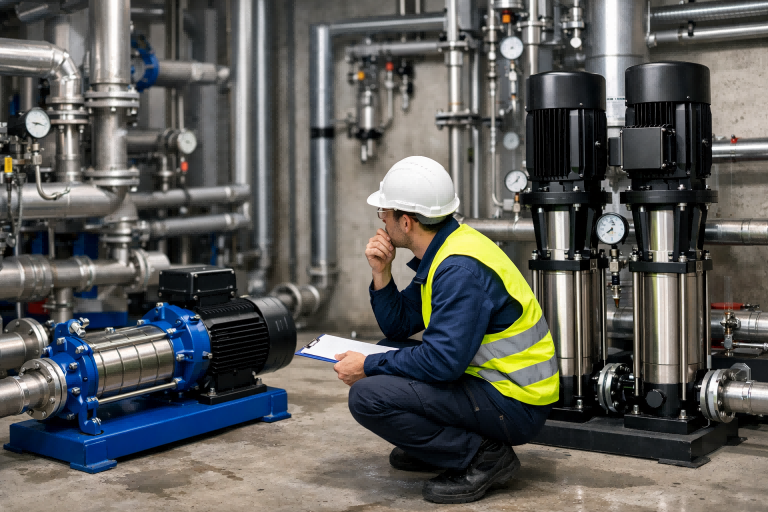
Making the right pump selection is critical for the long-term success of any fluid system.
It impacts everything from initial installation costs to daily operational efficiency and future maintenance burdens.
Understanding the fundamental design differences between horizontal and vertical multistage pumps is the first step toward optimizing your application.
This guide will break down these differences in detail.
We will explore the unique advantages of each orientation.
You will learn how their specific designs cater to distinct performance niches.
This will empower you to choose the perfect pump for your project's demands.
Horizontal Multistage Pumps
Are you dealing with an industrial application where floor space is available but headroom is limited?
A horizontal multistage pump might be your answer.
This design can cause installation challenges if you lack sufficient floor area.
Horizontal multistage pumps are workhorses for applications needing high flow rates at moderate pressure.
Their design, with a horizontal shaft and side-by-side impellers, offers excellent accessibility for maintenance, making them a practical choice for many industrial settings where reliability and ease of service are key.
A deep dive into horizontal multistage pumps reveals a design focused on accessibility and robust performance in specific environments.
Their orientation is the defining characteristic that influences every other aspect of their operation and serviceability.
Let's break down the core components and considerations that make these pumps a staple in many industries.
Shaft Orientation and Footprint
The primary feature of a horizontal pump is its horizontally oriented shaft.
Impellers are arranged sequentially along this shaft.
This side-by-side arrangement is what creates its larger footprint.
While it demands more floor space, it often requires less vertical clearance, or headroom.
This can be a significant advantage in facilities with low ceilings or overhead obstructions.
The layout directly contributes to the pump's stability and makes mounting and alignment a straightforward, albeit precise, process.
Maintenance and Accessibility Advantages
Ease of maintenance is arguably the greatest strength of the horizontal design.
Key components are more accessible compared to their vertical counterparts.
Key Maintenance Benefits:
- Easy Access: The pump, coupling, and motor are typically laid out at a comfortable working height. This allows maintenance staff to inspect, repair, or replace components without needing ladders or specialized lifting equipment.
- Simplified Disassembly: Servicing bearings, seals, or impellers often involves less complex disassembly. In many designs, the pump's hydraulic components can be serviced without disturbing the motor or major piping.
- Visual Inspection: The open layout allows for quick visual checks for leaks, vibration, or other potential issues, enabling proactive maintenance before a small problem becomes a major failure.
The table below compares the accessibility of key components.
| Component | Horizontal Pump Accessibility | Vertical Pump Accessibility |
|---|---|---|
| Motor | Exposed and easy to access | Stacked on top, may require lifting |
| Coupling | Easily accessible for alignment | Often enclosed or less accessible |
| Seals | Generally simple to reach | May require significant disassembly |
| Bearings | Accessible for lubrication/replacement | Can be more integrated and difficult |
Performance and Modern Enhancements
Horizontal pumps traditionally excel where high flow rates are needed more than extreme pressure.
They are common in water transfer, irrigation, and various industrial processing circuits.
Modern advancements have significantly enhanced their efficiency and control.
Many contemporary horizontal pumps now incorporate Variable Frequency Drives (VFDs).
A VFD allows the motor's speed to be adjusted in real-time.
This matches the pump's output to the system's actual demand.
The result is a massive reduction in energy consumption compared to older, fixed-speed pumps that rely on valves for control.
This intelligent control also enables a "soft start" and "soft stop" function.
This feature gradually ramps the motor up and down.
It drastically reduces mechanical stress on the entire system.
It also prevents hydraulic shock, known as water hammer, which can damage pipes and fittings.
By integrating smart technology, today's horizontal pumps offer not just high flow, but also highly efficient and reliable operation.
Vertical Multistage Pumps
Do you need to deliver high-pressure water in a facility with very limited floor space?
A vertical multistage pump could be the perfect solution.
However, its stacked design can make servicing more complex and labor-intensive.
Vertical multistage pumps are the masters of high-pressure, low-flow applications.
Their compact, vertical design saves valuable floor space, making them the default choice for boiler feed systems, pressure boosting in high-rise buildings, and deep well extraction where a small footprint is non-negotiable.
The vertical multistage pump is an engineering marvel designed for spatial efficiency and high-head generation.
Its vertical shaft, with impellers stacked one on top of another, is the key to its unique performance profile.
This design concentrates all the pressure-building stages into a minimal footprint, making it indispensable in modern construction and specialized industrial roles.
Space Efficiency and Design
The defining advantage of a vertical pump is its incredibly small footprint.
By stacking the impellers and motor vertically, the design uses vertical space instead of horizontal floor area.
This makes it ideal for:
- Urban Water Supply: Essential for pressure boosting in skyscrapers and other tall structures where mechanical rooms are small and costly.
- Compact Industrial Skids: Perfect for integration into prefabricated systems for water treatment, reverse osmosis, or chemical dosing where space is at a premium.
- Deep Wells: In-line vertical designs can be submerged for borehole and well applications, pushing water up from great depths.
The integrated, "in-line" nature of many vertical pumps also simplifies installation.
The inlet and outlet ports are often on the same axis, allowing the pump to be fitted directly into a straight run of pipe, minimizing complex plumbing and further saving space.
Engineering for High Pressure
Vertical pumps are built to generate high head, or pressure.
Each impeller in the stack acts as a separate pressure stage.
Water enters the first impeller and is discharged at a higher pressure into the next.
This process is repeated through each stage, compounding the pressure until it exits the final stage at the required high pressure.
Modern vertical pumps leverage advanced materials and technology to achieve this reliably.
Key Engineering Features:
- Premium Materials: Impellers are often crafted from high-grade materials like AISI304 stainless steel. This provides excellent corrosion resistance and durability, ensuring a long service life even with aggressive or high-temperature fluids.
- Advanced Motor Technology: Many high-performance models utilize a Permanent Magnet Synchronous Motor (PMSM). These motors are more efficient and can achieve higher speeds than traditional induction motors, contributing to the pump's powerful output.
- Robust Bearings: The use of high-quality, precision bearings is critical to handle the axial thrust generated by the stacked impellers and ensure quiet, long-lasting operation.
Servicing and Longevity Considerations
The compact design of a vertical pump can make maintenance more challenging.
Accessing internal components like seals or impellers often requires dismantling the entire pump stack.
This can be more time-consuming and may require specialized equipment to lift the motor and upper assembly.
To counteract this, manufacturers focus heavily on building in reliability and protecting the pump's core components.
A key innovation is the complete sealing of sensitive electronics.
The main controller board (PCB) may be fully potted in a protective compound.
This creates an impenetrable waterproof and dustproof seal, often achieving an IP67 rating.
This single feature can prevent the vast majority of failures related to moisture and condensation, extending the electronic controller's lifespan by several years and reducing the overall need for service interventions.
Key Differences Summarized
Are you confused by the technical details and just need a clear, direct comparison?
Choosing the wrong pump can lead to operational headaches and wasted money.
You need to know which pump fits your specific application's constraints.
The primary differences come down to footprint, maintenance access, and performance.
Horizontal pumps need more floor space but are easier to service, excelling at high flow.
Vertical pumps save space and deliver high pressure, but maintenance can be more involved.
Your choice should align with these core trade-offs.
When selecting a multistage pump, boiling the decision down to a few key criteria can simplify the process immensely.
Beyond the basic orientation, the practical implications for installation, maintenance, and long-term performance are what truly matter.
Understanding these core differences will ensure you select a pump that is not only capable of doing the job but is also a good fit for your operational environment and maintenance strategy.
Footprint and Spatial Requirements
This is often the first and most critical deciding factor.
The physical space available for the pump installation dictates which orientation is even possible.
- Vertical Pumps: The undisputed winner for space conservation. Their design utilizes vertical height, making them perfect for crowded mechanical rooms, compact equipment skids, and applications within tall buildings.
- Horizontal Pumps: Require a significantly larger floor area. They are best suited for industrial plants, agricultural settings, or single-story buildings where floor space is less of a concern than ceiling height.
The table below provides a simple decision matrix based on available space.
| Available Space Condition | Recommended Pump Type | Rationale |
|---|---|---|
| Limited Floor Space, Ample Height | Vertical | Maximizes use of vertical space. |
| Ample Floor Space, Low Ceiling | Horizontal | Spreads out horizontally, requires less headroom. |
| Extremely Constrained Space | Vertical (In-line) | Can be installed directly into pipework. |
| Large, Open Area | Horizontal | Space is not a constraint; easier access is prioritized. |
Accessibility for Maintenance
The long-term cost of ownership is heavily influenced by how easy it is to service a pump.
A pump that is difficult to maintain will receive less frequent service, leading to reduced efficiency and a shorter lifespan.
- Horizontal Pumps: Generally considered far easier to maintain. The motor, coupling, and pump casing are laid out at ground level, offering direct access to bearings, seals, and other wear parts. This simplifies routine checks and major repairs.
- Vertical Pumps: Notoriously more complex to service. Accessing the mechanical seal or internal impellers often requires removing the heavy motor and dismantling the pump from the top down, a labor-intensive process.
Performance Niche and Application
Each pump type is engineered to excel in a different performance window.
While there is some overlap, they each have a distinct specialty.
- Horizontal Pumps: The Flow Champions. Their design is inherently suited for moving large volumes of fluid at moderate pressures. This makes them ideal for large-scale water transfer, circulation systems, and general industrial supply.
- Vertical Pumps: The Pressure Specialists. The stacked impeller design is purpose-built for generating high head (pressure). They are the go-to choice for boiler feed, pressure boosting systems, reverse osmosis, and any application where overcoming significant elevation or system resistance is the primary goal.
Choosing the right pump means matching your system's demand for flow and pressure with the pump's most efficient operating point.
Selecting a pump outside of its ideal performance niche will lead to wasted energy, increased wear, and potential premature failure.
Conclusion
Choosing between horizontal and vertical multistage pumps depends entirely on your application's needs for space, pressure, flow, and maintenance access.
Each has clear advantages in its specific niche.
FAQs
What is the main advantage of a vertical multistage pump?
Its primary advantage is its small footprint.
This design saves significant floor space, making it ideal for installations in tight areas like high-rise buildings or compact equipment rooms.
Are horizontal pumps easier to maintain?
Yes, generally.
Their components are laid out at ground level, providing easier access for inspection, repair, and replacement of parts like seals and bearings without major disassembly.
When should I use a horizontal multistage pump?
Use a horizontal pump for high-flow, a moderate-pressure application where you have ample floor space.
They are common in industrial water transfer and large-scale irrigation systems.
Can vertical pumps handle high temperatures?
Yes, many vertical pumps are designed to handle hot water.
They are frequently used for boiler feed water and hot water circulation systems, often rated for temperatures up to 75°C or higher.
What is water hammer and how do pumps prevent it?
Water hammer is a pressure surge caused by a sudden stop in fluid flow.
Modern pumps with VFDs use a soft start/stop feature to prevent this by gradually changing motor speed.
Do vertical pumps need special alignment?
Vertical in-line pumps often simplify installation as they fit directly into a pipeline.
However, base-mounted vertical and all horizontal pumps require precise alignment between the pump and motor to prevent vibration and premature wear.
Which pump type is generally quieter?
Modern pumps of both types can be very quiet, especially those using PMSM motors and VFDs.
However, vertical pumps are often noted for their low operational noise due to their integrated and balanced design.
Are vertical pumps more expensive than horizontal pumps?
Cost can vary widely based on size, materials, and features.
For similar performance points, there may not be a significant price difference, so the choice should be based on technical suitability, not just initial cost.