Choosing the wrong size pump is a recipe for disaster.
It leads to wasted water, sky-high energy costs, and weak, underperforming crops.
You need to match the pump's power to your specific irrigation demands, not just guess.
The "size" of an irrigation pump is not about horsepower.
It is defined by two critical metrics: the required flow rate (how much water) and the total dynamic head (how much pressure).
Matching your system's needs to these two factors is essential for efficiency.
Simply knowing that you need to consider "flow and head" is just the beginning.
These are not just technical terms; they are the fundamental variables that will determine the financial success and sustainability of your entire irrigation setup.
A pump that provides the right flow but not enough head will fail to operate your sprinklers correctly.
A pump that provides too much head for a simple flood irrigation system is wasting energy with every rotation.
To select the right pump, you must first become a detective.
You have to investigate your land, your water source, and your irrigation method to uncover these two crucial numbers.
This guide will walk you through exactly how to do that.
Step 1: Calculating Your Required Flow Rate
You have a large field to irrigate.
But how much water is actually enough?
An undersized pump will lead to dry patches and inconsistent growth, while an oversized pump wastes precious energy and water, driving up your operational costs.
The solution is to calculate your exact demand.
To size your pump correctly, first calculate the total flow rate your irrigation system demands.This is measured in gallons per minute (GPM) or cubic meters per hour (m³/h).This calculation depends on the area you are watering and your irrigation method.
Flow rate is the volume of water your pump can deliver over a set period.
It is the lifeblood of your irrigation system, and getting it right is your first priority.
The goal is to deliver a sufficient amount of water to every plant in your target zone within a practical timeframe.
This number is not arbitrary; it is a calculated value based on your specific agricultural needs.
For distributors and installers, guiding a customer through this calculation demonstrates expertise and ensures they purchase a product that will perform as promised, leading to higher customer satisfaction.
The total required flow rate is the sum of the flow rates of all the outlets (sprinklers, drip emitters) that will be operating at the same time.
Determine Flow Rate by Irrigation Type
Different irrigation methods have drastically different flow rate requirements.
-
Sprinkler & Pivot Irrigation: These systems are designed to cover large areas and therefore require high flow rates.
You must add up the GPM rating of every single sprinkler head in a zone.
For example, if a zone has 50 sprinkler heads, and each is rated at 2 GPM, you need a pump that can deliver at least 100 GPM.
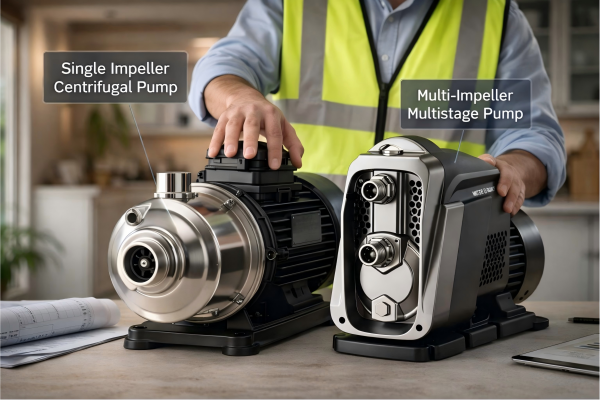
For these high-flow applications, a centrifugal impeller pump is the ideal choice.
They are designed to move large volumes of water efficiently. -
Drip & Micro-Irrigation: These methods are highly efficient and use very low flow rates.
The GPM is often measured in gallons per hour (GPH) for each emitter.
You would add the GPH of all emitters and convert to GPM.
For example, 1,000 emitters at 1 GPH each is 1,000 GPH, which translates to about 16.7 GPM.
These systems value pressure over volume, making a screw pump, known for its high-head capabilities, a suitable option, especially if the water source is deep.
Connect Flow Rate to Pump Selection
Once you know your required flow rate, you can start to narrow down your pump choices.
Your calculation will point you directly to one of two main categories.
| Required Flow Rate | Typical Irrigation Method | Recommended Pump Type | Primary Advantage |
|---|---|---|---|
| High (50+ GPM) | Sprinklers, Center Pivots, Flood | Centrifugal Impeller Pump | Moves large water volume efficiently |
| Low (5-20 GPM) | Drip Lines, Micro-Sprayers | Solar Screw Pump | Maintains high pressure for efficiency |
This simple calculation prevents the most common sizing mistake: buying a high-pressure screw pump for a high-flow flood irrigation system, or vice-versa.
Step 2: Measuring Your Total Dynamic Head (TDH)
Your new pump has a great flow rate at the wellhead.
But by the time the water reaches the sprinklers, it is just a trickle.
The problem is that you only considered flow and ignored the total pressure required, known as Total Dynamic Head (TDH).
Your pump is losing the fight against gravity and friction.
Total Dynamic Head (TDH) is the total equivalent height that water must be lifted, considering gravity, pipe friction, and operating pressure.
It is measured in feet or meters.
You must calculate your TDH to ensure the pump has enough power to deliver water effectively.
Total Dynamic Head is the second critical piece of the pump sizing puzzle.
It represents the total work your pump needs to do to get water from its source to its destination and make it usable.
Failing to calculate TDH is like trying to plan a road trip knowing the distance but not the elevation changes or road conditions.
You might not have enough engine power to make it up the mountains.
TDH is the sum of three distinct factors.
You must calculate each one and add them together.
Factor 1: Static Head
This is the simplest part of the equation.
Static head is the raw vertical distance in feet or meters that the water needs to be lifted.
- For a submersible well pump: It is the distance from the water level in the well to the highest point in your plumbing system (e.g., the inlet of a storage tank or the ground level of your field).
- For a surface pump: It is the vertical distance from the pump's intake to the final discharge point.
Factor 2: Friction Loss
Water doesn't move through pipes for free.
As it flows, it rubs against the inner walls of the pipes and has to navigate turns and fittings.
This creates friction, which the pump must overcome.
Friction loss depends heavily on:
- Pipe Diameter: Smaller pipes cause significantly more friction loss than larger pipes for the same flow rate.
Doubling pipe diameter can reduce friction loss by a factor of 16. - Pipe Length: The longer the pipe, the more friction.
- Flow Rate: Higher flow rates create more friction.
You can find friction loss charts online, but a rule of thumb is to size pipes generously to minimize this energy-wasting factor.
Factor 3: Operating Pressure
This is the pressure required at the end of the line for your equipment to work correctly.
- Sprinklers: Might require 30-60 PSI (Pounds per Square Inch) to operate.
- Drip Emitters: Might require 15-25 PSI.
- Filling a Tank: Requires 0 PSI at the outlet.
You must convert this PSI requirement into head.
The conversion is simple: 1 PSI = 2.31 feet of head.
So, a sprinkler needing 40 PSI adds (40 * 2.31) = 92.4 feet to your TDH calculation.
Your Total Dynamic Head = Static Head + Friction Loss + Operating Pressure (in feet).
A pump with a "high head" rating, like a solar screw pump, is designed for systems with a high TDH, especially those with large static head from deep wells.
A centrifugal impeller pump is better suited for moderate TDH systems.
Step 3: Why Motor Efficiency Is the Real Size Factor
You have your flow and head numbers.
Now you are looking at pumps and comparing horsepower (HP) or kilowatts (kW).
The mistake is assuming that a bigger HP number means a better pump.
This thinking leads to oversized systems, huge solar arrays, and wasted money.
The solution is to focus on motor efficiency instead.
The "size" of a pump is best measured by its efficiency, not its horsepower.
A pump with a high-efficiency Brushless DC (BLDC) motor (>90%) will deliver your required flow and head using significantly less energy, dramatically lowering your solar panel costs.
Horsepower is a measure of a motor's input power, not its output work.
It is a misleading metric for sizing a modern irrigation system.
The most important factor that determines the true cost and performance of your pump is the efficiency of its motor.
This is where the technological leap to Brushless DC (BLDC) permanent magnet motors changes everything.
Consider two pumps that both deliver the exact same flow rate and head.
- Pump A has an older brushed motor with 70% efficiency.
- Pump B has a modern BLDC motor with 92% efficiency.
To deliver 1,000 watts of actual water-pumping power, Pump A needs to draw approximately 1,428 watts of electricity from your solar panels.
Pump B, however, only needs to draw about 1,087 watts to do the exact same job.
The High Cost of Inefficiency
That 22% difference in efficiency is not just a number.
It has massive financial consequences.
To power Pump A, you need a 1,500-watt solar array.
To power Pump B, you only need an 1,100-watt array.
This means the inefficient motor forces you to buy 27% more solar panels, along with a larger mounting rack and heavier gauge wiring.
This is the "inefficiency tax" you pay for choosing a pump with an inferior motor.
The Benefits of Sizing for Efficiency
When you shift your focus from horsepower to efficiency, the benefits are clear.
- Lower System Cost: A hyper-efficient BLDC motor, which is up to 47% smaller and 39% lighter than older designs, allows you to use a significantly smaller and cheaper solar array.
This reduces the single largest expense of a solar pumping system. - Longer Pumping Day: High-efficiency motors require less power to start and run.
This means they start earlier in the morning, run later into the evening, and perform better on cloudy days, maximizing the water you pump. - Unmatched Reliability: BLDC motors are brushless.
They have no parts that are designed to wear out and be replaced.
This maintenance-free design delivers a service life exceeding 10 years, ensuring long-term reliability for a critical asset.
In modern pump sizing, the smartest question isn't "How much horsepower do I need?" but rather, "How efficient is the motor?"
Conclusion
Sizing an irrigation pump is a three-step process.
Calculate your flow rate, measure your total dynamic head, and then choose a pump with the highest efficiency motor you can.
Frequently Asked Questions
What size pump do I need for a 1-acre garden?
The size depends on your irrigation method.
For sprinklers, you may need 15-30 GPM.
For drip irrigation on 1 acre, you might only need 5-10 GPM.
How do I calculate the GPM for my irrigation pump?
Sum the GPM rating of all sprinkler heads that will run at once.
For example, 10 sprinklers at 2 GPM each requires a 20 GPM pump.
What is a good GPM for a sprinkler system?
It varies by sprinkler head.
Most residential heads use 1-4 GPM, while agricultural rotors can use 5-20 GPM or more.
Check the manufacturer's specs.
Is a 1 HP pump enough for irrigation?
Horsepower is a poor measure.
Focus on flow rate and head.
An efficient 1 HP pump can outperform an inefficient 1.5 HP pump while using less energy.
How far can a 1 HP pump push water?
This depends on the pump's head rating, not its horsepower.
A high-head pump can push water hundreds of feet vertically, while a high-flow pump may only manage 50 feet.
How do you size a submersible well pump?
Calculate your required GPM and your Total Dynamic Head (TDH), including the depth to water, friction loss, and required surface pressure.
Match these to a pump curve.
Does a longer pipe reduce water pressure?
Yes, a longer pipe increases friction loss, which reduces the pressure at the end of the pipe.
Using a larger diameter pipe can significantly decrease this effect.