Struggling with unreliable water access in an off-grid location?
You need a dependable solution, but traditional pumps are costly and complex.
A solar water pump's depth capacity, or "head," varies significantly.
Screw pumps can draw from over 200 meters (650 feet) for deep wells, while high-flow impeller pumps typically operate efficiently at depths of 50 to 150 meters (160 to 490 feet), depending on the specific model and power input.
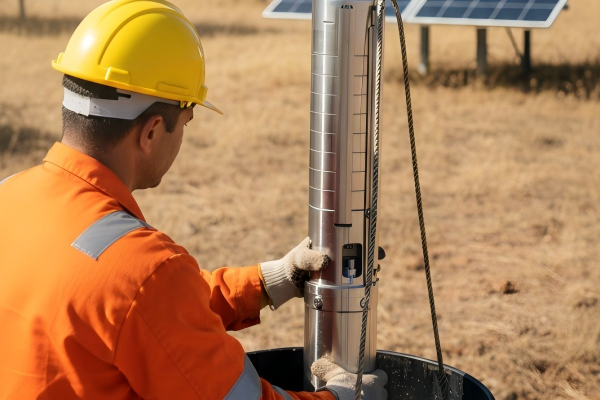
Choosing the right solar pump is crucial for your water security.
The depth of your well, required water volume, and even the water quality are key factors that determine which pump technology is best for you.
This guide will break down the different types of solar deep well pumps, helping you understand their specific capabilities and applications.
We will explore how each design meets unique challenges, from deep domestic wells to large-scale agricultural irrigation.
Let's find the perfect solar water solution for your needs.
Understanding the Solar Screw Pump: Low Flow, High Head
Need to lift water from an incredibly deep well?
Traditional pumps often fail at extreme depths, leaving you without a reliable water source.
The solar screw pump is engineered for this exact challenge.
It uses a progressing cavity design to efficiently push water from depths where other pumps struggle, making it the perfect solution for deep well applications requiring consistent, albeit lower, flow rates.
A solar screw pump excels in conditions that demand high pressure to lift water from significant depths.
This capability is known as having a 'high head'.
The core of its design is a single helical stainless steel screw (the rotor) that rotates inside a double-threaded rubber sleeve (the stator).
As the screw turns, it creates sealed cavities of water that are pushed progressively upwards from the inlet to the outlet.
This mechanism operates more like a positive displacement system than a centrifugal one, which allows it to generate immense pressure with relatively low energy consumption.
This makes it exceptionally efficient for deep wells, often exceeding 200 meters.
The Mechanics of a Progressing Cavity Pump
The genius of the progressing cavity design lies in its simplicity and effectiveness.
Unlike impeller pumps that 'throw' water upwards using centrifugal force, the screw pump gently 'pushes' it.
This process is less affected by the total vertical lift, allowing the pump to maintain a steady flow rate even as the well depth increases.
Furthermore, this gentle pushing action reduces turbulence, making it suitable for delicate applications and minimizing wear on the system components.
The consistent, non-pulsating flow is another significant advantage for systems requiring steady water delivery.
Superior Sand and Silt Resistance
One of the most significant advantages of a solar screw pump is its remarkable tolerance for sand and other abrasives.
Wells, especially newly drilled ones or those in sandy regions, often contain particulate matter that can quickly destroy the tight-tolerance impellers of centrifugal pumps.
The rubber stator of a screw pump, however, can flex to allow small particles to pass through without causing catastrophic damage.
This resilience makes it an ideal choice for boreholes in Africa and Latin America, where water quality can be unpredictable.
It reduces maintenance needs and extends the pump's operational lifespan in harsh conditions.
| Feature | Solar Screw Pump | Centrifugal Impeller Pump |
|---|---|---|
| Pumping Mechanism | Positive Displacement | Centrifugal Force |
| Best Application | Low Flow, High Head | High Flow, Medium Head |
| Max Depth | Up to 200m+ | Typically up to 150m |
| Sand Tolerance | Excellent | Moderate to Poor |
| Ideal For | Deep domestic wells, livestock | Farm irrigation, large tanks |
Limitations and Ideal Applications
The primary limitation of the solar screw pump is its lower flow rate.
The design prioritizes pressure over volume.
Therefore, it is not the best choice for applications that require large volumes of water quickly, such as flood irrigation for large agricultural fields.
Instead, it is perfectly suited for domestic water supply, filling storage tanks for livestock, and small-scale drip irrigation systems.
These applications benefit more from the pump's reliability and depth capability than from high-volume output.
Exploring the Solar Plastic Impeller Pump: High Flow, Wear-Resistant
Do you need to move large volumes of water for your farm or garden?
Low-flow pumps won't meet the demands of large-scale irrigation, slowing down your operations.
The solar plastic impeller pump delivers high flow rates efficiently.
It is designed as a multi-stage centrifugal pump, making it a powerful and economical solution for agricultural irrigation, pasture water supply, and filling large reservoirs where high water output is the priority.
The solar plastic impeller pump is the workhorse of agricultural water solutions.
Its design is centered around a series of impellers and diffusers stacked on top of each other.
Each stage in this multi-stage configuration increases the water pressure, allowing the pump to achieve a good balance of high flow and medium head.
This makes it perfect for moving significant water volumes from moderate depths, such as those typically found in wells used for farm and ranch irrigation.
The use of engineered, wear-resistant plastic for the impellers offers a unique combination of performance, durability, and cost-effectiveness.
How Multi-Stage Impellers Generate High Flow
A multi-stage centrifugal pump operates like a series of pumps linked together.
Water enters the first impeller at the bottom, which spins rapidly and throws the water outwards by centrifugal force.
A diffuser then collects this high-velocity water, slows it down, and converts the kinetic energy into pressure.
The pressurized water is then guided into the eye of the next impeller, and the process repeats.
Each stage adds more pressure, and the size and shape of the impellers determine the total flow rate.
This design is highly effective at producing the high water output needed for large-scale applications.
Cost-Benefit Analysis for Farm Irrigation
For farmers and ranchers, the total cost of ownership is a critical factor.
Solar plastic impeller pumps offer an outstanding economic advantage.
The materials and manufacturing processes for high-quality plastic impellers are more cost-effective than those for stainless steel.
This lower initial purchase price makes modern solar water technology accessible to a broader range of users, especially in developing agricultural economies in Africa and the Americas.
Furthermore, their lightweight nature reduces shipping costs and simplifies installation, which can often be done without heavy lifting equipment.
This combination of low upfront cost and easy setup provides a rapid return on investment.
| Aspect | Plastic Impeller Pump | Stainless Steel Impeller Pump |
|---|---|---|
| Primary Advantage | High Flow & Low Cost | Corrosion Resistance & Durability |
| Initial Cost | Lower | Higher |
| Weight | Lighter | Heavier |
| Wear Resistance | Excellent vs. sand/silt | Good vs. sand, excellent vs. chemicals |
| Best Environment | Non-corrosive water, farms | Corrosive/acidic water, premium homes |
Material Advantages and Limitations
Modern engineering plastics used in these pumps are not ordinary plastics.
They are advanced polymers specifically designed for high strength and excellent resistance to abrasion from fine sand.
This makes them surprisingly durable in many well conditions.
However, their main limitation is a lower resistance to highly corrosive environments (either very acidic or alkaline water) and extreme temperatures compared to stainless steel.
In standard water conditions, they provide a long service life, but for wells with known water quality issues, a more robust material may be necessary.
The Premium Solar Stainless Steel Impeller Pump: Corrosion Resistance
Is your well water acidic, alkaline, or salty?
Standard pumps will quickly corrode and fail in harsh water, leading to costly replacements and downtime.
The solar stainless steel impeller pump provides a definitive solution.
Constructed with high-grade SS304 stainless steel, this pump is engineered for maximum durability and a long service life in corrosive water environments, ensuring reliable performance where other pumps cannot.
When water quality is a challenge, material selection becomes the most critical factor in a pump's longevity.
The solar stainless steel impeller pump addresses this directly by utilizing SS304 stainless steel for both the impellers and the pump body.
This material is renowned for its excellent resistance to rust and corrosion caused by a wide range of chemical contaminants, including acids and alkalis.
This pump is the premium choice for applications where water quality is compromised or where maximum reliability is non-negotiable.
It is particularly valuable in regions with alkaline soils, such as parts of Australia, or in coastal areas where saltwater intrusion can be an issue.
The Science Behind SS304 Corrosion Resistance
Stainless steel's "stainless" property comes from a high chromium content, typically a minimum of 10.5%.
The chromium reacts with oxygen in the air and water to form a thin, invisible, and passive layer of chromium oxide on the surface of the steel.
This passive layer is incredibly resilient and self-healing.
If it gets scratched or damaged, a new layer instantly reforms, protecting the underlying steel from corrosive agents.
SS304 is an austenitic stainless steel containing 18% chromium and 8% nickel, which enhances its corrosion resistance and durability, making it an industry standard for high-quality fluid handling equipment.
Applications in Niche and High-End Markets
The superior materials and construction of the stainless steel impeller pump come at a higher price point.
This positions it as a premium product for more niche markets.
Ideal applications include supplying water for high-end homes and ranches where reliability is paramount, providing drinking water in regions with known water quality issues, and for any industrial or agricultural process where water corrosivity would destroy lesser pumps.
For distributors, this pump serves a vital segment of the market that prioritizes long-term investment and trouble-free operation over minimum initial cost.
It is a problem-solver for the most challenging water conditions.
| Pump Type | Key Strength | Ideal Water Condition | Typical Customer |
|---|---|---|---|
| Screw Pump | High Head (Depth) | Sandy or Silty | Deep-well homeowner |
| Plastic Impeller | High Flow (Volume) | Standard/Non-Corrosive | Farmer/Rancher |
| Stainless Steel | Corrosion Resistance | Acidic/Alkaline/Brackish | Premium property owner |
The Trade-Off: Cost vs. Lifespan
The primary consideration when choosing a stainless steel pump is balancing the higher initial investment against the total cost of ownership.
While the upfront cost is greater than a plastic impeller model, its service life in corrosive water is exponentially longer.
A less-suited pump might fail in as little as one or two years under such conditions, requiring complete replacement.
A stainless steel pump, however, can provide reliable service for many years, making it the more economical choice in the long run.
The added weight is another factor, potentially requiring more robust mounting and installation equipment, but for the right application, these are minor considerations compared to the benefit of unmatched durability.
The BLDC Motor: Core Power and High Efficiency
What truly drives the performance of a modern solar water pump?
The pump itself is only half the story; an inefficient motor wastes precious solar energy and requires a larger, more expensive solar array.
The heart of these advanced pumps is a Brushless DC (BLDC) permanent magnet motor.
With efficiencies often exceeding 90%, this motor technology is the core driver that makes the entire system powerful, compact, reliable, and cost-effective, setting a new standard for solar pumping.
The motor is the engine of the entire solar water pumping system.
Its ability to convert electrical energy from the solar panels into mechanical rotational force determines the overall efficiency.
All three pump types—screw, plastic impeller, and stainless steel impeller—are powered by advanced BLDC permanent magnet motors.
This technology represents a significant leap forward from older brushed DC or AC motors.
A BLDC motor uses powerful permanent magnets (made of materials like 40SH neodymium iron boron) on its rotor and electronic controllers to switch the electromagnetic fields in the stator, eliminating the need for physical brushes.
This design dramatically reduces friction and energy loss.
Technical Advantages of Brushless Design
The absence of brushes in a BLDC motor is the source of its primary advantages.
Brushes in traditional motors are a point of mechanical wear, friction, and electrical arcing, which leads to energy loss (as heat) and eventual failure.
By eliminating them, BLDC motors achieve several key benefits:
- Higher Efficiency: With no energy lost to brush friction, efficiencies can surpass 90%, compared to 75-80% for brushed motors. This means more water is pumped per watt of solar power.
- Longer Lifespan: With no brushes to wear out, the motor's operational life is limited only by its bearings, leading to a service life of tens of thousands of hours.
- Maintenance-Free: The lack of wearable components means the motor requires virtually no maintenance.
- Higher Power-to-Weight Ratio: These motors generate more power and torque in a smaller package. They can be up to 47% smaller and 39% lighter than conventional motors of equivalent power.
Market Value: Reducing System Costs
The high efficiency of the BLDC motor has a direct impact on the total cost of the solar water pumping system.
A more efficient motor requires less power to do the same amount of work.
This means a smaller solar panel array is needed to power the pump, significantly reducing one of the most expensive components of the entire installation.
For a distributor or installer, this is a powerful selling point.
It makes the entire package more affordable and competitive.
The motor's compact and lightweight design also simplifies transportation and installation, further reducing overall project costs.
The Role of the MPPT Controller
To maximize the motor's performance, it is paired with an intelligent Maximum Power Point Tracking (MPPT) controller.
Solar panels produce a variable voltage and current depending on sunlight intensity.
An MPPT controller constantly analyzes the output of the solar panels and adjusts the electrical load to a point that extracts the maximum possible power.
This ensures the BLDC motor receives optimal power throughout the day, from the lower light of early morning and late afternoon to the peak sun of midday.
This intelligent management can boost the total water output by up to 30% compared to systems without MPPT.
Conclusion
The best solar deep-well pump balances the pump type with a high-efficiency motor and an intelligent control system.
This combination ensures distributors can meet diverse market needs and end-users receive an energy-saving, durable, and cost-effective water solution.
FAQs
How deep can a 1hp solar water pump lift water?
A 1hp solar pump's lifting depth, or head, varies by type. A screw pump might reach 100-120 meters, while an impeller pump will lift to about 50-70 meters but with a higher flow rate.
Do solar pumps work on cloudy days?
Yes, but at reduced performance. They produce less water on cloudy days. Some systems include AC/DC hybrid controllers to switch to grid or generator power when sunlight is insufficient.
What size solar pump do I need?
The required size depends on your daily water needs (volume) and the total vertical distance you need to lift it (head). A professional calculation is recommended for proper sizing.
How long do solar water pumps last?
A quality solar water pump system can last for decades. The solar panels are often warrantied for 25 years, and the brushless DC motor can operate for over 10 years with minimal maintenance.
Can a solar pump fill a tank?
Yes, this is a very common and efficient application. The pump fills a storage tank during sunny hours, and water is then gravity-fed as needed, ensuring a consistent 24/7 water supply.
Are solar water pumps expensive?
The initial investment for a solar water pump can be higher than a conventional pump. However, they have no fuel costs and very low maintenance, making them more cost-effective over the long term.
What is the head of a solar pump?
"Head" is the maximum vertical distance a pump can lift water. It's a key specification, and you must choose a pump with a head rating greater than your well's depth plus any elevation to the storage tank.
Can solar water pumps run at night?
Standard solar pumps only run when there is sunlight. To run at night, the system would require a battery bank to store energy or an AC/DC hybrid controller to use an alternate power source.