Choosing the wrong irrigation pump can be a costly mistake.
It leads to inefficient water use, high energy bills, and ultimately, poor crop yields.
The solution is to find a pump perfectly matched to your specific needs.
**To choose an irrigation pump, you must evaluate four key factors.
These are your water source, your irrigation method, your water quality, and your power supply.
Analyzing these elements will guide you to the ideal pump for efficient and reliable performance.
**
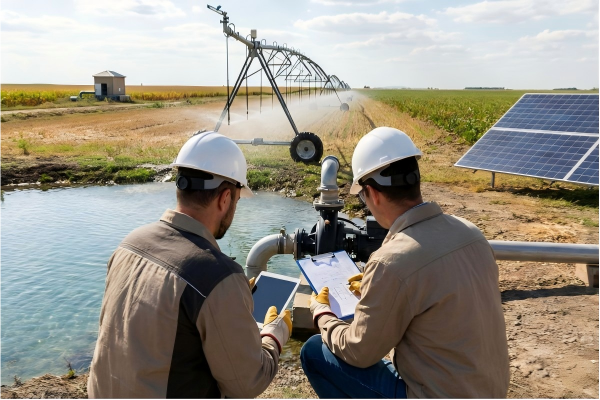
Picking a pump is not about finding the most powerful one.
It is about finding the smartest one for your unique situation.
A pump that works perfectly on a neighboring farm might be a complete disaster on yours.
This is because the right choice depends on a careful balance of several factors.
These factors include how deep your water is, how you plan to distribute it, what is in your water, and what power you have available.
This guide will break down each of these critical decision points.
We will help you understand the tradeoffs and make a confident choice.
This will ensure your irrigation system is both effective and economical for years to come.
Factor 1: Match the Pump to Your Water and Irrigation Method
A powerful pump is useless if it cannot lift water from your deep well.
This mismatch results in weak water flow and disappointingly high energy bills.
You must match your pump's capabilities to your farm's physical demands.
**Choose a high-head pump for deep wells or high-pressure sprinklers.
Select a high-flow pump for shallow sources and flood irrigation.
Matching these two metrics, flow rate and head, is the first and most critical step in choosing the right pump.
**
Every pump is defined by two primary performance metrics: flow rate and head.
Getting these two right is the foundation of an efficient irrigation system.
Flow rate is the volume of water the pump can move, usually measured in gallons per minute (GPM) or cubic meters per hour (m³/h).
Head is the pressure the pump can generate, which translates to its ability to push water vertically and overcome resistance.
It is measured in feet or meters.
A mismatch between these capabilities and your needs leads to either an underperforming system or a massive waste of energy.
Understanding when to prioritize one over the other is key.
For distributors, guiding a customer to the correct balance of flow and head builds trust and ensures the product will meet their expectations.
This leads to greater customer satisfaction and fewer service issues.
High-Head Pumps: For Deep Wells and High Pressure
A high-head pump excels at creating pressure.
It specializes in lifting water from great depths or pushing it against significant resistance.
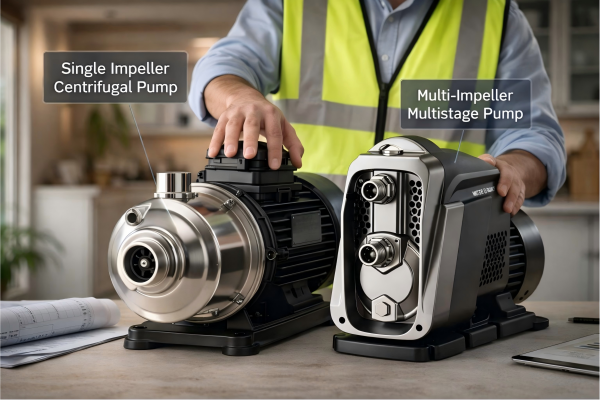
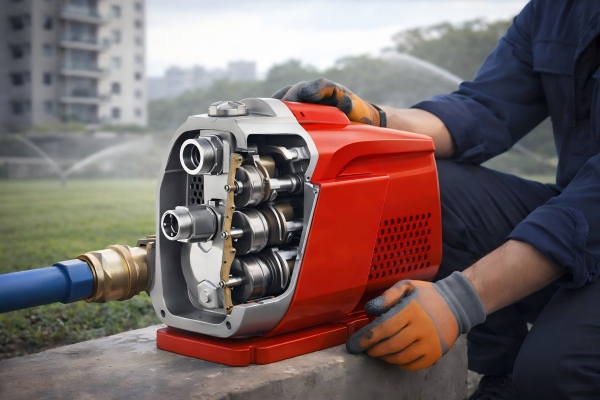
The solar screw pump is a perfect example of a high-head design.
It uses a rotating stainless steel screw inside a rubber stator.
This mechanism acts like an Archimedes' screw, progressively pushing "pockets" of water upward.
This creates immense pressure, allowing it to service very deep wells where other pumps would fail.
This makes it ideal for:
- Deep Well Water Extraction: Providing domestic or livestock water from wells over 200 feet deep.
- High-Pressure Drip Irrigation: Ensuring consistent pressure across long drip lines, especially on sloped terrain.
- Long-Distance Water Transfer: Pushing water to a distant tank or trough.
The trade-off for this incredible lifting power is a lower flow rate.
This makes screw pumps less suitable for applications that need to move massive volumes of water quickly.
High-Flow Pumps: For Moving Large Water Volumes
A high-flow pump is designed to move the largest possible volume of water over a shorter distance.
The centrifugal impeller pump is the champion of high-flow applications.
It uses a rapidly spinning impeller to fling water outward, converting rotational energy into water velocity and volume.
These pumps are the workhorses for large-scale agriculture.
They are ideal for:
- Flood or Furrow Irrigation: Quickly covering large fields with water.
- Center Pivot Systems: Supplying the high volume needed to operate large sprinkler arms.
- Draining or Transferring from Ponds and Rivers: Moving water from shallow, surface-level sources.
These pumps provide excellent flow rates but have a lower head capacity compared to a screw pump.
They are most effective when the water source is relatively shallow and the pressure requirements at the endpoint are moderate.
| Pump Characteristic | Best Suited For | Typical Application | Recommended Pump Type |
|---|---|---|---|
| High Head, Low Flow | Deep wells, high-pressure systems | Livestock water from 300ft well | Solar Screw Pump |
| High Flow, Medium Head | Shallow wells, large volume needs | Farm pivot irrigation from a pond | Centrifugal Impeller Pump |
Factor 2: Consider Your Water Quality
Sandy or corrosive water is a silent killer of irrigation pumps.
This leads to frequent breakdowns, expensive repairs, and frustrating downtime during critical growing seasons.
The solution is to choose a pump built with materials that can survive your specific water conditions.
**For sandy water, choose a wear-resistant pump like one with durable plastic impellers or a screw pump.
For acidic or alkaline water, you must invest in a corrosion-resistant stainless steel pump.
This choice directly determines your pump's lifespan and reliability.
**
The water you are pumping is not just water.
It is a liquid that carries dissolved minerals and suspended solids.
These elements can drastically shorten a pump's life if the pump is not designed to handle them.
Two of the most common threats are abrasives like sand and corrosives from imbalanced pH levels.
Before selecting a pump, it is wise to have your water tested.
Knowing your water's pH and whether it contains sand, silt, or iron will guide you to a much more durable and cost-effective pump choice.
Ignoring water quality is one of the most expensive mistakes an irrigator can make.
It means you are not just buying a pump; you are planning for its replacement.
The Challenge of Abrasives: Sand and Silt
Sand and other fine particles act like liquid sandpaper inside your pump.
They grind away at impellers, wear out seals, and clog tight tolerances.
This leads to a gradual but irreversible loss of pressure and efficiency, eventually causing total failure.
For these conditions, two types of pumps stand out.
- Solar Screw Pumps: These are highly resistant to sand.
The space between the steel screw and the rubber stator allows small particles to pass through without causing significant wear.
This makes them exceptionally durable in gritty well water. - Solar Plastic Impeller Pumps: High-quality plastic impellers offer excellent resistance to wear from fine sand.
They are often more economical than their stainless steel counterparts and are a fantastic choice for general farm and pasture irrigation where water is clean but may contain some sand.
The Threat of Corrosion: Acidity and Alkalinity
Water that is too acidic (low pH) or too alkaline (high pH) can chemically attack the pump's internal components.
This corrosion weakens the metal, leading to cracks, leaks, and eventual disintegration.
This is a common issue in regions with specific geological makeups, such as the alkaline soils found in parts of Australia.
For these environments, material selection is everything.
The solar stainless steel impeller pump is the definitive solution.
These pumps are built with SS304 or higher-grade stainless steel for both the impellers and the pump body.
This material provides superior resistance to chemical attack from a wide range of pH levels.
While the initial investment is higher, a stainless steel pump can last many times longer than a standard pump in corrosive water, offering a far lower total cost of ownership.
| Water Condition | Recommended Pump Material | Why It Works |
|---|---|---|
| Fine Sand / Silt | Plastic Impeller | Wear-resistant and economical. |
| Gritty / Sandy Wells | Stainless Steel Screw Pump | Design allows particles to pass through. |
| Acidic or Alkaline Water | Stainless Steel Impeller | SS304 has high corrosion resistance. |
Factor 3: Evaluate Your Power Source and Efficiency
Your irrigation pump's energy costs are too high.
Or, if you are using solar, the required solar panel array is enormous and expensive.
This high initial cost and ongoing operational expense are killing your return on investment.
The solution is to stop focusing on horsepower and start prioritizing motor efficiency.
**Choose a pump with a high-efficiency Brushless DC (BLDC) motor.
These advanced motors convert over 90% of electricity into pumping power.
This dramatically cuts solar panel requirements and long-term operating costs, making it a smarter investment than a less efficient, higher-horsepower motor.
**
The most overlooked aspect of choosing a pump is the efficiency of its motor.
Many people make the mistake of comparing pumps based on horsepower (HP) or kilowatts (kW).
These numbers only tell you how much power the motor consumes, not how much useful work it produces.
The real game-changer in modern pumps, especially solar pumps, is the transition to Brushless DC (BLDC) permanent magnet motors.
These motors represent a massive leap in efficiency.
A traditional brushed motor might operate at 60-70% efficiency.
This means 30-40% of the electricity you pay for is wasted as heat and friction.
A high-quality BLDC motor, in contrast, can achieve efficiencies greater than 90%.
This 20-30% efficiency gain is not a small detail; it has massive implications for your system's cost and performance.
The Financial Impact of Motor Efficiency
Let's consider two pumps that deliver the same flow and head.
- Pump A: Uses a 70% efficient brushed motor.
- Pump B: Uses a 92% efficient BLDC motor.
To get 1000 watts of water-pumping power, Pump A needs to draw 1428 watts from your solar panels.
Pump B only needs to draw 1087 watts to do the exact same job.
This means you would need a 31% larger and more expensive solar array just to cover the inefficiency of Pump A's motor.
This extra cost for panels, mounting, and wiring is a direct tax on inefficiency.
The BLDC motor's compact design, often 47% smaller and 39% lighter, also simplifies installation.
Powering Your Pump: Solar vs. Grid
Your choice of power source further refines your decision.
-
Solar-Only (DC): If you are in an off-grid area, a DC solar pump with a BLDC motor is the most efficient choice.
It runs directly from solar panels without the energy loss of converting to AC.
An intelligent MPPT (Maximum Power Point Tracking) controller is essential for these systems.
It constantly adjusts the electrical load to maximize the energy harvested from the solar panels throughout the day. -
Grid or Hybrid (AC/DC): If you have access to grid power but want to offset costs with solar, or if you need to pump 24/7, a hybrid AC/DC system is ideal.
These systems feature a special controller with inputs for both solar (DC) and grid/generator (AC) power.
The controller automatically prioritizes free solar energy.
It will blend in AC power only when sunlight is insufficient.
It switches fully to AC at night, ensuring a completely reliable, worry-free water supply.
This hybrid capability offers the best of both worlds: the sustainability and low cost of solar with the 24/7 reliability of the grid.
Conclusion
Choosing the right pump is a process of matching its capabilities to your needs.
Consider your source, method, water quality, and power supply to find the perfect, most efficient solution.
Frequently Asked Questions
What are the 3 types of irrigation pumps?
The main types are centrifugal (for high flow), submersible (for deep wells), and booster pumps (for increasing pressure).
Solar pumps often use screw or impeller designs.
Which pump is best for drip irrigation?
A high-head pump, like a solar screw pump, is often best.
It provides the consistent pressure needed for drip emitters to function correctly over long distances.
How do I choose a solar water pump?
Calculate your required daily water volume and Total Dynamic Head.
Choose a pump and solar array that can meet these needs, prioritizing a high-efficiency BLDC motor.
What is the difference between a water pump and an irrigation pump?
An irrigation pump is a type of water pump specifically chosen for the high-volume or high-pressure demands of agricultural watering systems, designed for continuous duty.
Can I use a pool pump for irrigation?
It is not recommended.
Pool pumps are designed for circulating clean water at low pressure, not for the high-pressure, continuous-duty demands of most irrigation systems.
How long do irrigation pumps last?
A quality pump can last 10-15 years.
Lifespan depends heavily on choosing the right materials for your water quality and performing regular maintenance.
What is the most efficient irrigation pump?
The most efficient systems use a pump with a high-efficiency BLDC motor paired with an intelligent MPPT controller to maximize the use of solar energy.