Your pool is turning cloudy and looks unsafe.
A broken pump means big trouble, quickly turning your backyard oasis into a health risk.
To circulate pool water without a pump, you can use methods like siphoning with a garden hose, manual stirring, or the bucket method. However, these are temporary, inefficient, and cannot replace a proper pump for filtration and sanitation, which is essential for safe swimming.
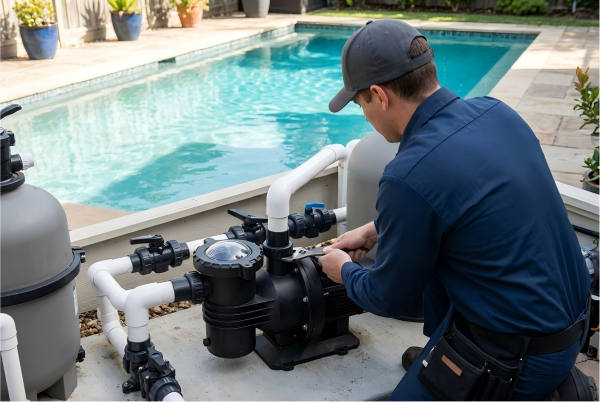
While these manual fixes might seem like a lifesaver in an emergency, they are far from a real solution.
Let's explore why circulation is non-negotiable for a healthy pool.
We will also look at the pros and cons of these pump-free methods.
Understanding this will show you why a reliable pump is the heart of your pool system.
Why Bother with Manual Circulation Methods?
Your pump just failed on the hottest day of the year.
Without circulation, your pool quickly becomes a stagnant, algae-filled mess, posing a health risk and leading to expensive cleanup.
Manual circulation methods are emergency, short-term fixes. They are useful only to prevent complete stagnation for a day or two while you source a replacement pump, helping to distribute chemicals and slow down algae growth, but they are not a sustainable solution at all.
Delving into Manual Circulation Techniques
Manual circulation is fundamentally about physical labor.
You are attempting to replicate the work of a machine designed to move thousands of gallons of water.
This is a daunting task.
The goal is to prevent the water from becoming completely stagnant.
Stagnant water is a breeding ground for bacteria and algae.
Let's break down the most common manual methods and their significant drawbacks.
The Siphoning Method
This technique uses a simple garden hose to create a siphon.
You place one end of the hose in the pool and the other end at a lower elevation outside the pool.
You'll need to get the siphon started, perhaps by filling the hose with water first.
Once flowing, you can move the hose end around the pool to draw water from different areas.
This creates a slow, passive circulation.
However, it also removes a significant amount of water from your pool.
This water loss is a major issue, especially in dry regions.
You will constantly need to refill the pool, which affects water chemistry and temperature.
The flow rate is also extremely low, often less than 5% of what a small pool pump could achieve.
This is not enough to properly filter or sanitize the water.
The Bucket Method
This is the most straightforward but also the most labor-intensive method.
It involves taking a bucket, scooping water from one end of the pool, and dumping it at the opposite end.
This action physically moves the water and creates some surface agitation.
Agitation helps to mix chemicals near the surface and slightly increases oxygenation.
To be even marginally effective, you would need to repeat this process for hours.
For an average-sized residential pool, you would be moving only a tiny fraction of the total volume.
It's physically exhausting and provides minimal benefit.
The circulation is inconsistent and fails to address the dead spots at the bottom of the pool.
Manual Stirring
Using a large pool brush or paddle can stir the water.
This is similar to stirring a giant pot of soup.
You can create visible currents and mix chemicals in the immediate area.
This method is better than nothing for distributing a dose of shock chlorine in an emergency.
However, its effect is temporary.
The water will become stagnant again within an hour.
It does not pull water through a filter, which is the primary way to remove debris and contaminants.
| Method | Labor Intensity | Water Loss | Effectiveness (0-10) |
|---|---|---|---|
| Siphoning | Low | High | 2 |
| Bucket Method | Very High | Low | 1 |
| Manual Stirring | High | None | 1 |
Ultimately, these methods are a stopgap.
They might buy you a day or two before the water quality deteriorates severely.
They do not and cannot replace the function of a pool pump.
The Inefficiency and Risks of Pump-Free Circulation
You're spending hours trying to manually circulate your pool water.
Despite all your hard work, the water is still not clean, and you're just getting exhausted while your pool's condition worsens.
Pump-free circulation is highly inefficient, failing to filter out contaminants, remove dangerous bacteria, and distribute chemicals evenly. This leads to unsafe swimming conditions, algae blooms, and potential damage to your pool surfaces, making it a risky and ineffective strategy.
A Deep Dive into the Failures of Manual Methods
A pool pump is not just about moving water.
It's the heart of a complex system designed to keep water clean, clear, and safe.
Attempting to bypass this critical component introduces significant risks and inefficiencies.
The effectiveness of pool maintenance relies on a concept called the "turnover rate."
This is the time it takes for the entire volume of your pool water to pass through the filter system.
A healthy pool requires at least one full turnover per day, with many experts recommending two.
Failure in Filtration
The primary failure of manual methods is the complete lack of filtration.
Your pool filter is designed to capture tiny particles, from dirt and pollen to dead skin cells and bacteria.
A pump creates the pressure needed to force water through this filter media.
Manual stirring or siphoning does not generate this pressure.
Without filtration, contaminants accumulate rapidly.
Cloudiness increases, which is not just an aesthetic problem.
Cloudy water can hide debris on the pool floor and makes it difficult to see if a swimmer is in distress.
These suspended particles also act as food for algae and bacteria, accelerating their growth.
Within 48-72 hours without filtration, a pool can begin to turn green.
Inadequate Chemical Distribution
Proper sanitation depends on evenly distributed chemicals like chlorine.
Chlorine works by oxidizing contaminants.
If it's not mixed throughout the entire body of water, you will have areas with dangerously low or excessively high concentrations.
- Low Concentration Zones: These areas, often in corners and at the bottom, become safe havens for pathogens. Algae will start to grow on the walls in these "dead spots."
- High Concentration Zones: Dumping chemicals in one spot can lead to "chlorine locking" or bleaching of pool surfaces like vinyl liners. High concentrations can also be irritating to swimmers' skin and eyes.
A pump ensures that freshly added chemicals are rapidly and thoroughly mixed.
This guarantees that the sanitizer level is consistent everywhere in the pool, providing a uniform shield against microbial growth.
The Unseen Dangers
The most significant risk is the one you cannot see.
A stagnant or poorly circulated pool is a breeding ground for harmful microorganisms.
This includes bacteria like E. coli and Pseudomonas aeruginosa, which can cause skin, ear, and gastrointestinal infections.
It also includes parasites like Giardia and Cryptosporidium.
A functioning pump and filter system removes over 99% of these harmful microbes.
Manual methods do not.
They merely give you a false sense of security.
The water might look slightly better after you've stirred it for an hour, but the invisible threat remains and multiplies.
Relying on these methods is a gamble with the health of anyone who enters the water.
The Unbeatable Efficiency of a Modern Pool Pump
You need a reliable way to keep your pool clean without constant manual labor.
Old pumps are noisy, consume a lot of energy, and drive up your electricity bills, making pool ownership more expensive than it needs to be.
A modern variable speed pump is the only effective solution. It provides powerful, consistent circulation and filtration, using up to 80% less energy than older models. This ensures a clean, safe pool while significantly lowering your operational costs and environmental footprint.
Why a Modern Pump is a Necessity, Not a Luxury
The evolution of pump technology has transformed pool maintenance.
It has moved from a costly, energy-intensive task to an efficient, automated process.
Understanding the capabilities of a modern pump makes the argument against manual methods even stronger.
It's not just about circulation; it's about intelligent water management.
Let's explore the specific advantages that make a high-quality pump indispensable for any pool owner.
Achieving Optimal Turnover and Filtration
As mentioned, a pool's turnover rate is critical.
A modern variable speed pump (VSP) excels at this.
Unlike single-speed pumps that run at a high, fixed speed, a VSP can be programmed to run at lower speeds for longer periods.
This is far more energy-efficient and provides superior filtration.
Slower water movement through the filter allows it to capture smaller particles more effectively.
This results in crystal-clear water.
A VSP can be programmed to run 24/7 at a very low, energy-sipping speed.
This ensures the pool is constantly being filtered and chemicals are always perfectly mixed.
It completely eliminates the problem of stagnant water.
Unmatched Energy Efficiency
This is the most significant advantage for pool owners.
The pump affinity law in physics states that if you halve the speed of a pump's motor, you reduce its energy consumption by a factor of eight.
- Single-Speed Pump: Runs at 100% speed, consuming a large amount of energy (e.g., 1,500 watts) for a few hours a day.
- Variable Speed Pump: Can run at 25% speed, consuming a tiny fraction of the energy (e.g., 100-200 watts) for many more hours.
This difference is dramatic.
Switching to a modern VSP can save a pool owner up to 80% on their pump-related electricity costs.
The pump often pays for itself in energy savings within 1-2 seasons.
This makes it one of the smartest investments for your pool.
Advanced Features and Longevity
Modern pumps are built with superior materials and technology.
They often feature permanent magnet motors, similar to those in electric vehicles.
These motors run cooler and quieter than traditional induction motors.
This extends the lifespan of the pump significantly.
Many advanced pumps also offer features like:
- Digital controls: For easy programming of speeds and schedules.
- Built-in diagnostics: To alert you to potential issues like blockages or overheating.
- Durable construction: Using corrosion-resistant materials to withstand harsh pool chemicals and outdoor environments.
| Feature | Single-Speed Pump | Variable Speed Pump (VSP) |
|---|---|---|
| Energy Use | High | Very Low (up to 80% less) |
| Filtration Quality | Good | Excellent |
| Noise Level | Loud | Very Quiet |
| Lifespan | Shorter | Longer |
| Control | On/Off | Fully Programmable |
Investing in a quality pump is investing in the health, safety, and efficiency of your pool.
It turns a daily chore into a hands-off, automated process.
It saves you time, money, and the immense effort of futile manual methods.
Choosing the Right Pump for Your Needs
You've decided a new pump is the only real solution, but the market is overwhelming.
Choosing the wrong size or type of pump can lead to inefficient operation, high energy bills, and even damage to your other pool equipment.
To choose the right pump, calculate your pool's volume and required turnover rate. Select a variable speed pump (VSP) for maximum efficiency. For B2B buyers, partnering with a manufacturer offering robust R&D, quality control, and OEM options ensures a superior product.
A Buyer's Guide to Selecting a Pool Pump
Selecting the right pump is a critical business decision for an importer or distributor.
It's also crucial for the end-user's satisfaction.
The process involves more than just picking a model from a catalog.
It requires a clear understanding of technical specifications, application needs, and supplier capabilities.
Let's break down the key factors to consider.
Step 1: Determining Flow Rate Requirements
The first step is always to calculate the required flow rate.
This is measured in gallons per minute (GPM) or cubic meters per hour (m³/h).
- Calculate Pool Volume:
Length x Width x Average Depth = Volume - Determine Desired Turnover Time: Usually 8 hours for residential pools.
- Calculate Flow Rate:
Pool Volume / Turnover Time (in minutes) = Required GPM
For example, a 24,000-gallon pool with an 8-hour turnover needs a flow rate of:
24,000 gallons / (8 hours * 60 minutes/hour) = 50 GPM
You must choose a pump that can efficiently deliver this flow rate.
Step 2: Understanding Total Dynamic Head (TDH)
Flow rate is only half the equation.
You must also account for the resistance in your plumbing system.
This resistance is called Total Dynamic Head (TDH).
TDH is influenced by:
- Pipe Length and Diameter: Longer and narrower pipes create more resistance.
- Fittings: Every 90-degree elbow, valve, and tee adds to the TDH.
- Equipment: The filter, heater, and chlorinator all create backpressure.
- Elevation: The height difference between the pump and the pool surface.
A professional can calculate the precise TDH of a system.
When selecting a pump, you must look at its "pump curve" chart.
This chart shows the GPM the pump can produce at different levels of TDH.
You need to match the pump to your system's specific GPM and TDH requirements for optimal performance.
Step 3: Evaluating Pump Technology and Quality (B2B Perspective)
For a business owner like Andrew in Australia, evaluating the manufacturer is as important as evaluating the pump itself.
This is where a partnership with a strong supplier becomes crucial.
- Technical Innovation: Does the manufacturer have a strong R&D department? Look for evidence of technical patents, especially in key areas like intelligent permanent magnet variable frequency technology. This indicates a commitment to efficiency and performance.
- Quality Control: A structured QC system is non-negotiable. Ask about their protocols (e.g., IQC, LQC, PQC, OQA). This ensures that every unit leaving the factory meets a high standard, reducing warranty claims and protecting your brand's reputation.
- Testing and Certification: The pump must meet international standards. Look for certifications like CE, IEC, and RoHS. Rigorous testing, such as extensive salt spray and UV resistance tests, is vital for products sold in harsh climates like Australia.
- OEM/ODM Capability: Does the supplier support private labeling? The ability to build a product under your own brand is a significant competitive advantage. This requires a supplier with flexible production lines and a collaborative engineering team.
By focusing on these technical and supplier-related factors, a distributor can secure a product that is not only efficient and reliable for the end-user but also a profitable and reputable addition to their own product line.
Conclusion
Manual circulation is an exhausting, ineffective, and risky temporary fix.
A modern, energy-efficient variable speed pump is the only real solution for a clean, safe, and cost-effective swimming pool.
FAQs
Can you swim in a pool without a pump?
It is not recommended. Without a pump, there is no filtration or proper chemical circulation, leading to a rapid buildup of harmful bacteria and making the water unsafe for swimming.
How long can a pool go without a pump?
In warm weather, a pool can start turning green and becoming unsafe in just 1-3 days. The water quality deteriorates quickly without constant circulation and filtration provided by a pump.
How can I add chlorine to my pool without a pump?
You can manually pour liquid chlorine or place tablets in a floating dispenser. However, you must stir the water vigorously with a pool brush to help it mix, though this is much less effective than pump circulation.
Will a solar cover help circulate water?
No, a solar cover will not circulate water. Its purpose is to heat the water and reduce evaporation by covering the surface. Circulation requires a pump to move the water volume.
Can I run my pool filter without a pump?
No, the pool filter cannot function without a pump. The pump provides the necessary pressure to push water through the filter media, which is how contaminants are captured and removed.
Does a pool vacuum circulate water?
An automatic pool cleaner that connects to your system does help circulate water, but it relies on the main pool pump to operate. Manual, suction-side vacuums also require the pump to function.
What is the first thing to do when a pool pump stops working?
First, check the circuit breaker to ensure it hasn't tripped. If it has power but won't run, the best course of action is to call a professional to diagnose the issue and arrange for repair or replacement.
How do I keep my pool from turning green without a pump?
Manually add a shock dose of chlorine and use a pool brush to stir it in as best you can. This is a temporary measure that might delay algae growth for a day or two.