Your irrigation pump is the heart of your farm.
When it falters, your crops and your livelihood are at risk.
Ignoring the subtle warning signs of failure can lead to catastrophic breakdowns, expensive emergency repairs, and devastating crop loss.
Key signs of a bad irrigation pump include a noticeable drop in water pressure, strange noises like grinding or rattling, and a sudden increase in energy bills.
The motor failing to start or cycling on and off too frequently are also critical indicators of a problem.
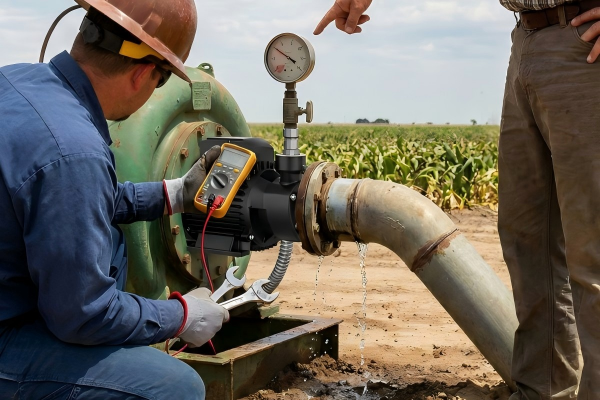
A failing pump rarely dies silently.
It almost always gives clues that something is wrong.
These clues can be auditory, like a new grinding sound.
They can be visual, like sprinklers that no longer reach their full range.
Or they can be financial, like an electricity bill that suddenly climbs 15-20% higher for no apparent reason.
Learning to recognize these signals is not just about fixing a broken machine.
It is about preventative maintenance that saves you money, prevents downtime during critical periods, and protects your investment.
This guide will walk you through the most common symptoms of a failing irrigation pump, helping you diagnose the problem before it becomes a disaster.
Symptom 1: Loss of Water Pressure and Flow
Your sprinklers used to cover the entire field with ease.
Now, they barely spray half the distance, and your drip lines are just trickling.
This weak performance means your plants are not getting the water they need to thrive.
**A significant drop in pressure or flow rate is the most common sign of a failing pump.
This issue usually points to an internal problem like a worn-out impeller or stator, a clog in the system, or a leak in the piping.
**
When your pump's performance declines, it is a clear message that something is wrong.
This is not a problem that will fix itself; it will only get worse.
The pump is the engine of your irrigation system, and when its output drops, the entire system suffers.
The causes for this performance degradation typically fall into two categories: internal wear or an external blockage/leak.
Understanding the type of pump you have and the quality of your water can provide big clues.
For example, a pump in sandy water will experience different wear patterns than a pump in corrosive, acidic water.
Diagnosing the cause accurately is the first step toward an effective and lasting repair, rather than a temporary fix.
Cause A: Internal Wear and Tear
The moving parts inside your pump are under constant stress and are subject to wear over time.
This wear directly impacts the pump's ability to build pressure and move water.
- Worn Impellers: In centrifugal pumps, the impellers spin at high speed to sling water outward.
Abrasive materials like sand slowly grind down the impeller vanes.
A pump with durable plastic impellers is excellent for fine sand, but over years of service, this wear will cause a gradual loss of pressure. - Corroded Components: In areas with acidic or alkaline water, corrosion can eat away at metal components.
A standard pump can fail quickly.
This is why a stainless steel impeller pump is essential in such conditions.
Even so, over a very long service life, even high-grade steel can show signs of wear that reduce performance. - Worn Screw or Stator: In a solar screw pump, the precise fit between the stainless steel screw and the rubber stator is what creates the high pressure.
Gritty water can wear down the stator, allowing water to slip backward and reducing the pump's head capacity.
Cause B: Clogs and Blockages
Sometimes, the problem is not wear, but a simple blockage that is choking the system.
- Intake Screen Clogged: The screen at the pump's intake can become clogged with leaves, algae, or sediment, starving the pump of water.
This is often the first place to check. - Impeller Jammed: Small stones or debris can get pulled into the pump and become lodged in the impeller, preventing it from spinning freely or blocking a water passage.
- Blocked Pipes or Emitters: The blockage may not be in the pump at all, but further down the line in your irrigation system, creating back-pressure that the pump struggles against.
| Symptom | Possible Internal Cause (Wear) | Possible External Cause (Blockage) |
|---|---|---|
| Gradual Pressure Loss | Worn plastic or steel impellers. | Slow buildup of sediment in pipes. |
| Sudden Pressure Loss | A broken impeller vane. | A large object blocking the intake screen. |
| Maintains Pressure, Low Flow | Worn seals allowing internal leakage. | Clogged drip emitters or sprinkler heads. |
Symptom 2: Strange and Unusual Noises
Your normally quiet pump is now making a loud, unsettling noise.
This new sound is a clear warning that something is mechanically wrong inside.
Ignoring it is a gamble that could lead to the pump seizing up completely.
**Grinding or screeching noises are a classic sign of failed motor bearings.
A rattling sound, like pumping gravel, often indicates cavitation (the pump is starved for water) or that debris is bouncing around inside the pump housing.
**
A pump should operate with a consistent, smooth hum.
Any deviation from this normal operating sound is a call for immediate investigation.
These noises are mechanical screams for help, and the type of sound it is making can tell you a lot about the nature of the problem.
Think of it like being a doctor for your equipment; you are listening to the symptoms to diagnose the illness.
High-efficiency BLDC permanent magnet motors, which power modern solar pumps, are incredibly quiet and reliable.
When they do make noise, it is almost always due to the bearings, which are the main physical wear point in an electric motor.
Other noises often originate in the "wet end" of the pump, where the impellers or screw are doing the work.
Diagnosing the Sounds
Different noises point to different failures.
Learning to distinguish between them can save you significant time and diagnostic costs.
- A High-Pitched Squeal or Grinding: This is the tell-tale sound of worn-out motor bearings.
The lubrication inside the sealed bearings has failed, and now there is metal-on-metal friction.
If left unchecked, the bearings will eventually overheat and seize, destroying the motor. - A Loud Rattling or Rumbling: This is often the sound of cavitation.
It occurs when there is not enough water getting to the pump intake.
This causes vacuum pockets in the water to form and then violently collapse inside the pump.
Cavitation is extremely destructive and can shatter impellers in a short amount of time.
The cause could be a clogged intake screen or a well that can't recharge fast enough.
Alternatively, a simple stone or bolt bouncing around inside the pump housing can also make this noise. - A Humming or Buzzing without Action: If the motor hums but the shaft does not turn, the problem is electrical or a major jam.
The motor is receiving power but cannot start.
This could be due to a jammed impeller, a bad starting capacitor (in AC motors), or a fault in the electronic controller of a solar pump system.
Modern solar controllers will often throw an error code for a "motor stall" in this situation.
Symptom 3: Spiking Energy Consumption
Your energy costs for running the pump have jumped up without any change in your watering schedule.
You are paying more money for the exact same amount of work.
This invisible symptom is a sure sign your pump has lost efficiency and is wasting power.
**A sudden increase in your electricity bill or fuel usage is a direct indicator of a pump problem.
It means the pump is working harder due to internal wear or a partial clog, converting expensive energy into wasted heat instead of water flow.
**
Efficiency is the name of the game in modern pumping.
Wasting energy is wasting money.
A healthy pump is an efficient pump.
When a pump starts to wear out, its hydraulic efficiency drops.
This means it requires more energy to produce the same pressure and flow it did when it was new.
This decline can be gradual, but it often hits a tipping point where the energy cost becomes noticeably higher.
For a solar-powered system, this loss of efficiency is just as critical.
A pump that suddenly requires 20% more power may no longer be able to run effectively on the existing solar array, leading to shorter running times, especially on cloudy days.
The high efficiency of a BLDC motor (often over 90%) is a huge asset, but this only applies to the motor itself.
If the "wet end" of the pump is worn and inefficient, the efficient motor will simply have to draw more power from the solar panels or the grid to overcome the hydraulic losses.
Where the Energy is Going
An inefficient pump is essentially turning electricity into three things: water movement, noise, and heat.
When the amount of water movement goes down, the energy must go somewhere else.
-
Friction from Worn Parts: As impellers, seals, and stators wear, the clearances inside the pump increase.
This allows more water to slip backward (internal recirculation), which does no useful work and wastes energy.
Worn bearings also create significantly more friction, which the motor must overcome, converting electricity directly into heat. -
Fighting Against Blockages: A partial clog in the system increases the head pressure the pump has to work against.
The pump will work harder and draw more current to try and force water past the obstruction, leading to a spike in power consumption. -
Motor Inefficiency: While less common with robust BLDC motors, an older motor with degrading internal windings can also become less efficient over time.
It will draw more amperage and run hotter than it should, signaling an impending electrical failure.
An energy audit can be a powerful diagnostic tool.
If you measure the amperage draw of your pump when it is new and compare it to a reading a few years later, an increase of more than 10-15% for the same job indicates a serious loss of efficiency.
Conclusion
Knowing these signs of failure helps you act fast.
By spotting low pressure, strange noises, or high energy use early, you can schedule repairs and avoid costly, catastrophic pump failures.
Frequently Asked Questions
What are the signs of a failing well pump?
Signs include low water pressure, sputtering faucets, a constantly running pump, and cloudy or muddy water.
A sudden spike in your electric bill is also a key indicator.
How do you test an irrigation pump motor?
You can use a multimeter to check for continuity in the motor windings and to ensure it's receiving the correct voltage.
Checking the amperage draw during operation can reveal inefficiency.
Why would an irrigation pump stop working?
Common reasons include a tripped circuit breaker, a failed pressure switch, a clogged intake, a burnt-out motor, or a problem with the electronic controller in solar systems.
Can a bad well pump ruin appliances?
Yes, a failing pump can cause low pressure, which affects appliances like washing machines.
More seriously, it can also send sediment through the lines, clogging filters and valves.
How often should an irrigation pump be serviced?
It's good practice to have your pump and system inspected annually.
This allows a professional to catch small issues like minor leaks or wear before they become major problems.
What is the first thing to check if a pump won't turn on?
Always check the power source first.
Make sure the circuit breaker hasn't tripped, any fuses are intact, and that the controller or switch is receiving power.
Does a pump lose pressure over time?
Yes, it's normal for a pump to experience a gradual loss of performance over many years due to internal wear and tear on components like impellers and seals.