You have abundant water in a well but no reliable grid power to access it.
Expensive diesel generators are noisy, dirty, and require constant refueling.
A solar pump uses the sun's free energy to move water effortlessly.
A solar water pump works by using solar panels to convert sunlight into DC electricity. This power flows to a smart controller, which optimizes the energy and runs an efficient motor. The motor then drives a pump, moving water from your source to where you need it.
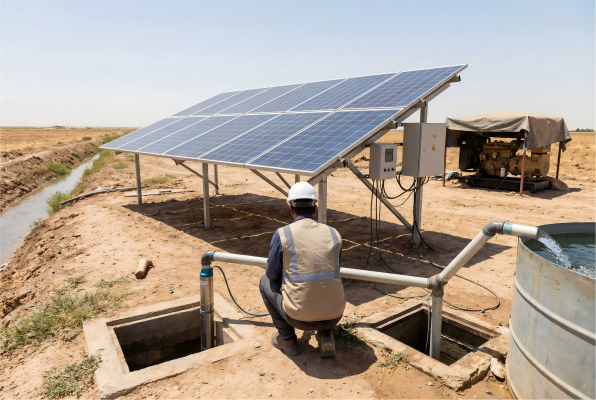
This system seems simple, but its effectiveness comes from how these components work together.
Each part plays a critical role in converting sunlight into a powerful and reliable flow of water.
Understanding this process helps you appreciate the technology and choose the right system for your needs.
Let's dive deeper into each stage of the process.
We will explore how sunlight becomes power, how that power is managed, and how it is finally used to pump water.
The Power Source | Capturing Sunlight with Solar Panels
Without a power source, your pump is just a piece of metal.
Solar panels provide the an independent, cost-free energy supply.
They are the fuel tank of your solar water pumping system.
Solar panels capture sunlight and convert it directly into DC (Direct Current) electricity.
This clean, silent power is the essential first step in the process, providing all the energy the pump needs to operate without relying on the grid.
The magic of a solar pump begins with its power source.
Solar panels, also known as photovoltaic (PV) modules, are the silent generators that make the entire system possible.
They are made up of many individual solar cells, typically composed of silicon.
When sunlight, which is made of tiny energy packets called photons, strikes these cells, it creates an electric field.
This phenomenon, called the photovoltaic effect, knocks electrons loose from atoms within the silicon.
These free electrons are then channeled into a current, creating usable DC electricity.
This process is direct, efficient, and produces zero emissions.
The amount of power generated depends on the intensity of the sunlight and the size and efficiency of the solar array.
How Solar Panels Generate DC Power
At the heart of every solar panel are semiconductor materials, usually silicon.
The process can be broken down into simple steps:
- Absorption of Light: Photons from the sun hit the surface of the solar cells.
- Electron Excitation: The energy from the photons "excites" electrons within the silicon, giving them enough energy to break free from their atoms.
- Creation of an Electric Field: The solar cells are manufactured with a built-in electric field. This field acts like a slide, directing the freed electrons to flow in a single direction.
- Generation of Current: This organized flow of electrons constitutes a direct current (DC). Metal contacts on the top and bottom of the cell collect this current, which is then sent through wires to the pump controller.
The more intense the sunlight, the more photons strike the cells, and the more electricity is generated.
Sizing Your Solar Array Correctly
Choosing the right number of solar panels is critical.
An undersized array won't provide enough power to run the pump effectively.
An oversized array is a waste of money.
Sizing depends on two main factors: the pump's power requirement (in watts) and the average daily "sun hours" in your location.
For example, a 750-watt pump needs a solar array that can reliably produce at least 750 watts of power during peak sunlight.
Installers often oversize the array by 20-30% to account for cloudy weather and panel degradation over time.
Panels are wired together in series to increase voltage or in parallel to increase current, matching the specific input requirements of the pump controller.
Panel Types: Monocrystalline vs. Polycrystalline
There are two dominant types of solar panels used for pumping systems.
| Feature | Monocrystalline Panels | Polycrystalline Panels |
|---|---|---|
| Efficiency | Higher (18-23%) | Lower (15-18%) |
| Appearance | Uniform black color | Blue, marbled look |
| Performance | Better in high heat and low light | Slightly less efficient in heat |
| Cost | More expensive | More economical |
| Footprint | Smaller for the same wattage | Larger for the same wattage |
For solar pumping applications where space is not a major constraint, polycrystalline panels often provide the best balance of cost and performance.
However, in high-temperature environments, the superior temperature coefficient of monocrystalline panels can give them an edge.
The Brains of the Operation | The Smart Controller (MPPT)
You have raw, fluctuating power from the panels.
Connecting this directly to the motor would be inefficient and damaging.
The controller safely manages this power for peak performance.
The solar pump controller is the intelligent link between the panels and the motor.
It takes the variable DC electricity from the panels and optimizes it, ensuring the motor receives a stable and efficient power supply to maximize water output.
The controller is perhaps the most sophisticated part of a solar water pump system.
It does much more than just switch the pump on and off.
Its primary job is to act as a highly intelligent power converter and manager.
The electricity coming from solar panels is not constant; its voltage and current fluctuate throughout the day with the changing angle and intensity of the sun.
The controller takes this "wild" DC input and tames it.
The most advanced controllers use a technology called Maximum Power Point Tracking (MPPT).
An MPPT controller can increase the water output of a pump by up to 30% compared to a system without one.
It constantly analyzes the power output from the solar panels and adjusts the electrical load to find the exact point—the "maximum power point"—where the panels are producing the most watts possible at any given moment.
This ensures that every bit of available solar energy is converted into useful work.
How MPPT Maximizes Water Flow
Imagine trying to push a car.
If you push too hard at the beginning, your feet slip.
If you don't push hard enough, the car won't move.
MPPT is like finding the perfect amount of force to apply at all times to get the most speed.
Technically, the controller rapidly adjusts the pump's operating voltage and current.
- In the morning or on cloudy days: Sunlight is weak. The MPPT controller will run the pump at a lower speed, ensuring it starts pumping earlier and continues pumping longer than a basic system would.
- During peak sun: The controller feeds maximum power to the pump, driving it at full speed for the highest possible flow rate.
This intelligent management means more total water pumped per day.
Core Functions and Protections
Beyond MPPT, the controller performs several vital protective functions for the entire system:
- Soft Start: It gradually ramps up the motor speed instead of starting it abruptly. This reduces mechanical stress on the pump and electrical strain on the motor, significantly extending their lifespan.
- Dry Run Protection: If the well or water source runs dry, the controller detects the change in motor load and shuts the pump off automatically. This prevents the pump from overheating and destroying itself.
- Over-voltage/Under-voltage Protection: It shields the motor from voltage spikes or drops coming from the solar panels.
- Over-current Protection: It protects the motor from drawing too much current and burning out.
The Hybrid AC/DC Advantage
For applications that need water 24/7, a standard solar-only system is not enough.
This is where hybrid controllers come in.
These advanced units have two separate power inputs: one for DC power from the solar panels and another for AC power from the electrical grid or a backup generator.
The controller's logic prioritizes solar power.
- Full Sun: The system runs 100% on free solar energy.
- Partial Clouds: The controller intelligently blends power, using all available solar energy and supplementing it with just enough AC power to maintain operation.
- Night/No Sun: It automatically switches over to 100% AC power.
This ensures an uninterrupted water supply while still maximizing the use of renewable energy and minimizing electricity costs.
The Heart of the Pump | The High-Efficiency BLDC Motor
Your system has captured and managed the sun's energy.
Now you need to turn that electrical energy into motion.
An inefficient motor wastes power and pumps less water.
The Brushless DC (BLDC) permanent magnet motor is the core of a modern solar pump.
Its high-efficiency design, often exceeding 90%, converts more electricity into rotational force, pumping more water with less power.
The motor is the component that does the physical work.
It takes the refined electrical energy from the controller and transforms it into the mechanical motion needed to drive the pump.
For decades, most motors used carbon "brushes" to transmit power to the rotating part of the motor.
These brushes create friction, generate heat, produce electrical sparks, and wear out over time, making them a point of failure and inefficiency.
Modern solar water pumps have abandoned this old technology in favor of the vastly superior Brushless DC (BLDC) motor.
As the name implies, a BLDC motor has no brushes.
Instead, it uses an intelligent electronic controller to switch the direction of the magnetic field in the stationary part of the motor (the stator).
This interacts with powerful permanent magnets on the rotating part (the rotor), causing it to spin.
This electronic commutation is contactless, silent, and incredibly efficient.
The Power of Permanent Magnets
The key to the high torque and efficiency of a BLDC motor lies in its rotor.
Instead of using electromagnets that consume power, they use high-strength permanent magnets.
Premium solar pump motors use rare-earth magnets, such as Neodymium iron boron (NdFeB), specifically a high-temperature grade like 40SH.
These magnets create an incredibly powerful and consistent magnetic field without using any electricity.
This means that nearly all the electrical energy sent to the motor is used to create motion, not wasted on creating its own magnetic field or overcoming internal friction.
This leads to efficiencies greater than 90%, compared to 60-75% for older brushed motors.
Technical Advantages Translated to Real-World Value
The advanced design of a BLDC motor provides several tangible benefits for the end-user and the distributor:
| Technical Advantage | Market Benefit |
|---|---|
| High Efficiency (>90%) | Requires fewer solar panels for the same water output, lowering the initial system cost. Pumps more water per day. |
| High Torque | Excellent starting performance, even in low light conditions. Can handle the high-pressure demands of deep wells. |
| Compact & Lightweight | Up to 47% smaller and 39% lighter than older motors. This makes shipping cheaper and installation far easier. |
| Maintenance-Free | No brushes to wear out or replace, leading to a "set it and forget it" user experience. |
| Long Service Life | Less friction and heat leads to significantly longer operational life, increasing the return on investment. |
The move to BLDC motors was a game-changer for the solar pumping industry.
It made systems more powerful, more reliable, and more affordable, accelerating their adoption worldwide.
The Pumping Mechanism | How Water is Moved
The motor spins, but how does that spinning move water?
The wrong pump type will be inefficient or fail quickly.
The pump end uses the motor's rotation to lift water.
The "pump end" is the part of the system that is submerged in water and uses the motor's rotational force to move it.
The specific mechanism it uses—whether a screw or impellers—determines its performance characteristics, such as flow rate and pressure.
Once the BLDC motor provides a powerful and efficient rotation, the final step is to use that motion to physically move water.
This is the job of the pump end.
There is no one-size-fits-all solution; different well conditions and water needs require different pumping mechanisms.
The pump end attaches directly to the motor shaft.
As the motor spins, it turns the internal components of the pump end, which creates pressure and forces water up the pipe.
The design of these internal components is what distinguishes one type of pump from another and dictates its ideal application.
The three most popular designs in solar deep well pumps are the screw pump, the plastic impeller pump, and the stainless steel impeller pump.
The Screw Pump: High Pressure, Low Flow
Also known as a progressive cavity pump, this design is a true specialist.
- Mechanism: It uses a single helical stainless steel rotor (the screw) that spins inside a flexible rubber stator. As it turns, it forms sealed cavities of water that are "progressively" pushed up the pump. This is a form of positive displacement.
- Performance: This mechanism is excellent at creating very high pressure (high head). It can push water up from extreme depths (over 150 meters). However, the volume of the cavities is small, so the flow rate is relatively low.
- Best Use: Ideal for deep, low-yield wells where you need to supply a house or livestock trough. It is also exceptionally resistant to sand, as the rubber stator can flex to allow particles to pass without damage.
The Centrifugal Impeller Pump: High Flow, Medium Pressure
This is the most common design and a versatile workhorse.
- Mechanism: It uses a series of stacked discs called impellers. The motor spins the impellers at high speed. Water enters the center of the first impeller and is thrown outwards by centrifugal force. This action increases the water's velocity and pressure. It is then guided into the center of the next impeller, which boosts the pressure again. This is called a multi-stage centrifugal pump.
- Performance: Each stage adds more pressure. By stacking more impellers, the pump can achieve a higher head. This design is capable of producing very high flow rates, making it perfect for moving large volumes of water.
- Best Use: The go-to choice for farm irrigation, filling large tanks, and general-purpose water supply from wells less than 100 meters deep.
Material Choice: Plastic vs. Stainless Steel Impellers
For centrifugal pumps, the material of the impellers is a crucial decision:
- Plastic Impeller Pumps: These use durable, engineered plastic for the impellers. They are lightweight, highly economical, and offer excellent resistance to wear from fine sand. They are the most popular choice for general agricultural and residential use in areas with non-corrosive water.
- Stainless Steel Impeller Pumps: These use SS304 stainless steel for the impellers and pump housing. They are the premium choice, designed specifically for harsh water conditions. If the water is acidic, alkaline, or has high salinity, stainless steel prevents corrosion and ensures an extremely long service life where a plastic pump would quickly fail.
The choice of pump end is not about which is "better," but which is precisely matched to the well depth, required flow rate, and water quality of a specific application.
Conclusion
A solar pump works by integrating sunlight, smart control, an efficient motor, and a tailored pump.
This synergy provides clean, reliable, and cost-free water anywhere the sun shines.
Frequently Asked Questions
Can a solar water pump work without a battery?
Yes, most modern solar water pumps are designed to work directly from the solar panels during the day and do not require batteries, which reduces system cost and maintenance.
How many solar panels are needed to run a water pump?
This depends on the pump's wattage.
As a general rule, you will need a solar array with a total wattage that is about 1.2 to 1.5 times the pump's wattage rating.
Can solar pumps work on cloudy days?
Yes, solar pumps can still work on cloudy days, but the flow rate will be reduced.
High-efficiency panels and MPPT controllers help maximize performance in low-light conditions.
Can I run a normal AC water pump with solar panels?
Yes, but you will need an appropriately sized solar array, a battery bank, and a solar inverter to convert the DC power from the panels and battery into AC power for the pump.
Do solar pumps work at night?
Standard DC solar pumps do not work at night.
However, systems with AC/DC hybrid controllers can automatically switch to grid or generator power to pump water 24/7.
What is the maintenance of a solar water pump?
Maintenance is very low.
You periodically need to clean the surface of the solar panels and check for any loose wiring.
The pump and motor are typically maintenance-free.
How deep can a solar pump pull water from?
This varies by model.
Solar screw pumps are designed for very deep wells and can pull water from depths exceeding 150 meters (500 feet).
Centrifugal pumps are typically used for wells up to 100 meters.