You need reliable water in a remote location.
Grid power is unavailable or too expensive.
Understanding how a solar pump works seems complex, preventing you from choosing this cost-effective solution.
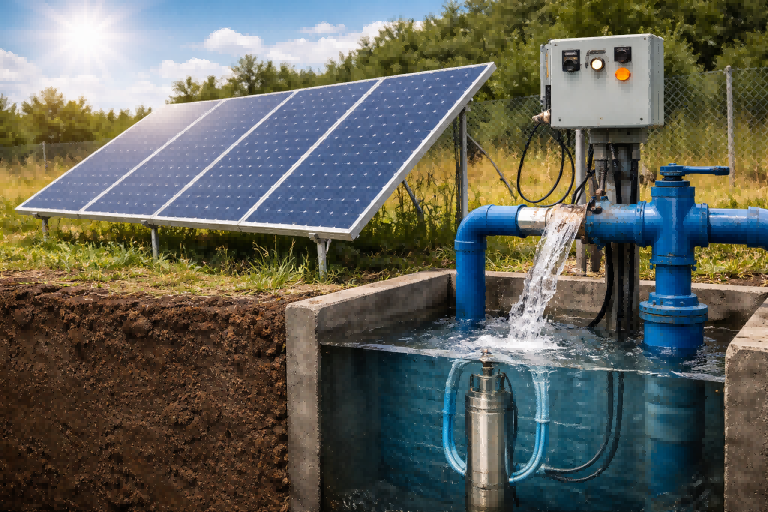
A submersible solar pump works as a system.
Solar panels generate DC electricity, an intelligent controller optimizes this power, and a high-efficiency motor drives a submerged pump to lift water to the surface without any fuel costs or grid connection.
It is a common mistake to think of a solar pump as a single piece of equipment.
The secret to its performance lies in how three distinct technologies work together in perfect harmony.
It is not just a pump powered by the sun.
It is an integrated, intelligent system designed from the ground up to convert sunlight into flowing water with maximum efficiency.
Understanding how each component—the panels, the controller, and the pump motor—plays its crucial role demystifies the entire process.
This knowledge empowers you to see beyond the initial hardware and appreciate the engineering that delivers water independence, reliability, and zero running costs.
Let's break down this elegant process, step by step, from the first ray of sunlight to the final drop of water.
Step 1: The Power Source - Capturing Energy from the Sun
You want to power a pump in the middle of nowhere.
Running power lines is prohibitively expensive.
A generator means constant noise, refueling, and maintenance, making it an unreliable long-term option.
The system starts with photovoltaic (PV) solar panels.
These panels directly convert sunlight into Direct Current (DC) electricity, creating a self-sufficient and silent power source right where you need water, with no moving parts to fail.
The entire process begins with the silent, elegant conversion of light into electricity.
A solar water pump system's power plant is its array of photovoltaic (PV) panels.
These panels are made up of many solar cells, typically composed of silicon.
When sunlight strikes these cells, photons (light particles) knock electrons loose from atoms, generating a flow of electricity.
This flow is Direct Current (DC), the native language of solar power and high-efficiency motors.
Unlike the Alternating Current (AC) that comes from the power grid, DC power from solar panels is not constant.
Its voltage and current fluctuate continuously throughout the day depending on the intensity of the sun, cloud cover, and the angle of the light.
This variability is a critical challenge that a simple pump cannot handle on its own.
This is why the solar panel array is just the first part of a much smarter system.
For a distributor like Andrew, the quality and wattage of the solar panels directly impact the entire system's potential output, forming the foundation of any performance calculation.
Understanding Solar Array Output
The power of a solar array is measured in watts (W).
The total wattage of the array must be correctly sized to match the power requirements of the pump motor.
An undersized array will not provide enough power for the pump to start or run effectively, especially during periods of lower light.
An oversized array provides more power than needed, adding unnecessary initial cost.
- Monocrystalline vs. Polycrystalline: The two most common types of solar panels. Monocrystalline panels are generally more efficient (typically 18-22%) and perform better in low-light conditions, but they are often slightly more expensive. Polycrystalline panels are slightly less efficient (15-18%) but can offer a better price point. The choice often depends on the available space and budget.
- Series and Parallel Connections: Individual panels are wired together to achieve the required system voltage and current. Connecting panels in series increases the voltage, while connecting them in parallel increases the current. The final configuration must match the input specifications of the system's controller.
- Factors Affecting Output: The actual power generated is influenced by several real-world factors:
- Solar Irradiance: The amount of sunlight hitting the panel, which changes with the time of day and season.
- Temperature: High temperatures can slightly decrease a panel's efficiency.
- Shading: Even partial shading on one panel can significantly reduce the output of the entire array.
- Panel Condition: Dust, dirt, or debris on the panels will block light and reduce power generation.
The solar array is the fuel tank of the system.
Its job is to capture as much raw energy as possible, but it is the next component in the chain that refines this raw energy into usable, intelligent power.
Step 2: The Brains - The Intelligent Controller
Solar panels produce fluctuating, "wild" DC power.
Connecting this directly to a pump motor would be incredibly inefficient.
The motor would constantly struggle, stall in low light, and could be damaged by voltage spikes, leading to poor performance and premature failure.
The intelligent controller is the brain of the solar pump.
It takes the variable DC power from the panels, uses Maximum Power Point Tracking (MPPT) to optimize it, and delivers a stable, controlled current to the motor, maximizing water output and protecting the pump.
This component is the single greatest difference between a professional solar pumping system and a simple DIY setup.
The controller is a sophisticated microcomputer that acts as the manager between the power source (panels) and the power consumer (motor).
Its primary job is to solve the problem of variable solar power.
It ensures that not a single watt of precious solar energy is wasted and that the pump motor operates within its safe, optimal range at all times.
A standard AC pump has nothing like this; it simply turns on or off.
The solar pump controller is constantly thinking, adjusting, and protecting.
For an importer focused on quality and reliability, the controller's technology is a major selling point.
It's the feature that guarantees both high performance and a long, trouble-free service life for the end user's investment.
Two Critical Functions: Optimization and Protection
The controller's sophisticated software and hardware perform two vital roles.
- Maximum Power Point Tracking (MPPT): This is the controller's core performance-enhancing feature. The output of a solar panel is not linear; there is a specific voltage and current combination (the "maximum power point") where the panel produces the most possible power at any given moment. This point changes constantly with the sunlight. The MPPT algorithm continuously scans the panel's output and adjusts the electrical load to force the panels to operate at this peak efficiency point. A system with MPPT can increase the daily water volume by up to 30% compared to a system without it.
- System and Pump Protection: This is the controller's critical role in ensuring longevity. It acts as a vigilant bodyguard for the expensive pump motor deep underground.
- Dry Run Protection: It monitors the motor's speed and power draw. If the water level drops and the pump starts sucking air, the load on the motor decreases. The controller detects this signature and shuts the pump down before it can overheat and destroy itself.
- Overload/Stall Protection: If the pump gets jammed with sand or a rock, the motor will try to draw a huge amount of current. The controller detects this spike, immediately cutting power to prevent the motor windings from burning out.
- Voltage and Thermal Protection: It protects the motor from under-voltage or over-voltage conditions from the panels and will reduce power or shut down if the electronics overheat.
The AC/DC Hybrid Advantage
For ultimate reliability, advanced controllers offer AC/DC hybrid capability.
This provides a seamless, automatic transition between power sources, ensuring water is available 24/7.
| Power Scenario | Controller Action | User Benefit |
|---|---|---|
| Full Sun | Uses 100% free DC solar power. | Zero operational cost. |
| Passing Clouds | Blends DC solar with AC grid/generator power as needed. | Uninterrupted flow, maximizes use of free solar energy. |
| Nighttime/No Sun | Automatically switches to 100% AC power input. | Guaranteed 24-hour water supply without manual switching. |
This hybrid intelligence makes the solar pump system not just an off-grid solution, but a primary water source that is more reliable than the grid itself.
Step 3: The Engine - The High-Efficiency BLDC Motor
You need an efficient motor to make the most of limited solar power.
Traditional AC motors are notoriously inefficient.
They waste a significant amount of electricity as heat, which would require a larger, more expensive solar array to get the same amount of work done.
The system is driven by a Brushless DC (BLDC) permanent magnet motor.
This advanced motor converts over 90% of the electricity it receives into rotational force, offering unmatched efficiency, high torque, and a maintenance-free design that is essential for a submersible pump.
At the heart of the modern submersible solar pump is a motor that is fundamentally different from the one in a standard grid-powered pump.
The brushless DC (BLDC) motor is the technological core that makes the entire system viable and cost-effective.
Whereas a typical AC motor might achieve 60-70% efficiency, a BLDC motor routinely exceeds 90%.
This efficiency gap is monumental in a solar-powered application.
A 30% gain in efficiency can mean a 30% reduction in the number of solar panels needed, directly lowering the system's upfront cost.
Instead of friction-inducing, wearable brushes, a BLDC motor uses powerful permanent magnets (often 40SH grade neodymium iron boron) on its rotor.
The intelligent controller then energizes the stator windings in a precise sequence to create a rotating magnetic field, which pulls the rotor around.
This electronic commutation is far more efficient and reliable than the mechanical brushes of older motor designs.
For a distributor like Andrew, whose customers value quality and long-term performance, the BLDC motor is the engine of his product's reputation.
Tangible Advantages of BLDC Technology
The design of the BLDC motor translates directly into measurable benefits for the end-user.
- Superior Efficiency: As mentioned, over 90% efficiency is standard. This translates to more water pumped per watt of solar power, every single day.
- High Starting Torque: BLDC motors can generate powerful torque even at low speeds. This means the pump can start working earlier in the morning and later in the afternoon, and can even continue pumping effectively during intermittent cloud cover.
- Zero Maintenance and Long Life: The absence of brushes eliminates the single most common failure point in traditional DC motors. With no parts designed to wear out, the motor can operate for years on end without any service, a crucial feature for a device installed hundreds of feet below ground.
- Compact and Lightweight Design: The high power density of BLDC motors allows them to be much smaller and lighter than AC motors of equivalent output. In some designs, they can be up to 47% smaller and 39% lighter. This reduces shipping costs and makes the pump far easier to handle and install.
| Feature | Standard AC Motor | High-Efficiency BLDC Motor | Impact on Solar System |
|---|---|---|---|
| Efficiency | 60% - 70% | > 90% | Fewer solar panels needed, lower initial cost |
| Low-Light Performance | Poor starting torque; may stall | High torque at all speeds | Longer daily pumping hours, more water |
| Service Parts | Brushes, bearings | Bearings only | Maintenance-free, higher reliability |
| Size & Weight | Bulky, heavy | Compact, light | Easier installation, lower shipping cost |
The BLDC motor is not simply an alternative; it is the enabling technology that allows the entire solar pumping system to function with the efficiency and reliability required for off-grid applications.
Step 4: The Workhorse - The Submersible Pump
You have power, but how do you move the water?
Your well might be extremely deep, or require a huge volume of water for irrigation, or contain corrosive minerals.
One pump design cannot efficiently handle all these different scenarios.
The final stage is the submersible pump's "wet end."
This is the mechanical part submerged in the water, specifically designed to either push water from great depths (screw pump) or move high volumes (centrifugal impeller pump) to match the application's exact needs.
The solar panels, controller, and motor work together to create rotational power.
The final job is to convert that rotation into moving water.
This is the task of the submersible pump itself, often called the "wet end."
This is the part of the system that is lowered deep into the borehole or well.
Its mechanical design is critically important and must be carefully matched to the specific water source and demand.
Using the wrong type of pump is like putting the wrong tires on a high-performance car; the power from the engine will be wasted.
A complete and competitive product portfolio includes several types of pump wet ends, each engineered to excel under different conditions.
This allows a distributor to provide a truly customized solution for every customer, whether they are providing drinking water for a single home or irrigating an entire commercial farm.
Matching the Pump Design to the Job
There are three primary designs of solar submersible pumps, each with a distinct operating principle and ideal application.
-
The Solar Screw Pump (Progressing Cavity Pump)
- How it Works: This pump uses a helical-shaped stainless steel rotor that spins inside a flexible rubber stator. This action creates a series of sealed pockets of water that are progressively "screwed" or pushed upwards with great force.
- Performance: It is a low flow, high head pump. It doesn't move a massive volume of water, but it can push that water up from extreme depths (over 200 meters).
- Best For: Deep domestic wells, livestock watering in mountainous regions, and applications where the water level is very far below the surface. Its design also makes it highly tolerant of sand and sediment.
-
The Solar Plastic Impeller Pump (Centrifugal Pump)
- How it Works: This is a multi-stage centrifugal pump. It has a stack of precisely shaped plastic impellers. As the motor spins them, they use centrifugal force to throw water outwards at high velocity, increasing its pressure and pushing it up to the next stage.
- Performance: It is a high flow, medium head pump. It excels at moving large volumes of water from wells of a moderate depth.
- Best For: Farm irrigation, filling large storage tanks or reservoirs, and any application where the primary need is high water volume. The engineered plastic impellers offer excellent wear resistance against fine sand.
-
The Solar Stainless Steel Impeller Pump (Centrifugal Pump)
- How it Works: This pump operates on the same centrifugal principle as the plastic model, but its impellers, pump body, and all wetted parts are made from corrosion-resistant SS304 stainless steel.
- Performance: It is a premium high flow, medium-to-high head pump.
- Best For: Aggressive water conditions. This includes areas with acidic or alkaline water, high salinity, or other minerals that would corrode lesser materials. It offers the longest possible service life in harsh environments.
| Pump Type | Primary Strength | Ideal Water Source | Best Application |
|---|---|---|---|
| Screw Pump | High Head (Pressure) | Very Deep Wells (>100m) | Domestic water, remote livestock tanks |
| Plastic Impeller | High Flow (Volume) | Moderate Depth Wells | Farm irrigation, filling reservoirs |
| Stainless Steel Impeller | Corrosion Resistance | Aggressive/Salty Water | High-end homes, coastal areas, alkaline regions |
By understanding how these components work in concert, it becomes clear that a submersible solar water pump is far more than the sum of its parts.
Conclusion
It is a complete, synergistic system.
Sunlight is converted to smart power, which drives an efficient motor, which in turn powers the right pump for the job.
Frequently Asked Questions
How does a solar pump work at night?
A standard solar pump does not work at night. It stores energy by pumping water into a storage tank during the day for use when the sun is not out.
Do solar pumps require batteries?
Most solar water pumping systems do not require batteries. Storing water in a tank is far more efficient and cost-effective than storing electricity in batteries.
How much water can a solar pump pump in a day?
The amount of water depends on the pump size, the power of the solar array, and the amount of sunlight. A properly sized system can pump thousands of gallons per day.
Can a solar water pump be used for high-pressure irrigation?
Yes, by choosing the correct pump (like a multi-stage centrifugal or a screw pump) and system design, solar pumps can generate the high pressure needed for drip or sprinkler irrigation.
What maintenance does a solar water pump require?
The system requires very little maintenance. The panels may need occasional cleaning, but the brushless motor and controller are maintenance-free, offering long-term reliability.
How do I choose the right size solar pump?
Sizing requires knowing your daily water needs (gallons per day) and the total dynamic head (the total vertical distance the water must be lifted plus friction loss).
Can a solar pump run an existing AC submersible pump?
No, a standard solar controller and DC motor system cannot run an AC pump. Running an AC pump on solar requires a large, specialized solar inverter, which is a different type of system.
How long do solar panels for a water pump last?
Solar panels are extremely durable and come with a performance warranty of 20 to 25 years. They will continue to produce power long after the initial investment is paid back.