Investing in a pump is a major decision.
You expect it to last for years.
Premature failure means lost money and no water.
A quality deep well pump can last 8 to 15 years, but its lifespan is not a fixed number. Longevity depends heavily on the specific pump type, water quality, usage patterns, and the quality of its internal motor. Proper matching of the pump to its environment is the single most important factor.
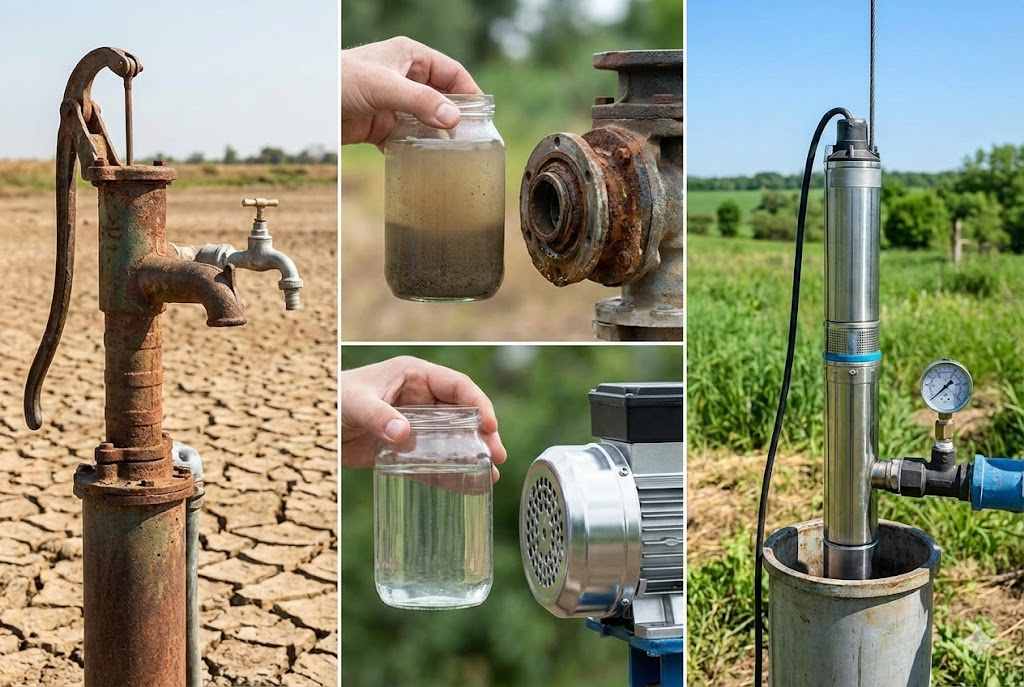
The question is not just "how long," but "what makes it last?"
A pump's potential service life is written in its design, materials, and motor technology.
However, the reality of its lifespan is determined out in the field.
A premium pump placed in the wrong environment can fail in months, while a more economical pump in its ideal setting can operate reliably for over a decade.
Understanding the specific strengths and weaknesses of different pump technologies is the key to maximizing your investment.
It allows you to look beyond a simple number and select a solution designed for durability in your specific conditions.
Let's explore the crucial factors that dictate a pump's true service life.
The Role of Application: Lifespan of a Solar Screw Pump
You need water from a deep, sandy well.
Many standard pumps wear out and fail quickly in these conditions.
This is a frustrating and expensive cycle of replacement.
In its ideal environment—deep wells with sandy water—a solar screw pump is engineered for longevity. Its unique design minimizes abrasive wear, allowing it to reliably outlast centrifugal pumps in harsh conditions and ensuring a longer, more predictable service life.
The lifespan of a solar screw pump is a direct result of its specialized design.
Unlike centrifugal pumps that use high-speed impellers to throw water, the screw pump uses a different principle.
A stainless steel screw-shaped rotor turns inside a flexible rubber stator.
This creates sealed pockets of water that are pushed upwards.
This gentle, positive displacement action is far less susceptible to the abrasive damage caused by sand and silt.
The components are not being eroded at high velocity.
This fundamental difference is why a screw pump often becomes the longest-lasting option for wells with poor water clarity or those that are newly drilled.
Built for Abrasion and Depth
The combination of materials and mechanics makes the screw pump exceptionally durable for specific challenges.
Its longevity is not accidental; it is a core design feature.
- Sand Resistance: The rubber stator can flex and allow small particles to pass without significant damage. A centrifugal pump's plastic or steel impellers would be sandblasted, losing efficiency and failing over a fraction of the time. In wells with even 5% sand content, a screw pump's life expectancy can be double or triple that of an impeller pump.
- Deep Well Reliability: The design naturally generates very high pressure (head). This means it can be used in wells over 150 meters deep without straining its components. Placing a pump rated for a shallower depth in a deep well causes excessive stress, leading to premature motor and bearing failure. The screw pump is built to handle this pressure continuously.
Matching Application to Maximize Life
The key to unlocking the long life of a screw pump is correct application.
If used for a low-flow, high-head task like filling a livestock trough from a deep well, it will perform reliably for years.
If it is misapplied to a high-flow irrigation system, its limitation—low flow rate—will cause it to run excessively, which could still lead to wear over time, even if it does not fail from abrasion.
| Factor | Solar Screw Pump | Standard Impeller Pump | Impact on Lifespan |
|---|---|---|---|
| Well Condition | Sandy / Silty Water | Clean Water | Screw pump life is extended; impeller pump life is drastically cut. |
| Well Depth | Very Deep (>100m) | Shallow to Medium (<80m) | Screw pump operates stress-free; impeller pump is over-stressed. |
| Required Flow | Low (Domestic, Livestock) | High (Large-scale Irrigation) | Both last longer when matched to the required flow rate. |
Ultimately, a solar screw pump's lifespan is maximized when its unique strengths—handling depth and abrasion—are the primary requirements of the job.
In these scenarios, it is an investment in long-term reliability.
The Impact of Water Quality: Lifespan of a Plastic Impeller Pump
You need an affordable pump that can move a lot of water.
But you worry a lower-cost option will not last.
A cheap pump that fails after one season is no bargain at all.
The lifespan of a solar plastic impeller pump is directly tied to water quality. In neutral, non-corrosive water for farming or gardens, it is a durable and economical choice that can last for many years. However, in chemically aggressive water, its service life can be significantly shortened.
This pump is the workhorse for many agricultural applications.
It uses a series of stacked, wear-resistant plastic impellers to efficiently move high volumes of water at a medium head.
For the majority of farming and pasture water supply needs in places like Africa and the Americas, it offers an incredible balance of performance, affordability, and durability.
Its excellent resistance to fine sand makes it robust for typical well conditions.
However, its longevity is defined by a critical environmental factor: the water's chemistry.
The engineering-grade plastic is chosen for its toughness and cost-effectiveness, but it does not have the universal chemical resistance of stainless steel.
Understanding this trade-off is essential to forecasting its service life accurately.
The Chemical Factor in Pump Durability
The primary threat to a plastic impeller pump's long life is not abrasion, but chemical attack.
Water that is too acidic or too alkaline can degrade the plastic components over time.
- Low pH (Acidic Water): Water with a pH below 6.5 can slowly eat away at the plastic, making it brittle and prone to cracking under the high-pressure environment inside the pump.
- High pH (Alkaline Water): Water with a pH above 8.5 can also cause material degradation, leading to premature failure of the impellers or pump casing.
- High Salinity: While not a pH issue, high concentrations of salt or other dissolved minerals can also accelerate the aging process of plastic components and internal seals.
In these environments, a pump that might have lasted 10 years in neutral water could fail in as little as 1-2 years.
This is not a defect in the pump; it is a predictable outcome of a material-environment mismatch.
Expected Lifespan Based on Water Conditions
For an importer or distributor, guiding a customer to test their water pH is a critical step in ensuring satisfaction.
A simple water test can be the difference between a satisfied customer with a long-lasting pump and a frustrated one with a premature failure.
| Water pH Level | Water Condition | Expected Lifespan of Plastic Impeller | Recommendation |
|---|---|---|---|
| 6.5 - 8.5 | Neutral / Ideal | Excellent (8-12+ years) | The most cost-effective and durable choice. |
| 5.5 - 6.5 | Mildly Acidic | Reduced (3-6 years) | Usable, but expect a shorter service life. |
| 8.5 - 9.5 | Mildly Alkaline | Reduced (3-6 years) | Monitor for brittleness and performance loss. |
| < 5.5 or > 9.5 | Highly Corrosive | Poor (1-2 years) | Not recommended. Stainless steel is required. |
For the vast majority of agricultural wells with normal water, the plastic impeller pump is an investment that provides high performance and a long, reliable service life.
Its lifespan is maximized when it is placed in the environment it was designed for.
The Ultimate Solution for Harsh Water: Lifespan of a Stainless Steel Pump
You face extremely corrosive water conditions.
You know that standard pumps will fail quickly.
This constant replacement is costly and disrupts your access to water.
A solar stainless steel impeller pump offers the longest possible lifespan in corrosive water. Constructed from SS304 steel, it is engineered to resist chemical attack from acidic or alkaline water, making it a "buy it for life" investment for the most challenging environments.
This is the premium option in the solar deep well pump lineup, and its primary selling point is maximum durability.
Both the pump body and the multi-stage impellers are made from SS304 stainless steel.
This material is specifically chosen for its superior resistance to rust and corrosion across a wide pH range.
It is designed for applications where other pumps are guaranteed to fail.
This includes the alkaline soil regions of Australia and areas with industrial or agricultural runoff that makes the water acidic.
The higher initial cost of this pump is not for better performance in normal conditions; it is a direct investment in extending the pump's service life from a few years to potentially decades in hostile water.
An Investment in Total Cost of Ownership
When asking "how long will a pump last?", the stainless steel model changes the calculation from years to decades.
The discussion shifts from replacement cycles to total cost of ownership.
- Chemical Immunity: SS304 steel is stable in water with a pH range far beyond the tolerance of plastic. It will not become brittle or dissolve, ensuring the internal components maintain their precise shape and efficiency for a very long time.
- Structural Integrity: The strength of steel provides superior resistance to the immense pressures found in deep wells and high-pressure systems. It is less prone to stress fractures or warping over its long operational life.
- Calculating the Payback: Imagine a well with acidic water where a plastic pump (costing $X) fails every 2 years. Over a 10-year period, this would require 5 pumps and 5 installation fees. A stainless steel pump (costing, for example, 2X) that lasts the entire 10 years eliminates 4 replacement and labor costs, making it the far cheaper option in the long run.
When is a Stainless Steel Pump Worth It?
The decision to choose a stainless steel pump is an economic one, based on a simple assessment of the environment.
It is the definitive solution when water quality, not budget, is the primary limiting factor.
| Application Environment | Plastic Impeller Pump | Stainless Steel Impeller Pump | Long-Term Financial Outcome |
|---|---|---|---|
| Neutral pH Farm Well | Long Lifespan (10+ yrs) | Very Long Lifespan (15+ yrs) | Plastic is more cost-effective. |
| Acidic Mine Drainage | Very Short Lifespan (1-2 yrs) | Very Long Lifespan (15+ yrs) | Stainless steel has a much lower total cost. |
| Alkaline Soil in Australia | Short Lifespan (2-4 yrs) | Very Long Lifespan (15+ yrs) | Stainless steel is the only viable long-term choice. |
| High-Value Ranch Water | Medium Lifespan (5-8 yrs) | Very Long Lifespan (15+ yrs) | Stainless steel provides reliability and peace of mind. |
For high-end homes, critical agricultural operations, or any user in a known corrosive water area, the stainless steel pump is the most direct path to a long-lasting, worry-free water system.
It answers the question "how long will it last?" with "longer than anything else."
The Heart of Longevity: The High-Efficiency BLDC Motor
You worry that a pump's motor is its weakest link.
A motor failure means the entire pump is useless.
This can lead to an expensive and complete system replacement.
The lifespan of any modern solar pump is fundamentally determined by its motor. Advanced Brushless DC (BLDC) permanent magnet motors are designed for a long, maintenance-free life, featuring efficiencies over 90% and no wearable parts like brushes, making them the core of a durable pump system.
The motor is the engine that runs non-stop, day after day.
Its durability is arguably more important than any other single component.
Older, brush-based DC motors had a built-in failure point: the carbon brushes.
These parts would physically wear down, create dust, and eventually need replacement, defining the service interval and ultimate lifespan of the pump.
Modern solar pumps have completely eliminated this weakness through the adoption of BLDC technology.
These motors use powerful neodymium iron boron permanent magnets and a sophisticated electronic controller.
There is no physical contact and no friction to cause wear.
This leap in technology is a primary reason for the extended lifespan of today's solar pump systems.
How BLDC Motors Extend Pump Lifespan
A BLDC motor's design directly contributes to a longer service life in several critical ways.
It is not just about being "brushless"; it is about a more intelligent and robust way of operating.
- Cooler Operation: High efficiency means less energy is wasted as heat. Heat is a primary enemy of electronics and motor windings, causing materials to degrade over time. A motor that runs cooler will inherently last longer. A BLDC motor's >90% efficiency means it can run continuously without overheating, prolonging the life of all its internal components.
- No Maintenance, No Wear Parts: The most significant advantage is the elimination of service parts. There are no brushes to inspect or replace. This creates a sealed, maintenance-free unit that can be expected to run for thousands of hours without intervention.
- Smart Control: BLDC motors are paired with intelligent controllers. These controllers provide crucial protections that extend the motor's life, such as soft starting (to reduce mechanical shock), and protection against overheating, and dry running, which can destroy a pump in seconds.
The motor is the core of the pump's reliability.
A pump system built around a high-quality BLDC motor has a foundation of durability that allows the "wet end" (the screw or impellers) to reach its own maximum potential lifespan.
Conclusion
A pump's lifespan is not a guess.
It is determined by matching the right pump, with a durable motor, to the specific water environment it will live in.
Frequently Asked Questions
What are the signs of a dying well pump?
Common signs include low water pressure, cloudy or sandy water, strange noises from the pump, and the pump cycling on and off more frequently than usual.
Can a well pump last 20 years?
Yes, a high-quality pump, like a stainless steel model in ideal non-corrosive water conditions, that is correctly sized and professionally installed can potentially last 20 years or more.
What is the most common cause of well pump failure?
The most common cause is dry running, where the pump operates without water, leading to rapid overheating and catastrophic failure of the motor and seals.
How much does it cost to replace a submersible well pump?
Replacement costs vary widely based on pump type, well depth, and local labor rates, but can range from several hundred to several thousand dollars.
Does a deeper well require a more powerful pump?
Yes, a deeper well requires a pump that can generate more pressure (head) to lift the water to the surface. Using an underpowered pump will cause it to fail prematurely.
Can running a pump continuously damage it?
Pumps are designed for continuous duty, but constant running could indicate a leak in your system or that the pump is too small for the demand, which can cause excessive wear.