Struggling to determine a borehole's true water output?
Guessing can lead to costly pump mismatches and system failures, damaging your business reputation.
Properly assessing yield ensures you select the right pump.
A borehole's daily water production can range from less than 5,000 litres to over 100,000 litres. The exact amount depends on the borehole's yield rate, which is determined by local geology, aquifer size, and recharge rate, and is measured in litres per minute or hour.
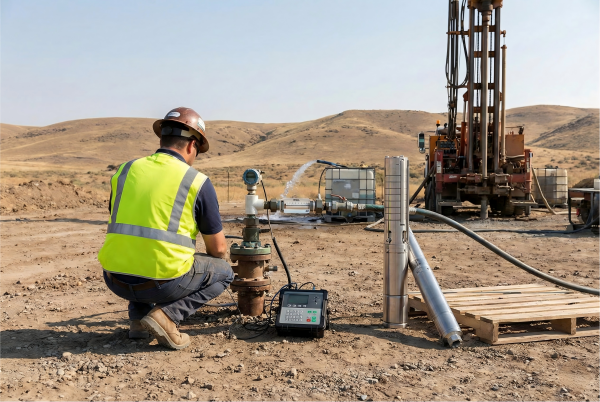
Understanding the daily potential of a borehole isn't a simple calculation.
It involves a mix of geology, hydrology, and precise testing.
For a distributor, providing the right pump for the right yield is paramount.
It's the difference between a satisfied customer and a problematic callback.
Let's explore the key factors that dictate a borehole's output, ensuring you can guide your clients with confidence and technical expertise.
Understanding Borehole Yield and Flow Rate
Are you uncertain about what "borehole yield" truly means for pump selection?
This uncertainty can lead to recommending underpowered or overpowered pumps, resulting in inefficiency and premature failure.
Mastering this concept ensures optimal system design and customer satisfaction.
Borehole yield is the maximum volume of water that can be sustainably drawn from the borehole over a long period. It's typically measured in litres per minute (L/min) or cubic meters per hour (m³/h), not just a single daily total, making it a critical metric.
To truly grasp a borehole's capacity, we must look beyond a simple daily number and focus on the sustainable rate of extraction.
This is the essence of borehole yield.
It's the vital sign that tells us how much stress the water source can handle.
A high initial flow might be misleading if the water level drops rapidly, indicating a non-sustainable rate.
Conversely, a steady, lower flow rate might provide a more reliable and substantial volume over a 24-hour period.
Understanding the distinction between initial flow, tested yield, and sustainable yield is crucial for any professional in the water pump industry.
What is the difference between flow rate and yield?
Flow rate is an instantaneous measurement.
It tells you how much water is coming out of the pipe at any given moment.
Yield, however, is a measure of the aquifer's performance and sustainability.
A proper borehole yield test, often called a pump test, is conducted over an extended period, typically 24 to 72 hours.
During this test, professionals monitor not just the flow rate but also the water level drawdown and recovery.
- Static Water Level (SWL): The water level in the borehole before pumping begins.
- Pumping Water Level (PWL): The water level while the pump is operating at a specific rate.
- Drawdown: The difference between the SWL and the PWL.
- Recovery Rate: How quickly the water level returns to the SWL after pumping stops.
A sustainable yield is one where the drawdown stabilizes, meaning the aquifer is recharging at a rate equal to or greater than the pumping rate.
How does this affect daily output calculations?
The daily output is calculated by multiplying the sustainable flow rate by the number of pumping hours.
It's a mistake to assume 24 hours of pumping.
Most domestic and agricultural systems operate intermittently.
| Flow Rate (Litres/Minute) | Pumping Hours per Day | Calculated Daily Output (Litres) | Common Application |
|---|---|---|---|
| 10 L/min | 8 hours | 4,800 L | Small Household |
| 25 L/min | 10 hours | 15,000 L | Large Home/Garden |
| 50 L/min | 12 hours | 36,000 L | Small-scale Farm |
| 100 L/min | 12 hours | 72,000 L | Commercial Use |
For a pump distributor, asking for the borehole yield test report is a non-negotiable step.
This data directly informs the selection of the deep well pump or solar pump, ensuring the pump's specifications match the borehole's capability.
Choosing a pump with a flow rate that exceeds the sustainable yield will cause the pump to run dry, leading to damage and failure.
Key Factors Influencing a Borehole's Daily Water Production
Wondering why two nearby boreholes produce vastly different amounts of water?
Ignoring the underlying geological and environmental factors leads to inaccurate estimates and poor pump system performance.
Understanding these variables is key to predictable and reliable water sourcing.
The primary factors dictating a borehole's water production are the local geology (rock and soil type), the size and characteristics of the underground aquifer, and the seasonal recharge rate from rainfall. These elements combine to determine the sustainable yield of the water source.
The amount of water a borehole can deliver is not a fixed number.
It is a dynamic value governed by a complex interplay of natural conditions beneath the ground.
As a supplier of water pumps, your expertise is demonstrated by your understanding of these factors.
It allows you to ask your clients the right questions and guide them toward a solution that is not just effective but also sustainable for the long term.
A pump is only as good as the water source it draws from; therefore, a deep dive into the source's characteristics is essential.
Geology: The Underground Water Highway
The type of rock and soil the borehole is drilled into is the single most important factor.
Different materials have different levels of porosity and permeability.
- Porosity: The amount of empty space within the rock that can hold water.
- Permeability: The ability of the rock to allow water to flow through it.
A material like clay may have high porosity but very low permeability, meaning it holds water but doesn't release it easily.
In contrast, fractured granite or gravel has high permeability, creating "water highways" that allow for high flow rates.
| Geological Formation | Permeability | Typical Yield Potential |
|---|---|---|
| Sand and Gravel | Very High | High to Very High |
| Fractured Basalt | High | Moderate to High |
| Sandstone | Moderate | Moderate |
| Shale | Low | Low to Very Low |
| Unfractured Granite | Very Low | Very Low |
The Aquifer: The Underground Reservoir
An aquifer is a body of permeable rock which can contain or transmit groundwater.
Its size, thickness, and whether it is confined or unconfined directly impact yield.
A confined aquifer is trapped between two layers of impermeable rock, often putting the water under pressure.
These can sometimes produce very high yields.
An unconfined aquifer has a permeable layer above it and its upper boundary is the water table.
Its yield is more directly and quickly affected by rainfall and surface conditions.
Recharge Rate: Replenishing the Supply
The recharge rate is the speed at which water is replenished in the aquifer, primarily from rainfall and snowmelt.
An area with high annual rainfall will naturally support a higher recharge rate than an arid region.
- Seasonal Variation: A borehole's yield can fluctuate significantly between the wet and dry seasons. A yield test conducted in the wet season might overestimate the year-round sustainable supply. A conservative approach is always recommended.
- Human Impact: The number of other boreholes in the vicinity can also affect yield. Over-extraction from multiple points can lower the regional water table, reducing the output for everyone. This is a critical consideration for large-scale agricultural or community projects.
Understanding these factors allows you to look at a borehole report and build a complete picture of its potential, leading to better pump recommendations and more resilient water systems for your clients.
How to Professionally Test a Borehole's Yield
Do you risk your reputation by trusting a client's "guesstimate" of their borehole's yield?
An informal test can provide dangerously misleading data, leading to the installation of an incorrect pump and inevitable system failure.
A professional step-rate or constant-rate test is the only reliable method.
A professional borehole yield test involves pumping water at a controlled rate for an extended period (24-72 hours) while meticulously recording the flow rate and the water level drawdown. This data determines the long-term sustainable yield, ensuring proper pump sizing and system longevity.
To avoid costly mistakes, a formal testing procedure is not just a recommendation; it is a necessity.
For a B2B supplier, insisting on a professional test report before quoting a submersible or deep well pump is a mark of quality and protects both you and your client.
It shifts the conversation from guesswork to data-driven decision-making.
The goal is to find the sweet spot: the maximum pumping rate that the borehole can sustain indefinitely without depleting the aquifer or overworking the pump.
This methodical approach is the foundation of a reliable water supply system.
The Step-Rate Test
This is often the first phase of professional testing.
The goal is to determine the borehole's performance at different pumping rates and to find an optimal rate for the longer test.
- The pump is started at a low flow rate and run for a set period (e.g., 60-120 minutes).
- Drawdown is measured and recorded.
- The flow rate is increased (stepped up), and the process is repeated for several steps.
- The results are plotted on a graph of drawdown versus flow rate. This helps identify the point of diminishing returns, where a large increase in pumping rate results in an excessive increase in drawdown.
This test helps determine the ideal rate for the subsequent constant-rate test.
The Constant-Rate Test
This is the most critical part of determining the sustainable yield.
It simulates long-term operational demand on the borehole.
- Duration: The test should run for a minimum of 24 hours, but 48 or 72 hours is preferable for greater accuracy, especially for critical applications like irrigation or community supply.
- Procedure: The pump is run continuously at the constant rate determined from the step-rate test. The water level (PWL) and flow rate are monitored and recorded at regular intervals.
- Analysis: The data shows how the water level behaves over time. Ideally, the drawdown level should stabilize. If the water level continues to drop steadily throughout the test, the pumping rate is too high and is not sustainable.
The Recovery Test
Immediately after the constant-rate test is complete, the pump is shut off.
The rate at which the water level returns to its original static water level is then meticulously measured.
A fast recovery rate is a positive sign of a healthy and productive aquifer.
A very slow recovery suggests that the aquifer releases its water slowly and could be easily depleted.
For your business, this level of detail is a competitive advantage.
When you can discuss drawdown curves and recovery rates with a potential client like Andrew in Australia, you position yourself not just as a seller of pumps, but as an expert partner in water management solutions.
This knowledge justifies your focus on quality and builds the trust necessary for a long-term business relationship.
Matching Pump Performance to Borehole Output
Are you installing pumps that are mismatched with the borehole's actual capacity?
This common error leads to pump cavitation, motor burnout, or an underperforming system, causing customer frustration and expensive warranty claims.
Properly matching pump specifications to the borehole's tested yield is essential for efficiency and reliability.
To correctly match a pump, its flow rate should be set at or slightly below the borehole's tested sustainable yield. Additionally, the pump's Total Dynamic Head (TDH) must be calculated to overcome the static head, friction loss, and pressure requirements of the system.
Selecting the right pump is a science.
It's about finding the perfect balance between the capabilities of the water source and the demands of the application.
As a manufacturer and supplier, your role extends to educating your distributors on this critical matching process.
Providing a high-quality pump is only half the battle.
Ensuring it's installed in the correct application is what guarantees its performance and longevity, solidifying your brand's reputation for reliability.
This technical diligence is what discerning buyers look for when choosing a long-term supply partner.
Step 1: Respect the Sustainable Yield
The golden rule is straightforward: Never install a pump with a capacity that exceeds the borehole's sustainable yield.
If a borehole is sustainably tested at 50 litres per minute, installing a pump capable of 80 L/min is a recipe for disaster.
The pump will quickly draw the water level down below its intake, causing it to run dry.
This can lead to:
- Cavitation: The formation of vapor bubbles that collapse and damage the pump's impellers.
- Overheating: The water being pumped is also used to cool the submersible motor. No water means no cooling, leading to motor burnout.
- Well Damage: Over-pumping can damage the borehole screen or even cause the surrounding geological formation to collapse.
A professionally selected pump should operate at around 80-90% of the tested sustainable yield. This provides a safety margin for seasonal fluctuations and long-term aquifer health.
Step 2: Calculate the Total Dynamic Head (TDH)
The pump doesn't just need to match the flow rate; it needs enough power to lift the water and push it to its destination.
This is measured by the Total Dynamic Head (TDH).
TDH = Static Head + Friction Loss + Pressure Head
- Static Head: The total vertical distance the water must be lifted. This is measured from the Pumping Water Level (PWL) in the borehole to the highest point of discharge (e.g., the top of a storage tank).
- Friction Loss: The pressure lost as water moves through pipes, fittings, elbows, and valves. The longer the pipe and the higher the flow rate, the greater the friction loss. Charts are used to calculate this value based on pipe diameter and flow. For example, pumping 50 L/min through 100 meters of 1.25-inch pipe might result in about 4 meters of head loss.
- Pressure Head: The operating pressure required at the end of the line. If a pressure tank is set to 40 PSI, this adds to the required head. (1 PSI ≈ 0.704 meters of head, so 40 PSI ≈ 28 meters of head).
Step 3: Use the Pump Performance Curve
Every pump has a performance curve.
This graph shows the relationship between its flow rate (horizontal axis) and the head it can generate (vertical axis).
To select the right pump, you find your required TDH on the vertical axis and your desired flow rate on the horizontal axis.
The ideal pump is one where this intersection point falls squarely on or near the pump's curve, preferably in the middle third of the curve, which is its Best Efficiency Point (BEP).
Using a Variable Speed Drive (VSD) pump offers a significant advantage here.
VSD pumps can adjust their motor speed to perfectly match the required flow and head, ensuring the pump always operates at its most efficient point.
This optimizes energy consumption and extends the life of the motor, a key selling point for quality-focused buyers.
Conclusion
A borehole's daily water output is dictated by its sustainable yield, not a simple guess.
This yield is determined by geology and confirmed through professional testing for reliable pump selection.
FAQs
What is a good recovery rate for a borehole?
A good recovery rate sees the water level return to 90-95% of its original static level within 24 hours after a pump test. Faster recovery indicates a very productive aquifer.
How deep should a borehole be for drinking water?
Depth varies greatly by location, but a domestic borehole is typically drilled between 30 and 150 meters. It must be deep enough to reach a stable, clean aquifer below any surface contaminants.
Can a borehole run out of water?
Yes, a borehole can run dry if the pumping rate exceeds the aquifer's recharge rate or during severe droughts. Proper testing and management help prevent this from happening.
How many hours a day can you run a borehole pump?
You can run a pump for as long as needed, even 24 hours, provided the withdrawal rate is at or below the tested sustainable yield of the borehole to avoid depleting the source.
What is the average life of a borehole?
A properly constructed borehole can last for 50 years or more. Its lifespan depends on the quality of construction, geological stability, and proper maintenance.
Does borehole yield decrease over time?
Yield can decrease due to several factors, including mineral incrustation on the well screen, regional over-extraction lowering the water table, or long-term changes in rainfall patterns.