Worried about your pool pump driving up your electricity bill?
That constant energy drain can be a major, ongoing expense for any homeowner.
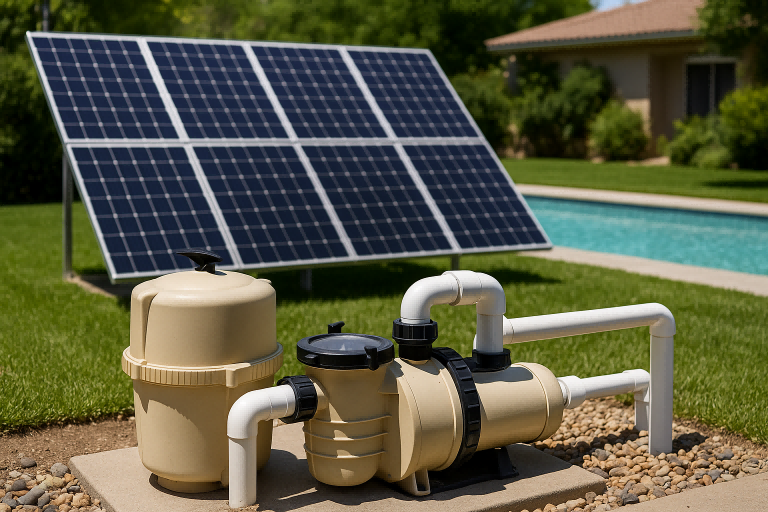
A typical 1.5 HP pool pump usually needs 6 to 8 solar panels of around 400 watts each.
The exact number depends on your pump's power, local sunlight, and desired runtime, but this provides a solid starting point for planning your system.
While that estimate gives you a general idea, several key factors can change the final count.
Getting the number of panels right is crucial for ensuring your pump runs effectively without overspending on your initial setup.
Let's dive into the details.
We will break down what you need to know to build an efficient and cost-effective solar pool pump system.
What Factors Determine the Number of Solar Panels?
Choosing the wrong number of panels can be a costly mistake.
Too few, and your pump won't run properly; too many, and you've wasted money on an oversized system.
The number of panels depends on four key factors: the pump's power consumption (wattage), the desired daily runtime, your geographic location (peak sun hours), and the efficiency of the system's components, especially the motor.
Calculating the right number of solar panels is not just a simple guess.
It is a calculation based on specific variables that determine how much energy your pump needs and how much energy the sun can provide at your location.
Each factor plays a critical role in designing a system that is both effective and economical.
Misjudging any of these can lead to an underperforming system or unnecessary expenses.
To ensure your investment is sound, you need to understand each of these elements in detail.
Understanding Your Pump's Power Consumption
The first step is to know exactly how much power your pool pump uses.
This information is typically found on the pump's label or in its manual.
You will see ratings for horsepower (HP) and/or wattage (W).
While HP is a common measure, wattage is the most important number for solar calculations because it represents the actual electricity consumption.
If you only have the HP, you can use a simple conversion.
One horsepower is approximately equal to 746 watts.
So, a 1.5 HP pump consumes about 1,119 watts (1.5 x 746).
Calculating Your Daily Energy Needs
Next, you need to decide how many hours per day you want the pump to run.
For most residential pools, 8 hours a day is a common target to ensure proper filtration.
To find your total daily energy requirement, you multiply the pump's wattage by the number of runtime hours.
This gives you the watt-hours (Wh) needed per day.
- Example Calculation: 1,119 Watts x 8 hours/day = 8,952 Wh/day.
To make the number more manageable, you can convert it to kilowatt-hours (kWh) by dividing by 1,000.
So, 8,952 Wh is equal to 8.95 kWh per day.
The Importance of Peak Sun Hours
"Peak sun hours" is a crucial metric that varies by location.
It represents the number of hours per day when the sun's intensity is strong enough to generate peak power for a solar panel.
It is not the same as the total hours of daylight.
A sunny location like Arizona might get 6-7 peak sun hours, while a less sunny area like Seattle might only get 3-4.
You can find the average peak sun hours for your specific location online using solar resource maps.
This number directly impacts how many panels you need.
Fewer sun hours mean you need more panels to generate the same amount of total energy.
| Location Factor | High Sun Area (e.g., Southwest US) | Low Sun Area (e.g., Northeast US) |
|---|---|---|
| Avg. Peak Sun Hours | 6-7 hours | 3-4 hours |
| Panel Requirement | Fewer panels needed | More panels needed |
| System Efficiency | High | Lower |
Putting It All Together
With all this information, you can calculate the total solar panel wattage required.
The formula is:
- Total Watts Needed = (Daily Energy Requirement in Wh) / (Peak Sun Hours)
Using our example:
- 8,952 Wh / 5 peak sun hours = 1,790 Watts.
This means you need a solar array that can produce approximately 1,790 watts of power.
If you choose 400-watt panels, you would divide the total watts needed by the panel wattage:
- 1,790 W / 400 W per panel = 4.47 panels.
Since you cannot buy a fraction of a panel, you would round up and install 5 solar panels for this specific scenario.
How Does Motor Efficiency Affect Panel Count?
Using an inefficient pump motor wastes electricity.
This means you are forced to buy more solar panels than necessary, increasing your upfront costs and system complexity.
A high-efficiency brushless DC (BLDC) motor can reduce your pump's energy needs by over 20%.
This allows you to run your system with fewer solar panels, significantly lowering the total system cost and making solar more affordable.
The motor is the heart of your pool pump, and its efficiency is the single most important factor in determining how much solar power you actually need.
Not all motors are created equal.
Older or cheaper pumps often use standard AC induction motors, which can waste a significant amount of electricity as heat.
Modern solar pump systems, however, leverage advanced motor technology to maximize every watt of energy generated by your solar panels.
Understanding this difference is key to designing a truly cost-effective system.
The Power of Brushless DC (BLDC) Motors
The core technology behind modern, efficient solar pumps is the Brushless DC (BLDC) permanent magnet motor.
These motors are engineered for one primary purpose: to convert as much electrical energy as possible into the mechanical work of pumping water.
Their technical advantages are substantial.
- Superior Efficiency: BLDC motors can achieve efficiencies of over 90%. This means more than 90 cents of every dollar of solar energy goes directly into pumping water. Standard AC motors typically operate at 60-75% efficiency.
- High Torque: They produce strong torque even at low speeds, which is perfect for solar applications where sunlight levels vary. This allows the pump to start easily in the morning and run smoothly even in lower light conditions.
- Compact and Lightweight Design: Advanced materials, such as neodymium iron boron magnets, allow BLDC motors to be smaller and lighter than their traditional counterparts without sacrificing power.
Comparing Motor Technologies
The difference in efficiency between a BLDC motor and a standard motor is not just a small percentage; it has a major impact on the overall system design and cost.
A more efficient motor requires less power to do the same job.
Less power means fewer solar panels.
| Feature | High-Efficiency BLDC Motor | Standard AC Induction Motor |
|---|---|---|
| Energy Efficiency | > 90% | ~ 70% |
| Power Consumption | Lower | ~20-30% Higher |
| Solar Panels Needed | Fewer | More |
| System Cost | Lower | Higher |
| Maintenance | None (no brushes) | Brushes may need replacing |
| Lifespan | Longer | Shorter |
The Financial Impact of High Efficiency
Let's revisit our earlier calculation.
We determined our 1.5 HP pump needed a 1,790-watt solar array.
That was based on a standard motor's consumption of 1,119 watts.
If a high-efficiency BLDC motor reduces that consumption by 25%, the pump would only draw around 840 watts.
Now, let's recalculate the daily energy need:
- 840 Watts x 8 hours = 6,720 Wh/day.
And the new solar array size:
- 6,720 Wh / 5 peak sun hours = 1,344 Total Watts.
Using 400-watt panels:
- 1,344 W / 400 W per panel = 3.36 panels.
In this case, you would only need to install 4 solar panels, saving you the cost of an entire panel and its associated mounting hardware.
Over the life of the system, this efficiency translates into a more compact, more affordable, and more reliable investment.
Can a Solar Pool Pump Run on Cloudy Days or at Night?
Relying only on the sun seems risky.
A string of cloudy days or the need to run your filter at night could leave your pool water stagnant and green.
Yes, it can.
Modern solar pump systems use a hybrid AC/DC controller that automatically switches to grid power when there is not enough sunlight.
This ensures your pool stays clean 24/7 without needing expensive, high-maintenance batteries.
The biggest concern for anyone considering a solar-powered system is reliability.
The sun is a powerful energy source, but it is not always available.
For an application like pool filtration, where consistent operation is key to maintaining water quality, this intermittency can be a deal-breaker.
Historically, the solution was to add a large bank of batteries to store solar energy for use when the sun isn't shining.
However, a far more practical and cost-effective technology has made this approach obsolete for most pool owners.
The Problem with Battery Storage
While batteries can store solar power, they introduce several significant disadvantages, especially for a high-power application like a pool pump.
- High Initial Cost: A battery bank large enough to run a pool pump for several hours can dramatically increase the total system cost, sometimes even doubling it.
- Ongoing Maintenance: Batteries require regular checking and maintenance to ensure their health and longevity.
- Limited Lifespan: All batteries degrade over time and will need to be replaced, typically every 5-10 years, adding a major future expense to your system.
- Inefficiency: The process of charging and discharging batteries is not 100% efficient, meaning some of your valuable solar energy is lost in the process.
The Smart Solution: Hybrid AC/DC Controllers
The modern answer to ensuring 24/7 reliability is the AC/DC hybrid controller.
This intelligent device is the brain of the solar pump system and is designed to manage power from two separate sources: your solar panels (DC power) and your home's grid connection (AC power).
It works based on a simple, automatic priority system.
- Solar First: Whenever the sun is shining, the controller will use 100% free solar energy to power the pump. This is the primary mode of operation.
- Hybrid Blending: On overcast days when solar production is reduced, the controller can blend solar power with just enough AC power from the grid to keep the pump running at its desired speed. This maximizes your use of free energy.
- Automatic AC Switchover: At night or during heavy, prolonged storms when there is no solar input, the controller seamlessly and automatically switches over to use 100% AC grid power.
This functionality gives you the best of both worlds.
You get the massive energy savings of solar power without ever having to sacrifice the reliability of a traditional grid-connected pump.
Your pool filtration schedule is never interrupted, and your water stays crystal clear, day in and day out.
What Type of Solar Pump is Best for My Pool?
Choosing the right pump feels complicated.
You worry that a generic solar pump won't provide the right flow for your pool's size or stand up to harsh pool chemicals.
The best solar pump for a pool is a multi-stage centrifugal pump.
Look for models with durable, corrosion-resistant components like stainless steel or high-grade polymer impellers to ensure a long life when exposed to chlorine and other chemicals.
While the solar panels and controller are critical, the pump unit itself is what does the actual work.
A pool environment is demanding.
The pump must be able to move a high volume of water efficiently and withstand constant exposure to corrosive chemicals like chlorine and salt.
Not just any pump will do.
The design and materials of the pump are crucial for ensuring both performance and longevity.
For pool applications, the clear choice is a centrifugal pump, which is specifically designed for high-flow, lower-pressure situations.
Why Centrifugal Pumps are Ideal for Pools
Unlike a deep well pump that needs to lift water from great depths (high head), a pool pump's job is to circulate a large volume of water through a filter (high flow).
This is exactly what centrifugal pumps are built for.
They use a spinning impeller to create pressure and push water through the system.
A multi-stage centrifugal pump uses several impellers in a series to achieve the perfect balance of flow and pressure for efficient pool filtration.
Material Matters: Resisting Corrosion
The biggest challenge for any pool equipment is the water itself.
Chlorine, salt (in saltwater pools), and other balancing chemicals are highly corrosive and can destroy a standard-issue pump in a short time.
That is why the materials used in the pump's "wet end"—the parts that touch the water—are so important.
- Solar Plastic Impeller Pumps: These are not made from ordinary plastic. They use high-strength, wear-resistant polymer composites for the impellers. This makes them a great economical choice that is lightweight and highly resistant to standard pool chemicals. They offer an excellent balance of durability and cost for most residential pools.
- Solar Stainless Steel Impeller Pumps: For the ultimate in durability and longevity, especially in saltwater pools or applications with aggressive water chemistry, a pump with stainless steel components is the premium choice. Models that use SS304 stainless steel for the impeller and pump body offer maximum resistance to corrosion and rust, ensuring a very long and reliable service life.
| Pump Material | Best For | Key Advantage | Limitation |
|---|---|---|---|
| Wear-Resistant Polymer | Standard chlorine pools, residential use | Economical, lightweight, good chemical resistance | Not ideal for highly aggressive water chemistry |
| SS304 Stainless Steel | Saltwater pools, high-end residential, commercial | Maximum corrosion resistance, very long lifespan | Higher initial cost and weight |
By selecting a centrifugal pump made from the right materials, you ensure that your solar-powered system will not only be energy-efficient but will also stand up to the harsh realities of a pool environment for years to come.
Conclusion
Determining the right number of solar panels involves a simple calculation based on your pump, location, and runtime.
Modern technology ensures your solar pool pump is a powerful, reliable, and highly cost-effective investment.
FAQs
How many solar panels does it take to run a 1 hp pool pump?
A 1 HP pump needs about 4-5 solar panels (400W each).
This depends on your location's sun hours and desired daily runtime.
Can you run a variable speed pool pump off solar panels?
Yes, you can.
A solar controller works perfectly with a variable speed pump, allowing it to adjust its speed based on available sunlight.
Is it worth getting a solar pool pump?
Yes, it is worth it.
It can eliminate the electricity cost of running your pool, paying for itself in savings within a few years.
How much can you save with a solar pool pump?
You can save hundreds of dollars a year.
The exact amount depends on your local electricity rates and how often you run your pump.
Can a solar pump run without a battery?
Yes.
Modern hybrid systems use the grid as a backup instead of batteries, ensuring 24/7 operation more cost-effectively and with less maintenance.
Do solar pool pumps work on cloudy days?
Yes, they still work but at a reduced speed.
A hybrid system can supplement with grid power to maintain full operation on cloudy days.
What is the lifespan of a solar pool pump?
A quality solar pump system can last 15-20 years.
The BLDC motors are extremely durable, and solar panels are often warrantied for 25 years.