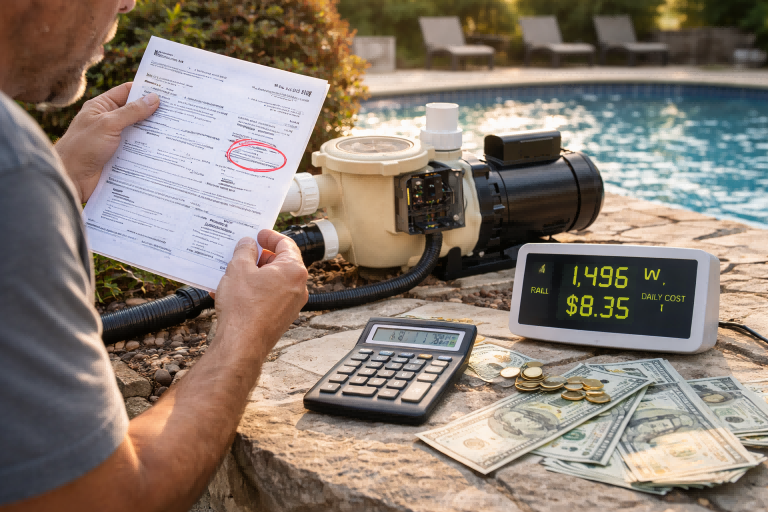
Your beautiful pool is becoming an expensive headache.
The electricity bill is shockingly high, and you know the single-speed pump is the main culprit, running endlessly.
What if you could cut that cost by 90%?
Running a standard 1,500-watt pool pump for 24 hours can cost between $5.76 and $10.80 per day.This depends on your local electricity rate.Over a month, this can balloon to over $170-$320, just for your pool pump.
Calculating the exact cost of running your pool pump seems straightforward.
However, the final number on your utility bill is often a surprise.
The cost isn't just about the pump's power rating and your electricity price.
It's also heavily influenced by the pump's underlying technology and its inherent inefficiency.
A traditional, single-speed AC pump is one of the most power-hungry appliances in a home.
It's a brute-force machine, always running at 100% power, whether it needs to or not.
Understanding this inefficiency is the first step toward finding a much smarter, more cost-effective solution.
Let's break down the real costs and explore how modern technology can save you a fortune.
Why is a traditional pool pump so expensive to run?
Your pump runs constantly, but your energy bill feels disproportionately high.
You suspect you're wasting a significant amount of money on an inefficient, outdated motor design.
**A traditional AC induction motor is only 50-70% efficient.
It wastes a huge amount of energy as heat and noise.
This outdated technology, combined with its single high-speed operation, makes it one of the most expensive appliances to run in your home.
**
The high running cost of a conventional pool pump is rooted in its century-old motor technology.
These pumps use an AC (Alternating Current) induction motor.
This design was revolutionary in its time, but it is fundamentally inefficient by modern standards.
A huge portion of the electricity it consumes is not converted into the mechanical force that moves water.
Instead, a significant percentage, often 30% to 50%, is simply lost.
This wasted energy manifests as heat, which you can feel if you touch the motor casing, and noise.
You are literally paying for energy that does nothing but warm up the motor and create a constant hum.
The Inefficiency of Single-Speed Operation
The problem is magnified by the pump's single-speed nature.
A one-speed pump is designed for the most demanding task, like running a cleaner or backwashing the filter.
It runs at this peak power level 100% of the time.
-
Constant High Power: For the majority of its runtime, the pump's only job is basic circulation to filter the water.
This task requires only a fraction of its full power.
Running at 100% speed for simple circulation is like using a sledgehammer to crack a nut. -
Energy Waste vs.
Flow Rate: A key principle in fluid dynamics, known as the Pump Affinity Laws, states that reducing a pump's speed by half reduces its power consumption by a factor of eight.
A single-speed pump cannot leverage this law.
It's stuck in the most energy-intensive mode. -
Motor Technology: The AC motor itself has inherent slip and resistance, which are major sources of energy loss.
This is simply the nature of their design.
| Feature | Traditional Single-Speed AC Pump | Impact on Cost |
|---|---|---|
| Motor Efficiency | 50% - 70% | 30-50% of electricity is wasted as heat. |
| Operating Speed | One high speed only | Always consumes maximum power, even for low-demand tasks. |
| Energy Law | Cannot utilize Pump Affinity Laws | Misses out on an 8x reduction in power for a 2x reduction in speed. |
| Result | Extraordinarily high electricity consumption and cost. |
This combination of an inefficient motor and a "one-size-fits-all" operating speed creates a perfect storm of energy waste, directly leading to the high costs you see on your bill.
How can you reduce pool running costs by over 90%?
You want a crystal-clear pool without the crushing energy bill.
The idea of running your pump for hours a day is financially daunting, forcing you to cut back on filtration.
**Switch to a pump with a Brushless DC (BLDC) motor.
These motors are over 90% efficient and allow for variable speed control.
By running at a low, optimal speed for most of the day, they can cut electricity consumption by over 90% compared to a single-speed pump.
**
The solution to high running costs is not to run your pump less, which can harm your pool's water quality.
The solution is to upgrade the core technology of the pump itself.
The modern answer is a pump driven by a high-efficiency Brushless DC (BLDC) permanent magnet motor.
This isn't just a minor improvement; it's a fundamental change in how the pump works and a revolutionary leap in efficiency.
BLDC motors eliminate the major sources of energy loss found in old AC motors.
They don't have brushes that wear out, and their permanent magnet rotor design means they convert more than 90% of electrical energy directly into pumping power.
This single advancement can cut your pump's energy waste by more than half.
The Power of Variable Speed
The true game-changer, however, is when this hyper-efficient BLDC motor is paired with intelligent, variable speed control.
This combination allows you to destroy the "one-size-fits-all" inefficiency of old pumps.
-
Matching Power to the Task: A variable speed pump can be set to run at a very low speed (and thus, very low wattage) for the long hours of daily filtration.
You can then ramp up the speed for a short time when you need to run a cleaner, backwash, or power a water feature. -
Leveraging the Pump Affinity Laws: This is where the massive savings come from.
By cutting the motor speed in half (e.g., from 3,450 RPM to 1,725 RPM), you still get 50% of the water flow, but your power consumption drops by a staggering 87.5%.
Running the pump at this low speed for twice as long results in the same amount of filtered water for a tiny fraction of the electricity cost.
| Pump Type | Speed | Motor Efficiency | Daily Cost (8 hours) | Monthly Cost | Potential Savings |
|---|---|---|---|---|---|
| Single-Speed AC | 100% | ~60% | $2.88 | $86.40 | 0% |
| Variable-Speed BLDC | Low (for 7 hrs) | >90% | $0.24 | $7.20 | >90% |
| High (for 1 hr) | >90% | ||||
This is not a hypothetical saving.
This is the real-world result of applying modern motor technology to the task of pool filtration.
You can run your pump for 24 hours a day at an ultra-low speed for less than it costs to run your old pump for just two hours.
Can you run a pool pump for free?
You've upgraded to an efficient pump, but you still rely on the expensive grid.
You want true energy independence and to eliminate your pool's running costs entirely.
**Yes, by pairing your high-efficiency DC pump with solar panels.
A solar pump runs entirely on free energy from the sun during the day.
With a hybrid AC/DC controller, it can automatically switch to grid power at night, giving you 24/7 operation with zero daytime running costs.
**
The ultimate step in cost reduction is to eliminate the electricity bill altogether.
This is now entirely possible with a solar-powered DC pool pump.
Since the efficient BLDC motor already runs on DC power, it can be connected directly to the DC power produced by solar panels.
This creates the most efficient system possible.
There is no need for a complex and inefficient inverter to change the power from DC to AC.
The sun's energy goes directly from the panels to the pump's controller, and then to the motor, with minimal loss.
During peak sun hours, you are running your pool pump for free.
The energy is generated on-site, it's clean, and it doesn't cost you a penny after the initial equipment investment.
This completely changes the economic equation of pool ownership.
The 24-Hour Solution: The Hybrid Controller
A common concern with solar power is what happens when the sun isn't shining.
For pool filtration, you need reliability, not just daytime operation.
This is where the hybrid AC/DC controller becomes essential.
This intelligent device is the brain of the modern solar pump system.
-
Dual Power Inputs: The controller has inputs for both the DC power from your solar panels and the AC power from your home's electrical grid.
-
Solar First Principle: The controller is programmed to always prioritize solar power.
If the sun is out, it will use 100% free solar energy to run the pump.
Grid power usage is zero. -
Smart Blending: On partly cloudy days, it doesn't just give up.
The controller will use all available solar energy and then "blend" in only the small amount of AC power needed to maintain the pump's speed.
This maximizes your use of free energy. -
Automatic AC Takeover: At night, or during extended storms, the controller seamlessly and automatically switches to the AC grid power source.
Your filtration schedule is never interrupted.
This system provides the absolute best of both worlds.
You get the maximum possible cost savings from solar, with the complete peace of mind and 24/7 reliability of a grid connection.
It makes batteries unnecessary for most applications, avoiding their high cost, maintenance, and limited lifespan.
Conclusion
A standard pump can cost over $300 a month to run 24/7.
By switching to a solar DC pump with a hybrid controller, you get 24-hour reliability with nearly zero running costs.
Frequently Asked Questions
Is it cheaper to run a pool pump at night?
It can be if you have time-of-use billing with cheaper off-peak rates.
However, running it for free during the day with solar power is always the cheapest option.
How many hours a day should a pool pump run?
Typically 8-12 hours.
The goal is to turn over the entire volume of pool water at least once.
With an efficient variable-speed pump, you can run it longer at a lower speed for less cost.
Should I run my pool pump 24/7?
With a traditional pump, this would be extremely expensive.
With a variable-speed solar pump, running 24/7 at a very low speed can be highly effective and very affordable.
Can a 2 HP pump be more efficient than a 1 HP pump?
Yes, if the 2 HP pump is a modern variable-speed model.
It can run at a much lower speed than the 1 HP's full power, using far less energy to achieve the same filtration.
What is the most energy-efficient pool pump?
The most efficient systems are DC-powered variable-speed pumps with a BLDC motor, especially when paired with solar panels and a hybrid controller.
How much can I save with a variable speed pump?
You can realistically save 70% to 90% on your pool's electricity consumption compared to a single-speed pump.
The savings can often pay for the new pump in 1-2 seasons.