Sizing a solar inverter for a water pump can be confusing.
An incorrectly sized inverter will cause system failure or damage.
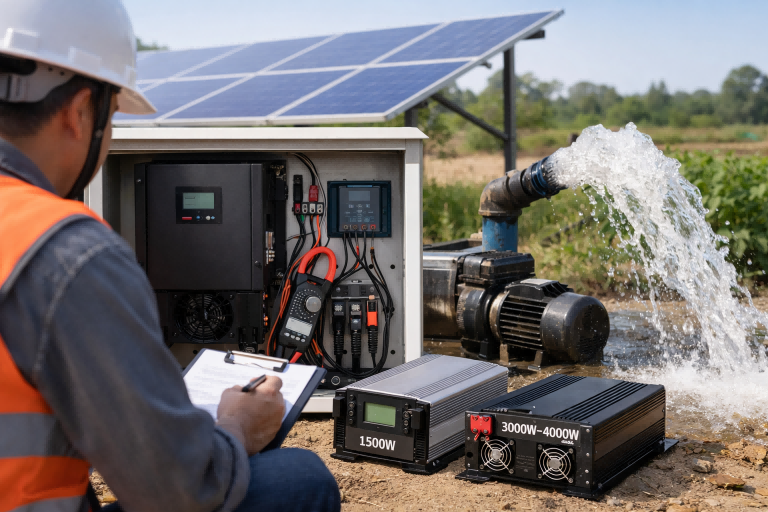
For a standard 1HP (746 Watts) AC water pump, you need a solar inverter with a continuous rating of at least 1500W and a peak or surge rating of 3000-4000W to handle the massive starting current.
This straightforward answer, however, only scratches the surface.
The calculation is not as simple as matching the pump's running wattage.
The type of pump motor, its starting power demand, and the overall system design are far more critical factors.
Understanding these details is the key to building a reliable and efficient solar pumping system that won't let you down.
Let's explore why the starting surge is so important and how modern systems offer a more integrated, efficient solution.
Calculating Power for a Standard 1HP AC Pump
You know your pump is 1HP, but you are not sure how that translates to electrical needs.
This uncertainty can lead to buying the wrong inverter, wasting money and time.
A 1HP pump consumes 746 watts during operation, but its starting surge can be 3 to 8 times higher.
To safely run a 1HP (746W) AC pump, you must size the inverter for the starting surge current, not the running watts. This means selecting an inverter capable of handling a peak load of 2,250W to 6,000W.
When sizing a solar inverter for a traditional AC water pump, we must look beyond the simple horsepower rating.
The most critical factor is the massive, momentary power demand that occurs the instant the pump is switched on.
This is known as inrush current or locked-rotor amps (LRA).
From Horsepower to Running Watts
First, we convert horsepower to watts, which is the standard unit for electrical power.
This conversion is a fixed electrical equivalent.
- 1 Horsepower (HP) = 746 Watts
This means that once your 1HP pump is up and running, it will continuously draw approximately 746 watts of power.
This is the "running power" and is the easier part of the equation.
The Hidden Challenge: Inrush Current
The inrush current is a characteristic of standard AC induction motors.
To overcome inertia and get the pump's components moving from a standstill, the motor requires a giant surge of energy for just a fraction of a second.
This surge can be anywhere from 3 to 8 times the normal running wattage.
An inverter that is only sized for 746 watts will immediately be overloaded by this surge and will shut down to protect itself, preventing the pump from ever starting.
Sizing the Solar Inverter Correctly
To ensure a successful startup every time, you must select an inverter based on its peak power or surge rating.
The formula is:
Required Inverter Peak Power = Running Watts x Surge Multiplier
Using our 1HP (746W) pump as an example:
| Surge Multiplier | Required Peak Power (Watts) | Recommended Inverter Size (Continuous) |
|---|---|---|
| Low Surge (3x) | 746W x 3 = 2,238 W | 1,500 W |
| Average Surge (5x) | 746W x 5 = 3,730 W | 2,000 W |
| High Surge (8x) | 746W x 8 = 5,968 W | 3,000 W |
As you can see, a conservative approach is best.
You should choose an inverter with a continuous output of at least 1,500W to 2,000W to ensure its peak power rating can handle the surge.
This oversized inverter must then be powered by a correspondingly large solar panel array, increasing the system's overall cost and complexity.
A Better Way: The Integrated Solar Water Pump System
You are trying to pair a standard AC pump with a separate inverter and solar panels.
This approach is inefficient, expensive, and prone to compatibility issues.
Instead of a separate inverter, modern solar pumps use an integrated system with a controller.
Modern solar water pumps do not use a standard inverter. They use a highly efficient BLDC motor paired with a dedicated MPPT controller. This integrated system eliminates the high starting surge, improves efficiency by over 30%, and reduces solar panel requirements.
The challenge of sizing a large inverter for a 1HP AC pump highlights the limitations of a component-based approach.
This method forces you to over-engineer the system to handle a problem—inrush current—that only lasts for a split second.
The modern solution completely redesigns the system to eliminate this problem from the start.
Instead of adapting solar power to an old AC pump, it uses a pump technology specifically designed for solar energy.
The Core Technology: BLDC Motors
The heart of an integrated solar pump system is a Brushless DC (BLDC) permanent magnet motor.
These motors are fundamentally different from traditional AC motors.
- Superior Efficiency: BLDC motors operate at efficiencies exceeding 90%, compared to 60-70% for typical AC motors. This means more water is pumped for every watt of solar energy produced.
- Permanent Magnets: The rotor uses powerful rare-earth magnets (like Neodymium iron boron), which eliminates the electrical energy loss required to create a magnetic field in an AC motor.
- No Brushes: The brushless design means there are no physical components to wear out, leading to a maintenance-free motor with an extremely long service life.
This high-efficiency motor is the foundation for a more powerful and economical system.
The Brains of the Operation: The MPPT Controller
The second key component is the dedicated controller, which takes the place of a standard inverter.
This device is far more intelligent.
It incorporates Maximum Power Point Tracking (MPPT) technology, which constantly adjusts the electrical load to extract the maximum possible power from the solar panels as sunlight conditions change throughout the day.
Crucially, the controller also provides a "soft start" for the pump motor.
It gradually ramps up the power and speed, completely eliminating the destructive inrush current.
There is no power surge, meaning you no longer need an oversized inverter or an oversized solar array.
The controller and motor are engineered to work together perfectly, creating a seamless and optimized system.
Choosing the Right Pump for Your Integrated System
You understand the benefits of an integrated system, but now you need the right pump.
Choosing the wrong pump type will lead to poor performance for your specific well conditions.
The best pump matches your well's depth, water quality, and required flow rate.
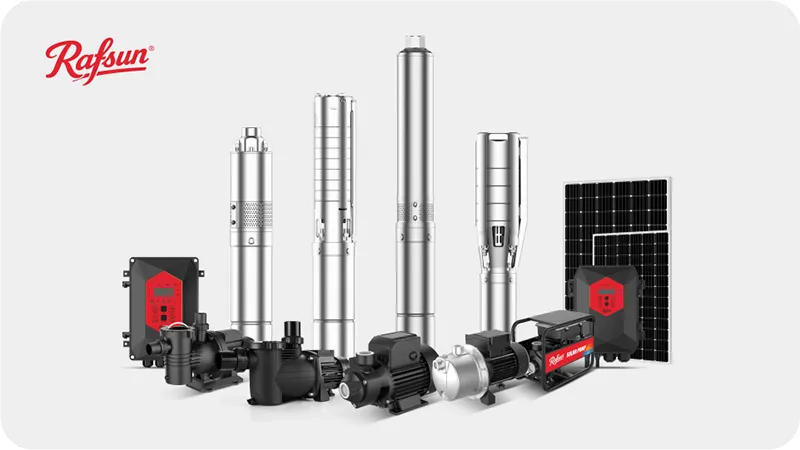
For deep wells, a solar screw pump is best. For high water volume in sandy conditions, use a plastic impeller pump. For corrosive water, a stainless steel impeller pump is the premium choice. All are powered by the same efficient BLDC motor.
Once you have committed to a highly efficient integrated system, the final step is selecting the "pump end" that matches the physical characteristics of your water source.
The beauty of this system approach is that the same core technology—the high-efficiency BLDC motor and MPPT controller—can be paired with different types of pumps.
This allows you to create a customized solution that is perfectly tailored to your needs for water volume, depth, and quality.
For Maximum Depth: The Solar Screw Pump
If you are dealing with a very deep borehole, your primary challenge is "head," which is the vertical distance you need to lift the water.
- How it Works: The screw pump uses a helical rotor spinning inside a rubber stator. This mechanism pushes trapped pockets of water upward, creating very high pressure.
- Best Application: Ideal for domestic water supply and livestock watering from deep wells, especially in regions like Africa and Latin America.
- Key Advantage: It offers exceptional performance at high head and has a remarkable tolerance for sand and silt in the water, which would quickly damage other pump types.
For Maximum Volume: The Plastic Impeller Centrifugal Pump
If your goal is to move a large quantity of water for irrigation or filling a stock tank, you need high flow.
- How it Works: This multi-stage centrifugal pump uses a series of durable, wear-resistant plastic impellers to move a high volume of water at medium head.
- Best Application: Perfect for farm irrigation, pasture water supply, and larger gardens.
- Key Advantage: It is lightweight, economical, and offers excellent resistance to fine sand. It delivers the most water for your investment in non-corrosive environments.
For Maximum Durability: The Stainless Steel Impeller Pump
When water quality is a concern, such as in areas with acidic or alkaline water, longevity is paramount.
- How it Works: This pump is a premium version of the centrifugal pump, using SS304 stainless steel for the impellers, pump body, and other wetted parts.
- Best Application: Essential for boreholes with corrosive water chemistry, found in areas like the alkaline soil regions of Australia or high-end residential applications where water purity is critical.
- Key Advantage: Its superior corrosion resistance ensures a very long service life and high reliability, justifying the higher initial cost.
Conclusion
Answering the inverter question for a 1HP pump reveals a better solution.
An integrated DC solar pump system is more efficient, reliable, and cost-effective than a component-based AC system.
Frequently Asked Questions
Can I run a 1HP pump directly with solar panels?
No, you cannot connect a pump directly to solar panels. You need a controller or inverter to manage the variable DC power from the panels and deliver it correctly to the pump motor.
How many watts does a 1 HP solar water pump use?
A 1 HP pump uses 746 watts while running. However, a modern 1 HP DC solar pump system is rated by its solar input, often requiring a solar array of 900W to 1200W for optimal performance.
Which inverter is best for a 1HP submersible pump?
For a standard 1HP AC pump, a pure sine wave inverter of at least 2000W is best. For a DC solar pump, a dedicated MPPT controller is used instead of an inverter.
What is the starting current of a 1HP single-phase motor?
The starting current can be 3 to 8 times the running current. For a 1HP (746W) motor at 230V, the running current is about 3.2 amps, so the starting current could be 10 to 26 amps.
Can a 2kW inverter run a 1HP motor?
Yes, a 2kW (2000W) inverter can typically run a 1HP motor. Its peak power rating should be sufficient to handle the motor's starting surge, making it a safe choice for most 1HP AC pumps.
What is the difference between a solar inverter and a solar charge controller?
A solar charge controller regulates power from panels to charge a battery bank. A solar inverter converts DC power (from panels or batteries) into AC power to run standard appliances.
What is a VFD in a solar water pump?
VFD stands for Variable Frequency Drive. In solar pumps, this function is part of the MPPT controller, allowing it to adjust the motor's speed based on available sunlight, ensuring efficient operation all day.