Tired of high electricity bills just to keep your pool clean?
A solar pump is the answer, but sizing the system seems complex.
You need a clear, simple solution.
A typical residential pool pump requires between 1,500 and 2,500 watts of dedicated solar panels.
The exact amount depends on your pump's horsepower (HP) and your location's peak sun hours.
A 1.5 HP pump, for example, pairs well with a 2.0 kW solar array.
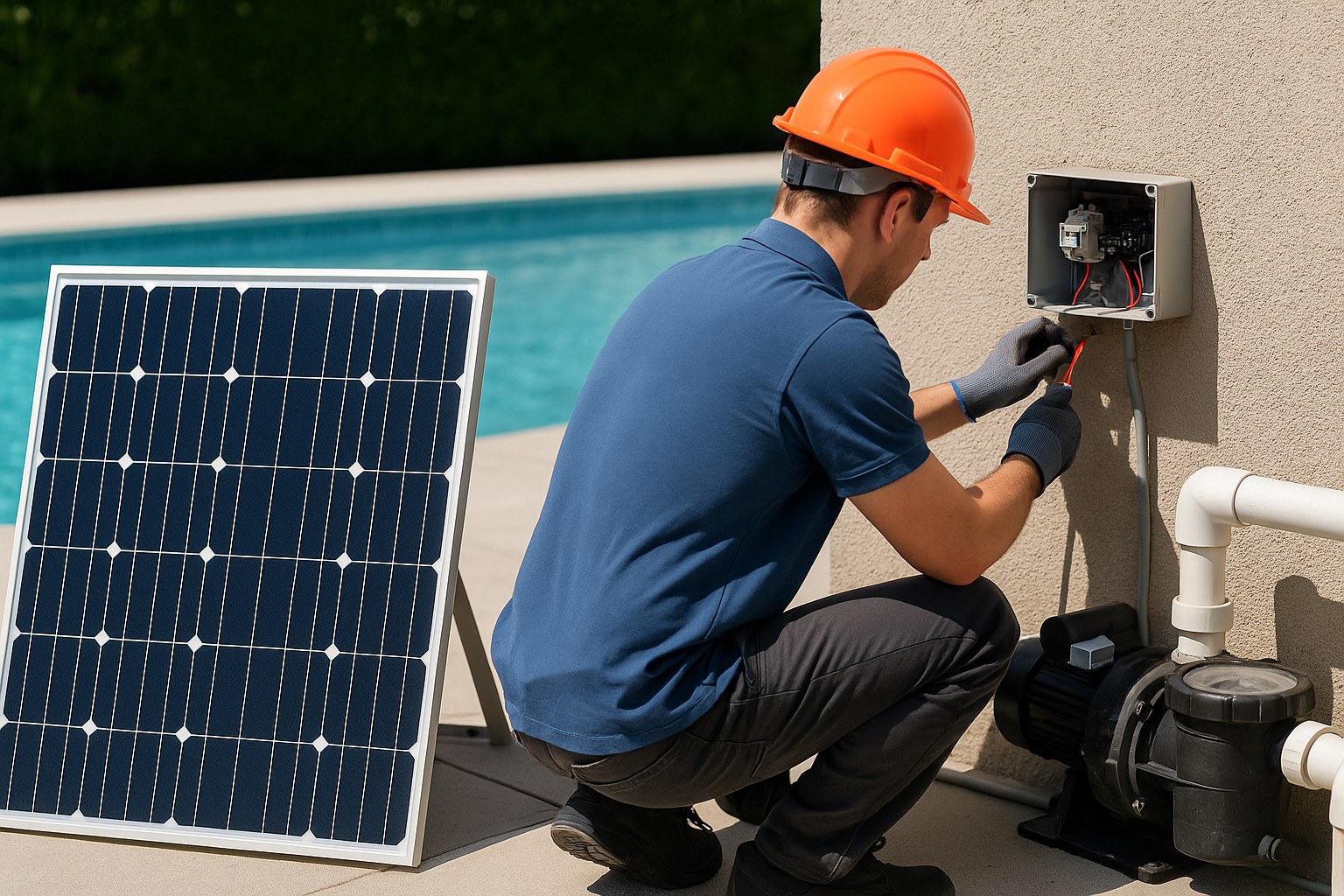
Switching to solar feels like a smart move.
But you need to be sure it will actually work for your specific pool.
Let's break down the factors that determine your power needs.
This will help you build a system that saves you money and keeps your pool sparkling.
What Determines Your Pool Pump's Power Needs?
You look at your pump's label and see numbers for volts, amps, and HP.
It's confusing to translate these into a solar panel requirement.
This uncertainty can stop you from making a cost-saving upgrade.
Your pump's horsepower (HP) and its runtime are the two most important factors.
A higher HP pump requires more watts to run.
To calculate your needs, you must convert HP to watts and then account for the number of hours you need the pump to operate daily.
The core of your solar calculation lies in understanding your pump's energy appetite.
Most people focus only on the upfront cost of panels.
But the real starting point is the device you need to power.
A small miscalculation here can lead to an undersized system that doesn't filter your water properly, or an oversized one that wastes money.
We will deconstruct this process.
You will learn to confidently match solar panels to your specific pool pump.
Decoding Your Pump's Specifications
First, find the label on your pool pump's motor.
You are looking for its horsepower (HP) rating.
This is the most direct indicator of its power consumption.
Most residential pool pumps range from 0.75 HP to 2.5 HP.
If you cannot find the HP, you can calculate the wattage using the voltage (V) and amperage (Amps) listed.
The formula is straightforward: Watts = Volts x Amps.
This number gives you the pump's running wattage.
Matching Panels to Pump Wattage
Once you know the pump's running wattage, you can size your solar array.
The goal is to produce enough power during peak sunlight to run the pump effectively.
A good rule of thumb is to oversize the solar array slightly.
This ensures performance on less-than-perfectly-sunny days.
For a pump that consumes 1,200 watts, an array of 1,500 watts (1.5 kW) is a safe and effective choice.
This provides a buffer for efficiency losses and lower light conditions.
Here is a simple matching guide:
| Pump Horsepower (HP) | Typical Running Watts | Recommended Solar Array Size (Watts) |
|---|---|---|
| 0.75 HP | ~800 W | 1,000 W (1.0 kW) |
| 1.0 HP | ~1,100 W | 1,500 W (1.5 kW) |
| 1.5 HP | ~1,500 W | 2,000 W (2.0 kW) |
| 2.0 HP | ~2,000 W | 2,500 W (2.5 kW) |
| 2.5 HP | ~2,400 W | 3,000 W (3.0 kW) |
The Importance of Peak Sun Hours
The final piece of the puzzle is your location.
"Peak Sun Hours" refers to the number of hours per day when the sun's intensity is strong enough for your panels to produce their rated output.
A location in Arizona might get 6-7 peak sun hours.
A location in the Northeast might only get 4-5.
Your system needs to be sized to filter the entire volume of your pool during these available hours.
More sun hours mean you can use a smaller solar array to do the same amount of work.
Can You Use Any Pump with Solar Panels?
You have a perfectly good AC pool pump.
You wonder if you can just connect some solar panels to it.
This seems like a simple way to save money without buying a whole new pump.
No, a standard AC grid-powered pump cannot connect directly to DC solar panels.
You would need an inverter to change the panel's DC electricity to AC.
However, a far more efficient solution is a purpose-built DC solar pump with a high-efficiency BLDC motor.
The heart of an efficient solar pool system isn't just the panels.
It is the motor driving the pump.
Using the wrong type of motor is like trying to drive a sports car with a lawnmower engine.
It will work, but poorly and inefficiently.
Understanding the difference between motor types reveals why a dedicated solar pump is a superior long-term investment.
It saves you money not just on electricity bills, but also on the initial cost of the solar panels themselves.
The Inefficiency of AC Pumps with Inverters
You can make a standard AC pump run on solar.
The setup requires a solar array, a charge controller, a battery bank, and a large inverter.
The inverter's job is to convert the DC power from the panels and batteries into AC power for the pump.
The problem is that every conversion step loses energy.
The inverter itself can lose 10-20% of the precious solar power as heat.
This means you must buy more solar panels to compensate for this waste.
It creates a more complex, expensive, and less reliable system.
The Power of a BLDC Motor
Modern DC solar pumps use a Brushless DC (BLDC) permanent magnet motor.
This is the core technology that makes solar pumping so effective.
These motors are radically different from their AC counterparts.
- High Efficiency: BLDC motors can be over 90% efficient. They waste very little energy as heat, converting almost all the solar electricity directly into water-pumping power.
- No Inverter Needed: They run directly on DC power from the solar panels, eliminating the need for a power-wasting inverter.
- Long Lifespan: With no brushes to wear out, these motors are virtually maintenance-free and last for many years.
- Compact Power: They deliver more power in a smaller, lighter package compared to traditional motors.
A system with a BLDC motor requires significantly fewer solar panels to do the same job as an AC pump system.
This reduces the total system cost and simplifies installation.
| Feature | AC Pump with Solar Inverter | Dedicated DC Solar Pump (BLDC) |
|---|---|---|
| System Efficiency | Lower (due to inverter loss) | Very High (>90%) |
| Solar Panel Needs | Higher | Lower |
| System Complexity | High (more components) | Low (direct connection) |
| Maintenance | Moderate | Very Low |
| Long-Term Cost | Higher | Lower |
Choosing a dedicated DC solar pump with a BLDC motor is the most direct and efficient path to a solar-powered pool.
It is an investment in a smarter, more streamlined system.
What Happens When the Sun Isn't Shining?
You love the idea of a solar-powered pool.
But you worry about a string of cloudy days.
If the pump doesn't run, your pool could quickly turn green.
Modern solar pump systems solve this with a hybrid controller.
This intelligent device can draw power from both your solar panels and your home's AC grid.
It prioritizes free solar power first and only uses grid power when absolutely necessary to keep your pool clean.
The biggest fear for a pool owner is losing filtration.
A non-circulating pool is a breeding ground for algae and bacteria.
Early solar pump systems were "solar-only," which made them vulnerable to bad weather.
But technology has evolved.
The invention of the hybrid AC/DC controller completely eliminates the cloudy-day problem.
It gives you the best of both worlds: the cost savings of solar and the reliability of the grid.
Let's see how this critical component ensures your peace of mind.
How a Hybrid Controller Works
Think of a hybrid controller as the brain of your pump system.
It has inputs for both your DC solar panels and your AC home electricity.
Its internal logic is programmed with one primary goal: use solar power whenever possible.
- Full Sun: The controller directs 100% of the DC power from the solar panels to the pump. You are using free energy, and the grid is not used at all.
- Partial Clouds: If clouds reduce solar output, the smart controller can blend power. It takes as much as it can from the panels and seamlessly supplements the rest with AC power from the grid to maintain pump speed.
- No Sun (Night/Heavy Clouds): When there is zero solar input, the controller automatically switches over to 100% AC grid power. Your pump continues to run its scheduled filtration cycle without any interruption.
This process is completely automatic.
You do not need to flip any switches.
The controller constantly monitors the solar input and makes the best decision to run the pump efficiently.
The Benefit of 24/7 Reliability
The main advantage of a hybrid system is worry-free operation.
You can set your pool's filtration schedule just like you would with a normal pump.
The system will meet that schedule regardless of the weather.
- Algae Prevention: Consistent daily filtration is the number one way to prevent algae growth. A hybrid system guarantees this.
- Maximum Savings: You still maximize your use of free solar energy. The system only draws from the expensive grid when it has no other choice.
- No Battery Needed: A hybrid controller eliminates the need for a large, expensive, and high-maintenance battery bank. The grid itself acts as your backup power source.
For any pool owner who values both savings and a consistently clean pool, a system with a hybrid controller is the modern standard.
It removes the final disadvantage of solar-only systems.
Are All Solar Pool Pumps Made the Same?
You've decided on a DC solar pump.
Now you see different models, some with plastic parts and others with stainless steel.
You wonder if paying more for metal components is worth it for your pool.
No, the internal materials are crucial, especially for your pool's chemistry.
A high-flow pump with wear-resistant plastic impellers is perfect for standard chlorinated pools.
However, for saltwater pools, a pump with SS304 stainless steel internals is essential to prevent corrosion and ensure a long life.
Just as the motor's efficiency is critical, the pump's physical construction is key to its longevity.
Pool water is a chemically treated environment.
Chlorine is a sanitizer, but it is also corrosive.
Saltwater systems, while gentler on the skin, are even more corrosive to metals.
Choosing a pump made from materials that can withstand your specific pool water is the difference between a system that lasts three years and one that lasts for over a decade.
Let's examine the two main options.
The Workhorse: Plastic Impeller Pumps
The most common type of solar pool pump is a multi-stage centrifugal pump.
It uses a series of spinning discs, called impellers, to move water.
In standard models, these impellers are made from a very durable, wear-resistant engineered plastic.
This material choice is excellent for most applications.
- High Flow: The centrifugal design is perfect for moving the large volumes of water required for pool filtration.
- Wear Resistance: It handles the small dust and debris found in pool water without a problem.
- Cost-Effective: Engineered plastic is economical, keeping the pump's price reasonable.
For a traditional chlorine or bromine pool, a high-quality pump with plastic impellers is a reliable and economical choice.
It provides the high flow needed for filters and heaters to work correctly.
The Premium Choice: Stainless Steel Pumps
If you have a saltwater pool, the game changes.
The salt concentration, while low, is highly corrosive to many materials over time.
This is where a stainless steel pump becomes a necessity, not a luxury.
These pumps use impellers and a pump body made from SS304 stainless steel.
This specific alloy is designed for exactly this kind of environment.
| Feature | Plastic Impeller Pump | Stainless Steel Impeller Pump |
|---|---|---|
| Ideal Pool Type | Chlorine, Bromine | Saltwater, High-Mineral, or Acidic Water |
| Corrosion Resistance | Good | Excellent |
| Lifespan in Saltwater | Shorter | Very Long |
| Upfront Cost | Lower | Higher |
| Long-Term Value | Excellent for standard pools | The only cost-effective choice for saltwater |
Investing in a stainless steel pump for a saltwater pool prevents premature failure.
The higher initial cost is offset by not having to replace the pump every few years.
It is about choosing the right tool for the job to ensure decades of reliable filtration.
Conclusion
Sizing a solar system for your pool pump is straightforward.
It starts with your pump's horsepower.
It ends with choosing a durable, efficient DC pump.
This ensures a clean pool and lower energy bills.
Frequently Asked Questions
How many solar panels does it take to run a 1.5 HP pool pump?
A 1.5 HP pool pump typically needs about 2,000 watts (2.0 kW) of solar panels. This provides ample power for effective operation during peak sun hours.
Can I run my pool pump entirely on solar?
Yes, you can run a pool pump entirely on solar during sunny days. A hybrid controller is recommended to use grid power as a backup for cloudy days.
How long do solar pool pumps last?
A quality solar pool pump with a BLDC motor can last over 10 years. The solar panels themselves are often warrantied for 25 years of production.
Is it worth getting a solar pool pump?
Yes, for most pool owners, it is worth it. The significant savings on electricity bills mean the system often pays for itself within a few years.
Do solar pool pumps work on cloudy days?
They work at reduced speed on cloudy days. To maintain full filtration, a system with a hybrid AC/DC controller will automatically supplement with grid power.
Do you need batteries for a solar pool pump?
No, batteries are not necessary. It is more cost-effective to use a hybrid controller that uses the grid as a backup instead of storing power.
How much can I save with a solar pool pump?
You can eliminate most of the electricity cost associated with running your pool. Depending on your rates, this could save you hundreds of dollars per year.
What maintenance does a solar pool pump require?
Maintenance is very low. The brushless motor requires no service, and the solar panels only need occasional cleaning to remove dust or debris.