Tired of trickling showers and weak faucets?
Fixing low water pressure often means installing a booster pump.
Correctly sizing your pump is the key to solving the problem permanently.
Sizing a booster pump involves two main calculations: the required flow rate in gallons per minute (GPM) and the total dynamic head (TDH) in feet or PSI.
You find the flow rate by counting fixtures and the TDH by adding up vertical lift, friction loss, and required final pressure.
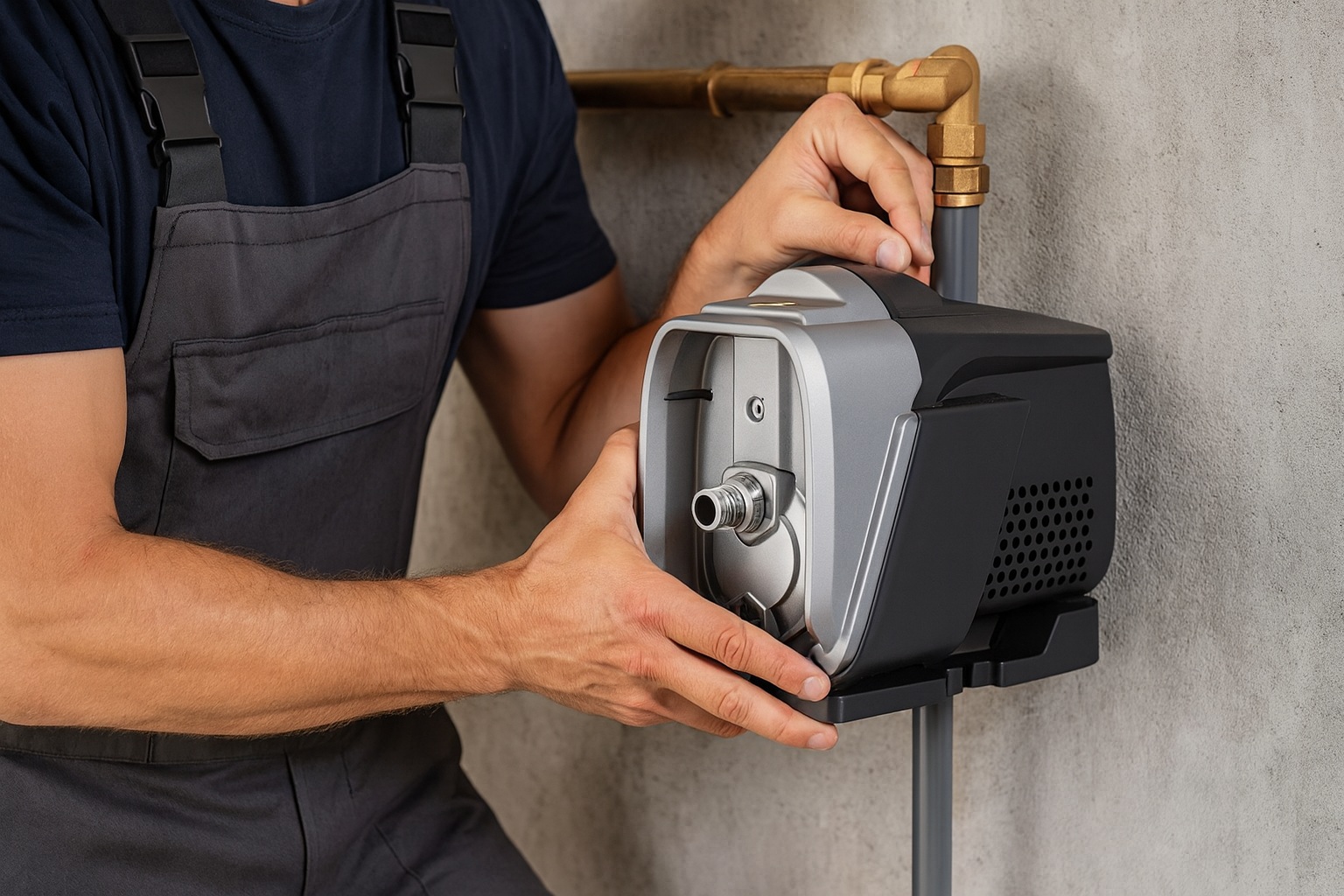
Getting these calculations right is the difference between a perfectly pressurized home and a pump that either underperforms or wastes energy.
Choosing the wrong pump can be a costly mistake, leading to poor performance or premature failure.
This guide breaks down the professional method into simple, manageable steps.
We will walk you through calculating your exact needs and selecting a pump that will provide reliable, powerful water pressure for years to come.
Let's dive into the first critical step: determining your required flow rate.
Step 1: Calculate the flow rate (gallons per minute - GPM)
Guessing your water needs can lead to a pump that's too weak or too powerful.
An undersized pump won't fix your pressure problems, while an oversized one wastes electricity.
To calculate your flow rate, you'll tally your water fixtures, assign a "fixture unit" (FU) value to each, and convert the total FU value to Gallons Per Minute (GPM) using a standard chart.
This method provides a reliable estimate of peak water demand.
Calculating the precise flow rate your property demands is the foundation of a successful booster pump installation.
It ensures that your pump can handle the demand when multiple faucets, showers, and appliances are running simultaneously.
Without this data, you are simply taking a guess.
This step replaces guesswork with a systematic approach used by professional plumbers and engineers.
How to Tally Fixture Units (FUs)
The Fixture Unit (FU) system is a standardized method for estimating water demand.
Instead of just adding up the maximum flow of every single fixture, which would result in a wildly oversized pump, the FU system uses a weighted value.
This value accounts for the fact that it's highly unlikely all fixtures will be used at once.
First, you need to list every fixture the booster pump will supply.
This includes sinks, toilets, showers, bathtubs, dishwashers, washing machines, and outdoor hose bibs.
Next, assign an FU value to each fixture using a reference chart.
These charts are readily available in plumbing design handbooks or online.
| Fixture Type | Fixture Units (FU) - Private Use |
|---|---|
| Bathroom Sink | 1.0 |
| Bathtub | 4.0 |
| Shower | 2.0 |
| Standard Toilet | 2.5 |
| Kitchen Sink | 1.5 |
| Dishwasher | 1.5 |
| Clothes Washer | 4.0 |
| Hose Bib (Outdoor Faucet) | 2.5 |
From Total FUs to GPM
Once you have a total FU value, you'll use a conversion chart to find the corresponding Gallons Per Minute (GPM).
This chart translates the probability of simultaneous use (represented by FUs) into a realistic peak flow rate.
For example, a total of 30 FU might correspond to a demand of 20 GPM, while 100 FU might equal 45 GPM.
This conversion is not linear; the GPM doesn't double if you double the FUs.
Adjusting for Special Demands
Finally, consider any special high-demand applications.
This is a critical step that is often overlooked.
Do you have a large irrigation system with multiple zones?
Does your property include a commercial laundry facility?
These systems often have specific flow rate requirements that must be added to your calculated fixture demand.
For instance, an irrigation zone might require 15 GPM on its own.
If this zone will operate at the same time as indoor fixtures, you must account for this combined demand to ensure your pump can keep up without a drop in pressure.
Step 2: Calculate the Total Dynamic Head (TDH)
Choosing a pump based on flow rate alone will lead to failure.
If the pump isn't strong enough to push water to where it's needed, you'll still have low pressure.
Total Dynamic Head (TDH) is the total pressure the pump must generate.
It's calculated by adding the vertical lift (static head), pressure loss from pipe friction (friction head), and the desired final pressure at the highest fixture, then subtracting any existing supply pressure.
Understanding TDH is just as important as calculating flow rate.
This value represents the total amount of work your pump needs to do.
It's a comprehensive measure of all the resistance in your plumbing system that the pump must overcome to deliver water effectively.
An accurate TDH calculation ensures your pump not only moves the right amount of water but also does so with enough force to provide excellent pressure everywhere in the building.
Let's break down each component of the TDH formula:
Total Head = Static Head + Friction Head + Required Pressure - Current Pressure + Safety Margin
Static Head: The Uphill Battle
Static head is the simplest part of the equation.
It is the vertical distance, measured in feet or meters, from the pump to the highest point where water will be used.
For a three-story house, this would be the height from the pump in the basement to the showerhead on the third floor.
Remember that 1 PSI of pressure is needed to lift water 2.31 feet vertically.
So, if you need to lift water 46.2 feet, you'll need at least 20 PSI from your pump just to overcome gravity.
Friction Head: The Hidden Resistance
Friction head is the pressure lost as water travels through your pipes.
Water dragging against the inner walls of pipes, elbows, valves, and other fittings creates resistance.
This is a significant factor, especially in systems with long pipe runs or smaller diameter pipes.
Calculating it requires knowing:
- Pipe Length: The total length of pipe from the pump to the furthest fixture.
- Pipe Diameter: Smaller pipes cause much more friction than larger ones for the same flow rate.
- Pipe Material: Different materials (copper, PVC, PEX) have different friction characteristics.
- Flow Rate (GPM): The faster the water moves, the greater the friction loss.
Friction loss charts, available online, help you find the PSI lost per 100 feet of pipe for a given GPM and pipe size.
Required and Current Pressure
This part of the calculation ensures your fixtures work correctly.
Most fixtures, like showers and faucets, require a minimum pressure to function properly—typically between 30 and 40 PSI.
You must set your Required Pressure to meet the needs of the most demanding fixture at the highest point.
If you are boosting an existing municipal supply, you can subtract the Current Pressure from your calculation.
However, be conservative.
Use the lowest likely pressure from your city supply, not the peak pressure.
The Safety Margin
Finally, always add a safety margin.
Pipes can accumulate scale over time, increasing friction.
You might add new fixtures in the future.
A safety margin of 5 to 10 PSI ensures your pump remains effective as the system ages and your needs change, providing long-term reliability.
Step 3: Select the Pump
You have your two magic numbers: required GPM and total TDH.
But how do you turn these numbers into the right piece of equipment?
Choosing from endless options can be confusing.
Select a pump by finding the intersection of your required GPM (flow rate) and TDH (head) on a manufacturer's pump performance curve.
Choose a model where your operating point is near the center of the curve for optimal efficiency and longevity.
This is the final and most critical step in the process.
It’s where your careful calculations translate into a hardware choice.
The pump performance curve is a graph provided by every manufacturer for each specific model.
It visually represents the pump's capabilities, showing you exactly how much pressure (head) it can produce at any given flow rate (GPM).
Making the right choice here means you'll have a pump that is not only powerful enough but also efficient, quiet, and durable.
Reading the Pump Performance Curve
The performance curve graphs the relationship between head (on the y-axis) and flow rate (on the x-axis).
As a pump moves more water (higher GPM), its ability to produce pressure (head) decreases.
Your goal is to find a pump where your calculated GPM and TDH requirements intersect on the curve.
The ideal selection will have this intersection point, known as the duty point, located in the middle third of the curve.
This is the pump's Best Efficiency Point (BEP).
Operating at or near the BEP ensures the pump is not overworking or underworking.
This results in lower energy consumption, quieter operation, and significantly longer service life.
Key Features of a Modern Booster Pump
Beyond the performance curve, several key technologies separate a basic pump from a high-performance, intelligent system.
1. Drive Technology and Efficiency
Modern pumps use a Variable Frequency Drive (VFD) paired with a Permanent Magnet Synchronous Motor (PMSM).
This combination is the gold standard for efficiency and control.
-
Constant Pressure: The VFD adjusts the motor's speed in real-time to maintain a perfectly stable water pressure, regardless of how many taps are open.
-
Energy Savings: By running only at the speed needed, a VFD pump can reduce electricity consumption by up to 50% compared to a traditional fixed-speed pump.
-
Soft Start/Stop: This function gradually ramps the motor up and down, eliminating the sudden "thump" of water hammer in your pipes and reducing mechanical stress on the pump itself.
2. Durability and Protection
A quality pump is built to last in harsh conditions.
Look for robust construction and a comprehensive set of built-in protections.
| Feature | Benefit |
|---|---|
| Sealed Electronics (High IP Rating) | Completely protects the controller board from moisture, dust, and insects, preventing the most common cause of electronic failure. |
| Stainless Steel Components | Impellers and pump housings made from high-grade stainless steel resist corrosion and wear, ensuring a long service life. |
| Comprehensive Electronic Safeguards | The pump's brain should protect it from dry running, overheating, voltage fluctuations, freezing, and pipeline leaks. |
| Advanced Cooling Design | An efficient cooling system prevents the motor from overheating, which is critical for longevity and sustained performance. |
3. Smart Systems and User-Friendliness
Top-tier pumps offer intelligent features that enhance usability and system health.
-
Intelligent Dry-Run Protection: Sophisticated algorithms allow the pump to detect a water shortage, shut down to prevent damage, and periodically re-test for water return without user intervention.
-
Twin Pump Operation: For larger applications, some systems can link two pumps together. They operate in tandem to meet high demand and can alternate use to ensure even wear.
-
Real-Time Monitoring: A clear digital display should provide live data on power consumption, motor speed, and system pressure. Optional Wi-Fi connectivity allows for remote monitoring and control via a smartphone app.
By matching your calculated GPM and TDH to a pump performance curve and prioritizing these modern features, you ensure a reliable, efficient, and long-lasting solution to your water pressure problems.
Conclusion
Calculating your flow rate and total dynamic head are the essential first steps.
Use these figures to select an efficient, durable pump from its performance curve for a lasting solution.
FAQs
What is the formula for calculating booster pump capacity?
There isn't a single formula.
Capacity is found by calculating flow rate (GPM) from fixture counts and Total Dynamic Head (TDH) from system pressures and losses.
How do I choose a booster pump for my house?
Calculate your home's peak water demand (GPM) and total pressure requirement (TDH).
Use these two values to select a pump where your need falls on its performance curve.
What PSI should a booster pump be?
A booster pump should be sized to deliver 40-60 PSI at the highest fixture, after accounting for all pressure losses from height and pipe friction.
How much pressure can a booster pump add?
This depends on the model.
Pumps can add anywhere from 15 PSI to over 100 PSI.
The pump's performance curve will show the exact pressure it can add at a specific flow rate.
What size booster pump do I need for a 3-story building?
Size depends on fixture count and pipe runs, not just stories.
You must calculate the specific GPM and TDH, accounting for the significant static head (vertical lift) to the third floor.
How many GPM does a house use?
A typical family home might see a peak demand of 10-25 GPM.
This varies widely, so calculating based on your specific fixtures is crucial for accurate sizing.
What is a good flow rate for a house?
A good flow rate ensures multiple fixtures run without pressure drops.
For most homes, a pump capable of delivering 10-20 GPM at the required pressure is sufficient.