You constantly have to re-prime your water pump.
It’s a frustrating, repetitive task, and you know that each time the pump runs dry, it risks permanent damage.
To stop a water pump from losing prime, you must find and eliminate all air leaks on the suction side of the system.
Installing a properly functioning foot valve at the end of the intake line is the single most effective way to solve this problem for good.
A surface pump losing its prime is one of the most common yet misunderstood issues in water systems.
It's not a fault of the pump itself but a failure of the plumbing connected to it.
A pump operates by creating a vacuum to draw water in.
Even a microscopic air leak is enough to break this vacuum, allowing the water column in the suction pipe to drain back to the source.
This leaves the pump full of air.
When the pump turns on again, its impeller spins uselessly, unable to move the low-density air.
This "dry running" generates intense heat that can destroy critical components like mechanical seals and impellers within minutes.
Understanding how to make your suction line perfectly airtight is the key to creating a reliable, maintenance-free water supply.
This guide will walk you through the diagnostic process to find leaks and the best preventative measures to keep your pump primed permanently.
Pinpointing the Source of the Problem: Air Leaks
Your pump loses prime overnight, even though there's no visible water leak.
You've re-primed it multiple times, but the problem always returns, making you question the pump itself.
The most common cause of lost prime is an air leak.
These tiny, often invisible leaks are typically found at pipe joints, fittings, or the pump's shaft seal, allowing air to seep in and break the vacuum when the pump is off.
Think of your pump’s suction line as a straw.
If the straw has even a tiny pinhole in it, you can’t effectively draw liquid up.
The same principle applies to your pump.
The entire suction side—from the intake in the water source to the inlet of the pump—must be perfectly sealed and airtight.
When the pump is running, the internal pressure is lower than the atmospheric pressure outside, which can sometimes help seal tiny leaks.
However, as soon as the pump shuts off, this vacuum dissipates.
Air is then drawn into the pipe through the path of least resistance, displacing the water and causing the prime to be lost.
Finding these leaks can be tricky because air leaking in doesn't leave a puddle like water leaking out.
It requires a systematic approach to inspect every potential point of failure.
A Systematic Guide to Finding Air Leaks
A methodical inspection is the fastest way to locate the source of your problem.
-
Step 1: Visual Inspection
Start by visually examining all pipes and fittings on the suction side. Look for obvious cracks in PVC pipes or signs of corrosion on metal fittings. Ensure all hose clamps are tight. -
Step 2: The Soapy Water Test
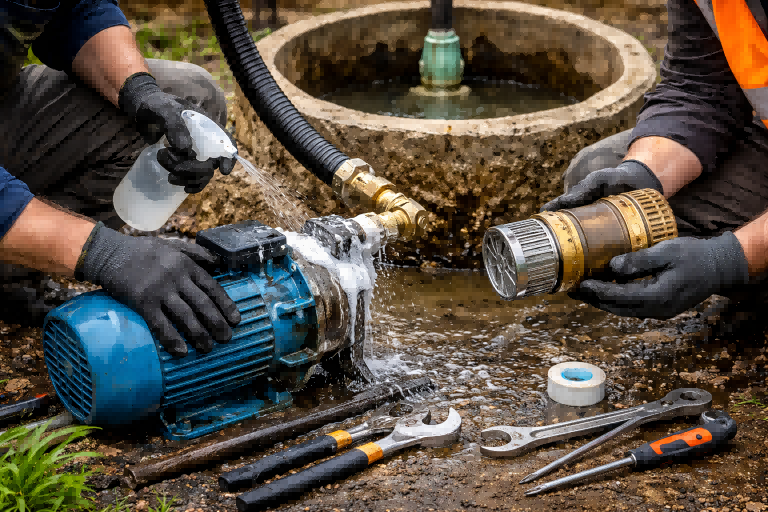
This is the most reliable method for finding small leaks. Mix some dish soap with water in a spray bottle. Prime the pump and get it running. Now, spray the soapy solution liberally on every joint, fitting, and valve stem on the suction line. If there is an air leak, the pump's suction will pull the soapy water toward the leak, often creating small bubbles or foam right at the source. -
Step 3: Checking the Pump Itself
Don't forget to check the pump's components.- The Pump Lid/Cover: Many pumps have a clear lid with an O-ring. If this O-ring is old, cracked, or not seated correctly, it's a very common leak point.
- The Drain Plugs: Ensure the pump's drain plugs are tightened securely with thread seal tape.
- The Shaft Seal: The seal where the motor shaft enters the pump can wear out. A tell-tale sign of a failing shaft seal is a slow drip of water from underneath the pump when it's running. This drip turns into an air leak when the pump is off.
Securing the Connections
Once you've located a leak, the fix is usually straightforward.
| Common Leak Point | Identification Method | Solution |
|---|---|---|
| Threaded PVC/Metal Fittings | Bubbles form during soapy water test. | Disassemble the fitting, clean the old tape/sealant off, re-apply fresh PTFE thread seal tape (5-6 wraps in the direction of the threads), and tighten securely. |
| Pump Lid O-Ring | Lid appears loose; bubbling around the edge. | Turn off the pump, remove the lid, and inspect the O-ring for cracks or flattening. Clean the O-ring and its groove. Apply a silicone-based O-ring lubricant before reinstalling. Replace if damaged. |
| Cracked Suction Pipe | A visible crack, often near a fitting. | The section of pipe must be cut out and replaced. Do not attempt to patch it, as it will likely fail again. |
Properly sealing every connection is not just about stopping the loss of prime; it's about ensuring the entire system operates at peak efficiency.
An air leak forces the pump to work harder, reducing water flow and increasing energy consumption.
The Foot Valve: Your First Line of Defense
You've sealed every joint, but after a few days, the pump loses its prime again.
This intermittent failure is frustrating and makes your water system unreliable for critical tasks.
A foot valve is a one-way check valve installed at the very end of the suction line.
It acts as a gate, allowing water to be drawn in but preventing it from draining back out, effectively locking the prime in place.
For any surface pump that is positioned above its water source—a situation known as "suction lift"—a foot valve is not just recommended; it's essential for reliable operation.
Without one, you are relying solely on the perfect, absolute integrity of every inch of your plumbing to hold the prime against the constant pull of gravity.
Over time, temperature changes cause pipes to expand and contract, vibrations from the pump can slightly loosen fittings, and O-rings can lose their flexibility.
A foot valve acts as a mechanical backstop that makes the system far more resilient to these minor imperfections.
It holds the column of water in the pipe, ensuring the pump is always full of water and ready to start instantly.
This simple device transforms a high-maintenance problem into a set-and-forget solution.
How a Foot Valve Secures Your System
Understanding the foot valve’s function helps in both installation and troubleshooting.
-
Core Mechanism: A basic foot valve consists of a hinged flap or a spring-loaded disc inside a housing. When the pump creates suction, the pressure difference opens the valve, allowing water to flow in. When the pump turns off, the suction disappears, and the weight of the water column (plus a spring in some models) instantly closes the valve, trapping the water.
-
Built-in Strainer: Most foot valves include an integrated screen or strainer on the intake. This serves a dual purpose: it prevents large debris like leaves, rocks, or fish from being sucked into the pump, where they could cause a clog or damage the impeller. This is especially important for a high-flow solar plastic impeller pump used for farm irrigation, where water sources can contain significant organic matter.
Common Foot Valve Failures and Solutions
While highly effective, a foot valve can also be a point of failure if not maintained.
-
Problem 1: Debris in the Valve
The most common failure is a small piece of debris—a grain of sand, a twig, or a small pebble—getting lodged in the valve mechanism. This prevents the flap from closing completely, allowing water to leak out slowly and the prime to be lost over several hours or a day.- Solution: Pull the suction line out of the water source and thoroughly clean the foot valve, both inside and out. Actuate the flap by hand to ensure it moves freely and seals properly.
-
Problem 2: Worn-Out Seal or Spring
Over years of operation, the rubber seal on the valve flap can degrade, or the spring can weaken. This will also lead to a slow leak.- Solution: Foot valves are generally inexpensive. Rather than attempting a repair, the most reliable and cost-effective solution is to replace the entire unit.
-
Problem 3: Clogged Strainer
In water sources with a lot of algae, weeds, or sediment, the outer strainer can become completely clogged.- Symptom: The pump will run, but water flow will be severely restricted or stop altogether. The pump may sound like it's struggling or cavitating.
- Solution: Regular inspection and cleaning of the foot valve strainer is a key piece of preventative maintenance.
The choice of pump can impact what to look for.
A solar screw pump, known for its excellent resistance to sand, will not be damaged by fine particles.
However, its performance will still suffer if the foot valve strainer is completely blocked by larger debris, effectively starving the pump of water.
The Ultimate Solution: Eliminating the Need for Priming
You need a water solution for a very deep well or a remote, unattended location.
Manually priming a pump is not an option, and you need maximum reliability with minimal maintenance.
For the ultimate in reliability, choose a pump that eliminates the need for priming entirely.
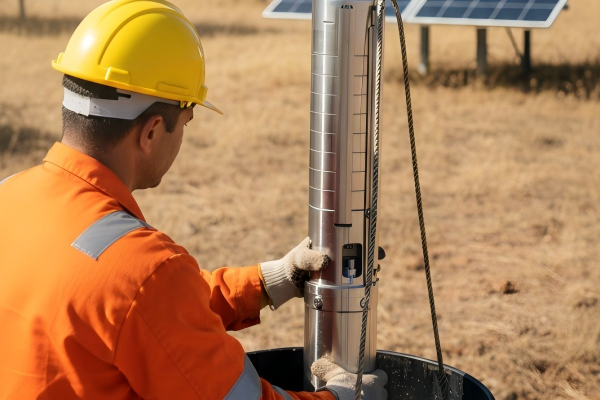
Submersible pumps, which operate fully underwater, are the best solution, as they can never become air-bound and lose their prime.
While fixing air leaks and installing foot valves are effective strategies for surface pumps, the most robust and technologically advanced solution is to design a system where priming is simply not a factor.
This approach is mission-critical for applications like deep well water extraction for livestock in the Australian outback or providing domestic water in off-grid regions of Africa and the Americas.
In these scenarios, reliability isn't a convenience; it's a necessity.
Modern pump technology offers designs that are inherently immune to the problems of losing prime.
By placing the pump directly in the water source, the entire issue of suction lift and air leaks is engineered out of the system from the start.
This leads to a dramatic increase in operational reliability and a significant reduction in long-term maintenance.
Why Submersible Pumps Are the Superior Choice
Submersible pumps represent a fundamental shift in design that offers numerous advantages over surface pumps, especially for wells.
-
Physics is on Your Side: Submersible pumps don't suck water; they push it. Pushing a column of water is far more energy-efficient than creating a vacuum to lift it. This allows them to move water from incredible depths—hundreds of meters—far beyond the physical limits of any surface pump (which is limited by atmospheric pressure to a theoretical maximum of 10.3 meters, or about 34 feet).
-
Zero Priming, Ever: Because the pump is always submerged, its intake is always flooded with water. Air can never enter the pump casing, so it can never lose its prime. It is ready to pump the instant it receives power.
-
Silent and Efficient Operation: The surrounding water muffles the pump's operational noise, making it virtually silent. Furthermore, the water provides constant, perfect cooling for the motor, allowing it to run at peak efficiency for longer periods. The high-efficiency BLDC permanent magnet motor used in modern solar submersibles achieves electrical efficiencies over 90%, a significant improvement over older motor designs.
A Portfolio for Every Deep Well Need
The modern solar deep well pump market offers specialized submersible solutions for diverse applications.
-
For Extreme Depths: The solar screw pump is an engineering marvel. It uses a helical rotor to push water, generating extremely high pressure (head). This makes it the ideal choice for very deep wells where it needs to lift water hundreds of feet to the surface, perfect for domestic and livestock use.
-
For High Water Volume: The solar plastic impeller pump is a multi-stage centrifugal design. It provides high flow rates at moderate depths, making it perfect for farm irrigation or filling large storage tanks quickly.
-
For Challenging Water Quality: The solar stainless steel impeller pump is the premium option. Its SS304 construction provides superior resistance to corrosion and abrasion, making it the only choice for acidic water or regions with alkaline soil, ensuring a long service life in harsh environments.
By selecting the right type of submersible pump, you are not just solving the priming problem—you are investing in a more efficient, more reliable, and longer-lasting water solution.
Conclusion
To permanently stop a pump from losing prime, either meticulously seal all suction-side air leaks and install a foot valve, or upgrade to a submersible pump that eliminates the problem by design.
Frequently Asked Questions
Why does my pump lose prime when turned off?
Your pump loses prime when turned off because an air leak in the suction line allows water to drain back to the source. A faulty foot valve is a common cause.
Can a pump lose prime without a leak?
It's highly unlikely. A tiny, invisible air leak is almost always the cause. Without an air leak, a solid column of water should be held by atmospheric pressure.
How do I keep my shallow well pump from losing prime?
Install a high-quality foot valve at the end of the suction line and use PTFE tape on all threaded fittings to ensure they are airtight. This is the most reliable method.
Will a check valve keep a pump primed?
Yes, a check valve (like a foot valve) is designed specifically for this purpose. It allows water to flow in one direction but prevents it from flowing back out.
Will an air lock cause a pump to lose prime?
An air lock doesn't cause a loss of prime, but it is a related problem. An air lock is a bubble trapped in the system that stops flow, often fixed by repriming.
How often should a well pump lose its prime?
A properly installed and maintained well pump should never lose its prime. If it happens at all, it indicates there is a problem that needs to be fixed.
Can a bad pressure switch cause loss of prime?
No, a pressure switch only tells the pump when to turn on and off. It has no role in holding the prime. The problem will be on the suction side plumbing.
What is the difference between a foot valve and a check valve?
A foot valve is a specific type of check valve that includes a strainer on its inlet. It is always installed at the start of a suction line.