Are you concerned about the quality of the water your pump delivers?
Contamination is a serious risk.
But a modern submersible pump is designed from the ground up to protect your drinking water.
Yes, a submersible pump is safe for drinking water, provided it is certified for potable use.
Safety depends on an inert, corrosion-resistant pump body and components, like stainless steel, and a hermetically sealed motor to prevent any contamination.
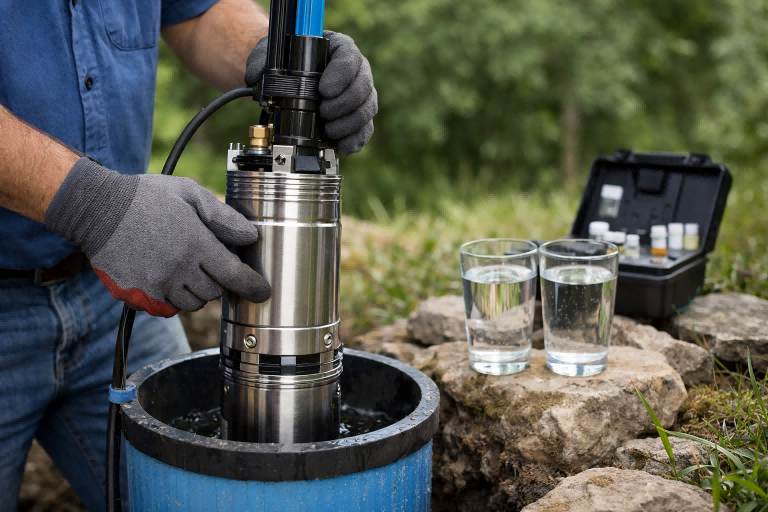
The safety of a submersible pump is not an accident.
It is a direct result of careful engineering and deliberate material selection.
When a pump is submerged hundreds of feet underground, it becomes an integral part of your water supply system.
Therefore, its construction must guarantee that it will not introduce impurities into the water it is designed to move.
Understanding the key safety features, from the materials touching the water to the sealed motor design, is crucial.
This knowledge empowers you to choose a pump that doesn't just supply water, but also safeguards the health of your family, livestock, or community.
The Critical Role of Pump Materials in Water Purity
Worried that your pump might be leaching harmful substances into your water?
Using a pump made from low-grade materials is a significant risk.
Choosing a pump made from certified, food-grade materials is the only way to ensure lasting water purity.
The safety of drinking water from a submersible pump is determined by its materials.
Stainless steel is the premium choice for preventing corrosion and leaching, while certified food-grade plastics and rubbers offer safe, economical alternatives for non-corrosive water sources.
The materials that are in constant contact with your drinking water matter immensely.
A pump is not just a machine; it is a long-term fixture in your water source.
Over years of submersion, materials can corrode, degrade, and leach contaminants into the water supply if they are not specifically chosen for potable water applications.
This is why regulatory bodies and quality-conscious manufacturers place such a strong emphasis on material science.
The difference between a safe pump and an unsafe one often comes down to the simple choice between corrosion-resistant stainless steel and standard cast iron, or between a certified engineering plastic and a cheap, unregulated alternative.
A deep dive into these materials reveals why this choice is so fundamental to delivering safe drinking water.
Stainless Steel: The Gold Standard for Purity
When absolute safety and longevity are required, stainless steel is the undisputed leader.
Grade SS304 stainless steel is a "food-grade" material.
This means it is certified safe for contact with food and beverages.
Its high chromium and nickel content create a passive, non-reactive surface layer.
This layer provides exceptional resistance to rust and corrosion, even in acidic or alkaline water conditions.
Because it does not corrode, it does not leach iron, manganese, or other harmful metals into the water.
This makes it the ideal choice for wells with aggressive water chemistry or for any application where water purity is the highest priority.
It is the same material trusted in dairy production, surgical instruments, and food processing plants.
While it has a higher initial cost, its extreme durability provides a long, reliable service life, ensuring water safety for decades.
Certified Plastics and Rubbers: The Safe Alternative
High-quality pumps often utilize specialized plastics and rubbers for components like impellers and stators.
It is critical that these are not just any plastics.
They must be certified food-grade, potable-water-safe materials.
Engineering plastics like Noryl are commonly used for impellers in centrifugal pumps.
These materials are valued for their structural stability, excellent wear resistance, and, most importantly, their inert nature.
They do not impart any taste, odor, or chemicals into the water.
Similarly, the rubber stators used in screw pumps are made from specific synthetic rubber compounds designed for drinking water applications.
These materials meet stringent international standards like NSF/ANSI 61, which governs components of drinking water systems.
Choosing a pump with certified polymer components is a perfectly safe and economical choice for wells with neutral, non-aggressive water.
Comparing Materials for Drinking Water Safety
| Feature | SS304 Stainless Steel | Certified Engineering Plastic | Standard Cast Iron |
|---|---|---|---|
| Corrosion Resistance | Excellent | Good (in neutral pH) | Poor |
| Leaching Risk | Extremely Low | Very Low (when certified) | High (rust, iron) |
| Best Use Case | All water types, especially corrosive | Neutral pH, non-aggressive water | Non-potable applications only |
| Longevity | Very High | Good | Low to Medium |
| Cost | High | Low to Medium | Low |
Why a Sealed Motor Design is Non-Negotiable
Can the pump's motor contaminate your water with oil or electricity?
This is a valid fear, as the motor is a complex electrical and mechanical device.
A properly engineered submersible pump completely eliminates this risk with a sealed, isolated motor housing.
A safe submersible pump uses a hermetically sealed motor.
This design creates an impassable barrier between the motor's internal components (lubricants, windings) and the surrounding well water. This physical isolation is essential to prevent any form of contamination.
A submersible pump motor is a powerhouse.
It contains electrical windings, bearings, and often a cooling/lubricating fluid.
None of these elements should ever come into contact with drinking water.
The single most important safety feature that prevents this is the integrity of the motor housing.
Manufacturers of pumps for potable water go to great lengths to ensure this enclosure is perfectly sealed and physically separated from the path of the water.
The water flows through a separate chamber, often located above the motor.
Understanding how this isolation is achieved provides confidence in the pump's fundamental safety and its ability to operate for years without compromising water quality.
This design philosophy is a core principle for any pump intended for human or animal consumption.
The Principle of Hermetic Sealing
A hermetically sealed motor is completely airtight and watertight.
This is achieved through several layers of protection.
First, the motor is encased in a durable, corrosion-resistant stainless steel housing.
Second, precision gaskets and O-rings are used at every joint, particularly where the power cable enters the motor and where the motor assembly connects to the pump end.
These seals are designed to withstand high pressure and long-term submersion.
Inside this sealed environment, the motor can operate safely.
Many high-efficiency motors, like BLDC permanent magnet types, are filled with a non-toxic liquid (often a water/glycol mixture or a special oil) that serves two purposes: it lubricates the bearings and transfers heat from the motor windings to the outer casing, where it is dissipated into the surrounding well water.
The robust, multi-layered sealing system ensures this fluid can never escape.
Two Chambers: Separating Water Flow from the Motor
A key aspect of safe submersible pump design is the physical separation of the pump end from the motor.
- The Pump End (Wet End): This is where the impellers or screw are housed. Water is drawn into the intake at the bottom of the pump end and driven upwards through the stages. This is the only part of the pump designed to handle water.
- The Motor (Dry End): This sits below the pump end. It is a completely separate, sealed module. A splined shaft passes through a heavy-duty mechanical seal to connect the motor to the pump, but there is no path for water to travel downwards into the motor compartment.
This two-chamber design is a fundamental safety feature.
Even in the unlikely event of a seal failure, the design prevents catastrophic contamination and often allows for repair without having to replace the entire unit.
The Role of the Electrical Cable
The submersible power cable is another critical component.
It must be sheathed in a durable, waterproof, and non-toxic material suitable for permanent submersion in drinking water.
The point where the cable enters the motor housing is one of the most critical seal points.
Reputable manufacturers use an epoxy-filled or compression-gland system to create a permanent, watertight bond.
This prevents water from wicking down the cable and entering the motor, ensuring electrical safety and preventing contamination.
A cheap, poorly sealed cable is a significant point of failure that can compromise the entire system.
Water Source Quality: The Other Half of the Safety Equation
You have a safe, certified pump.
Does this guarantee your water is safe to drink?
Unfortunately, no.
The pump can only preserve water quality; it cannot create it.
Even the safest pump cannot make contaminated water safe.
The pump's role is to deliver water without adding impurities. The ultimate safety of your drinking water depends on the quality of the source—the aquifer—and requires regular testing for bacteria and chemicals.
It is a common misconception that a high-quality pump somehow purifies water.
This is not the case.
A submersible pump is a transportation device.
Its job is to move water from Point A (the aquifer) to Point B (your tap) efficiently and, most importantly, without altering its composition.
If the water in the aquifer is contaminated with bacteria, nitrates, pesticides, or industrial chemicals, the pump will dutifully deliver that contaminated water to your home.
Therefore, ensuring your drinking water is safe is a two-part responsibility.
The first part is selecting a pump made from safe materials with a secure design.
The second, equally important part, is verifying the quality of the water source itself through professional testing.
The Pump's Role: To Do No Harm
The prime directive for a potable water pump is to be "inert."
It must not react with the water in any way.
This means:
- No Corrosion: It will not rust or break down, adding minerals like iron to the water.
- No Leaching: Its materials will not release chemicals, plastics, or heavy metals.
- No Contamination: Its sealed motor will not leak lubricants or other fluids.
A pump that meets these three criteria, such as a stainless steel model, has fulfilled its role in the safety chain.
It acts as a clean, transparent conduit.
It ensures that the water arriving at your tap is in the exact same condition as it was in the aquifer.
The pump's job is one of preservation, not purification.
The Owner's Role: Test Your Water
Since the pump does not treat the water, the responsibility falls to the well owner to understand what is in their water.
You should never assume that clear, odorless well water is safe.
Many dangerous contaminants are invisible.
Regular water testing is essential.
- Initial Testing: When a new well is drilled or a new pump is installed, a comprehensive water test is crucial. This should check for a wide range of contaminants, including bacteria (like E. coli), nitrates, pH, hardness, and any chemicals common in your area.
- Annual Testing: At a minimum, well water should be tested annually for coliform bacteria and nitrates. These are the most common indicators of contamination.
- When to Test More Often: You should test your water after a flood, if you notice a change in the water's taste, smell, or color, or if there is a known contamination event nearby (e.g., a chemical spill).
If testing reveals contaminants, the solution is not a different pump.
The solution is a water treatment system, such as a UV sterilizer for bacteria, a reverse osmosis system for chemicals, or a water softener for hardness.
This system would be installed after the pump, treating the water before it reaches your taps.
Conclusion
A submersible pump is safe for drinking water if it is made from certified materials like stainless steel and has a sealed motor.
However, the pump only preserves quality.
You must test your well water regularly.
Frequently Asked Questions
Do you need a special pump for drinking water?
Yes, you need a pump certified for potable (drinking) water.
These are made from materials like stainless steel that will not contaminate the water.
What are submersible pumps made of?
They are typically made of stainless steel, cast iron, or have components made from engineered plastics.
For drinking water, stainless steel is the safest and most durable choice.
Can oil from a submersible pump contaminate a well?
If the pump's motor seals fail, oil can leak.
However, modern pumps for drinking water have hermetically sealed motors to prevent this from happening.
How do I know if my well pump is safe?
Look for certifications like NSF/ANSI 61 on the pump or in its manual.
Using a pump from a reputable manufacturer is the best way to ensure safety.
Can submersible pumps have lead?
Older pumps, especially those with brass or bronze components made before 2014, could contain lead.
Modern, certified pumps use lead-free materials for all wetted parts.
Does a new well pump need to be disinfected?
Yes, the entire well system should be "shock chlorinated" and flushed after installing a new pump to kill any bacteria introduced during installation.
What is the safest type of well pump?
A submersible pump made from 100% stainless steel (like SS304) is generally considered the safest option due to its superior corrosion resistance and inert nature.