Struggling with high electricity bills from your pool pump?
You feel the constant drain on your wallet.
There must be a better, more sustainable way to keep your pool clean.
Yes, pool pumps that don't use grid electricity exist. The most effective and popular option is the solar-powered pool pump. It uses photovoltaic (PV) panels to convert sunlight directly into the energy needed to circulate and filter your pool water, offering a green, cost-effective alternative.
Switching to off-grid solutions can feel like a major leap.
You might worry about the initial investment, reliability, and whether it can truly handle your pool's needs.
But imagine a world where your pool pump runs for free, powered only by the sun.
This technology is more accessible and powerful than ever before.
Let's explore how you can break free from the grid and harness sustainable power for crystal-clear water.
Understanding this shift is the first step toward significant long-term savings and energy independence for your customers.
What Are Solar-Powered Pool Pumps?
Tired of unpredictable energy costs?
A solar pool pump seems like a perfect solution, but you wonder if it's truly a viable replacement.
This technology harnesses the sun to power your pool's circulation system.
A solar-powered pool pump is a circulation pump system that runs on energy generated by solar panels.
Unlike traditional pumps that draw power from your home's electrical grid, these systems operate independently, significantly reducing or even eliminating electricity costs associated with pool filtration.
A solar pool pump is not just a standard pump with a solar panel attached.
It's an integrated system designed for high efficiency and optimal performance with direct current (DC) power.
This distinction is crucial for understanding its benefits and capabilities.
The core technology often involves a brushless DC motor, which is inherently more efficient—by up to 30%—than the AC motors found in conventional pumps.
This efficiency means it can do more work with less power, a vital feature when your energy source is variable like the sun.
How are they Different from Standard Pumps?
Standard AC pumps run at a fixed, high speed, consuming a large amount of energy whenever they are on.
Solar DC pumps, especially those paired with a sophisticated controller, can operate at variable speeds.
They run faster during peak sun hours and slower in lower light, maximizing water circulation throughout the day without wasting energy.
This variable speed operation is a cornerstone of modern pump technology, like the intelligent variable frequency systems we specialize in.
The Role of the Controller
The controller, or driver, is the brain of the solar pump system.
It does more than just switch the pump on and off.
It manages the power coming from the solar panels and optimizes the pump's performance.
Key functions include:
- Maximum Power Point Tracking (MPPT): This feature constantly adjusts the electrical operating point of the pump to extract the maximum available power from the solar panels. MPPT technology can boost the system's output by up to 25% compared to systems without it.
- Variable Speed Control: The controller adjusts the pump's speed based on the intensity of sunlight, ensuring consistent operation.
- Dry-Run Protection: It can detect if there's no water flowing into the pump and shut it down to prevent damage.
- Over-voltage and Under-voltage Protection: This protects the motor from electrical surges or drops from the solar array.
Sizing and Power Considerations
Choosing the right solar pump system depends on several factors.
It's not a one-size-fits-all solution.
Proper sizing is essential for customer satisfaction and ensures the pool remains clean.
| Sizing Factor | Description | Impact on System Choice |
|---|---|---|
| Pool Volume | The total amount of water in the pool (gallons or liters). | Larger pools require a higher flow rate, meaning a more powerful pump and a larger solar array. |
| Turnover Rate | The time it takes to circulate the entire volume of pool water. | A typical residential pool needs at least one turnover per day. Commercial pools may need 2-4 turnovers. |
| Dynamic Head | The total resistance in the plumbing system from friction and elevation. | Higher head requires a more powerful pump to maintain the desired flow rate. |
| Local Sunlight | The average number of peak sun hours per day in the location. | Areas with less sun may require a larger solar panel array to achieve the necessary runtime. |
By accurately calculating these needs, you can provide a system that delivers reliable performance and validates the customer's investment in off-grid technology.
Breaking Down the System: Key Components
Thinking about offering solar pumps?
You need to understand every part to advise clients confidently.
A system is more than just a pump and a panel.
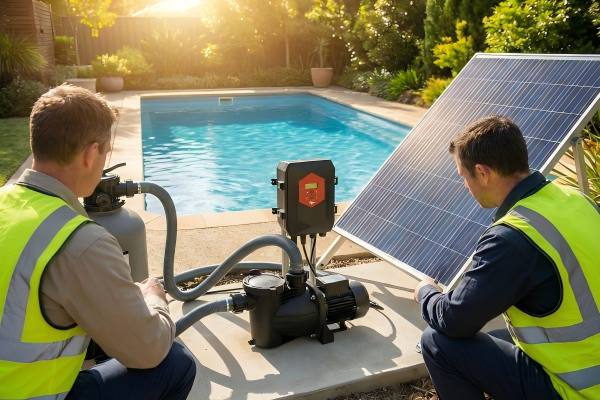
A complete solar pool pump system consists of three primary components.
These are the solar panels (PV array), the controller (or driver), and the pump motor unit itself.
Each part plays a critical role in converting sunlight into clean pool water efficiently and reliably.
Understanding how these components integrate is key to appreciating the system's value and engineering.
It allows you to explain the technology clearly to your clients, building trust and demonstrating expertise.
Let's examine each component in greater detail.
The Solar Panel Array
This is the power plant of the system.
Solar panels, also known as photovoltaic (PV) modules, are made of silicon cells that convert sunlight directly into DC electricity.
The size and number of panels needed are determined by the pump's power requirements and the geographic location's solar irradiation levels.
- Monocrystalline Panels: Known for their high efficiency (typically 18-23%) and excellent performance in low-light conditions. They have a sleek, uniform black appearance. This is often the preferred choice for space-constrained applications.
- Polycrystalline Panels: Slightly less efficient (typically 15-18%) but offer a better price point. They are recognizable by their blue, speckled appearance.
- Series vs. Parallel Connection: Panels are wired together in a "solar array." Wiring in series increases the voltage, while wiring in parallel increases the current. The configuration must match the pump controller's input specifications perfectly to avoid damage and ensure optimal performance.
The MPPT Controller
As mentioned before, the controller is the system's intelligent manager.
It's typically housed in a weatherproof enclosure.
Its primary job is to optimize the DC power from the panels before sending it to the motor.
A high-quality controller with Maximum Power Point Tracking (MPPT) is non-negotiable for a professional-grade system.
It ensures the pump starts earlier in the day, runs longer, and maintains better flow even when it's cloudy.
Some advanced controllers also offer features like:
- Remote Monitoring: The ability to check system status and performance via a smartphone app.
- AC/DC Hybrid Input: Allows the system to be connected to a backup grid or generator power source, ensuring 24/7 operation if needed.
- Water Level Sensor Inputs: Can integrate with sensors in the pool or a tank to automate operation.
The Pump and Motor Unit
This is where the electrical energy becomes hydraulic work.
The heart of the unit is the brushless DC motor.
These motors are fundamentally different from their AC counterparts.
| Feature | Brushless DC Motor (Solar) | Standard AC Motor (Grid) |
|---|---|---|
| Efficiency | High (85-90%) | Moderate (60-75%) |
| Power Source | Direct Current (DC) from panels | Alternating Current (AC) from grid |
| Speed Control | Easily variable | Typically fixed speed |
| Lifespan | Longer due to no brushes to wear out | Shorter, brushes may need replacement |
| Starting Current | Low, soft start | High inrush current |
The pump's "wet end" (the part that moves the water) is also designed for efficiency.
It must be well-matched to the motor's power curve to achieve the desired flow rate against the system's total dynamic head.
Materials like corrosion-resistant stainless steel or high-grade thermoplastic are used to ensure durability in treated pool water.
Weighing the Pros and Cons of Solar
Is solar power the ultimate solution?
The benefits are clear, but potential drawbacks must be considered for a balanced business decision.
Making an informed choice is key.
Solar pool pumps offer compelling advantages, primarily zero electricity costs and a long lifespan with low maintenance.
However, the main disadvantages are a higher initial purchase price and the fact that performance is dependent on available sunlight, with no operation at night without a battery backup system.
For importers and distributors, presenting a balanced view to customers is crucial for building long-term relationships.
Highlighting the massive upside while being transparent about the limitations shows integrity and helps clients make the best decision for their specific circumstances.
Let's dive deeper into the financial and operational realities of adopting solar pump technology.
The Advantages: A Closer Look
- Zero Operational Energy Costs: This is the number one selling point. A conventional pool pump can be one of the top three energy consumers in a household, costing hundreds or even thousands of dollars per year to run. A solar pump eliminates this cost entirely. The return on investment (ROI) can often be realized in just 2-4 years.
- Environmental Benefits: In an increasingly eco-conscious market, offering a green alternative is a powerful differentiator. Solar pumps produce zero carbon emissions, appealing to environmentally aware consumers and aligning with global sustainability trends.
- Long Lifespan and Reliability: Brushless DC motors have fewer moving parts to wear out compared to AC motors. This results in a significantly longer operational lifespan, often exceeding 10 years for the motor and 25+ years for the solar panels. This reduces long-term replacement costs and service calls.
- Ideal for Remote Locations: For properties without reliable access to the electrical grid, solar pumps aren't just an option; they are the solution. This opens up new markets in rural and off-grid areas.
- Quiet Operation: Brushless DC motors are noticeably quieter than their AC counterparts, enhancing the tranquility of the poolside environment.
The Disadvantages: An Honest Assessment
- Higher Initial Investment: There is no getting around it; the upfront cost for a complete solar pump system is 2 to 4 times higher than a conventional pump. This can be a barrier for some customers. It is important to frame this as an investment with a clear payback period, not just an expense.
- Sunlight Dependency: The system's output is directly tied to the sun. On very cloudy days, the flow rate will be reduced. It will not run at night, which can be an issue for pool owners who prefer nighttime filtration or have very high bather loads requiring 24/7 circulation.
- The Battery Question: To achieve 24-hour operation, a battery bank and a more complex charge controller are required. This significantly increases the system's cost (often doubling it) and adds a component (batteries) with a limited lifespan (typically 5-7 years) that requires maintenance. For most residential pools, running only during daylight hours is sufficient for proper sanitation.
- Complex Installation: While not overly difficult, installing a solar pump system is more involved than a simple plug-and-play AC pump. It involves mounting solar panels and running DC wiring safely. Professional installation is highly recommended.
Choosing the Right Off-Grid Pump for Your Market
Your customers rely on your expertise.
Simply offering one solar option isn't enough.
You need to guide them to the perfect fit.
Choosing the right off-grid pump means matching the technology to the client's specific needs.
This involves analyzing pool size, local climate, usage patterns, and budget to recommend a system that guarantees performance, reliability, and delivers a strong return on investment.
As a distributor, your role is to be a solution provider, not just a product seller.
Guiding a client like Andrew in Australia, who values quality and brand ownership, requires a consultative approach.
You must equip him with the knowledge to serve his market effectively.
This means understanding the nuances of different pump models and system configurations.
Matching Pump to Pool Size
The first step is always a proper calculation.
Your goal is to ensure the pump can turn over the entire volume of the pool at least once during the available sun hours.
| Pool Size (Gallons) | Typical Flow Rate Needed (GPM) | Recommended Pump Power (Watts) | Suggested Solar Array (Watts) |
|---|---|---|---|
| Up to 10,000 | 20-30 GPM | 200 - 400 W | 300 - 600 W |
| 10,000 - 20,000 | 35-50 GPM | 500 - 800 W | 700 - 1200 W |
| 20,000 - 40,000 | 60-90 GPM | 900 - 1500 W | 1200 - 2000 W |
Note: These are estimates. A precise calculation must also account for total dynamic head.
Providing your clients with clear sizing charts and calculation tools empowers them to make accurate recommendations.
Considering Hybrid Systems
For some applications, 100% solar may not be the best fit.
This is especially true for commercial pools, pools with attached spas and water features, or in regions with long, cloudy winters.
In these cases, a hybrid pump system is the ideal solution.
- AC/DC Hybrid Pumps: These systems are designed with inputs for both solar DC power and grid AC power. The controller automatically prioritizes solar power. If the sun is insufficient to meet demand, it will supplement or switch over to AC power. This provides the best of both worlds: maximum energy savings from solar with the 24/7 reliability of the grid.
- Why this matters for distributors: Offering a hybrid option broadens your potential market. It addresses the "what if" concerns of customers who are hesitant to go fully off-grid. It's a premium solution for clients who want uncompromising performance.
Presenting the Business Case
For B2B customers like Andrew, the numbers must make sense.
Your sales pitch should be an investment proposal.
Use data to build a compelling case.
- Calculate the Payback Period: Show them the calculation:
(Initial System Cost) / (Annual Electricity Savings) = Payback Period in Years. In many sunny regions like Australia or South Africa, this can be as low as 2 years. - Emphasize Lifetime Value: A conventional pump might be cheaper upfront but could be replaced 2-3 times over the 25-year lifespan of a single set of solar panels. The total cost of ownership for solar is almost always lower.
- Private Labeling Opportunity: For distributors wanting their own brand, solar pumps represent a modern, high-tech product line. As a manufacturer with strong R&D, we can support the development of custom-branded solutions that meet specific market requirements for quality and price-competitiveness.
By providing a range of quality-tested, certified products with clear technical data and a strong business case, you enable your distributors to lead their markets with confidence.
Conclusion
Yes, you can absolutely run a pool without grid electricity, thanks to modern solar pump technology.
This solution eliminates energy bills, offers a long lifespan, and provides a reliable, green alternative.
FAQs
How can I run my pool pump without electricity?
The most common and effective way is by using a solar-powered pool pump system. It converts sunlight directly into DC electricity to power the pump, making you independent of the grid.
Can a pool pump run on solar only?
Absolutely. A properly sized solar pump system is designed to run entirely on solar power during daylight hours, which is sufficient to keep most residential pools clean and sanitized.
How much does a solar pool pump cost?
A complete solar pump system has a higher initial cost than a standard pump, typically ranging from $800 to $2,500 depending on the size and power required for your pool.
Are solar pool pumps worth it?
For most pool owners in sunny climates, yes. The elimination of electricity costs means the system can pay for itself in 2-4 years, providing free operation for the rest of its long lifespan.
Do you need batteries for a solar pool pump?
Batteries are not required for standard daytime operation. They are only necessary if you need to run the pump at night or during extended periods of no sun, but they add significant cost.
How long do solar pool pumps last?
The brushless DC motors in solar pumps are very durable, often lasting over 10 years. The solar panels themselves are typically warrantied for 20-25 years, making it a very long-lasting investment.
Can you run a pool pump with a generator?
Yes, a standard AC pool pump can be run with a generator, but this is an inefficient, noisy, and costly solution. A hybrid solar pump can use a generator as a backup power source more effectively.
What size solar pump do I need for my pool?
Sizing depends on your pool's volume, required turnover rate, and local sun exposure. A professional can calculate the right pump and solar array size to ensure your pool stays clean.