Are you considering a multistage pump for your next project?
Choosing the wrong one leads to unexpected costs and operational headaches.
Understanding their drawbacks is key to making a profitable and reliable choice.
Multistage pumps offer high-pressure performance but come with significant drawbacks.
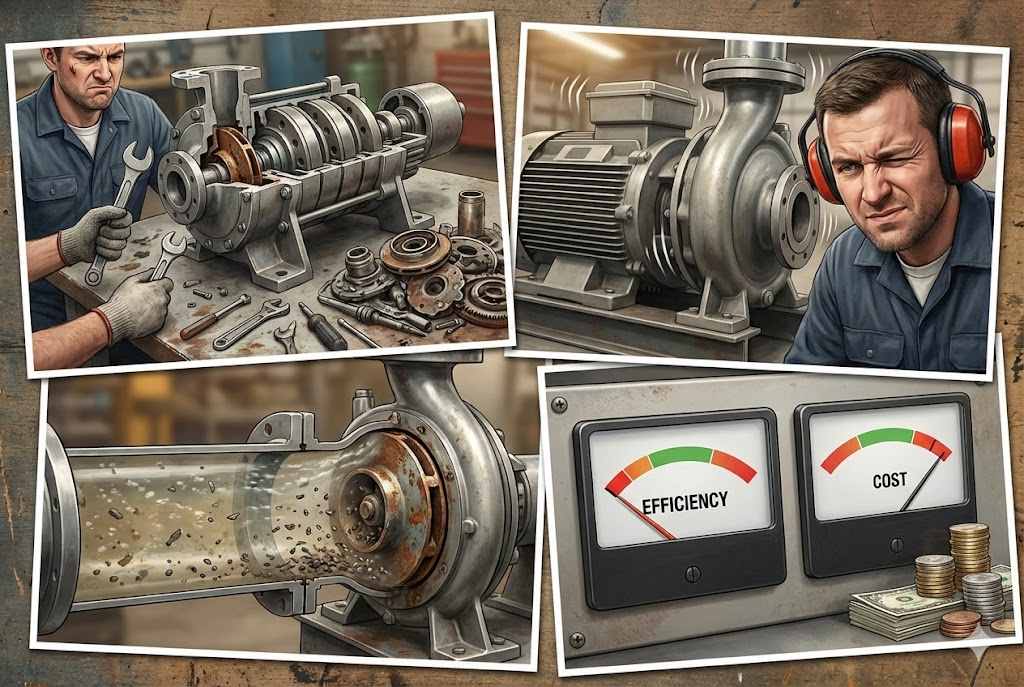
They often have higher initial and maintenance costs, are complex to service, and are very sensitive to impure fluids.
They can also be noisy and inefficient when not running at their peak design capacity.
While the high-head capability of multistage pumps is attractive for many applications, these benefits are not without trade-offs.
For importers and distributors, understanding these inherent disadvantages is crucial.
It allows you to guide your clients toward the best long-term solution.
This protects both their investment and your reputation.
Diving into the specific drawbacks reveals why a careful evaluation is necessary before committing to this technology.
Let’s explore the key disadvantages in detail.
Higher Costs: More Than Just the Price Tag
Is your budget being squeezed by hidden operational expenses?
Unexpectedly high maintenance and repair bills for complex pumps can easily erode your project's profitability.
This can frustrate your clients.
Understanding the total cost of ownership is essential before making a purchase decision.
Multistage pumps carry a higher upfront purchase price due to their complex design.
Furthermore, their repair expenses are significantly increased.
They often require specialized tools and expert technicians.
This drives up the long-term cost for your business.
The financial implications of choosing a multistage pump extend far beyond the initial purchase order.
For business owners and distributors, these accumulating costs can impact profitability and customer satisfaction.
A deeper analysis reveals exactly where these expenses come from.
It also shows how they can be mitigated with modern alternatives.
The True Initial Investment
A multistage pump’s complexity is directly linked to its cost.
Each stage consists of an impeller, diffuser, and casing.
Adding more stages to achieve higher pressure multiplies these components.
This intricate assembly requires more high-grade materials and precision engineering.
This naturally drives up the manufacturing cost compared to a simpler single-stage pump.
This higher initial outlay must be factored into any project budget.
The Hidden Costs of Maintenance and Repair
The expenses do not stop after installation.
When a multistage pump requires service, the costs can escalate quickly.
| Cost Factor | Traditional Multistage Pump | Modern VFD Pump |
|---|---|---|
| Labor | Requires specialized technician | General technician can manage |
| Parts | Multiple sets of impellers, seals, bearings | Fewer internal wear parts |
| Downtime | Longer repair time due to complexity | Quicker diagnosis and repair |
| Tools | Specialized alignment tools needed | Standard tools often suffice |
Troubleshooting is more complex due to the number of stages.
Disassembly and reassembly are time-consuming processes.
Specialized seals and bearings for each stage add to the bill.
This means more downtime for the end-user and higher labor costs.
These factors can strain service agreements and reduce your margins.
A Smarter Approach: Total Cost of Ownership
Modern pump technology shifts the focus from initial price to total cost of ownership (TCO).
Intelligent pumps with Variable Frequency Drives (VFDs) incorporate features that drastically reduce long-term expenses.
For example, a soft-start function gradually ramps the motor speed up and down.
This reduces mechanical stress and mitigates hydraulic shock, also known as water hammer.
This simple feature extends the life of bearings, seals, and even the pipes themselves.
Integrated electronic protections can prevent common causes of catastrophic failure, like running dry or overheating.
By preventing these failures, you avoid expensive repairs and damaging downtime, resulting in a much lower TCO.
Maintenance Complexity: A Technician's Challenge
Are you tired of lengthy and complicated pump repairs?
The intricate design of multistage pumps means more components to fail.
This leads to longer downtime for your customers, hurting your service efficiency and reputation.
Opting for simpler, smarter systems can streamline maintenance operations.
With more impellers, diffusers, and seals, multistage pumps are inherently more difficult to service.
Troubleshooting a performance issue requires a systematic check of each stage.
This complexity makes maintenance more time-consuming.
It also demands a higher level of technical skill, adding to operational delays.
The complexity of a multistage pump is not just a technical detail.
It is a significant operational hurdle for service teams.
For distributors who offer after-sales service, this complexity translates into longer repair times.
It also means a need for more highly skilled technicians and a larger inventory of spare parts.
These factors can negatively impact business efficiency and customer satisfaction.
Why More Parts Mean More Problems
A single-stage pump has one impeller and one set of seals to worry about.
In contrast, a five-stage pump has five of each.
The probability of a single component failing—a worn seal, a damaged impeller, or a cracked diffuser—is multiplied by the number of stages.
Diagnosing which stage is causing a pressure drop or vibration requires a methodical and often lengthy process of elimination.
This makes every service call potentially more complicated and less predictable.
The Skill Gap and Specialized Tools
Servicing multistage pumps is not a job for a general mechanic.
It requires technicians with specific training and experience.
Properly aligning the long shaft through multiple stages is critical.
Misalignment can lead to premature bearing failure and excessive vibration.
This process requires specialized alignment tools.
It demands a level of expertise that may not be readily available, especially in remote areas.
For a distributor, this means investing in specialized training for your service team.
The alternative is risking improper repairs that lead to repeat failures and warranty claims.
The Modern, Service-Friendly Alternative
Modern intelligent pumps are designed with serviceability in mind.
They often feature a more compact, integrated design with fewer critical wear components.
Most importantly, their "brain"—the VFD controller—includes advanced self-diagnostics.
| Diagnostic Feature | Benefit for Technicians |
|---|---|
| Error Codes | Pinpoints the exact fault (e.g., dry run, overvoltage). |
| Real-Time Data | Displays live voltage, RPM, and temperature. |
| Fault History Log | Helps diagnose intermittent problems. |
Instead of disassembling a pump to find a problem, a technician can simply read an error code on a digital display.
The system can report issues like sensor failure, water shortage, or overheating.
This allows for faster, more accurate troubleshooting.
It reduces downtime from hours or days to just minutes.
This level of intelligence transforms maintenance from a complex mechanical puzzle into a straightforward diagnostic process.
Sensitivity to Solids & Viscosity: Not for Every Job
Are pump failures from dirty water hurting your bottom line?
Using pumps that are not designed for abrasive or viscous fluids leads to frequent clogging.
This causes rapid wear and costly breakdowns.
Choosing the right pump for the fluid is critical for reliability.
The tight clearances between impellers and diffusers in multistage pumps make them highly intolerant of solids.
They are also sensitive to abrasives or viscous liquids.
Even small particles can cause rapid wear, leading to a significant loss of performance.
Larger debris or high viscosity can cause severe damage or complete clogging.
The performance of a pump is only as good as its compatibility with the fluid it is moving.
Multistage pumps are champions of clean water.
However, their precise engineering becomes a significant weakness when the water quality is less than perfect.
For applications involving well water with sand, process water with particulates, or thicker fluids, this sensitivity is a major risk.
The Danger of Tight Tolerances
To build pressure efficiently across multiple stages, the gap between the rotating impeller and the stationary diffuser must be very small.
This is what allows the pump to be so effective with clean water.
However, this same design feature creates a problem when solids are present.
-
Abrasive Wear: Sand, grit, and other small, hard particles act like sandpaper inside the pump. They rapidly erode the surfaces of the impellers and diffusers. This widens the clearances and drastically reduces the pump's efficiency and pressure output.
-
Clogging: Larger organic matter, stringy material, or sediment can easily become trapped within these tight passages. This can obstruct flow, cause severe vibration, and potentially lead to motor overload and complete pump failure.
The Viscosity Limitation
Viscosity refers to a fluid's thickness or resistance to flow.
Multistage pumps are designed for low-viscosity fluids like water.
When attempting to pump more viscous liquids, several problems arise.
Increased friction inside the pump's narrow channels causes the pump's performance to drop sharply.
The motor must work much harder, leading to increased energy consumption and a high risk of overheating.
In contrast, some modern pumps are constructed with more robust materials like AISI304 stainless steel impellers, offering better resistance to light abrasion.
While they are still not designed for heavy slurry, this material choice provides an extra margin of durability in real-world conditions where water is not perfectly clean.
Noise & Vibration: The Unwanted Side Effects
Do you receive customer complaints about noisy pump systems?
Excessive vibration and noise not only create an unpleasant environment but also signal underlying mechanical stress.
This stress can lead to premature failure and costly replacements.
The increased number of rotating assemblies in a multistage pump can generate more vibration and noise.
This is especially true compared to simpler pump designs.
While a well-balanced, new pump might be quiet, any slight wear or misalignment is amplified across the stages, creating significant operational noise.
Noise is more than just a nuisance; it is an indicator of a system's health.
For residential and light commercial applications, a noisy pump is unacceptable.
For distributors, selling a pump that creates noise complaints can damage your brand's reputation for quality.
Understanding the sources of this noise and how to prevent it is key.
The Source of the Sound
Vibration in a multistage pump originates from its core design.
A long shaft supports multiple impellers, and this entire assembly rotates at high speeds.
Several factors can contribute to noise:
- Rotational Imbalance: Even minor imperfections in the impellers can create an imbalance that is magnified along the length of the shaft.
- Bearing Wear: As bearings wear down, they allow for more movement (play) in the shaft, leading to increased vibration.
- Misalignment: Imperfect alignment between the pump and motor is a major source of vibration and noise.
- Hydraulic Noise: The movement of water through multiple stages at high pressure can itself generate significant hydraulic noise.
The Problem with Vibration
Vibration is not just an audible issue; it is a destructive force.
Constant vibration accelerates wear on every component of the pump.
It causes bearings to fail faster and seals to leak sooner.
It can even cause fatigue cracks in the pump casing or connected piping over time.
This means more frequent service calls and a shorter overall lifespan for the equipment.
Designing for Silence
In contrast, modern intelligent pumps are often engineered from the ground up for quiet operation.
The synergy between a Permanent Magnet Synchronous Motor (PMSM) and a VFD controller is key.
This combination allows for smoother, more controlled motor operation.
Advanced systems can operate at noise levels below 50dB, which is quieter than a typical library.
This is achieved through several design choices:
- High-Precision Bearings: Using premium bearings reduces friction and play, minimizing a primary source of mechanical noise.
- Superior Motor Control: The VFD eliminates the abrupt start-up and shutdown shocks, resulting in smoother and quieter operation.
- Optimized Hydraulics: Advanced hydraulic design minimizes turbulence as water flows through the pump, reducing hydraulic noise.
This focus on quiet performance makes modern pumps ideal for indoor installations and noise-sensitive environments.
Part-Load Inefficiency: Paying for Power You Don't Use
Are your clients' energy bills higher than expected?
Many pumps consume excessive power when demand is low, because they are forced to run at a fixed, high speed.
This inefficiency wastes energy and increases operational costs daily.
Multistage pumps are designed to operate at a specific Best Efficiency Point (BEP).
When water demand is lower than this point, their efficiency drops significantly.
Running at partial loads forces the pump to work against unnecessary pressure, wasting large amounts of energy and increasing electricity bills.
Energy efficiency is no longer a luxury; it is a core requirement for modern building systems.
A pump that is only efficient at its maximum capacity is not an efficient pump for most real-world applications, where demand fluctuates constantly.
This inefficiency translates directly into higher operating costs for the end-user and makes the product less competitive for distributors focused on value and sustainability.
The Problem with Fixed Speed
Traditional multistage pumps are typically paired with a fixed-speed motor.
This means the pump is always running at or near its maximum speed, regardless of how much water is actually needed.
Consider a residential building:
- High Demand: In the morning, when many people are showering, demand is high, and the pump runs near its BEP.
- Low Demand: In the middle of the night, when only a single faucet might be used, demand is very low.
In the low-demand scenario, the fixed-speed pump still runs at full power, generating high pressure that is not needed.
This excess energy is wasted as heat and noise, and it puts unnecessary stress on the entire plumbing system.
How Variable Frequency Drives (VFDs) Solve the Problem
This is the single biggest advantage of a modern intelligent pump equipped with a VFD.
A VFD, also known as a variable speed drive (VSD), acts as the pump's brain.
It constantly monitors the pressure in the system and adjusts the motor's speed in real-time.
| Demand Level | VFD Pump Action | Result |
|---|---|---|
| High | Runs motor at high speed (e.g., 5000 RPM) | Full pressure and flow delivered efficiently. |
| Medium | Reduces motor speed (e.g., 3500 RPM) | Target pressure maintained, energy saved. |
| Low | Runs motor at low speed (e.g., 2000 RPM) | Target pressure maintained, significant energy savings. |
Instead of running at 100% speed to meet 20% demand, the VFD slows the motor down to the precise speed needed to maintain constant pressure.
This ensures the pump only uses the exact amount of energy required at any given moment.
This can result in energy savings of up to 50% or more compared to a fixed-speed system.
For a building owner, this means a rapid return on investment through lower electricity bills.
For a distributor, it is a powerful selling point that emphasizes long-term value over short-term price.
Conclusion
Multistage pumps have many drawbacks.
They come with high costs, complex maintenance, and operational sensitivities.
Modern VFD pumps offer a superior, more reliable, and cost-effective alternative for your clients.
FAQs
What is the main limitation of a multistage pump?
The main limitation is their complexity. This leads to higher initial cost, more difficult maintenance, and a greater sensitivity to wear from non-clean fluids.
Are multistage pumps noisy?
Yes, they can be. The multiple rotating impellers can generate more noise and vibration than single-stage pumps, especially as components begin to wear over time.
At what pressure are multistage pumps used?
Multistage pumps are used for high-pressure applications. These typically range from 100 PSI to over 1500 PSI, depending on the number of stages and design.
Do multistage pumps use a lot of electricity?
They can be very inefficient and use a lot of electricity when operating away from their best efficiency point, especially at low flow demands in fixed-speed systems.
Can a multistage pump run dry?
No, a multistage pump cannot run dry without causing severe damage. The lack of fluid for lubrication and cooling will quickly destroy the internal seals and components.
How do you control the pressure of a multistage pump?
In traditional systems, pressure is controlled with a pressure relief valve, which is inefficient. Modern systems use a Variable Frequency Drive (VFD) to control motor speed and precisely regulate pressure.