Worried solar pumps are expensive and unreliable?
You fear high costs and inconsistent water supply, impacting your daily life or farm operations.
The main disadvantages of solar water systems are the high initial investment cost and their dependency on sunlight.
Performance can drop on cloudy days or stop at night without a backup system.
While these drawbacks are real, they are not insurmountable.
Modern technology offers powerful solutions to each of these challenges.
Let's explore how to turn these weaknesses into strengths.
Is the High Initial Cost a Deal-Breaker?
The upfront price of a solar pump system seems overwhelming.
You worry it won't pay off, making you stick with expensive grid power or fuel-guzzling generators.
**While the initial cost is higher than conventional pumps, solar pumps have zero energy expenses.
This means they often achieve a full return on investment within a few years through significant energy savings.**
The initial price tag is often the biggest hurdle for potential buyers.
A complete solar water system includes the pump, the controller, and the solar panels.
When compared to a simple grid-powered pump, the upfront investment is clearly higher.
However, this comparison is incomplete because it ignores the long-term operating costs.
A conventional pump requires you to pay for electricity or diesel fuel for its entire lifespan.
These costs are not only significant but also unpredictable, as fuel and electricity prices fluctuate.
A solar pump, on the other hand, runs on free energy from the sun.
Once the system is installed, the operational energy cost is zero.
This fundamental difference is what makes solar pumps a sound long-term investment.
The Role of Motor Efficiency in Reducing Costs
The heart of a modern solar pump system is its motor.
The motor's efficiency directly impacts the overall system cost.
An inefficient motor wastes solar energy, requiring you to buy more solar panels to achieve the desired water output.
This is where Brushless DC (BLDC) permanent magnet motors make a huge difference.
These motors can achieve an electrical efficiency of over 90%.
This high efficiency means that more of the sun's energy is converted into pumping power.
As a result, you can run the same pump with fewer solar panels.
Since solar panels are often the most expensive component of the system, this efficiency gain directly reduces the initial investment.
| Feature | Inefficient Motor System | High-Efficiency BLDC System |
|---|---|---|
| Motor Efficiency | ~60-70% | >90% |
| Solar Panel Need | Higher | Lower |
| Initial System Cost | High | Reduced |
| Long-Term Value | Lower ROI | Higher ROI |
Furthermore, BLDC motors are more compact and lightweight than traditional motors.
A motor with a 40SH neodymium iron boron rotor can be up to 47% smaller and 39% lighter.
This reduction in size and weight simplifies shipping and handling, lowering logistics and installation labor costs, especially for remote locations.
The result is a system that not only costs less to buy but also less to install.
What Happens When the Sun Doesn't Shine?
You need a reliable water supply, even on cloudy days or at night.
You worry a solar-only system will fail you when you need it most, leaving your crops or livestock thirsty.
This is a valid concern for basic systems.
However, advanced solar pump controllers feature an AC/DC hybrid function that guarantees a 24/7 water supply by automatically switching to a backup power source.
The most common question about solar power is about its reliability.
Sunlight is variable.
It changes throughout the day and is affected by weather.
A simple solar pump will slow down on overcast days and stop working completely at night.
For critical applications like farm irrigation or residential water supply, this intermittency is a major disadvantage.
Many users solve this by pumping water into a large storage tank during the day.
The stored water can then be used whenever needed.
However, this requires a large and costly tank.
A more advanced and flexible solution lies in the system's electronics.
Modern technology has completely solved the problem of intermittent power.
Guaranteeing Water 24/7 with Hybrid Technology
The brain of the solar pump system is the controller.
A high-quality controller does much more than just turn the pump on and off.
It optimizes energy use and manages power sources.
The most critical innovation is the AC/DC hybrid controller.
This type of controller is designed with dual power inputs.
You can connect both your DC solar panels and an AC power source, like the public grid or a backup generator, at the same time.
The controller's intelligent software then manages the power automatically.
- Solar First: The controller always prioritizes using free solar energy. This keeps your operating costs at zero whenever possible.
- Smart Blending: If sunlight is weak (e.g., during early morning or on a cloudy day), the controller can blend AC power with the available solar power to maintain the pump's speed and flow rate. This maximizes the use of free energy before fully switching to the backup source.
- Automatic Switchover: When there is no solar input at all, such as at night or during a heavy storm, the controller seamlessly and automatically switches to the AC power supply.
This technology ensures a completely uninterrupted, worry-free water supply, 24 hours a day, 7 days a week.
It gives you the reliability of a grid-powered pump combined with the massive energy savings of solar.
Is One Pump Type Enough for All Needs?
You might think a solar pump is a single product.
You risk choosing the wrong pump for your specific well depth or flow needs, leading to poor performance or premature failure.
No single pump is perfect for every job.
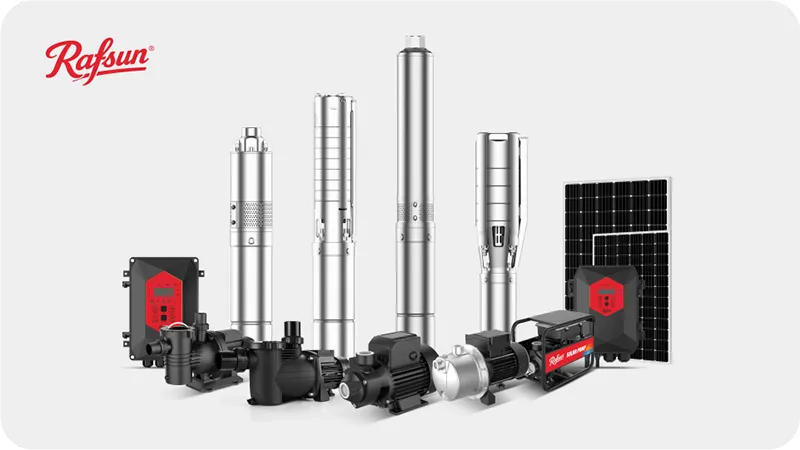
Top manufacturers offer a portfolio of specialized pumps, like screw and impeller types, ensuring you get the right tool for deep wells, high-volume irrigation, or harsh water.
A common mistake is to view "solar pump" as a one-size-fits-all category.
The reality is that different water challenges require different pump designs.
A pump designed for a shallow well will fail to draw water from a deep one.
A pump built for low flow cannot irrigate a large field.
Using the wrong pump is not just inefficient; it can lead to damage and a shortened service life.
This is why a diverse product portfolio is a key advantage.
It allows you to match the right pump technology to the specific requirements of the job.
The three main types of solar deep well pumps address distinct needs for head (lifting height) and flow rate (volume of water).
Understanding their differences is crucial to overcoming the disadvantage of poor performance.
High Head for Deep Wells: The Solar Screw Pump
This pump is a specialist designed for high-head, low-flow applications.
It uses a hardened stainless steel screw (rotor) that turns inside a durable rubber housing (stator).
This action traps "pockets" of water and pushes them upwards with immense force.
- Best Use: Deep wells for domestic water or livestock troughs, common in electricity-scarce regions like Africa and Latin America.
- Key Advantage: Its design is highly resistant to sand and grit, which quickly wears down other pump types.
- Limitation: It provides a lower flow rate, making it unsuitable for large-scale irrigation.
High Flow for Agriculture: The Solar Plastic Impeller Pump
This is a multi-stage centrifugal pump and is the workhorse for high-volume applications.
It uses a series of spinning impellers to accelerate water, generating a high flow rate at a low to medium head.
The impellers are made from a high-strength, wear-resistant engineered plastic.
- Best Use: Farm irrigation, pasture water supply, and filling large storage tanks.
- Key Advantage: It is lightweight, economical, and offers excellent resistance to the fine sand often found in agricultural wells.
- Limitation: It is not ideal for very deep wells or for water that is highly corrosive.
Premium Quality for Harsh Water: The Solar Stainless Steel Impeller Pump
When water quality is a problem, you need a pump built for maximum durability.
This premium model uses an SS304 stainless steel pump body, impeller, and outlet.
| Pump Type | Best For | Primary Advantage |
|---|---|---|
| Solar Screw Pump | Deep wells, low flow | High head, sand resistance |
| Plastic Impeller Pump | Irrigation, high flow | Wear resistance, cost-effective |
| SS Impeller Pump | Corrosive water, high flow | Corrosion resistance, longevity |
This robust construction makes the pump highly resistant to rust and chemical degradation from acidic, alkaline, or salty water.
It is the perfect choice for alkaline soil regions in Australia and parts of the Americas.
Its main disadvantage is a higher initial cost, but it provides a superior return on investment in harsh environments due to its long service life.
Conclusion
The perceived disadvantages of solar water—high cost and unreliability—are solved by modern technology.
High-efficiency motors, hybrid controllers, and specialized pump portfolios make solar a superior choice.
FAQs
What are the 2 main disadvantages of solar energy?
The two main disadvantages are the high initial cost of the equipment and its intermittent nature, as it only generates power when the sun is shining.
What is the main problem with solar water pumps?
The main problem historically was their dependence on sunlight.
However, modern AC/DC hybrid systems have solved this by providing a reliable 24/7 water supply using backup power.
Can solar pump work without battery?
Yes, most solar water pump systems are designed to work without batteries.
They pump water when the sun is out, and some systems store water in tanks for later use.
How long will a solar pump last?
A high-quality solar pump system can last for 20-25 years.
The solar panels have a long lifespan, and a brushless motor requires virtually no maintenance, ensuring durability.
Does solar pump work in cloudy weather?
Yes, a solar pump can work in cloudy weather, but its output will be reduced.
Systems with MPPT controllers maximize power extraction, and hybrid systems can supplement with AC power.
Can solar water pump work at night?
A standard solar pump cannot work at night.
However, a system with an AC/DC hybrid controller can automatically switch to grid or generator power to operate 24/7.