Struggling with weak water features or an ineffective pool cleaner?
Your pool's main pump might not be providing enough pressure to handle everything at once.
A pool booster pump is a secondary pump.
It increases water pressure for specific features.
This powers automatic cleaners, waterfalls, and jets without straining your main filtration system, ensuring everything runs at full power.

You might wonder how one extra piece of equipment can make such a big difference.
A booster pump doesn't replace your main pump; it works with it.
It creates a dedicated, high-pressure line for demanding accessories.
This allows your main system to focus purely on filtering and circulating water.
The result is a cleaner, more dynamic pool where all features operate perfectly, just as they were designed to.
Let's explore how these pumps work and what makes them such a vital component for a fully optimized pool experience.
What are the core functions of a booster pump?
Is your automatic pool cleaner sluggish and leaving dirt behind?
This happens when water pressure from the main pump is too low to power it effectively.
A booster pump powers pressure-side cleaners and boosts water features like jets and waterfalls.
It provides the dedicated, high-pressure flow needed for these accessories to work at their peak, ensuring thorough cleaning and impressive visual effects.
Understanding the specific jobs a booster pump handles reveals its importance.
It’s not just about more power; it’s about applying that power intelligently.
By taking on the high-pressure tasks, it allows the entire pool system to function more efficiently and reliably.
Without it, features that rely on strong water flow might underperform or fail to work at all.
This can lead to a dirtier pool and less impressive water features.
Let's break down the key functions to see how a booster pump provides a solution to these common pool problems.
Powering Pressure-Side Cleaners
A primary job for a booster pump is to run a pressure-side automatic pool cleaner.
These robotic cleaners connect to the pool's return line, where water is sent back into the pool after filtration.
They use the force of the water to move around the pool floor and walls, scrubbing surfaces and collecting debris.
A standard pool pump focuses on volume, not pressure.
It circulates a large amount of water for filtration but often lacks the force needed to propel a cleaner effectively.
A booster pump solves this problem.
It takes a portion of the filtered water and gives it a high-pressure push before sending it to the cleaner.
This ensures the cleaner has enough power to move correctly, navigate obstacles, and create the suction needed to pick up leaves, dirt, and other debris.
The table below shows the clear difference in function:
| Pump Type | Primary Function | Pressure Output | Best For |
|---|---|---|---|
| Main Pool Pump | Water circulation & filtration | Low to Medium | Moving large volumes of water through the filter. |
| Booster Pump | Powering accessories | High | Driving pressure-side cleaners and water features. |
Without this dedicated pressure, a cleaner might move slowly, get stuck, or fail to clean the entire pool surface.
A booster pump guarantees your automatic cleaner performs its job at peak efficiency, keeping your pool sparkling clean with minimal effort.
Boosting Water Features
Many pools include beautiful water features like waterfalls, deck jets, or bubblers.
These elements add a sense of luxury and tranquility, but they all depend on a strong, consistent flow of water to look their best.
A gentle trickle from a waterfall designed to be a rushing cascade is disappointing.
Likewise, deck jets that just weakly bubble instead of creating graceful arcs of water fail to deliver the intended effect.
This is where a booster pump becomes essential.
It supplies the extra power needed to drive these features to their full potential.
- Waterfalls: A booster pump provides the high pressure required to push a large volume of water up and over a waterfall feature, creating a full and visually impressive cascade.
- Deck Jets: These require significant pressure to shoot streams of water from the pool deck into the pool. A booster ensures these arcs are high, smooth, and consistent.
- Bubblers: For bubblers on a sun shelf or tanning ledge, a booster pump creates a vigorous bubbling effect rather than a weak gurgle.
By dedicating a booster pump to your water features, you ensure they always operate at their best.
This allows your main pump to continue its critical job of filtration without being overburdened.
You can run your cleaner and your waterfall at the same time, without either one compromising the other's performance.
Handling Multiple Demands Simultaneously
A modern pool is often a complex system with many components running at once.
You expect the water to be filtered, the surface to be skimmed, the cleaner to be running, and the waterfall to be on.
Asking a single main pump to handle all these tasks is often too much.
When a main pump tries to power everything, its performance is split.
The pressure available for each task drops.
The result is that nothing works quite right.
The filter flow rate might decrease, reducing filtration efficiency.
The skimmers may not pull in debris effectively.
The cleaner will move slowly, and the waterfall will be weak.
A booster pump is the key to effective multitasking in a pool system.
It creates a division of labor.
- The Main Pump: Focuses entirely on its core mission: circulating water through the filter and skimmers, ensuring the water stays clean and clear.
- The Booster Pump: Takes on the high-pressure jobs, like running the cleaner and powering the waterfall.
This separation ensures that every part of your pool system gets the exact pressure it needs to function correctly.
You don't have to choose between a clean pool and a beautiful waterfall.
A booster pump allows you to have both running at the same time, delivering peak performance across the board and maintaining a perfectly balanced and efficient pool environment.
How does the technology inside an advanced booster pump work?
Are you concerned about high energy bills and loud, clunky pool equipment?
Older pump technologies are often inefficient, noisy, and lack intelligent control, costing you money and peace of mind.
Modern booster pumps use a Permanent Magnet Synchronous Motor (PMSM) with a Variable Frequency Drive (VFD).
This combination delivers a quiet, powerful, and constant pressure supply while drastically cutting energy use.
It’s a smart system that adapts to your pool's needs in real time.
The technology behind today's best booster pumps is a significant leap forward from traditional models.
Instead of running at a single, fixed speed, these pumps can adjust their motor speed precisely to meet demand.
This is not only more efficient but also better for the equipment and the entire plumbing system.
Understanding this core technology helps explain why these pumps offer superior performance, exceptional durability, and intelligent operation that older pumps simply cannot match.
Let's examine the key components that make this possible.
Core Drive Technology and Performance
The heart of an advanced booster pump is its drive system.
The combination of a Permanent Magnet Synchronous Motor (PMSM) and a Variable Frequency Drive (VFD) controller is what sets it apart.
This isn't just an upgrade; it's a fundamental change in how a pump operates.
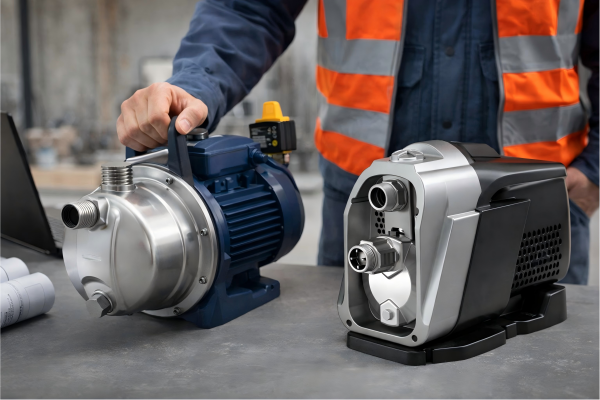
A traditional pump uses an induction motor that runs at a constant, high speed whenever it's on.
This is like driving your car with the accelerator pushed to the floor all the time.
It's inefficient and creates a lot of noise.
A modern VFD pump works differently.
The VFD controller acts as the brain, telling the PMSM motor exactly how fast to run.
Key Performance Advantages
- Ultra-Quiet Operation: The synergy between the PMSM motor and VFD control results in incredibly quiet performance. Some models operate at noise levels below 50 decibels, which is quieter than a library. This eliminates the loud, intrusive hum associated with old pool pumps.
- Constant, Customizable Pressure: The system constantly monitors pressure and adjusts motor speed to keep it stable. You can set the exact pressure you need, from a gentle flow to maximum power. This ensures your cleaner and water features always perform consistently.
- Soft Start & Soft Stop: When the pump turns on, it doesn't just jolt to full speed. The VFD gradually ramps the motor up. This "soft start" reduces mechanical stress on the pump's bearings and motor. It also prevents "water hammer," a hydraulic shockwave that can damage pipes and fittings over time. This gentle operation significantly extends the life of the entire system.
This intelligent control over the motor is what delivers a superior user experience, greater efficiency, and better protection for your investment.
Excellence in Mechanical and Material Engineering
A powerful motor is only as good as the mechanical parts that support it.
High-performance booster pumps are built with premium materials designed for durability and a long service life.
Every component is chosen to withstand the demanding environment of pool operation, which involves constant water exposure, chemicals, and temperature changes.
The internal construction reflects a deep commitment to quality.
This starts with the core motor components and extends to every seal and bearing.
Component Breakdown
- Advanced Stator Design: The stator, a stationary part of the motor, is engineered for top efficiency and heat management. It uses high-grade silicon steel to reduce energy loss. Its design ensures it runs cooler, which directly contributes to a longer motor lifespan.
- High-Grade Magnets and Bearings: The rotor uses powerful ferrite magnets that can handle high temperatures without losing performance. Critically, these pumps use premium, high-precision bearings from leading manufacturers. These bearings run quieter, are more durable, and last significantly longer than standard alternatives.
- Corrosion-Resistant Materials: The parts that touch water must resist corrosion. The impeller, which is the spinning wheel that moves the water, is often made from AISI304 stainless steel. This material is famous for its excellent resistance to rust and pool chemicals. The pump housing is also made from UV-resistant materials to prevent cracking and fading from sun exposure.
This attention to material quality ensures the pump will not only perform well when new but will continue to operate reliably for many years.
The table below highlights the benefits of using premium materials.
| Component | Standard Material | Premium Material (e.g., AISI304) | Benefit of Premium |
|---|---|---|---|
| Impeller | Plastic or low-grade metal | Stainless Steel | Resists corrosion, erosion, and warping from heat. |
| Bearings | Generic brand | Precision-engineered brand | Quieter operation, less friction, and 10%+ longer life. |
| Housing | Standard ABS plastic | UV-Resistant ABS | Prevents sun damage, cracking, and brittleness over time. |
Investing in a pump with superior mechanical engineering means investing in reliability and peace of mind.
Uncompromising Electronic Reliability
Electronics and water are a bad combination.
The most common point of failure in many modern pumps is the electronic controller board, which is vulnerable to moisture, dust, and corrosion.
Top-tier booster pumps solve this with an ingenious and highly effective solution.
The main controller board, or PCB, is completely sealed in a process called potting.
The entire board is encased in a solid block of a waterproof, non-conductive resin.
This creates an impenetrable fortress around the sensitive electronic components.
The UltraShield Advantage
- Total Environmental Protection: Potting makes the electronics 100% waterproof and dustproof, achieving a high protection rating like IP67. This means the controller is completely protected from rain, splashes, humidity, and condensation, which are common culprits in pump failure. This single feature can prevent over 95% of moisture-related electronic failures.
- Extended Lifespan: By insulating the electronics from the harsh environment, potting is projected to extend the controller's life by several years. It protects solder joints and components from vibration and thermal stress, further enhancing durability.
- Enhanced Safety: The potting compound also improves electrical insulation, adding another layer of safety against short circuits.
While it's a feature you can't see, the sealed PCB is arguably one of the most critical innovations for ensuring the long-term reliability of a modern booster pump.
It transforms the most vulnerable part of the pump into one of its most durable.
This is a clear indicator of a product designed not just for performance, but for lasting endurance in real-world conditions.
A Comprehensive Suite of Protection Functions
An intelligent pump must be able to protect itself.
Advanced booster pumps are equipped with a sophisticated system of sensors and software that acts as a digital "shield," constantly monitoring operations to prevent damage.
This system can detect a wide range of potential problems and take action automatically.
These protections safeguard the pump from both internal and external issues, from electrical fluctuations to problems in the plumbing system.
It’s like having a dedicated technician watching over your equipment 24/7.
The "14-Shield" System
This comprehensive suite can be broken down into key categories:
- Electrical & Thermal Protections: The pump actively monitors the power supply. It will shut down if the voltage is too high or too low, or if it detects an overcurrent situation. It also has multiple temperature sensors. It protects itself from the driver board overheating, the motor overheating, or even if the water temperature gets too high.
- System & Sensor Protections: This is where the pump's intelligence really shines.
- Dry Run Protection: If the pump detects there is no water (a "dry run" situation that can quickly destroy a pump), it doesn't just shut off. It enters a smart recovery mode. It will stop, wait a few minutes, then try again. If it still detects no water, it will wait for a longer period before trying again. This prevents the pump from burning out while automatically resolving the issue once water returns.
- Antifreeze Protection: In cold climates, the pump can automatically run itself for brief periods if the temperature drops near freezing, preventing ice from forming and cracking the pump housing.
- Pipeline Leak Warning: The pump can detect a slow, steady pressure drop that indicates a small leak somewhere in your plumbing, alerting you to a problem you might not have noticed otherwise.
These built-in protections provide complete peace of mind, ensuring the pump operates safely and reliably while protecting your investment from a wide range of common operational hazards.
FAQs
What size booster pump do I need for my pool?
The right size depends on the features you want to power.
Check the flow requirements for your specific pool cleaner or water features and choose a pump that meets or exceeds those specifications.
Can a booster pump run 24/7?
Most booster pumps are designed to run only when needed, such as during a cleaning cycle or when water features are active.
Running them on a timer with the associated feature saves energy.
Is a booster pump noisy?
Older models can be loud.
However, modern VFD booster pumps are designed for ultra-quiet operation, with some models running at noise levels below 50 decibels, making them virtually silent.
Do I need a separate switch for a booster pump?
Yes, a booster pump is typically wired to its own switch or, more commonly, to an automated controller.
This allows it to turn on and off with the specific feature it powers.
How much electricity does a booster pump use?
Modern variable speed booster pumps are very energy-efficient.
Because they only run when needed and can adjust their speed, they use significantly less electricity than older, single-speed models.
Can I install a booster pump myself?
While possible for those with experience, installation involves both plumbing and electrical work.
To ensure safety and proper operation, it is highly recommended to have a qualified pool professional perform the installation.
Does a booster pump need maintenance?
Booster pumps are generally low-maintenance.
Regularly check that the pump is priming correctly and keep the area around it clear of debris to ensure proper airflow for cooling.
Conclusion
A booster pump is an essential upgrade for any pool with high-pressure features.
It guarantees your cleaner and water features perform perfectly while protecting your main pump from overload.