Worried a single hailstorm could shatter your investment in off-grid water solutions?
The fear of catastrophic damage from wind, hail, or lightning makes many hesitate, imagining costly replacements.
High-quality solar panels are engineered and rigorously tested to withstand severe weather, including large hail and hurricane-force winds. Damage is rare, and modern solar systems include multiple layers of protection to ensure long-term reliability.
Investing in a solar-powered system is a significant commitment to sustainability and independence.
For agricultural, livestock, or domestic water supply, that system isn't a luxury; it's a lifeline.
The thought of it being destroyed by a storm is a major concern.
However, the solar panels you see today are not fragile glass sheets.
They are sophisticated, robust pieces of equipment, born from decades of engineering to survive in the harshest environments on Earth.
Manufacturers understand that their products will face everything from desert heat to mountain blizzards and tropical cyclones.
Because of this, they are subjected to a battery of internationally recognized tests that simulate the worst of Mother Nature.
Understanding how these panels are built and tested can replace fear with confidence, ensuring you see a storm as a temporary event, not a threat to your water security.
Impact Resistance: Are Solar Panels Hail-Proof?
Does the thought of hail turning your panels into a shattered mess keep you up at night?
This fear often stems from seeing hail damage cars, but solar panels are built to a much higher standard of durability.
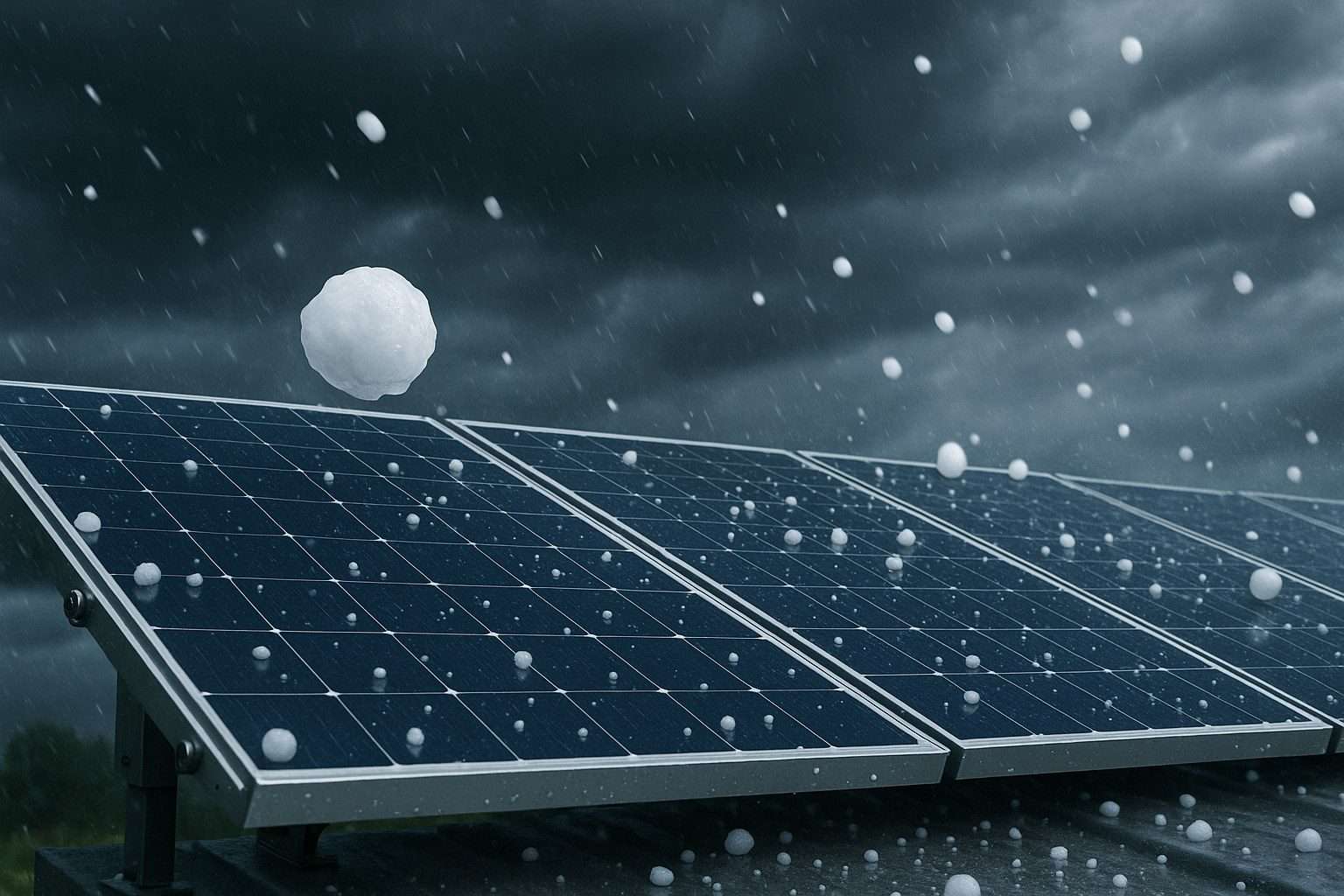
Reputable solar panels are certified to withstand significant hail impact, typically tested with 1-inch (25mm) diameter hailstones fired at over 50 mph (80 kph) without sustaining damage to the cells.
The frontline defense for a solar panel is a sheet of high-strength, tempered glass.
This isn't the same as the glass in your windows.
Tempered glass is up to four times stronger than standard annealed glass.
It undergoes a process of extreme heating and rapid cooling, which creates high compressive stress on the surface and tensile stress in the interior.
This structure allows it to absorb significant impact energy without shattering.
To ensure this durability isn't just a claim, panels undergo rigorous testing to achieve certifications like the IEC 61215 standard.
This is a critical benchmark for quality that business owners like you should always look for.
A key part of this certification is the hail impact test.
The Science of Surviving Hail
The testing protocol is designed to be tougher than what most panels will ever experience.
- Standardized Projectiles: Ice balls of a specific size and density are used to ensure consistent testing across all manufacturers.
- High-Velocity Impact: These ice balls are pneumatically launched at the panel's surface at specific speeds to simulate the terminal velocity of falling hailstones during a severe storm.
- Multiple Impact Points: The tests target various locations on the panel, including the center, edges, and corners, to identify any potential weak spots in the design.
After the impacts, the panel undergoes a thorough inspection.
There must be no visual evidence of cracking or major damage.
More importantly, it must also pass a power output test to prove that the underlying photovoltaic cells have not been compromised.
What the Certifications Mean for You
When you source solar panels, looking for these certifications provides a guarantee of quality and durability.
| Test Standard | What It Simulates | Pass Criteria for Quality Panels |
|---|---|---|
| IEC 61215 Hail Test | Severe hailstorm with large hailstones. | Withstands 1-inch (25mm) hail at 50 mph (23 m/s) with no cell damage. |
| Class 4 Impact Rating (UL 1703) | Even more severe hail conditions. | Withstands 2-inch (51mm) hailstones, providing the highest level of protection. |
Choosing panels with these ratings means you are investing in a product specifically designed to survive the impact forces of a serious storm.
This dramatically reduces the risk of damage and ensures your water system's power source remains intact and functional for years to come.
Wind Resistance: Will Your Panels Blow Away?
Do you picture your solar panels being ripped from their mounts and sent flying by a strong gust of wind?
This dramatic image is a valid concern, but panel failure in high winds is almost never caused by the panel itself.
Solar panels are tested to withstand extreme wind loads (over 140 mph), but their security depends entirely on the quality of the mounting system and the installation. Failures are overwhelmingly due to poor racking, not panel defects.
The aerodynamic forces exerted on a large, flat surface like a solar array during a storm are immense.
A panel can experience both positive pressure (wind pushing down on it) and negative pressure, or uplift (wind trying to lift it from underneath).
Uplift is often the more dangerous of the two forces.
Solar panel manufacturers design for this reality.
The panels themselves are built around a rigid, anodized aluminum frame that provides exceptional structural integrity and prevents the panel from flexing or twisting under load.
These frames are then subjected to mechanical load tests as part of their certification.
During these tests, force is applied to both the front and back of the panel to simulate extreme wind conditions.
The pressure is measured in Pascals (Pa).
A typical high-quality panel is rated to withstand a downward pressure (snow load) of 5400 Pa and an upward pressure (wind uplift) of 2400 Pa.
A 2400 Pa rating is equivalent to wind speeds of approximately 140 mph (225 kph), which is the strength of a Category 4 hurricane.
The panel itself can handle the storm.
The real question is, can its mounting?
The Critical Role of Racking and Installation
The weak link in a storm is never the certified panel; it's the system holding it in place.
A high-quality racking system is the unspoken hero of storm survival.
1. Material and Design
- Corrosion-Resistant Materials: Racking should be made from aluminum and stainless steel to prevent rust and degradation over decades of exposure.
- Engineered for Your Location: In high-wind areas like coastal regions or open plains, the racking system must be specifically engineered to meet or exceed local building codes for wind loading.
2. Proper Installation Technique
- Correct Fasteners: Using the specified bolts and ensuring they are torqued to the manufacturer's recommendations is non-negotiable.
- Structural Connection: For roof mounts, the racking must be secured to the underlying rafters, not just the roof decking. For ground mounts, the foundation (concrete piers, ballasts) must be appropriately sized and installed to prevent movement.
- Component Compatibility: All components—from the bolts and clamps to the rails and footings—must be from a single, compatible system designed to work together.
The durability of your solar array against wind is a direct result of the quality of the installation.
For distributors and importers, supplying a robust, well-engineered mounting system is just as important as supplying a high-quality panel.
It ensures the end-user's system will survive and protects the reputation of the equipment.
Water and Electricity: How Panels Handle Rain and Lightning
Are you concerned that heavy rain could leak into your panels or that lightning could fry the entire system?
These are valid worries, as water and high-voltage electricity are a dangerous mix, but solar systems are designed with layered defenses.
Solar panels and their connectors are sealed with high IP (Ingress Protection) ratings to be fully waterproof. While no system is 100% lightning-proof, proper grounding and surge protection devices drastically minimize the risk of damage.
Solar panels are built to live outdoors for 25+ years, meaning they are designed to be completely impervious to rain, snow, and humidity.
This is achieved through several key design features.
First, the laminate that seals the solar cells is fully encapsulated, leaving no path for moisture to get in from the front or back.
The most critical point for water ingress is the junction box on the back of the panel where the electrical connections are made.
This box, along with the cables and connectors, is given an IP rating.
IP stands for Ingress Protection, and the rating consists of two numbers.
The first digit rates protection against solids (like dust), and the second rates protection against liquids (water).
Understanding IP Ratings
A high IP rating is a non-negotiable sign of a quality, weather-resistant product.
- IP65: The component is protected against low-pressure water jets from any direction. This is considered the minimum for outdoor electrical equipment.
- IP67: The component can be submerged in up to 1 meter of water for 30 minutes. This ensures protection against even the most driving rain.
- IP68: The component is rated for continuous submersion in water under conditions specified by the manufacturer. This is the gold standard for waterproof connectors, often used in solar water pump systems.
Defending Against Lightning
Lightning poses a different kind of threat.
A direct strike can carry up to a billion volts and hundreds of thousands of amps, which is enough to vaporize any electronic device.
However, direct strikes are very rare.
The more common threat is from a nearby strike, which can induce a powerful electrical surge throughout the system's wiring.
This is where proper electrical protection comes in.
- Grounding: The primary defense is a robust grounding system. The metal frames of the solar panels and the mounting rack must be bonded together and connected to a grounding rod driven deep into the earth. This gives the electrical energy from a surge a safe path to dissipate into the ground, away from sensitive equipment.
- Surge Protection Devices (SPDs): These devices are installed on both the DC side (from the panels) and the AC side (if connected to the grid or a generator). An SPD acts like a pressure-release valve for electricity. It constantly monitors the voltage and, if it detects a sudden spike from a lightning surge, it instantly diverts the excess energy to the ground in a fraction of a second.
A well-designed system with proper grounding and SPDs can reliably withstand the electrical effects of a nearby lightning strike, protecting the inverter, controller, and pump motor from damage.
System-Wide Resilience: What About the Pump and Motor?
You might feel confident about the panels on the surface, but what happens to the expensive parts hidden underground?
After a storm passes, the last thing you want to worry about is whether the heart of your water system—the pump and motor—survived.
While the panels face the storm directly, the most critical components of a solar water pump system—the motor and the pump itself—are safely submerged deep in the well, completely shielded from wind, hail, and lightning.
The beauty of a submersible pump system is its inherent physical protection.
The storm's fury is a surface-level event.
Dozens or even hundreds of feet below the ground, the well provides a perfectly stable and safe environment.
Let's break down the resilience of the components you can't see.
The Insulated Controller
The intelligent controller, the brains of the operation, is the one component that is often at the surface.
However, it is always housed within a weather-resistant enclosure.
These enclosures are typically rated to at least NEMA 3R or higher, which means they are designed to protect the internal electronics from falling rain, sleet, and external ice formation.
When installed correctly, the controller remains safe and dry.
The Protected Core: A Maintenance-Free Motor
Deep in the well, the brushless DC (BLDC) permanent magnet motor drives the pump.
This component is not only safe from the storm but is engineered for extreme longevity in its own harsh environment.
- Hermetically Sealed: The motor is housed in a stainless steel casing that is completely sealed from the outside world. Water cannot get in, and it's protected from any sediment or mineral buildup.
- Zero Electrical Exposure: Being submerged in the well an incredible distance from the surface array, it is electrically isolated from the atmospheric effects of a lightning storm. Any surge that gets past the surface-level SPDs will have been greatly diminished.
- No Maintenance, No Worries: The brushless design means there are no internal parts designed to wear out. It's a "fit and forget" component, providing peace of mind that there is no hidden damage to worry about after a storm.
The Workhorse Below: The Durable Pump End
Attached to the motor is the pump end itself.
Its resilience is not about the storm but about its suitability for the well's water quality, which ensures long-term reliability.
Choosing the right pump type is a form of proactive storm-proofing for your entire system's health.
| Pump Type | Key Durability Feature | Role in System Reliability |
|---|---|---|
| Solar Screw Pump | Handles sandy, abrasive water | Ensures reliable water flow even when well quality is not perfect after heavy rains stir up sediment. |
| Plastic Impeller Pump | High-flow, cost-effective | A durable choice for clean water sources, providing high-volume output once the storm passes. |
| Stainless Steel Impeller Pump | Resists corrosion from harsh water | The ultimate choice for longevity, ensuring that aggressive water chemistry doesn't compromise the system. |
By pairing storm-resistant surface components with a properly selected, durable submersible pump and motor, you create a complete water solution that is resilient from top to bottom.
Conclusion
Modern solar panels are built to endure storms.
By ensuring high-quality components and professional installation, your entire solar water system offers a reliable, long-term solution resilient to extreme weather.
Frequently Asked Questions
Do solar panels work in the rain?
Yes, solar panels produce power in the rain, though output is lower than on a sunny day.
Rain also has the added benefit of washing away dust and dirt.
Do I need to cover my solar panels in a hailstorm?
No, you should not try to cover your panels.
Quality panels are tested to withstand hail, and trying to cover them during a storm is dangerous and unnecessary.
Can lightning destroy a solar panel?
A direct strike can destroy a panel, but this is extremely rare.
Proper grounding and surge protection are highly effective at protecting the system from more common nearby strikes.
Do solar panels need to be turned off during a storm?
No, the system is designed to manage itself.
The integrated controller and safety devices will protect the system's components from electrical surges without any user intervention.
How much wind can a solar panel handle?
Standard panels are often rated for wind speeds up to 140 mph (225 kph).
The ultimate wind resistance of the array depends on the strength of the mounting system.
Does homeowners insurance cover solar panel storm damage?
In most cases, yes.
Solar panels are typically considered a permanent fixture of the property and are covered under standard homeowners insurance policies, but you should always confirm with your provider.