Thinking about going solar but worried about reliability?
The sun doesn't shine at night or on cloudy days, making a 100% solar solution seem risky for critical needs.
The biggest problem with solar power is its intermittency. Power generation stops when the sun isn't shining, making it an unreliable energy source for applications that require a constant, 24/7 power supply, such as providing essential water or running critical equipment.

This fundamental challenge has historically been a major barrier to the widespread adoption of solar energy for essential services.
While solar power is clean, free, and abundant during the day, its absence at night creates a significant reliability gap.
For a homeowner, this might be an inconvenience.
But for a farm, a remote community, or any operation that depends on a constant supply of water, this inconsistency is not just a problem; it's a critical failure point.
However, modern technology has directly confronted this issue, offering intelligent solutions that bridge the gap and transform solar power from an intermittent source into a dependable, round-the-clock utility.
Solving Intermittency: The Hybrid Power Solution
Worried your water will stop flowing the moment a cloud covers the sun?
Relying solely on direct sunlight means no water at night or on overcast days, which is unacceptable for critical needs.
The solution is an intelligent AC/DC hybrid controller. This device automatically powers the pump with solar energy when available, but seamlessly switches to grid or generator power when sunlight is insufficient, guaranteeing a reliable 24/7 water supply.
The challenge of solar intermittency is not a new one, but the solution has become incredibly elegant and efficient.
Instead of relying on large, expensive, and maintenance-heavy battery banks, the modern approach is to create a smart, blended power system.
An AC/DC hybrid controller is the brain of this operation.
It serves as an intelligent energy manager, equipped with inputs for both DC power from the solar array and AC power from an alternative source like the electrical grid or a backup generator.
This system is engineered with a simple yet powerful "solar-first" priority.
Its core logic is to use every available watt of free energy from the sun before drawing any power from a paid AC source.
This dual-capability eliminates the anxiety of weather dependency and provides complete peace of mind.
It ensures water is available whenever it is needed, day or night, rain or shine, effectively solving the biggest problem of solar power for critical applications.
How a Hybrid Controller Works
The controller’s operation is completely automatic, requiring no manual switching or monitoring from the user.
It constantly analyzes the power coming from the solar panels and makes instant decisions.
- Peak Sunlight: During bright, sunny periods, the system runs on 100% solar power. The controller directs all the DC electricity from the panels to the pump motor, while the AC connection remains on standby, drawing zero power.
- Low Light Conditions: On a cloudy day, the solar energy might decrease. The controller’s Maximum Power Point Tracking (MPPT) feature first works to squeeze every last watt of power from the available light. If that's still not enough to run the pump at the required speed, the controller will intelligently supplement the solar power by blending in just enough AC power to make up the deficit. This ensures a consistent water flow without wasting any solar energy.
- No Sunlight: At night or during very heavy storms, the solar input falls to zero. The controller detects this instantly and automatically switches the pump to run entirely on the AC power source. The pump continues to operate at full capacity.
When the sun returns, the controller immediately switches back to prioritizing solar power.
The Strategic Value of Hybrid Systems
This intelligent power management provides several key advantages that make solar-powered systems far more practical and valuable.
| Feature | Benefit | End-User Impact |
|---|---|---|
| Automatic Switching | Uninterrupted 24/7 operation | Eliminates weather dependency and ensures water is always available. |
| Solar-First Priority | Maximizes use of free solar energy | Drastically reduces electricity bills or generator fuel consumption. |
| No Batteries Needed | Lower initial cost and complexity | Avoids the high cost, maintenance, and eventual replacement of battery banks. |
| System Reliability | Provides the dependability of grid power | Makes solar a viable option for critical infrastructure, not just a daytime supplement. |
Maximizing Every Sunbeam: The Role of an Ultra-Efficient Motor
Does poor performance on cloudy days make you question solar power's viability?
If a system is inefficient, even a small drop in sunlight can cause it to fail.
Wasting precious solar energy is like trying to fill a bucket with a hole in it.
The core of a modern solar application is a Brushless DC (BLDC) permanent magnet motor with over 90% efficiency. It converts nearly all available solar energy into work, ensuring strong performance even in low-light conditions and reducing overall system costs.
While a hybrid controller solves the problem of having no sun, an ultra-efficient motor addresses the challenge of having less sun.
Efficiency is the unsung hero of solar-powered systems.
When your fuel source is variable, the last thing you want is a machine that wastes a large portion of it.
Traditional motors can lose 25% or more of the electricity they consume as waste heat.
In a solar application, this is a critical flaw.
It means that on a slightly overcast day, when a highly efficient system would still be running strong, the inefficient system has already shut down.
This is where the Brushless DC (BLDC) permanent magnet motor creates a revolutionary advantage.
By operating at over 90% efficiency, it minimizes energy loss.
This means for every 100 watts of solar power generated by the panels, more than 90 watts are converted into useful mechanical work.
This extreme efficiency has a profound impact.
It allows the system to start earlier in the morning, run later into the evening, and perform far more reliably on cloudy days.
It directly combats the problem of solar intermittency by making the absolute most of every moment of sunlight.
The Technical Edge of BLDC Motors
The superior performance of BLDC motors comes from advanced design and materials.
- High-Efficiency Design: The "brushless" nature of the motor eliminates the energy loss caused by friction from physical brushes found in older DC motors. This leads directly to efficiency ratings that were previously unattainable.
- Powerful Magnets: The rotor is built with 40SH neodymium iron boron, a type of high-strength rare-earth permanent magnet. These magnets create an intense magnetic field, allowing the motor to produce very high torque with less electrical input.
- Compact and Durable: High efficiency means less energy is wasted as heat. A cooler-running motor can be built in a more compact and sealed enclosure. This results in a design that is up to 47% smaller and 39% lighter than conventional motors of the same power output, while also being maintenance-free due to the lack of wearable parts.
The Financial Advantage of Efficiency
For a system designer or end-user, higher motor efficiency translates directly into lower system costs.
Since the motor requires less power to do the same amount of work, it needs a smaller, less expensive solar array to run it.
Consider a pump that needs 800 Watts of mechanical power to operate.
| Motor Type | Motor Efficiency | Electrical Power Required | Necessary Solar Array Size* |
|---|---|---|---|
| Standard Brushed Motor | ~70% | 1143 Watts (800 / 0.70) | ~1.7 kW |
| High-Efficiency BLDC Motor | >90% | 889 Watts (800 / 0.90) | ~1.3 kW |
*Solar array is oversized to account for real-world conditions.
As the table shows, choosing the high-efficiency BLDC motor can reduce the required size of the solar array by over 20%.
Since the solar panels are one of the most expensive components of the system, this represents a massive saving in the initial investment.
Using Energy Wisely: Matching the Right Tool to the Job
Is your solar pump underperforming even on a sunny day?
Using the wrong type of pump is a common mistake.
It wastes valuable solar energy, resulting in poor water flow and putting unnecessary strain on the system.
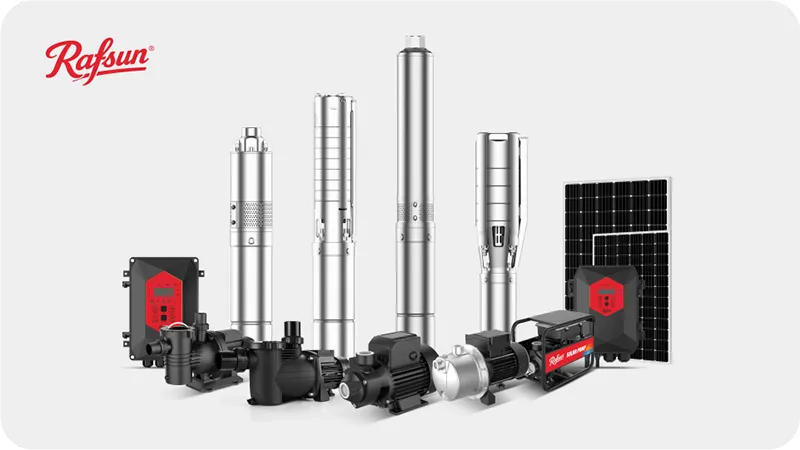
To truly solve the solar power problem, you must use the energy efficiently. This means selecting a specialized pump designed for your specific need: a screw pump for deep wells, a plastic impeller for high volume, or a stainless steel model for harsh water.
Even with a hybrid controller and an ultra-efficient motor, the final piece of the reliability puzzle is ensuring that no energy is wasted at the point of use.
The pump end—the part of the machine that physically moves the water—must be perfectly matched to the task at hand.
Using the wrong type of pump is like trying to move a pile of sand with a rake instead of a shovel.
You might get the job done eventually, but you will waste an enormous amount of energy in the process.
In a solar-powered system, this wasted energy means reduced water output and a system that is far more sensitive to changes in sunlight.
A well-designed solar pump portfolio offers different tools for different jobs.
Each design is optimized for a specific combination of "head" (the vertical distance the water must be lifted) and "flow" (the volume of water moved in a period of time).
Choosing the correct pump ensures that every watt delivered by the highly efficient BLDC motor is converted into the maximum amount of water movement, making the entire system more robust and effective.
The Deep Well Specialist: Solar Screw Pump
This pump is a master of pressure, built to lift water from extreme depths.
- How it Works: It uses a positive displacement mechanism. A single helical rotor (the "screw") spins inside a rubber stator. This action traps pockets of water and forces them upwards, building immense pressure to overcome the force of gravity in deep wells.
- When to Use It: Best for domestic water, livestock watering from boreholes, and low-volume irrigation where the water source is more than 70 meters deep.
- Key Advantage: It produces very high head with low flow. Its design is also highly resistant to sand and silt, making it ideal for newly drilled or challenging wells.
The High-Volume Mover: Solar Plastic Impeller Pump
This pump is a workhorse, designed to move large quantities of water efficiently.
- How it Works: It is a multi-stage centrifugal pump. A series of plastic impellers spin at high speed, with each stage adding kinetic energy to the water to generate a high flow rate at a moderate head.
- When to Use It: Perfect for farm irrigation, filling ponds and tanks, and managing water on pastures where moving a high volume of water is the primary goal.
- Key Advantage: It delivers the highest flow rate for the energy consumed. The lightweight and economical design makes it a popular choice for agricultural applications.
The Indestructible Option: Solar Stainless Steel Impeller Pump
This pump is built for longevity and reliability in the toughest environments.
- How it Works: It operates on the same centrifugal principle as the plastic model, but its key components—the impellers, diffuser, and pump casing—are all constructed from corrosion-resistant SS304 stainless steel.
- When to Use It: Essential for areas with acidic or alkaline water, coastal regions with brackish water, or in high-end applications where durability and long service life are the top priorities.
- Key Advantage: Its superior resistance to corrosion and abrasion ensures it will operate reliably for years in water conditions that would destroy other pumps.
Conclusion
The biggest problem with solar power—intermittency—has been effectively solved for critical applications.
Smart hybrid controllers, hyper-efficient motors, and specialized pumps create reliable, 24/7 solutions.
Frequently Asked Questions
What are the 2 main disadvantages of solar energy?
The two main disadvantages are intermittency, as it only works when the sun is out, and the high initial upfront cost for installation of panels and equipment.
Do solar panels work in the rain?
Yes, solar panels do work in the rain.
Their power output is significantly reduced because of the dense cloud cover, but they will still generate some electricity.
Is solar power reliable in winter?
Solar power can be reliable in winter, but production is lower.
Shorter days and a lower sun angle reduce output, though cold temperatures can actually improve panel efficiency.
What happens to solar panels after 25 years?
After 25 years, solar panels do not stop working but degrade slowly.
Most manufacturers guarantee their panels will still produce at least 80% of their original output.
Can a house run on solar power alone?
Yes, a house can run on solar power alone, but it requires a large battery storage system to provide power at night and on cloudy days, making it completely off-grid.
What is the biggest problem with solar panels?
The biggest problem with the panels themselves is their efficiency rates are still limited (typically 17-23%), and they require a significant amount of physical space to generate large amounts of power.
How much does a solar system cost?
The cost varies greatly based on the size of the system, location, and equipment quality.
Costs have decreased significantly, but a full residential system is still a major investment.